
Points clés à retenir
- Trois décisions définissent chaque type de ceinture. Matériau de la sangle, mécanisme de fermeture et construction des bords/coutures — dès que vous savez décrire ces trois points, vous pouvez comparer deux ceintures quelconques au monde et donner des consignes précises à n’importe quelle usine.
- Associez le type au canal de distribution. La grande distribution privilégie les constructions décontractées, en toile et élastiques ; les collections de mode misent sur les types skinny, larges et à chaîne ; les vêtements de travail et les uniformes exigent des filières robustes et en sangle.
- Les types à mécanisme sont des systèmes, pas des sangles. Les ceintures à cliquet, réversibles et élastiques dépendent entièrement de la géométrie de la piste, de la quincaillerie rotative et du comportement de reprise — validez le mécanisme, pas seulement l’aspect.
- Les défaillances de chaque type sont prévisibles. Peinture des bords sur les ceintures habillées, dérive de surface sur les ceintures casual lavées, fixation de la quincaillerie sur les ceintures western, perte de reprise sur les élastiques — vos limites de contrôle qualité doivent nommer ces défauts par type.
- Une collection, plusieurs types, un seul ensemble de validations. Chaque type dans un programme mixte a besoin de son propre échantillon de référence, de sa logique de tailles et de ses spécifications d’emballage avant la production en série.
Ce que couvre ce guide
- Comment la construction définit le type
- Les 16 types en un coup d’œil
- Types de ceintures en cuir : de l’habillé au western
- Ceintures à mécanisme : à cliquet, réversible, élastique
- Tissé, tressé, toile et sangle
- Quelles filières de matériaux correspondent à quels types
- Types de mode et de spécialité
- Les mêmes types, quatre publics
- Comment les acheteurs choisissent les types pour un programme
Demandez à dix acheteurs ce qu’est une ceinture et vous obtiendrez dix produits différents : une ceinture habillée se définit par le travail de ses bords, une ceinture western par sa boucle et son repoussage, une ceinture à cliquet par un système de fermeture mécanique. “ Types de ceintures ” n’est pas une liste de mode — c’est une question de matériau de sangle, de mécanisme de fermeture et de détails de construction, les mêmes dimensions utilisées pour classer les ceintures dans des références générales comme celle-ci Vue d’ensemble des ceintures vestimentaires.
En bref : si vous pouvez nommer la filière matière d’une ceinture, son système de fermeture et la construction de ses bords, vous avez spécifié l’essentiel de son coût et presque tout son risque qualité — le reste est un détail.
Chaque ceinture ci-dessous peut être développée dans le cadre d’un programme OEM, ODM ou de marque de distributeur, et chaque type renvoie à une page plus détaillée sur sa construction et sa filière d’approvisionnement. Ce guide est destiné aux acheteurs de détail et de marques qui planifient des collections, et non aux acheteurs à l’unité.
Comment la construction de la ceinture définit le type
Trois décisions déterminent presque chaque catégorie de ceinture, et elles interagissent — un changement dans l’une force généralement un changement dans les autres :
- Matériau et structure de la sangle — cuir pleine fleur ou fleur corrigée, cuir refendu ou reconstitué, PU, textile tissé, sangle en toile, élastique, ou filières spéciales comme la paille et le raphia. Notre guide des matériaux pour ceintures en cuir couvre comment l’identité du matériau change la durabilité, l’étiquetage et la gamme de prix.
- Système de fermeture — boucle à ardillon, piste à cliquet et griffe, mécanisme rotatif réversible, anneau en D, rouleau, plaque, clip ou pince. La fermeture détermine comment la ceinture se règle, comment elle s’use et ce que coûte la quincaillerie.
- Chant, couture et finition — chant peint, chant replié, chant bruni, motif de couture, passants, embouts et renfort. Ces détails sont ceux où la qualité se dégrade en production de masse, ils doivent donc figurer dans l'échantillon approuvé, et non dans un “ identique à l'échantillon ” verbal.”
La carte complète de nos parcours produits — par audience, style et matériau — se trouve sur le hub des types de ceintures. Le reste de ce guide passe en revue les catégories qu'un programme B2B approvisionne réellement.
Les 16 types en un coup d'œil
Le tableau ci-dessous est tout le catalogue en un seul balayage — ce qui définit chaque type, où il est couramment prescrit, et le détail qui décide de sa qualité. Les sections en prose qui suivent exposent les compromis, alors lisez les deux ; le tableau vous indique quel type, les sections vous disent comment l'acheter.
| Type | Défini par | Canaux courants | À surveiller au contrôle qualité |
|---|---|---|---|
| Habillé et formel | Boucle discrète, chant fin, maîtrise des proportions | Mode masculine, tenues formelles, entreprise | Peinture de chant, uniformité de la brillance, placage |
| Décontracté & jeans | Sangle plus épaisse, surface délavée ou vintage | Marques de grandes surfaces, de grands magasins, de denim | Variation de teinte et de toucher d'un lot à l'autre |
| Western & rodéo | Tooling, conchos, decorative buckles | Western retail, rodeo, country | Hardware attachment, plating wear |
| Work & heavy-duty | Strap strength, tool compatibility | Workwear, industrial, uniform | Hardware function under load |
| Ratchet & automatic | Track-and-claw closure system | Gift, menswear, e-commerce retail | Mechanism cycles, claw tension |
| Réversible | Two faces + rotary mechanism | Travel retail, menswear, corporate | Rotation feel, both-face edge work |
| Woven & braided | Strap built from strips/textile | Casual, golf, youth | Braid density, edge security |
| Canvas & webbing | Fabric strap + D-ring/roller/plate | Uniform, youth, casual, golf | Webbing-buckle pairing, edge seal |
| Elastic & stretch | Stretch/recovery behavior | Kids, ladies comfort, uniform | Recovery after wear, seam strength |
| Hidden money | Concealed pocket structure | Travel and security retail | Closure function, seam integrity |
| Skinny & thin | Narrow width, buckle proportion | Womenswear, fashion | Edge quality at narrow width |
| Wide & corset | Fashion waist statement | Womenswear, runway-adjacent | Structure holds shape; no shaping claims |
| Studded & punk | Rivets, grommets, chains | Alternative and fashion retail | Stud attachment strength |
| Chain & metal | Decorative metal hardware | Fashion accessory programs | Surface finish, assembly control |
| Belt straps & blanks | No buckle — component sourcing | Assemblers, craft brands | End finish, punch accuracy |
| Suspenders | Own hardware and elastic system | Formalwear, uniform, retail | Clip grip, elastic recovery |
Two reading notes on the table. First, “defined by” is the shorthand buyers can use to brief a factory — name those attributes and the factory knows the construction class without a drawing. Second, the QC column is not decoration: those are the recurring failure points per type, and they belong in your acceptance limits by name, not as a blanket “good quality.”
Leather Belt Types: Dress to Western
Ceintures de costume et formelles
A dress belt is defined by restraint: a narrow-to-medium strap, a low-profile buckle, fine edge work and tight proportion control between strap, buckle and keeper. In production we watch edge paint thickness, surface gloss consistency and buckle plating, because a formal belt shows every defect under office light. Because suspenders and formalwear accessories share the dress channel, buyers often develop them in the same program.
Where it fails in bulk: edge paint cracks at the fold, gloss varies between leather lots, and the buckle’s plating scratches against the keeper in transit. All three belong in your QC limits.
Ceintures décontractées et ceintures pour jeans
Casual belts run the opposite direction: heavier straps, vintage or washed surfaces, rugged stitching and larger buckles. The construction risk here is surface consistency — distressed and washed finishes must be approved against a reference sample, or bulk straps will drift in tone and hand-feel from lot to lot. Casual programs are the volume workhorse of a retail belt program, which is exactly why lot-to-lot consistency matters most here.
Ceintures western et de rodéo
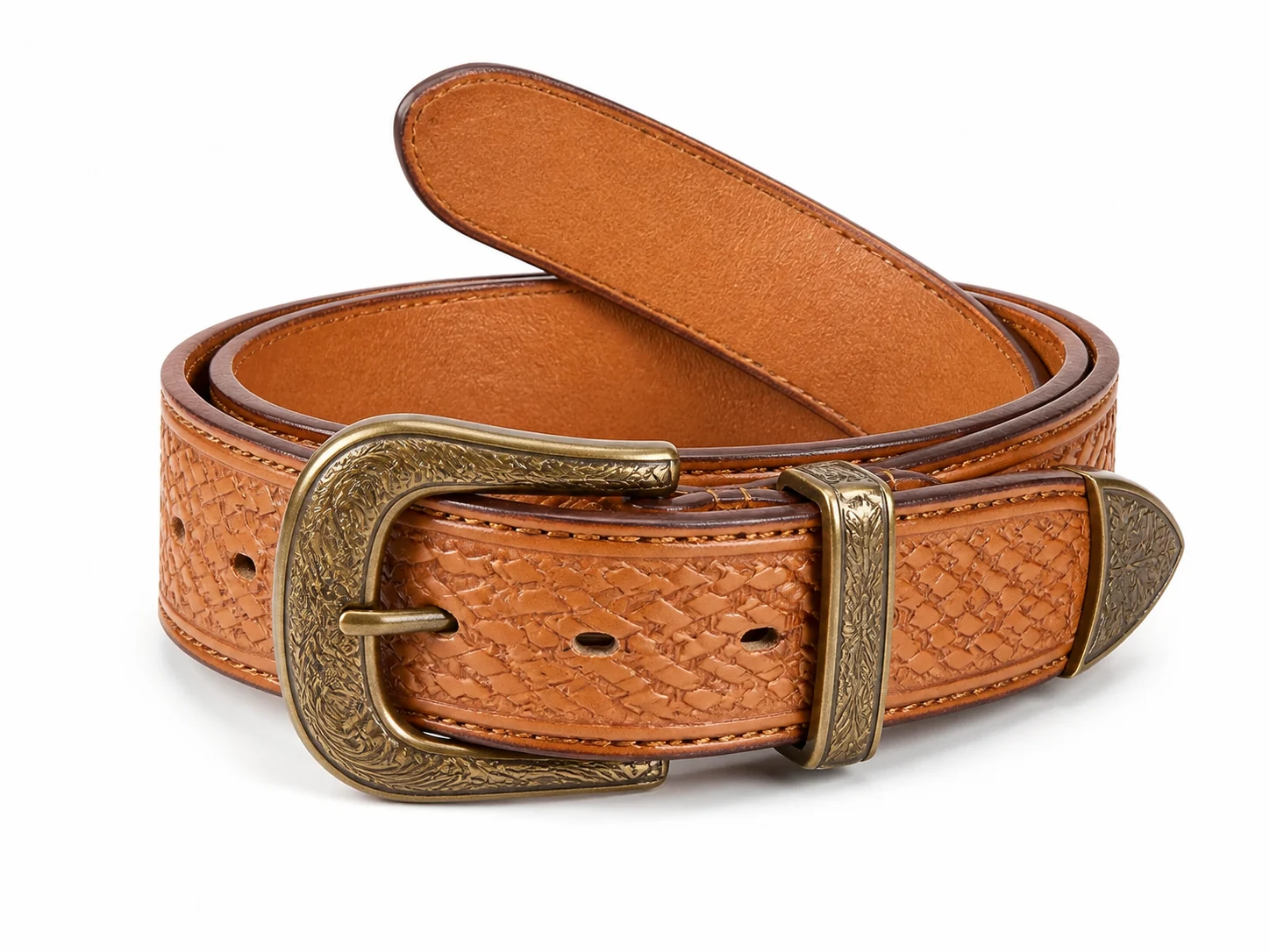
A western belt is a hardware-and-decoration program as much as a leather program: tooled or embossed straps, decorative buckles, conchos, lacing and stitching patterns. Because the buckle carries the design, western programs usually need 3D buckle development, sample rounds on proportion and finish, and a functional check that the decorative hardware sits flat and stays attached under daily flex.
Where it fails in bulk: concho and stud attachment strength, and plating wear on oversized buckles. A western belt that loses its decoration in a fitting room is a return, whatever the leather quality.
Ceintures de travail et pour usage intensif
Work belts prioritize strap strength and hardware reliability: thicker straps, reinforced stitching, tool-compatible constructions and buckles that survive abrasion. Any performance claim for a work program should be backed by the specific construction and testing agreed for that project — we define the evidence before we put a claim on a label. Work and heavy-duty routes also carry strict hardware specifications, because a failed buckle on a jobsite is a safety issue, not a style issue.
Mechanism Belts: Ratchet, Reversible, Elastic
Ceintures à cliquet et automatiques
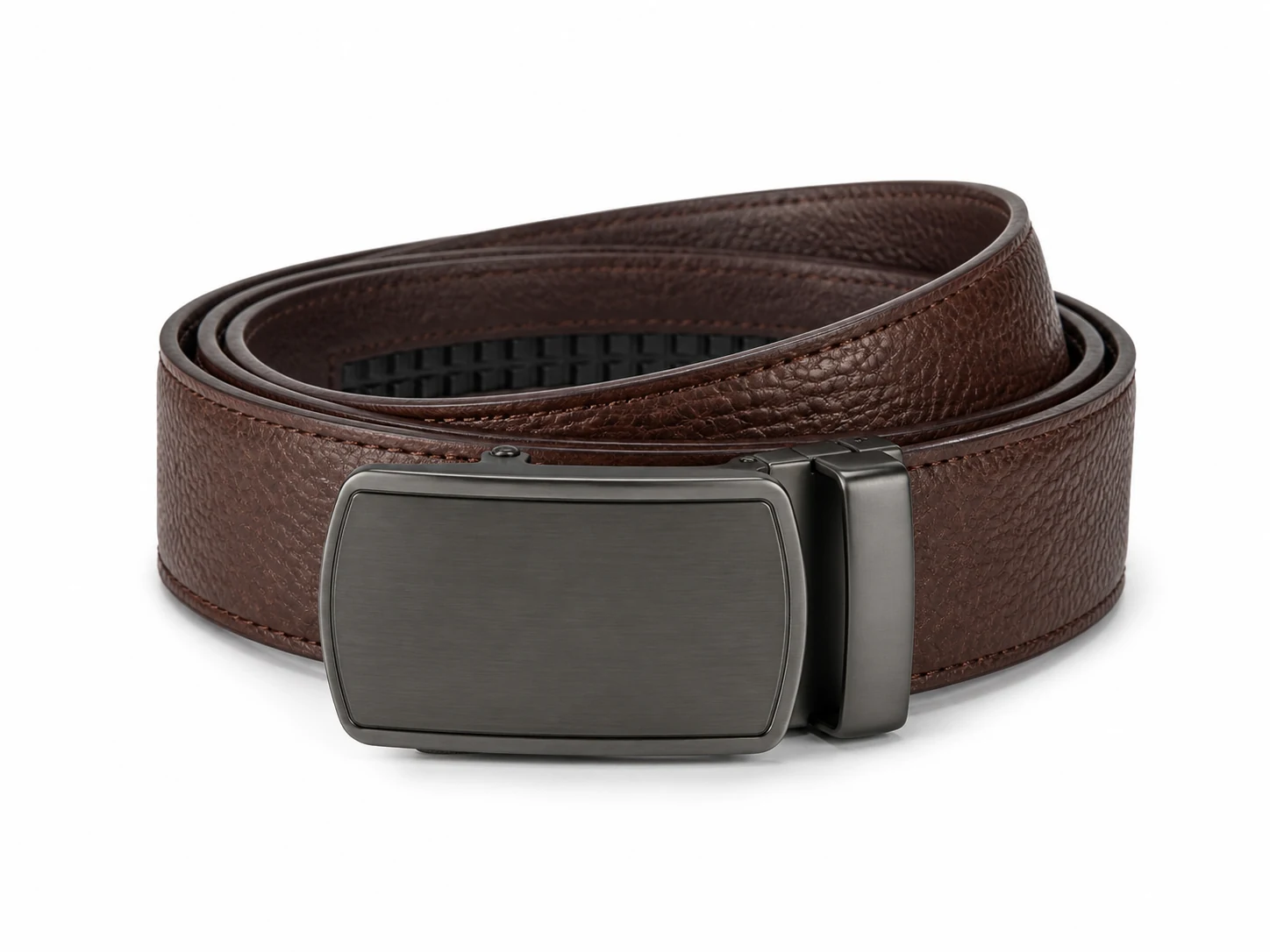
A ratchet belt replaces punched holes with a track on the strap underside and a claw mechanism in the buckle. The type is a system: track geometry, claw tension, strap stiffness and the cut-to-fit end all have to work together. When buyers compare ratchet programs, the approval points are the mechanism’s hold and release feel, track durability over repeated cycles, and replacement-strap compatibility.
Sizing logic differs: a ratchet belt adjusts continuously instead of by hole positions, so the size label reflects strap length range rather than hole spacing — retailers switching from punched belts should re-check their size chart rather than reuse it.
Ceintures réversibles
A reversible belt laminates two faces and uses a rotary or detachable buckle mechanism. The construction challenge is thickness: two faces plus reinforcement must stay slim enough to rotate smoothly while keeping both sides visually clean. Edge work matters twice as much here, because the edge is visible from both faces — a reversible belt with cracked edge paint fails on two sides at once.
Ceintures élastiques et extensibles
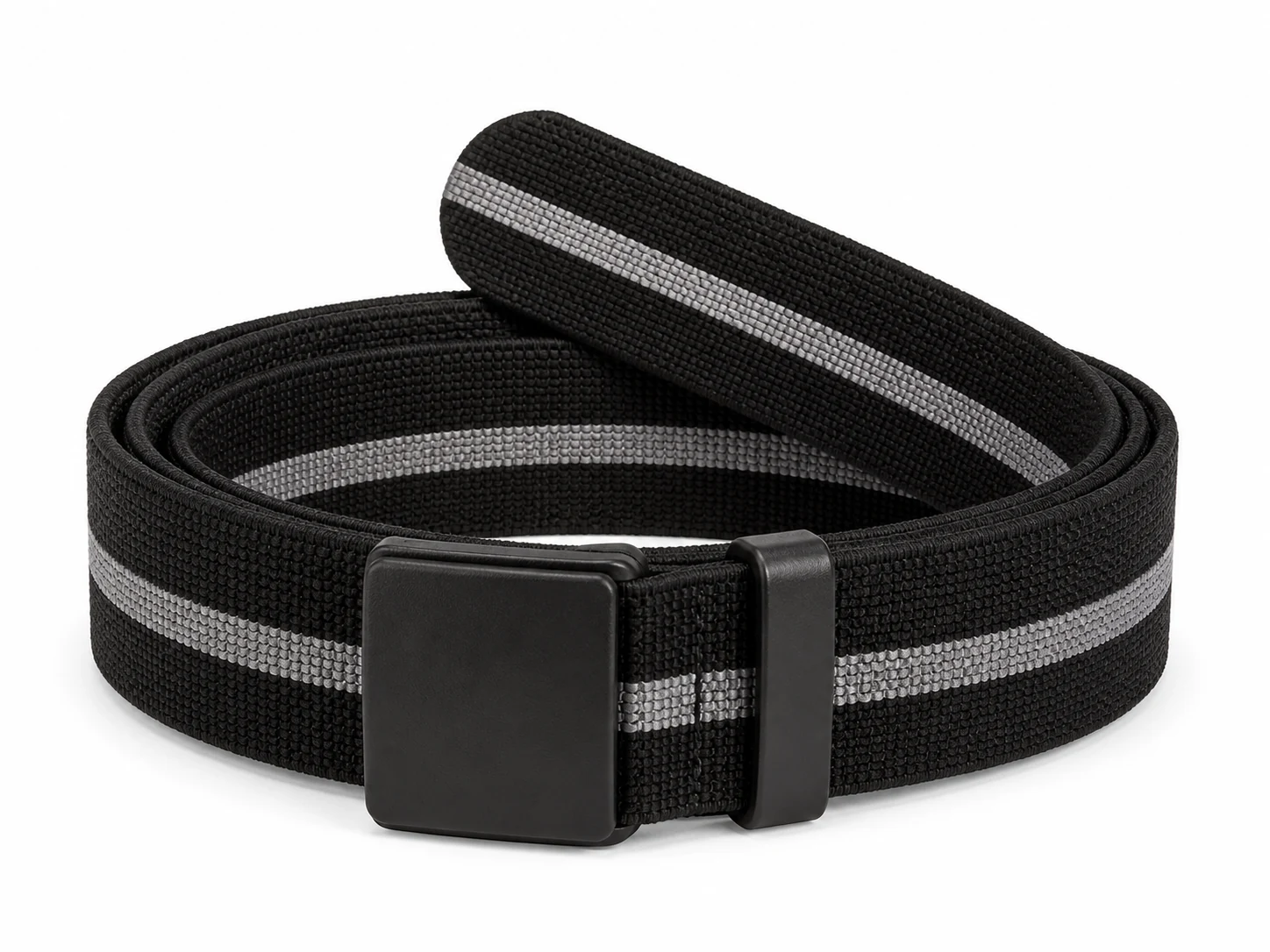
Elastic belts are defined by behavior, not looks: stretch, recovery, fatigue resistance and how the woven elastic joins the buckle and tip. A stretch belt that grows out after weeks of wear is a construction failure, so recovery and seam strength are part of the specification, and sizing logic differs from punched-strap belts. Elastic constructions are also a natural fit for kids and youth programs, where easy-fit closures beat precision sizing.
Woven, Braided, Canvas and Webbing Belts
Braided and woven belts build the strap from leather strips, textile, elastic or mixed materials. The braid pattern is the design, but density and edge security determine whether the strap keeps its shape — a loose braid stretches, a tight one resists adjustment. Braided constructions also interact with the closure: a classic pin buckle depends on the braid holding the pin, so braid density is a functional spec, not only an aesthetic one.
Canvas and webbing belts pair fabric straps with D-ring, roller or plate buckles and are a staple for casual, uniform and youth programs; the approval points are fabric density, edge sealing, and hardware compatibility with the webbing thickness. Webbing too thick for the buckle jams; too thin and it slips — the pairing is part of the specification.
Which Material Routes Fit Which Types
Type and material are two axes, and not every crossing works. A braided construction needs a material that holds a braid; a reversible belt needs two faces stable enough to laminate; a dress belt’s edge paint behaves differently on full-grain than on split. The table shows the pairings we run most often and the ones that need care — use it before you brief a type-material combination you have not made before.
| Filière matière | Natural pairings | Combos that need care |
|---|---|---|
| Full-grain / top-grain leather | Dress, casual, western, work, reversible | Braided — workable, but braid density must be spec’d |
| Split / bonded leather | Casual, uniform, price-point programs | Dress — edge paint and labeling need explicit agreement |
| PU / vegan routes | Casual, fashion, reversible, youth | Any “vegan” or sustainability claim needs evidence, not the material name |
| Woven textile / webbing | Canvas types, D-ring closures | Pin-buckle braids — pairing depends on weave density |
| Élastique | Stretch belts, kids, comfort programs | Any laminated two-face build — recovery and seams must be tested together |
| Straw / raffia | Seasonal fashion statements | Everything structural — fragile edges need packaging protection spec’d |
| Recycled / sustainable routes | Casual, fashion, corporate programs | All claims — composition, ratio and certificate holder must be verified per product |
| Embossed / exotic-effect | Fashion, western, dress | Copy — an embossed effect must never be described as a protected species’ real leather |
Read the third column as “spec first, order second”: those combinations are not banned, they are the ones where a generic purchase order produces surprises. In each case the fix is the same — name the risk in the spec, approve it in the sample, and the combination becomes routine. The deeper material-by-material detail, including grade identification and what each label means, is in our guide des matériaux pour ceintures en cuir.
Fashion and Specialty Belt Types
- Skinny and thin belts — womenswear accents where width, edge finish and buckle proportion carry the design; at narrow widths, edge quality is most of what the eye sees.
- Wide and corset belts — fashion waist statements; they are accessories, not medical or shaping devices, and copy should never imply otherwise.
- Studded and punk belts — rivets, grommets and chains; attachment strength and plating are the quality gates.
- Chain and metal belts — decorative hardware programs where surface finish and assembly control define returns.
- Hidden money belts — travel and security retail; structure and closure must be verified against the actual function before any claim.
- Suspenders — formal, uniform and retail programs with their own clip/button hardware and elastic recovery specs.
- Belt straps and blanks — buckle-less straps for component sourcing and downstream assembly routes.
The Same Types, Four Audiences
The 16 constructions above do not change by audience — but proportions, hardware scale, sizing logic and safety expectations do. Buying by audience without adjusting the type is how programs end up with a men’s buckle on a youth strap.
Men’s Belt Programs
Men’s programs concentrate on dress, casual, ratchet and work constructions, with wider straps and larger hardware as the default scale. The recurring decisions are strap width against trouser loops, buckle scale against price band, and — for ratchet styles — whether the mechanism is part of the brand story or hidden. Men’s programs also cover the corporate and uniform briefs, where the specification pulls toward durability and consistent hardware finishes.
Women’s Belt Programs
Women’s programs spread across skinny, wide/corset, chain, elastic and braided types, where the belt is an accessory statement as much as a functional item. Width is the primary design variable — the same closure system reads completely differently at 20 mm and 60 mm — and seasonal color pulls make lot consistency across reorders a live issue. Fashion programs also run more specialty hardware, which moves the QC weight from strap to attachment strength.
Kids and Youth Programs
Kids and youth programs favor elastic and easy-fit closures over precision sizing, with lightweight, size-appropriate constructions and hardware scaled down safely. Two rules follow the audience: any children’s product route must be checked against the safety requirements of the target market before claims or labels are written, and constructions must be verified for the age group they serve — market-specific requirements decide what evidence is needed, not the factory’s general catalog.
Unisex Programs
Unisex programs build flexible sizing and neutral styling into the construction itself — typically adjustable systems like ratchet, elastic or D-ring routes where one SKU covers a wider size range. The trade-off is inventory efficiency against fit precision, and the specification should state which one the program is optimizing for.
How Buyers Choose Belt Types for a Program
Retailers rarely buy “belts”; they buy a matrix of type, customer and price band. A practical way to build the matrix:
- Start from the channel. Big-box retail favors casual, canvas and elastic constructions with simple sizing; fashion collections lean on skinny, wide, chain and reversible types; workwear and uniform programs need heavy-duty and webbing routes.
- Match material to claim. If the program needs vegetable-tanned, recycled or vegan routes, the material identity, composition and any certification paperwork must be confirmed for the specific product and market — material names alone do not prove a claim. Our sustainable routes page explains what evidence each claim needs.
- Fix the sizing logic per type. Punched straps, ratchet tracks and elastic belts size differently, and label sizes must match measured lengths. Our belt size guide shows the measurement framework we use.
- Approve the details that fail in bulk. Edge paint, stitching, hole position, hardware plating and logo direction are the recurring risk points we inspect before shipment — name them per type in your acceptance limits.
Closure Systems and Sizing Logic
Because the closure decides how a belt sizes, a mixed program is really a mixed set of sizing rules. The table is the summary; the note under it is the mistake most first programs make.
| Fermeture | How it sizes | Label means | Fit range per SKU |
|---|---|---|---|
| Pin buckle (punched) | Hole spacing, fixed | Strap length / waist range | Narrow — multiple sizes per style |
| Ratchet / automatic | Continuous track | Strap length range | Wide — fewer SKUs cover more waists |
| Elastic / stretch | Stretch and recovery | Nominal size or S-M-L bands | Widest — one SKU spans bands |
| D-ring / roller (webbing) | Continuous friction | Strap length range | Wide |
| Reversible rotary | Punched, both faces share holes | Strap length / waist range | Narrow |
The note: reusing a punched-belt size chart on a ratchet or elastic program is the most common labeling error in mixed lines. Sizing is approved per closure system, against measured lengths — our size guide shows the measurement framework, and the label must match the measured reality, not the previous program’s convention.
A Worked Example: Building a 12-SKU Belt Wall
To make the matrix concrete: a mid-size retailer plans a 12-SKU wall and briefs it by type, not by habit. The mix they land on — two dress leathers, four casual leathers, two braided, two elastic, two ratchet — is not arbitrary: dress and casual carry the core volume, braided and elastic widen the fit range without multiplying sizes, and ratchet adds the gifting price point. Each type gets its own golden sample; the sizing chart is written per closure system; and the elastic SKUs drop from four size runs to two bands. Twelve SKUs, three sizing logics, one approval set per type — that is what “choosing types for a program” looks like in practice.
Planning a collection across several belt types?
Bring your product brief — types, target customer, material and hardware direction, quantity mix — and we will map it to workable constructions, flag the approval points per type, and quote a development plan. Mixed-type programs are our standard work, not an exception.
For programs that mix several types in one order — a common case for wholesale and private label buyers — packaging, barcodes and carton marking get approved alongside the product, because mixed cartons are where SKU errors happen. Each style in the mix gets its own golden sample and its own line in the QC limits; treating “the belt program” as one approval is how mixed programs drift.
Once the belt type is selected, convert the style choice into controlled material and release criteria. Use the bonded leather buyer guide for fibre-based material claims and the AQL inspection guide for lot, defect-class and acceptance decisions.
Questions fréquentes
What are the main types of belts?
The main types are dress and formal, casual and jeans, western and rodeo, work and heavy-duty, ratchet and automatic, reversible, woven and braided, canvas and webbing, elastic and stretch, plus fashion specialties like skinny, wide, studded and chain belts. Each type is defined by its strap material, closure system and edge construction.
Are ratchet belts more durable than punched-hole belts?
Durability depends on construction, not on the category label. A ratchet belt lives or dies by track geometry, claw tension and strap stiffness; a punched belt fails first at the holes and the buckle attachment. Both can be built to last or built to fail, which is why we specify mechanism cycles, recovery and seam strength in the approved sample rather than arguing about categories.
Which belt type should a new retail brand start with?
Most new brands start with one core construction they can describe clearly — typically a casual or dress leather belt — and add one mechanism type such as ratchet or reversible once the first program ships. Starting narrow keeps material, hardware and packaging approvals manageable.
Can one manufacturer produce all of these belt types?
It depends on the factory’s material routes and hardware network. HongDing coordinates leather, PU, woven, braided, canvas, elastic and specialty constructions, with buckle development and leather finishing support, and confirms the production route for each specific program. If you send a product brief, we will tell you which types fit which route before quotation.
How do I match belt types to my sales channel?
Big-box retail favors casual, canvas and elastic constructions with simple sizing; fashion collections lean on skinny, wide, chain and reversible types; workwear and uniform programs need heavy-duty and webbing routes; western and rodeo is its own channel with its own hardware vocabulary. Start from the channel, then let material and price band narrow the choice.
Do men’s and women’s belts need different constructions?
The construction types are shared — dress, casual, braided, elastic and the rest apply across audiences. What changes by audience are proportions, hardware scale, sizing logic and safety requirements: women’s programs make width the primary design variable and run more specialty hardware, kids and youth programs favor easy-fit closures and must be checked against the target market’s children’s product requirements, and unisex programs build the flexibility into adjustable closure systems.
Why We Write This
We manufacture custom belts across every construction in this guide, for brands, retailers, wholesalers and sourcing teams. We would rather a buyer arrive knowing exactly which type they need and what to approve — it makes the first conversation about the program instead of the vocabulary.
References and Sources
- HongDing belt construction and material routes — hdbelt.com/belt-styles, hdbelt.com/leather-belt-materials
- Belt sizing and measurement framework — hdbelt.com/size-guide
- General background on belt clothing — Wikipedia: Belt (clothing)
- Company facts stated on this page follow the HongDing company knowledge base, version 1.0, 2026-09-01
Ready to build your belt matrix? Send us your brief — product type, target customer, materials and hardware direction — and we will map it to a workable development and production route.