Written and reviewed by HongDing Editorial Team · Published 2026-09-06 · Updated 2026-09-06
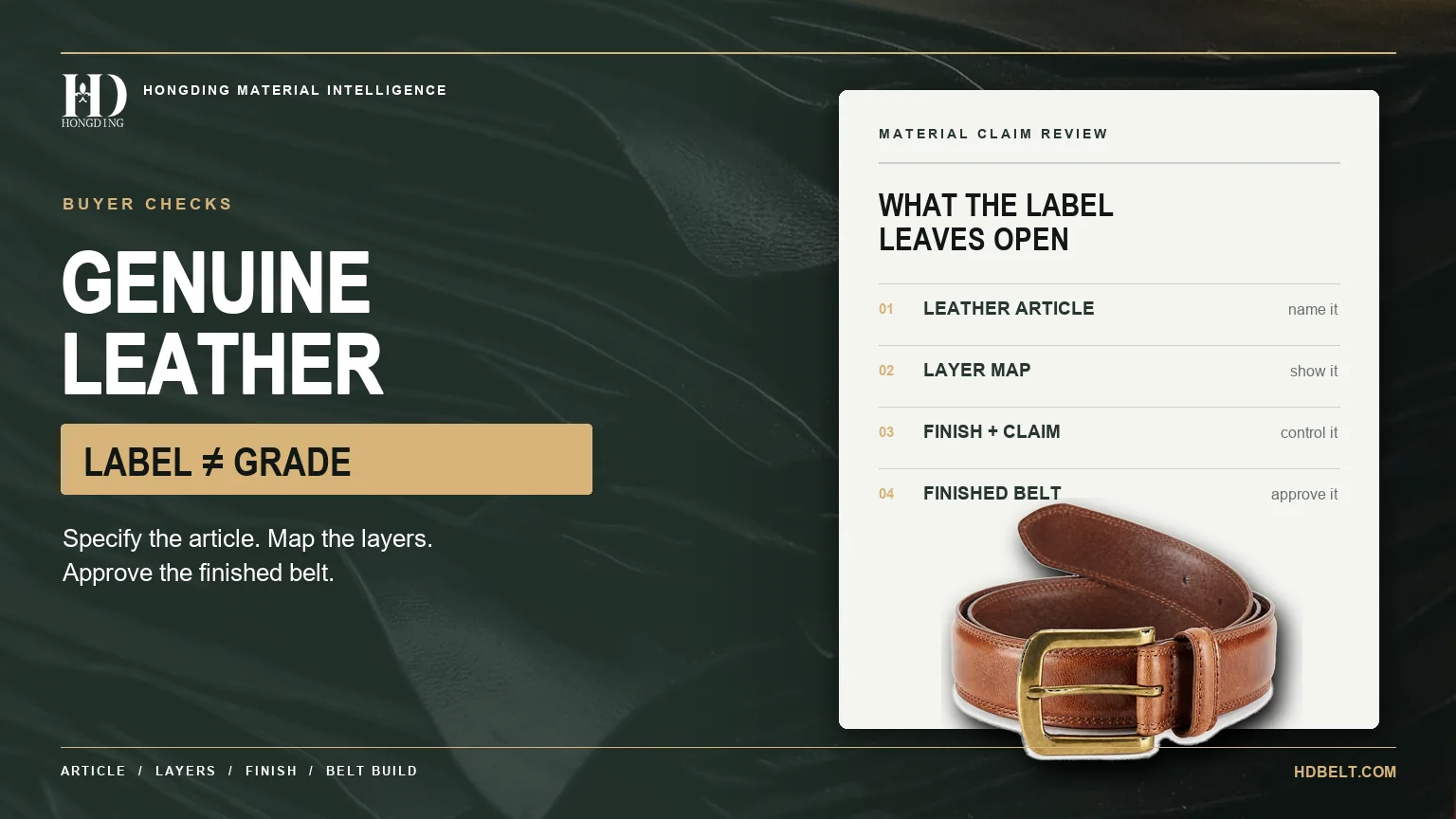
A “genuine leather” stamp can be accurate and still tell a buyer almost nothing about genuine leather belt quality. It does not identify the hide layer, surface correction, tannage, backing, reinforcement, edge system or finished-belt performance. Treat it as the start of a material question, not the answer.
- “Genuine leather” is not a quality grade defined by the FTC Leather Guides or ISO 15115:2019.
- For US sales, 16 CFR Part 24 covers belts not sold as part of a garment and addresses misleading material, grade, quality and construction claims.
- Specify the leather article and every hidden layer instead of approving one broad material phrase.
- Inspect the buckle fold, hole field, keeper contact, tip, edge and laminated interfaces on a finished belt.
- Keep material identity, approved construction, test criteria and consumer wording in one controlled record.
In short: genuine leather belts are not one construction or performance class. A defensible purchase order names the actual leather, maps the complete strap, defines the claim and ties production to approved evidence.
What Genuine Leather Tells a Buyer
The useful meaning is narrow: the seller is representing the material as leather rather than an imitation. That statement still leaves most purchasing variables open. It does not establish full grain, corrected grain, split leather, animal species, tannage, finish, substance or belt construction.
The US Federal Trade Commission’s Guides for Select Leather and Imitation Leather Products apply to belts when they are not sold as part of a garment. Part 24 focuses on whether descriptions misrepresent composition and other material characteristics. It does not publish a four-step quality ladder with “genuine leather” as one fixed grade.
This distinction matters in an RFQ. Two suppliers can quote “genuine leather belts” while pricing different hide layers, coatings, backings and assemblies. Their quotations are not comparable until those fields match.

Why the Quality Ladder Fails
Many retail guides repeat a simple order: full grain, top grain, genuine leather and bonded leather. It is easy to remember and unreliable as a specification. The first two terms describe grain retention or an upper hide region, while “genuine” is broad and bonded material has a reconstituted structure.
ISO 15115:2019 is the current published leather vocabulary standard after review and confirmation in 2025. It defines full grain leather as retaining the entire grain without corrective mechanical surface removal. It separately defines split leather as a tanned flesh-split or middle-split layer without grain structure.
The standard does not list “genuine leather” as a named material grade. That absence is important. A marketer may use the phrase as an authenticity signal, but a buyer cannot derive the hide layer or processing route from it.
A quality decision needs more than a ranking word. A corrected-grain article with a controlled finish may suit a consistent dress collection better than a highly variable article chosen only for a higher-sounding label. A weak backing or buckle fold can also make a belt fail even when the face leather is correctly described.
| Claim on offer | What it can indicate | What it does not prove | Buyer evidence |
|---|---|---|---|
| Genuine leather | A leather representation | Hide layer, finish or performance | Article declaration and layer map |
| Full grain | Entire grain retained | Species, tannage or belt build | Article specification and approved sample |
| Corrected grain | Grain surface mechanically corrected | Correction level or coating performance | Permitted-process statement |
| Split leather | Flesh or middle split | Coating, backing or reinforcement | Cross-section and component records |
| Bonded leather | Reconstituted leather content | Whole-hide leather construction | Composition percentages and claim review |
Map the Leather Article First
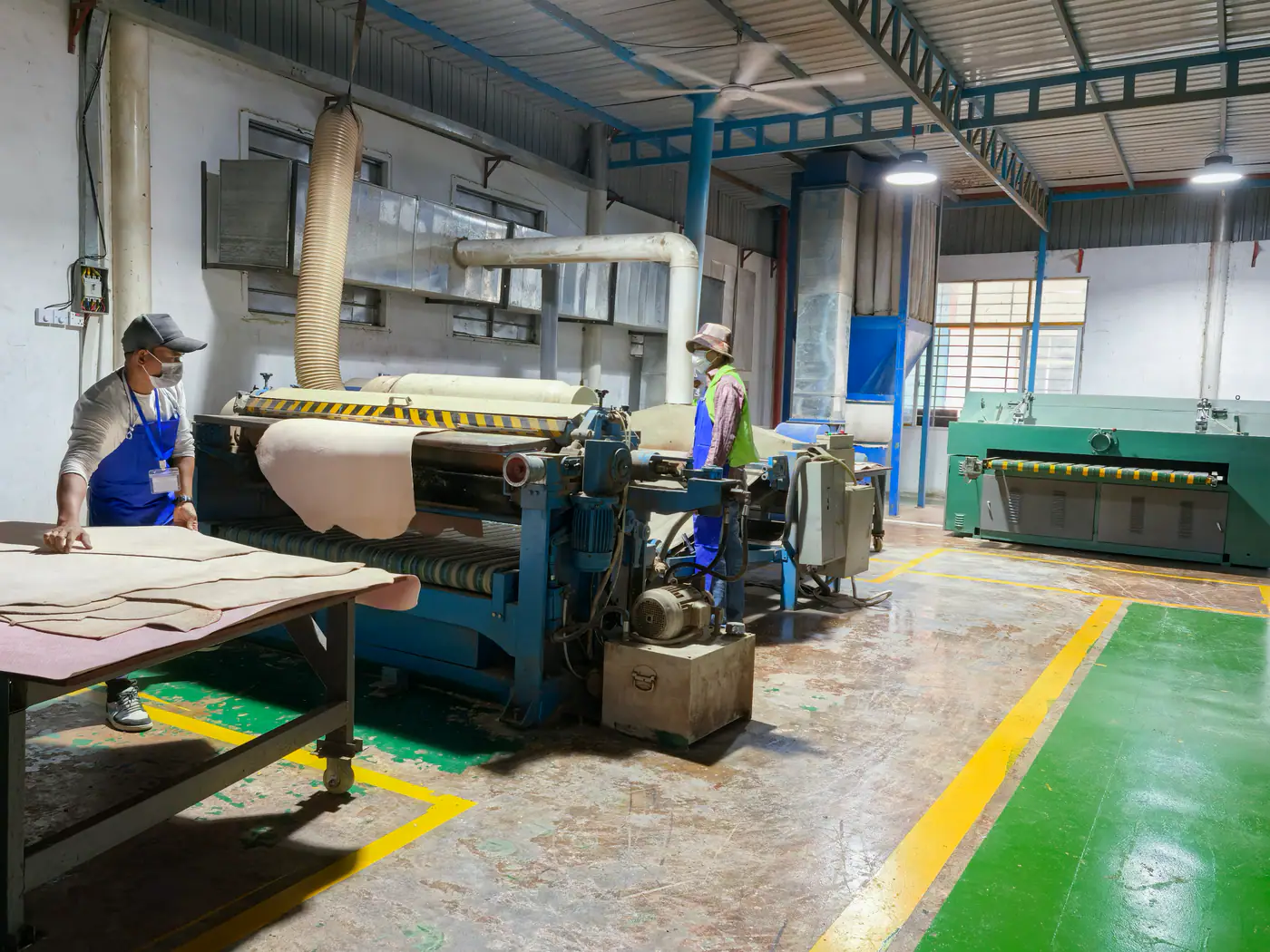
A leather article is the specific material grade controlled by the supplier or finishing route. HongDing’s buyer record starts with that identity, not a generic swatch name. The file should connect the supplier, article code, source layer or composition, finish and applicable lot or report.
Name the material structure
State whether the article is full grain, corrected grain, split or another defined construction. Record animal species only when documented and relevant to the claim. Add tannage, color, grain treatment, temper and finished substance when those fields affect appearance or assembly.
Do not infer the structure from surface grain. Embossing and pigmented finishes can create a consistent appearance across very different substrates. A cross-section and supplier declaration answer questions that a face photograph cannot.
Separate finishing from tanning
Finishing changes color, hand, gloss, texture and surface behavior after tanning. It does not rewrite the original hide layer. HongDing can coordinate leather finishing through the relevant project route, while Pro Pelli is documented as a leather-finishing facility rather than a blanket tannery claim.
The distinction protects the sourcing file. It prevents a finish sample from being treated as proof of origin, tannage, species or certification. Each claim needs its own evidence.

Inspect the Complete Belt Construction
A belt is a system, not a strip of face leather. The face can be leather while the core, backing, lining, reinforcement or edge contains another material. FTC guidance calls for backing disclosure when an unseen backing would otherwise mislead a purchaser about composition.
Map the stack from front to back. Record the face article, core or reinforcement, lining or backing, adhesive, stitch route and edge treatment. Then document local constructions at the buckle fold, keeper, holes, tip, rivets, screws and logo zones.
Follow the stress path
The buckle fold bends repeatedly and also carries the hardware connection. The hole field combines tensile load with cut edges, while the keeper rubs the face during use. These zones deserve separate acceptance checks because a flat swatch does not reproduce them.
Edge quality also depends on preparation and geometry. A painted edge needs a controlled substrate, radius, coating sequence and cure. A folded or burnished edge uses a different route, so “clean edge” is not a reproducible requirement.
| Belt zone | Main uncertainty | Useful buyer check |
|---|---|---|
| Buckle fold | Skive, bend and attachment | Production-intent assembly sample |
| Hole field | Stretch, cracking and layer exposure | Repeated-use inspection with defined method |
| Keeper contact | Surface rub and color transfer | Contact-area appearance criteria |
| Tip and edge | Peeling, overflow or roughness | Finished edge master and defect limits |
| Strap body | Layer adhesion and shape stability | Cross-section plus finished-belt review |
| Hardware interface | Clamp, screw, rivet or stitch security | Approved attachment construction |
Compare Common Leather Material Descriptions
Full grain and corrected grain describe what happened to the grain surface. Split leather identifies a lower hide layer without grain structure. Bonded material is made from leather particles or fibres combined with other substances, while synthetic material does not become leather because its surface looks similar.
These are structural differences, not automatic verdicts for every retail program. A specified split article with a validated coating can be a deliberate choice. An unspecified full-grain article can still arrive with unacceptable shade, temper, thickness or cut yield.
The bonded-leather boundary deserves special care. Section 24.2(f) of the FTC Guides says material containing ground, shredded, reconstituted or bonded leather should not be represented as wholly leather. When bonded-leather terms are used, the guidance calls for leather-fibre and non-leather percentages.
That topic is covered in the dedicated bonded leather buyer guide. For broader sourcing decisions, use the leather belt materials guide to compare the available routes without collapsing them into one grade ladder.
Turn the label into a producible belt brief
Send the intended market, use, material claim, face article, layer construction, hardware and packaging requirements. HongDing can then scope the material and sample route around the actual program.
Article definition | Construction map | Approval evidence
Control Labels Across Every Channel
The material claim begins in development and ends in front of the customer. Product descriptions, swing tags, packaging, line sheets and digital advertising should describe the same approved construction. A late marketing rewrite can create a claim that the supplier’s documents do not support.
Under 16 CFR 24.1, it is unfair or deceptive to misrepresent a covered product’s kind, grade, quality, material content, thickness, finish, serviceability, durability or construction. This is why “genuine leather” cannot safely carry implied promises about long life, premium grade or a particular hide layer. Those statements need separate support.
Section 24.2 also says a representation about one product part should identify the part to which it applies. If only the face is leather, do not let a whole-product statement conceal a non-leather backing that affects the buyer’s understanding. Name the components clearly and review the wording for the destination market.
Freeze the approved claim
Put the final consumer-facing phrase in the same approval pack as the bill of materials and sample. Record who approved it, which market it serves and which material evidence supports it. A supplier substitution should trigger a claim review, not just a color check.
Approve the Finished Belt System
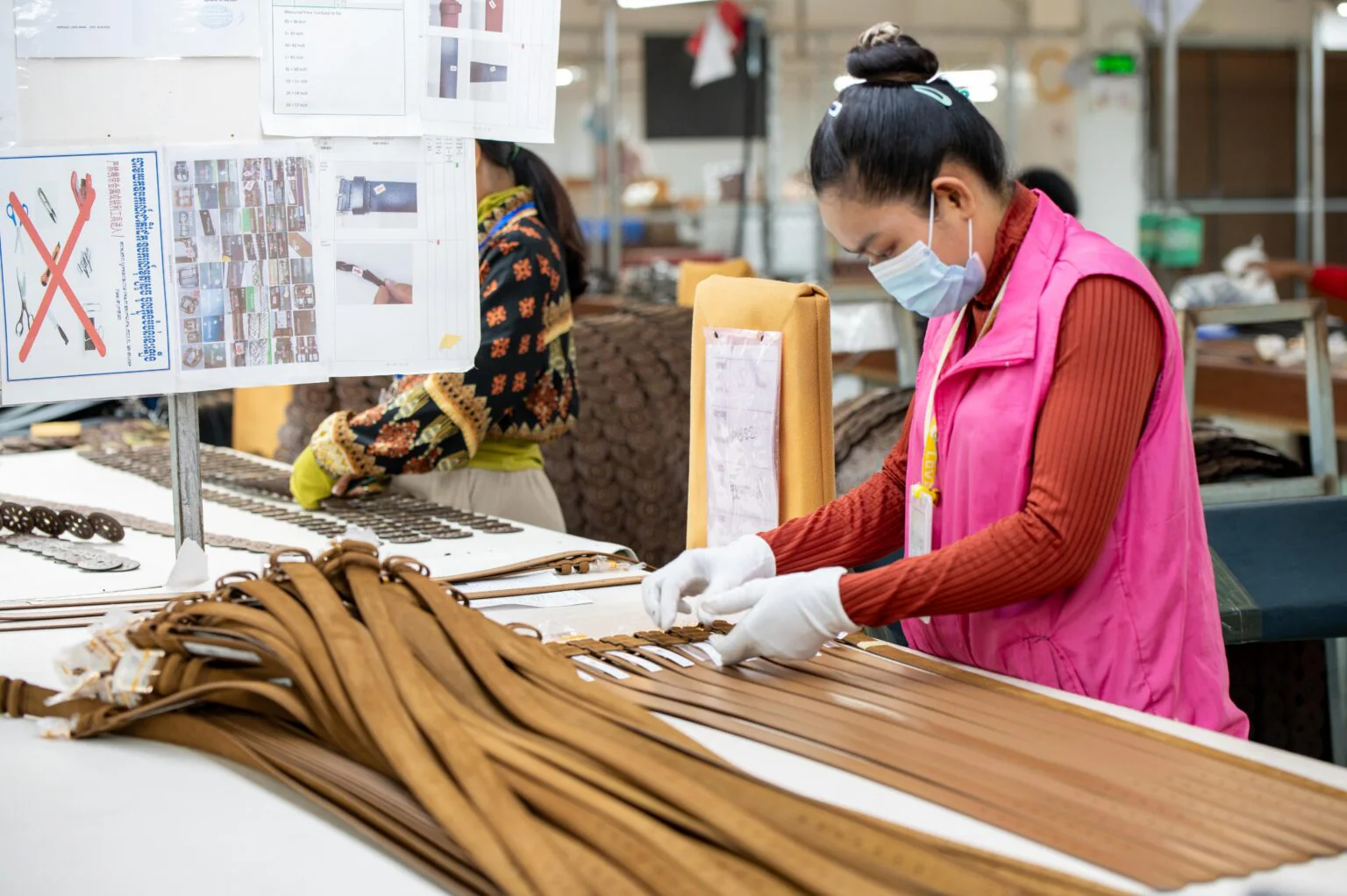
Material approval should begin with documents and end with a production-intent belt. First confirm the article and layer map. Then build a sample using the intended backing, reinforcement, adhesive, edge, stitch, buckle and packaging.
Choose tests from the product risk. Flexing may matter at the buckle fold and holes; adhesion matters at laminated interfaces; abrasion and color transfer matter at contact areas. The method, conditioning, sample location and acceptance limit must be named for the project.
Do not copy an attractive threshold from another belt. A lined dress belt and a double-layer work-style belt create different loads and failure modes. Project-specific criteria are more useful than a universal number with no traceable method.
Check the packed product
A finished belt can pass open-table inspection and still show pressure marks after coiling. Review the approved fold or coil, separators, buckle contact and carton arrangement. Packaging is part of the construction outcome when it changes the face or edge.
Close the loop with change control. No supplier, article, backing, finish, adhesive or hardware change should move into production without an impact review. Appearance matching alone is not proof of equivalence.
Match Construction to Retail Use
A dress program may value controlled color, a refined edge and a low-profile buckle. A casual collection may accept more natural variation or a more expressive surface. A work-style program can place greater demand on reinforcement and hardware attachment, but the exact load still belongs in the brief.
“Genuine leather” does not choose among these routes. The intended garment, wearing position, consumer expectation, retail channel and packaging determine the useful construction. Start with the use case and work backward to the article.
Natural markings are not automatically desirable or defective. The buyer should define the approved range by product position and cutting plan. A uniform retail presentation may require a more controlled finish, while a natural-look collection may preserve more variation.
If the brand story depends on full grain, vegetable tanning or a named species, request direct evidence for that claim. If the program needs a stable fashion surface at a different price position, evaluate another route honestly. The best material is the one that matches the claim and survives the approved use.
HongDing’s full-grain leather belt page and leather belt program page show how material choice connects to the finished article. The quality control process then defines how the approved record moves into inspection.
Build a Useful Supplier RFQ
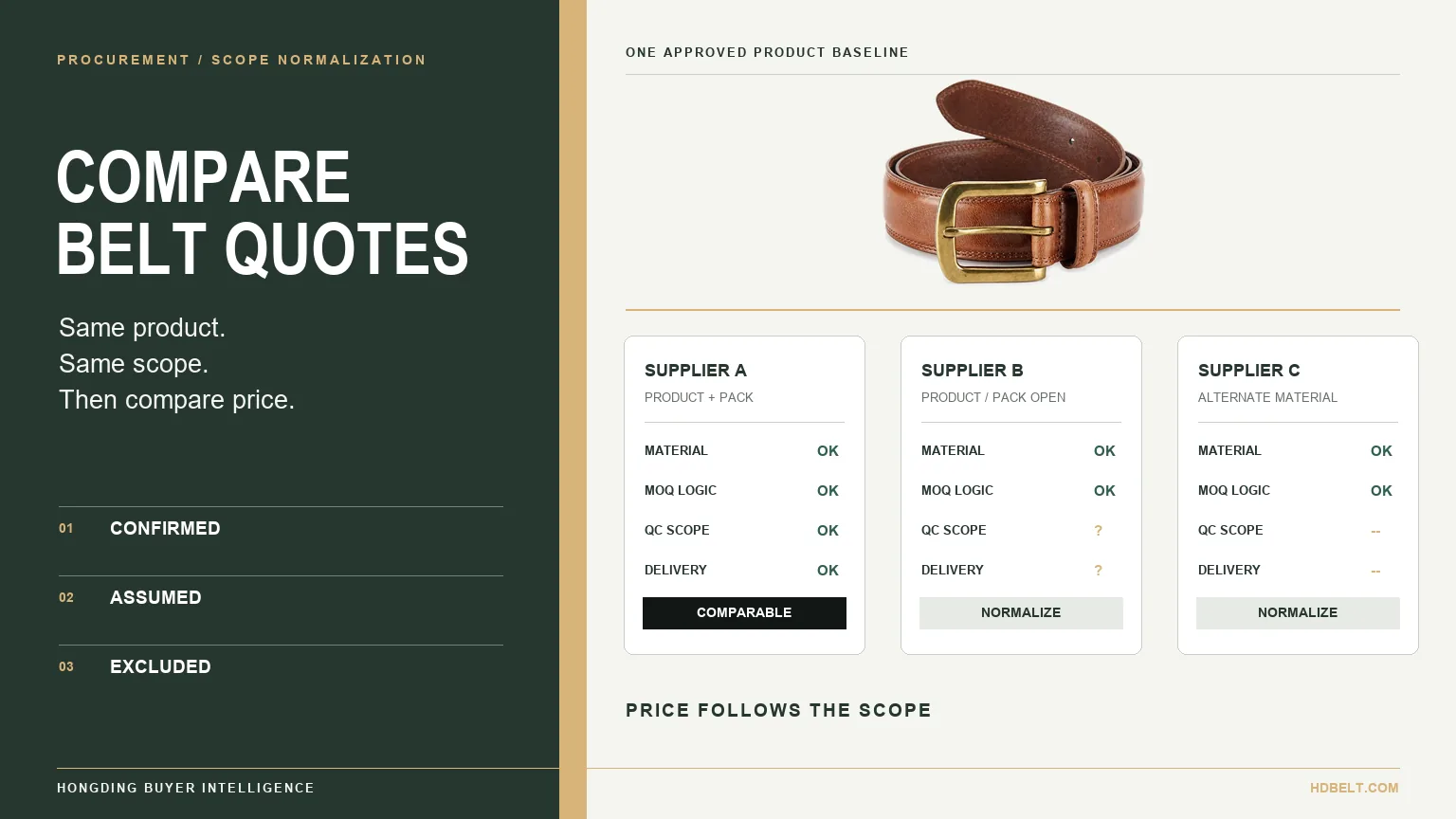
A useful RFQ lets every supplier price the same object. Give the intended market, belt type, target use, size basis, packaging and claim language. Add drawings or a reference sample, but state which characteristics the reference controls.
For the leather, request the supplier and article code, material structure, tannage, finish, color, substance and approved variation. For the belt, map every layer and local construction. For the commercial review, separate price options only after those fields are aligned.
| RFQ field | Useful input | Weak input |
|---|---|---|
| Material identity | Supplier, article and defined leather structure | Genuine leather |
| Finish | Color, grain treatment, gloss and hand reference | Premium brown |
| Layer map | Face, core, backing, reinforcement and adhesive | Leather belt |
| Local construction | Fold, holes, keeper, tip, edge and hardware | Same as photo |
| Quality plan | Named methods, locations and acceptance criteria | High quality |
| Claim control | Approved wording and supporting evidence | Real leather label |
| Change control | Written approval before material or process change | Equivalent allowed |
Ask the supplier to identify every assumption in the quote. One vendor may include a leather lining while another uses a textile backing. A visible difference can be corrected in sampling; a hidden commercial assumption can survive until production.
The same discipline supports wholesale belt sourcing. A buyer can compare material routes, hardware and packaging only after the baseline specification is shared. That is the point where a quotation becomes decision-ready.
Frequently Asked Questions
Is genuine leather real leather?
It is a representation that the material is leather, but the phrase does not identify the hide layer, finish or complete belt construction. Buyers should request the exact leather article and supporting records.
Is genuine leather an official leather grade?
No fixed “genuine leather” quality grade appears in the FTC Leather Guides or ISO 15115:2019 vocabulary. Treat the phrase as broad marketing language, then specify the actual material structure.
Is genuine leather the same as full-grain leather?
No. ISO defines full grain by retention of the entire grain without corrective mechanical surface removal. “Genuine leather” does not provide that structural detail.
Is genuine leather the same as bonded leather?
No. Bonded leather is a reconstituted material containing leather fibres and non-leather substances. US guidance calls for percentage disclosures when bonded-leather terminology is used.
How can a buyer verify genuine leather belt quality?
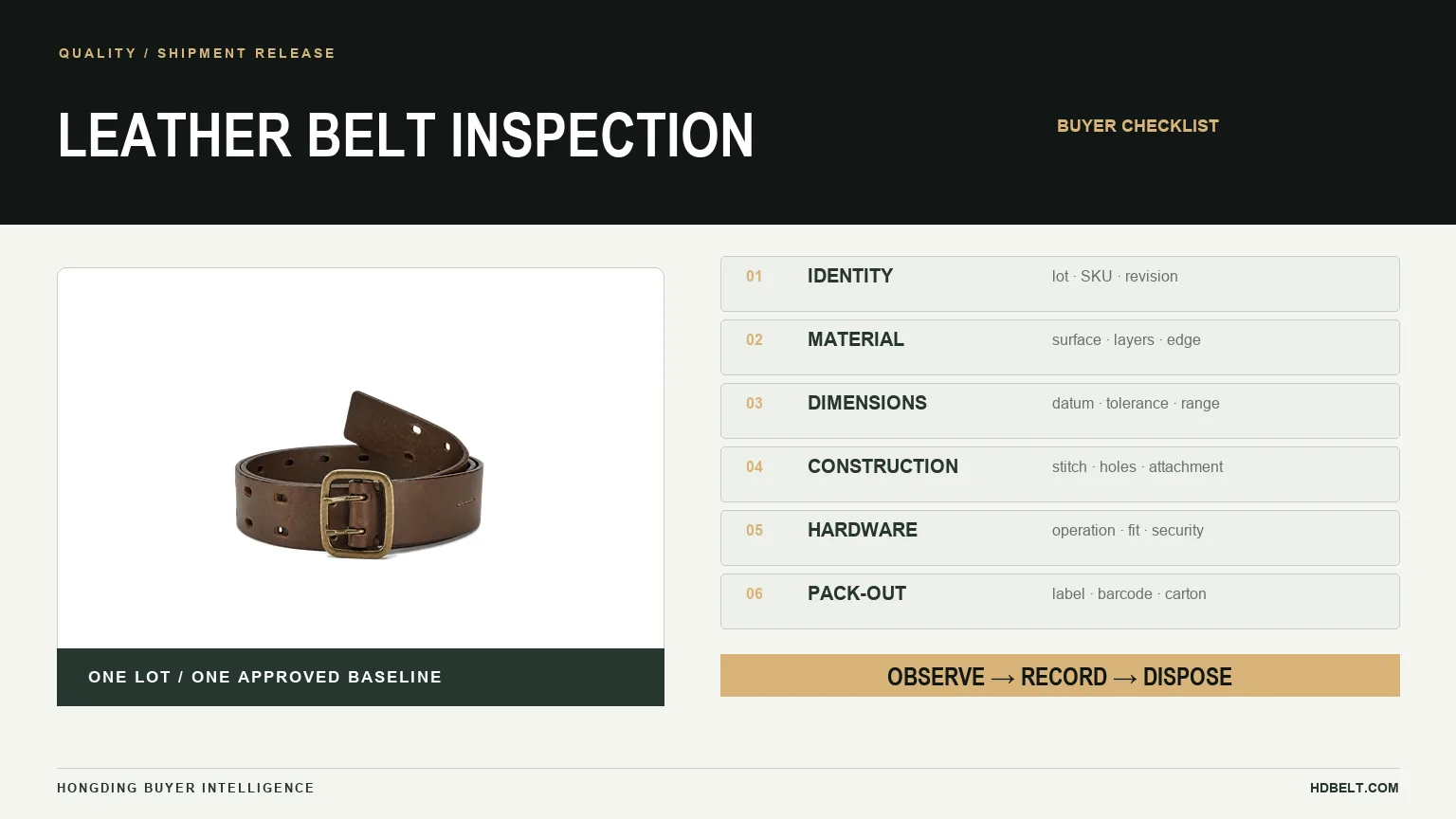
Verify the article, layer map, finish, local construction, approved sample, test criteria and claim wording. Inspect the finished belt at folds, holes, edges and hardware interfaces.
How long should a genuine leather belt last?
The phrase genuine leather cannot predict a service life. Durability depends on the named leather article, complete layer construction, finish, hardware, use conditions and the project-specific tests and acceptance evidence agreed for the finished belt.
Conclusion
A genuine leather belt should never be approved from the stamp alone. The phrase can indicate a leather representation, but it does not define the article, surface treatment, backing, reinforcement or expected result. Buyers gain control by replacing the label with a documented material and finished-belt system.
- Name the leather structure and supplier article before sampling.
- Map face, core, backing, reinforcement, edge and hardware interfaces.
- Set project-specific checks at the buckle fold, holes, keeper, tip and packed-product contact points.
- Lock consumer wording to the same evidence and change-control record.
Send HongDing the intended use, selling market, target claim and construction brief when you are ready to compare routes. The next useful step is not choosing a better adjective; it is building a specification that the supplier can quote, sample and reproduce.