Written by HongDing Editorial Team · Standards and technical review by HongDing Quality Control Team · Published 2026-09-09 · Updated 2026-09-09
A leather colorfastness test can return a clean-looking report. A belt buyer may still be unable to release production. The failure usually starts before testing because the request omits the surface, condition, result field or acceptance owner.
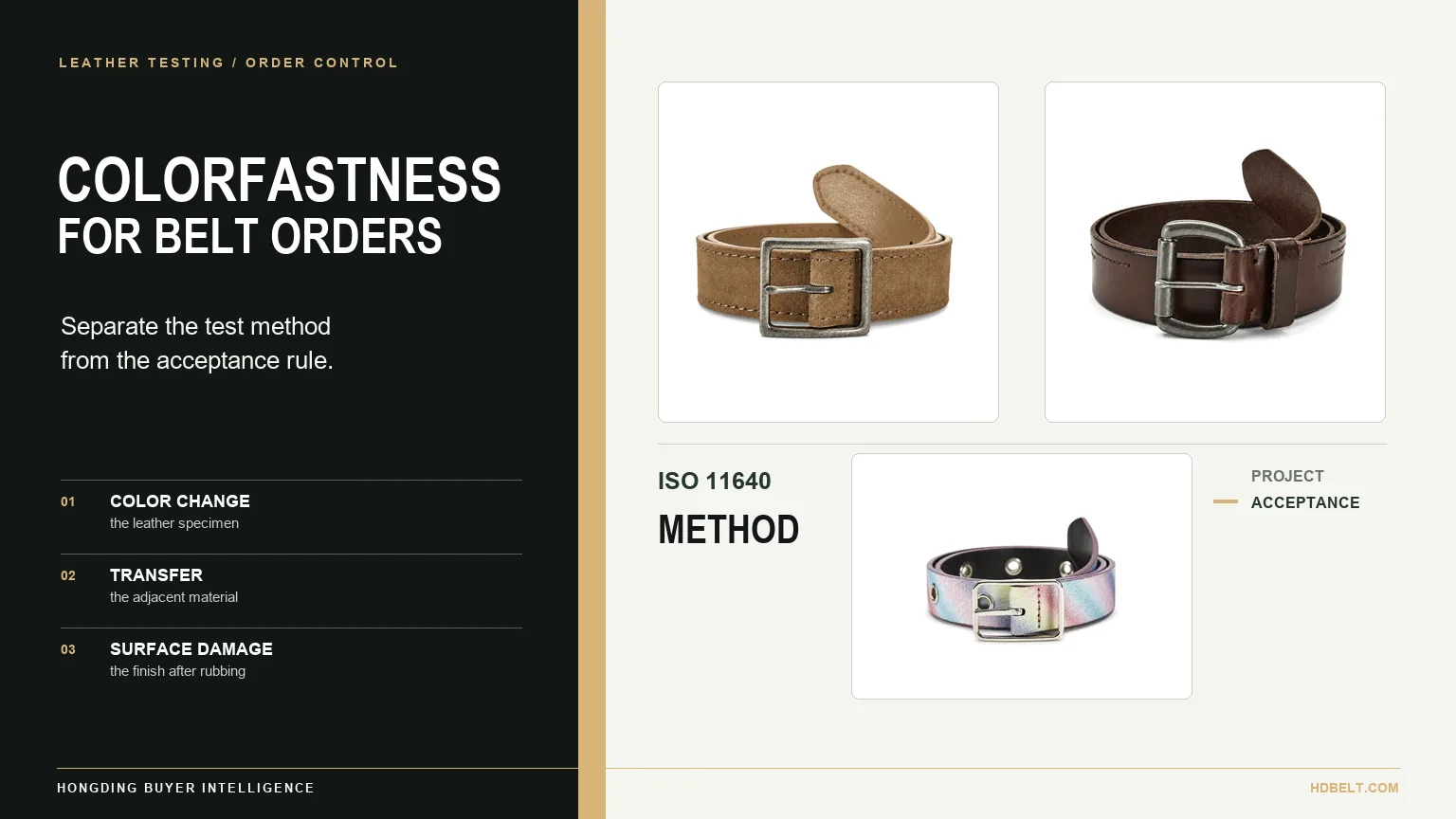
- ISO 11640:2018 is a published wool-felt rubbing method; it does not set one universal belt pass grade.
- ISO 20433:2024 is a separate crocking method using dry and wet white rubbing cloth.
- Record leather colour change, transfer to the felt or cloth, and visible surface damage separately.
- Name the article, colour, finish, face, sample stage and test condition before sending specimens.
- Only the buyer or governing program can approve the project-specific acceptance rule and release authority.
- Test the production-intent belt when assembly, edge, hardware or packaging creates a contact risk a flat swatch cannot show.
In short: select the method from the failure risk, not from a copied test list. Then define the specimen, condition and result format. Finish the purchasing instruction with an acceptance rule and retest trigger.
What the Test Must Answer
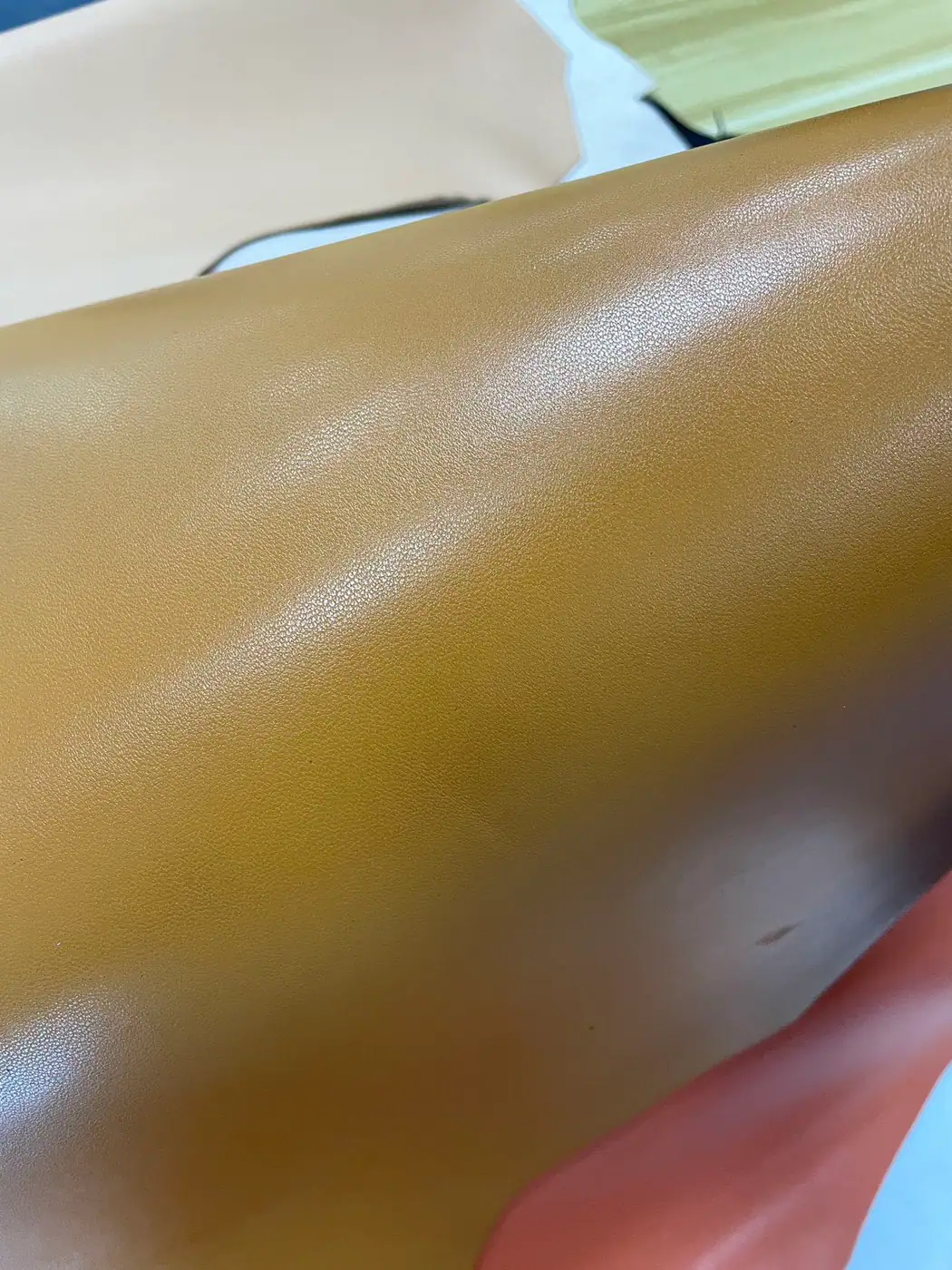
The first decision is the failure you need to detect. A dark suede belt may transfer colour to a light garment. A smooth pigmented belt may show polishing, finish damage or colour change where the keeper and buckle contact the strap. Those are related risks, not one result.
A useful instruction states the intended contact and the evidence needed for release. If garment staining is the concern, transfer to the rubbing medium matters. If the finish must retain its appearance, inspect the leather surface as well. If water or perspiration contact is credible, the chosen condition must represent that question.
Do not treat a visual master as test evidence. A swatch controls colour, gloss, grain and hand under agreed viewing conditions. The leather-finishing route can then connect that master to a named article and lot, while the test request evaluates the selected contact risk.
Separating Test Methods and Purchase Specifications
The method tells a laboratory how to conduct and report a controlled procedure. The purchase specification tells the laboratory and supplier which method, specimen, conditions, outputs and limits apply to this order. A method reference without those fields is not release-ready.
Separate Three Colorfastness Test Outputs
Colourfastness reports often compress several observations into one conversation. That creates avoidable disputes. A rating for staining on felt or cloth does not automatically describe the change on the leather, and neither result fully describes cracking, peeling, gloss change or other visible damage.
| Output | What is examined | Buyer question | Do not infer |
|---|---|---|---|
| Leather colour change | Tested versus untested surface | Did the leather appearance shift? | Transfer to another surface |
| Felt or cloth staining | Colour on rubbing medium | Could contact soil another material? | Finish integrity |
| Surface damage | Finish, grain or nap condition | Did rubbing alter the surface? | A universal service life |
A buyer should request each relevant result as its own report field. Photographs can support the record when lighting, orientation and specimen identity are controlled. They do not replace the named assessment method.
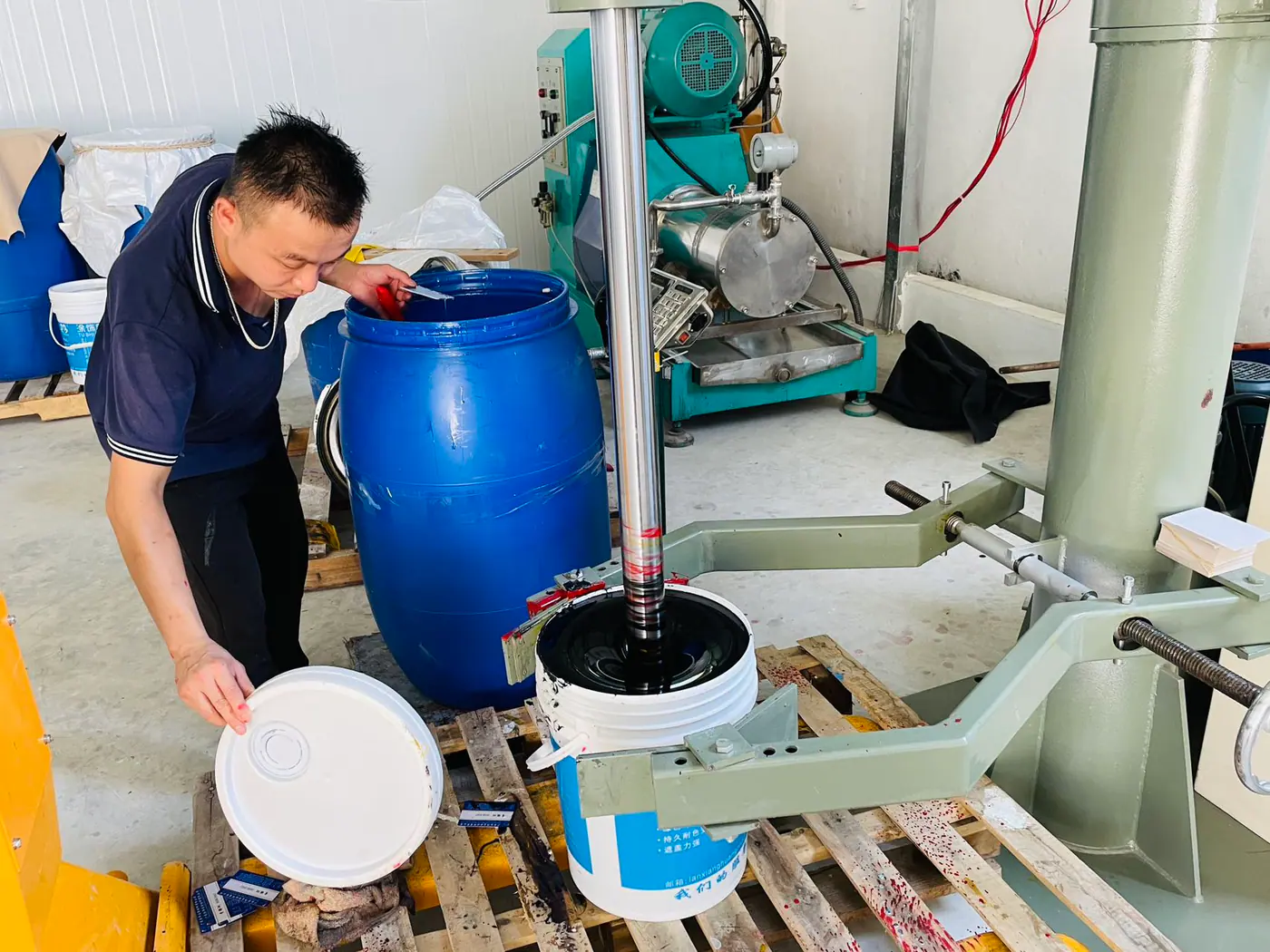
Keep the three outputs separate in corrective action as well. A formulation or topcoat change may address transfer but alter gloss or hand. Releasing the new finish from one improved value can move the defect into another field.
Choose the Right Leather Rubbing Method
ISO 11640:2018 specifies a method for observing the behaviour of a leather surface under cycles of to-and-fro rubbing with wool felt. ISO lists the third edition as published and marks it “to be revised.” The linked ISO page also identifies ISO/DIS 11640 as the expected replacement under development.
A DIS is a Draft International Standard. It is not the effective replacement. The buyer should verify the published edition at the time of contracting and avoid silently changing methods when a revision moves through development.
ISO 20433:2024 addresses colour transfer from coloured leather to other surfaces by crocking. Its official scope uses a dry white rubbing cloth and a wet white rubbing cloth. The method may be applied before or after surface finishes or after-treatments because those changes can affect transfer.
For US-facing specifications, ASTM D5053-03(2023) covers colour transferred from leather by wet or dry rubbing, or both. ASTM states that it applies to leather generally and excludes wet blue. This is not a license to mix its apparatus, rubbing medium or evaluation rules with an ISO report.
| Reference | Primary question | Contact medium | Buyer caution |
|---|---|---|---|
| ISO 11640:2018 | Surface behaviour under to-and-fro rubbing | Wool felt | No universal belt pass limit |
| ISO 20433:2024 | Colour transfer by crocking | Dry and wet white cloth | Separate from ISO 11640 |
| ASTM D5053-03(2023) | Wet or dry leather crocking | Method-defined rubbing material | Does not apply to wet blue |
| ASTM D6012-03(2021) | Bleeding stain transfer | Wet cloth contact | Different contact mechanism |
| ASTM D5552-10(2023) | Resistance to leather bleeding | Method-defined contact | Not a crocking substitute |
Bleeding is not just another name for crocking. ASTM D6012-03(2021) examines staining produced when leather contacts wet cloth, while ASTM D5552-10(2023) addresses resistance of coloured leather to bleeding. Choose them when the contact mechanism matches the order risk.
The best method is the one that answers the declared failure mode and governing requirement. Do not build a menu of every test available. That creates cost without creating a release decision.

Use the leather belt materials guide to identify the article. Identify its surface route before assigning a test. A family name such as leather, suede or split does not define the exact specimen.
Define Specimens and Test Conditions
Start with specimen identity. Record the supplier article, colour, finish, face or side, lot or sample reference, and the stage at which it was taken. “Brown leather” cannot tell the laboratory whether the piece matches the belt offered for production.
The instruction should also state whether the laboratory receives flat leather, a cut strap, a production-intent belt or more than one stage. Mark the tested surface and specimen location. A reversible belt needs separate scope for each face unless the buyer approves a documented equivalence.
Lock Test Conditions Before Sending Specimens
Use the selected standard’s requirements for conditioning, rubbing medium, apparatus, test state and reporting. Then record any project choices the method leaves to the user. Do not borrow cycle counts, loads or grading limits from a supplier brochure.
| Instruction field | Release-ready entry | Weak entry |
|---|---|---|
| Material identity | Supplier, article, colour, finish, lot | Brown leather |
| Specimen | Named face, location and sample stage | Random piece |
| Method | Standard number and published edition | Crock test |
| Condition | Method-defined dry, wet or selected contact | Normal use |
| Procedure choices | Recorded cycles, load and deviations | Standard setting |
| Outputs | Colour change, staining and damage fields | Pass or fail |
| Acceptance | Project limits and approving authority | Industry standard |
The standard number and edition belong together. A laboratory report that names only “ISO 11640” cannot show which published text governed the work. If the order spans a revision, the buyer should record whether existing approvals remain valid or require review.
Read the Laboratory Report Without Guessing
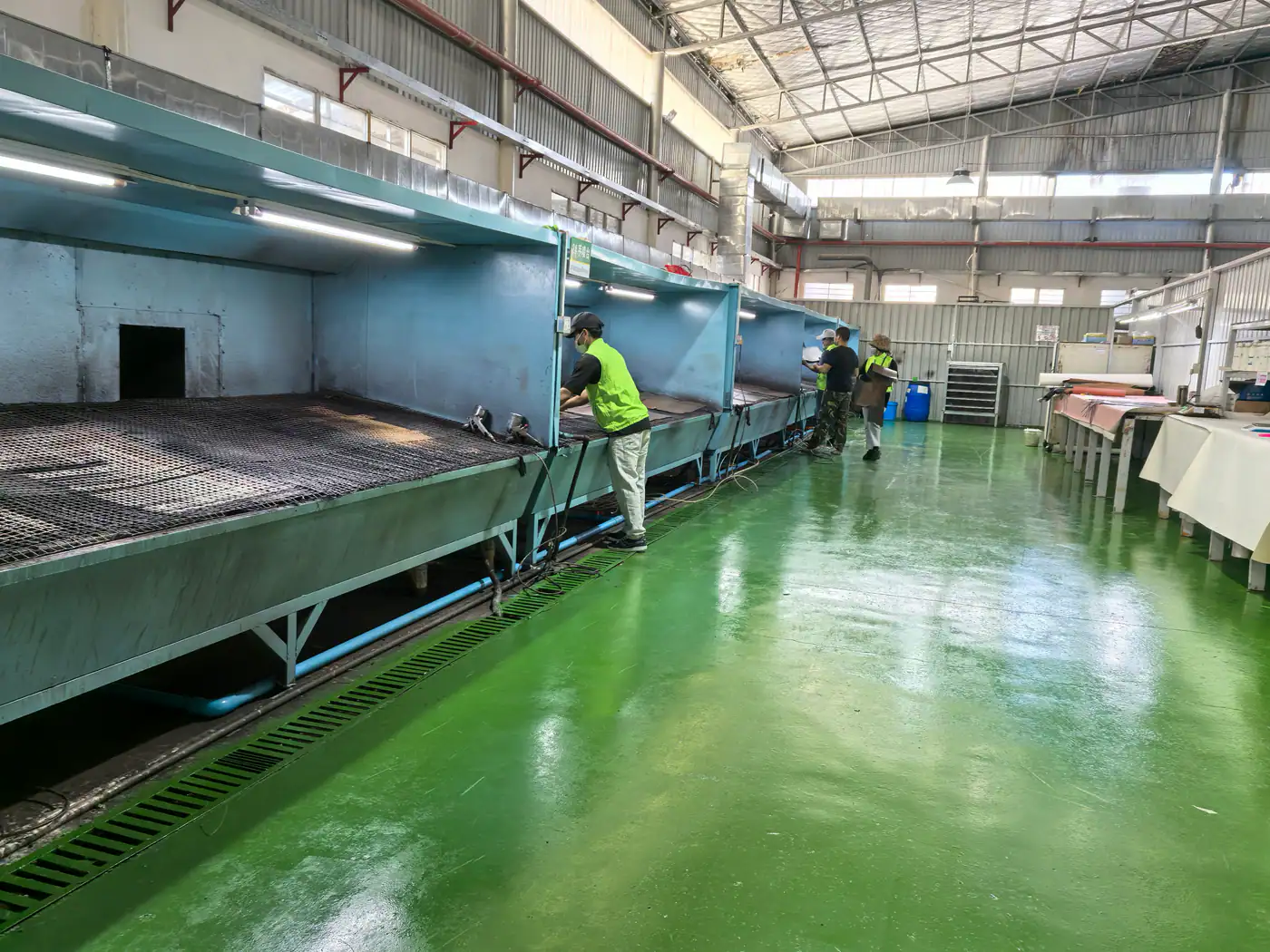
Begin with traceability, not the final word “Pass.” Match the laboratory, report number, issue date, applicant, sample description, article, colour, finish and specimen stage to the purchase file. A technically valid test on the wrong sample cannot release the order.
Next, compare the named standard and edition with the request. Check the test state, rubbing medium, procedure choices, evaluation method and any deviation. A deviation may be acceptable, but it must be visible and approved by the authority that owns the specification.
Read Every Required Result Field Separately
The report should not collapse colour change, staining and surface damage into one undocumented conclusion. Review the value or observation for each required output. Then compare each result with the corresponding project limit.
Photographs are supporting context. Ask whether the image shows the tested and control areas under a stated viewing setup, and whether specimen labels remain visible. A cropped close-up without identity can illustrate damage but cannot close traceability.
Set Project Acceptance Criteria Before Testing
ISO 11640 supplies a method. It does not supply one cycle count, one grade or one pass line for every belt. The same boundary applies when a buyer chooses a crocking or bleeding method: the order still needs a separate acceptance record.
Set limits from the intended product, contact risk, destination requirement and buyer policy. Identify which result controls release, which result requires correction, and who may approve a concession. Do this before testing, not after an inconvenient result appears.
HongDing’s belt quality-control process treats method, specimen and condition as project fields. Evaluation and acceptance are separate project fields. That prevents a laboratory method from being mistaken for the buyer’s complete quality plan.
| Decision field | Owner | Required record | Release question |
|---|---|---|---|
| Applicable output | Buyer or program | Named result field | What risk controls release? |
| Acceptance limit | Buyer or governing rule | Approved criterion | What value or condition passes? |
| Failure response | Buyer and supplier | Containment and correction | What happens to affected stock? |
| Concession authority | Named approver | Written disposition | Who may accept a deviation? |
| Retest trigger | Project owner | Change-control rule | Which changes reopen approval? |
Build Test Instructions Before Laboratory Requests
Send the leather article, belt construction, colour and finish scope, intended market and contact risks. HongDing can help map the production-intent sample and project evidence route without inventing a universal pass line.
Named specimen | Separate outputs | Buyer-owned acceptance
Do not negotiate the criterion from memory after the report arrives. A late decision rewards whichever interpretation supports shipment. A controlled pre-test record protects both buyer and supplier from that ambiguity.
Test Flat Leather and Finished Belts
Flat leather is useful for screening and lot control. It isolates the article and finish before assembly. It cannot reproduce every contact point created by a buckle fold, keeper, edge system, lining, adhesive, logo, hardware or retail pack.
A production-intent belt answers the assembled question. Test or inspect the zones that touch garments, hardware, adjacent layers or packaging. The strap face, reverse, cut edge, keeper path and buckle contact area may not share the same surface or risk.
The approved pre-production belt sample should use the intended material, finish, backing, edge, hardware and pack route. Link its sample code to the laboratory report. If testing uses a separate flat specimen, record how that piece relates to the belt article.

Include Packaging Contact in Test Scope
A coiled belt can place the buckle, tip or reverse face against the visible surface. Tissue, sleeves and dividers can also create prolonged contact. If packed storage creates the credible transfer risk, an open-table rub result answers only part of the question.
Record packaging review separately from the laboratory method. A pack trial is not ISO 11640, and ISO 11640 is not a complete packed-product simulation. Each piece of evidence keeps its own name and purpose.
Control Changes Across Belt Order Variants
Colour and finish are part of test scope. A result for black pigmented leather does not automatically release brown pull-up leather, navy suede or a coated split article. Even two colours on the same base article can require review when dyes, pigments or topcoats differ.
Two-sided constructions need the same discipline. A reversible belt program may expose two faces, a finished edge and a rotating hardware contact path. Name the surfaces covered by each result rather than assigning one report to the whole product.
Write Retest Triggers Before Repeat Orders
Review the approval when the supplier article, colour route, finish chemistry, coating, backing or processing site changes. Review it again when the exposed face, hardware contact or packaging changes. Not every change requires the same test, but every relevant change requires an impact decision.
Lot-to-lot appearance matching is not proof of equal rubbing behaviour. Record the reason when a prior result is extended to a new variant. That documented equivalence decision is part of the evidence, not an informal shortcut.

A clear change record also limits unnecessary retesting. The project owner can compare what changed, which risk moved and which evidence remains applicable. That is stronger than retesting everything or assuming nothing changed.
Leather Colorfastness Questions Buyers Often Ask
Does ISO 11640 Set a Universal Passing Grade?
No. ISO 11640 specifies a rubbing method, while the buyer or governing program defines the project cycle count, evaluated outputs, acceptance limits and release authority.
Does ISO 11640 Equal a Crocking Test?
No. ISO 11640 uses wool felt to evaluate leather surface behaviour under to-and-fro rubbing. ISO 20433 uses dry and wet white rubbing cloth to measure colour transfer by crocking.
Should Buyers Request Dry and Wet Testing?
Request the conditions that match the intended contact risk and governing requirement. Dry, wet and perspiration-related questions are not interchangeable, so name each required condition in the test instruction.
Can One Result Approve Every Colour and Finish?
No. The approval scope should identify the article, colour, finish, face, batch and component. Extend a result only through a documented equivalence decision and change-risk review.
Should the Laboratory Test Leather or Finished Belts?
Use flat leather for article screening and a production-intent belt when assembly, edges, hardware or packaging create relevant contact zones. Many programs need both evidence stages.
Does HongDing Issue Accredited Laboratory Reports?
HongDing coordinates project requirements, samples and evidence as a belt development and manufacturing partner. It does not present itself as a standards body or accredited test laboratory.
Why We Built This Buyer Guide
Most method pages explain apparatus or laboratory scope. Belt buyers still need to decide what to test, which surface matters, how the specimen maps to an order and who owns the pass line. That missing purchasing layer causes more ambiguity than the method name itself.
As a custom belt development and manufacturing partner, HongDing works from buyer briefs and controlled material routes. It also controls production-intent samples, project quality criteria and documented changes. This guide turns those controls into a reusable test request without presenting HongDing as the issuer of ISO or ASTM methods.
The practical asset is the record. It joins the failure mode, published method and edition, identified specimen, stated condition and separate outputs. Keep the approved acceptance criteria, report traceability and retest triggers with the approved sample and purchase specification.
Turn Test Results Into Release Decisions
A leather colorfastness test becomes useful only when it closes a defined belt-order decision. ISO 11640, ISO 20433 and ASTM methods answer different contact questions. None removes the buyer’s responsibility to identify the specimen, select the applicable condition and approve the acceptance rule.
- Define the transfer, colour-change or surface-damage risk before selecting a method.
- Record the published standard edition, article, colour, finish, face and sample stage.
- Keep leather colour change, rubbing-medium staining and surface damage as separate report fields.
- Link the result to a production-intent belt, named release authority and written retest triggers.
Send the failure mode and current belt brief before requesting a test quotation. HongDing can help organize the material, sample and evidence route around the actual program. The laboratory method remains the method; the order file remains the place where acceptance becomes reproducible.