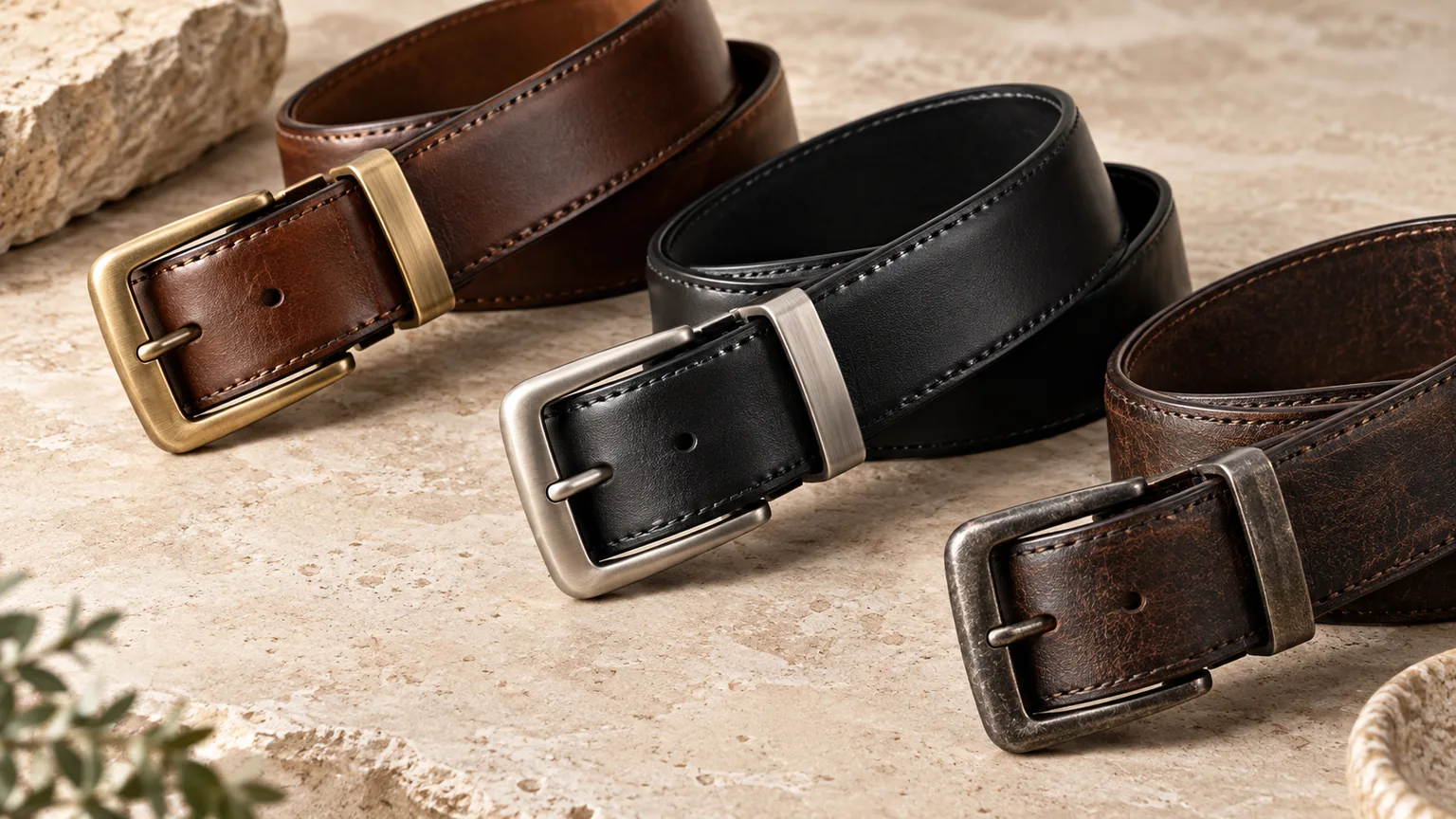
A belt-hardware finish is a product-system choice, not a color chip attached to a buckle. The useful directions for current development are controlled polish, lower-glare brushed or satin surfaces, deliberately aged effects, and coordinated mixed-metal accents. None is a universal trend forecast. For an OEM/ODM belt range, the decision is which finish makes the buckle, keeper, tip and strap read as one intended product under store light, survives the agreed use and can be repeated from approved sample to bulk.
Points clés
- Separate appearance words such as “antique brass” from substrate, finishing route, coating and verification requirements.
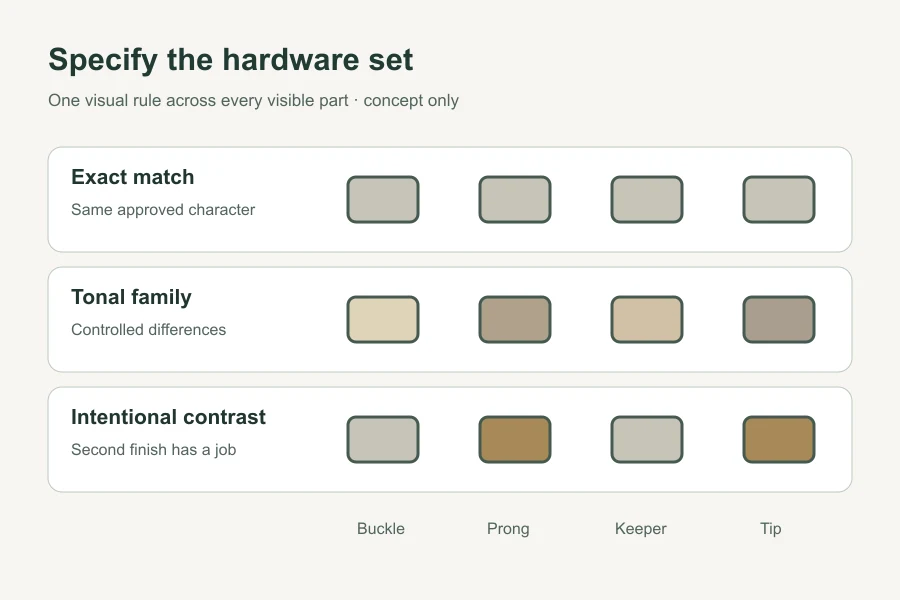
- Choose a hardware-set rule: exact match, deliberate contrast or controlled tonal variation. Apply it to every visible metal part.
- Approve physical masters on the actual leather or webbing, in at least the lighting conditions where the product will be judged.
- Freeze part codes, finish references, acceptable variation and test requirements before a sample becomes the bulk benchmark.
What a “finish direction” can—and cannot—tell a buyer
A finish board often shows a polished silver buckle beside an antique brass one and calls the choice a trend. That visual comparison is useful only after the brand names the customer, garment context, price architecture and intended range relationship. A polished frame on a narrow dress belt may emphasize a crisp edge and a formal appearance. A brushed surface can lower glare on an everyday style. An intentionally aged effect may support a Western or heritage story. These are design hypotheses to test against the line, not evidence that one surface is growing faster in the global market.
Current assortments demonstrate that multiple finish options coexist. For example, the first-party Guarded Goods Foundation Belt listing presents brushed nickel, antique brass and polished brass options for one belt concept. That is evidence of product availability, not a sales ranking or a forecast for HDBelt customers. A brand choosing between these looks should evaluate its own assortment and channel, not copy an assumed industry-wide winner from a product page.
Begin with the role of the hardware. Is the buckle a quiet functional component, the focal point of a fashion belt, or a visual cue that joins several SKUs? On a reversible belt, both face materials must make sense with the visible frame. On a Western style, engraving and surface relief may be more important than a flat color reference. On a workwear-inspired item, a large dark buckle can look strong in a rendering yet dominate the finished silhouette. The finish direction is successful when it advances that specific product decision.
Design teams should also distinguish an enduring range rule from a seasonal accent. “All core black leather belts use the same low-glare nickel family” is a reusable rule if the approved sample and supply route support it. “This capsule uses one aged silver focal buckle” is a controlled exception. Either may be right. The mistake is allowing different suppliers or sample rounds to interpret an unqualified phrase such as “vintage metal” independently.
Design the visible hardware as a set, not a lone buckle
A finished belt may show a frame, prong, bar, keeper, tip, rivets, snaps, eyelets or a decorative plaque. The shopper sees their relationships even if the specification lists them on separate lines. A plated buckle beside a coated keeper may match on a screen and diverge on the garment. A prong that is darker than the frame can look intentional when repeated elsewhere, or like an unapproved replacement when it appears only on one SKU.
Choose one of three relationships before selecting codes. Exact match asks visible pieces to share an approved color and surface character within a practical tolerance. Controlled tone family allows small differences but keeps one warm or cool direction and a clear gloss hierarchy. Deliberate contrast uses a documented second finish as a design element. If the buyer cannot explain which relationship applies, bulk teams cannot tell acceptable variation from a mistake.
| Direction | What to approve | Common failure |
|---|---|---|
| Controlled polish | Reflection level, visible polish lines, buckle and keeper color together | One part appears mirror-bright while the other reads satin. |
| Brushed or satin | Grain direction, fineness, edge highlights and accepted touch points | A replacement part has a different brushing direction or glare. |
| Antiqued effect | Base tone, dark recesses, high-point exposure and variation envelope | Pieces vary randomly or wear is mistaken for intended aging. |
| Mixed metal | Which part carries each finish and why the contrast repeats | A second finish enters through substitution without a design rule. |
The strap changes this judgment. Warm brass against cognac leather can feel continuous; the same brass against a cool gray strap may become the focal contrast. White or pale leather amplifies slight hardware discoloration and transfer. A heavily textured strap can make intricate metal texture visually busy. Specify the hardware on a finished belt rather than on an isolated metal card. Include edge color, stitching and branding placement in that review, because they alter what the metal appears to match.
Where a style uses removable or interchangeable parts, define the combinations that are actually authorized. “Works with all buckles” is a risky promise if hole shape, bar width, prong reach or fold thickness changes. A finish match does not prove mechanical compatibility. HongDing’s documented development scope includes belt concepts, material selection, hardware development and sampling; the approved component system still has to be specified for the individual project. The buckle-type guide can help resolve closure architecture before finish selection.
Translate appearance into a buildable, testable specification
“Antique gold” and “gunmetal” are visual labels, not complete manufacturing instructions. A buyer needs to know the base metal or component material, the intended finish route, the reference master, the visible surface treatment, and any coating or protective requirement. Two parts can share a color name but behave differently because one is plated, another painted, and another intentionally oxidized. The appearance may be close at sampling and separate after handling. Do not infer a process or corrosion resistance from a photograph.
For an OEM/ODM brief, attach front, side and detail views of the finished reference. Mark faces that remain visible when worn, edges that contact the leather, areas allowed to show polishing or patina, and any engraved or relief features. Give each part a code, revision and finish reference. If an existing physical sample is the starting point, record what is being copied visually and what must change functionally. A brand can begin with a concept image or a material direction; a complete tech pack is helpful for final control but is not a prerequisite to discuss the development route.
Finish integrity is a separate question from finish color. An attractive approved master may still require checks for coating adhesion, abrasion, color transfer or corrosion behavior appropriate to the product and retailer requirement. Contact areas—the prong against a hole, buckle bar against the folded strap, keeper against the tail—may be more revealing than an untouched front face. A scratch intentionally permitted in an aged look is not the same thing as uncontrolled flaking or base-metal exposure. Define what counts as appearance character and what counts as a defect.
Do not borrow a universal “plating test passed” label without the method, substrate, exposure and acceptance rule. The HDBelt buckle plating-tests guide explains how to request relevant evidence and distinguish coating questions. Hardware retention and belt pull behavior are different again; the assembled-belt pull-strength guide addresses the load path. These checks can share a sample plan, but one result cannot certify another property.
Judge finishes under the conditions in which buyers will see them
A swatch can look stable under diffuse daylight and different under warm shop lighting, phone photography or adjacent garments. Polished surfaces mirror their surroundings; brushed surfaces scatter reflections; textured relief creates dark and light zones. Review the physical sample with the actual strap, packaging and range companions. A screen render is useful to narrow options, but it is a poor final master for gloss, texture and small tonal differences.
Use a short, repeatable review protocol. Place the belt beside the intended leather colorways or webbing shades. Inspect from normal shelf distance, on-body distance and close enough to see prong and keeper mismatch. Check neutral and warm light rather than approving only under a single studio lamp. Photograph the sample with a color reference if remote reviewers need to discuss it, while treating the physical approved master as the source of truth for subtle surface effects. Record the reviewer, date and version; otherwise the next sampling round may argue over which photograph was final.
Range coordination needs rules as well as taste. A retailer may want a consistent hardware family across black, brown and tan belts, or distinct metal accents that make each colorway easy to shop. Ask whether the color system should be consistent within a style, across a capsule or across the brand’s entire core line. These are different scopes. If cost or minimum quantities make a finish impractical on a small capsule, a nearby existing component may be preferable—but it should be presented as a design trade-off for approval, not a silent equivalent.
Think about packaging and digital display at the same time. A dark antiqued finish on a dark belt may disappear in a thumbnail, while a mirror-polished part may create distracting glare. Neither observation means the product is wrong. It means the brand should decide what the merchandising image must show and whether the metal is supposed to lead or support the leather. Avoid promises such as “scratch-proof” or “won’t tarnish” unless the actual material and test evidence support them for the intended use.
Illustrative range decision: one buckle family, three leather colors
Hypothetical development example, not a HongDing customer order: a brand plans a narrow everyday belt in black, dark brown and tan leather. The first concept board uses a highly polished silver frame on all three. On black, it creates the crisp contrast the designer wanted. On tan, it looks cooler than the edge finish and pale stitching. The team also considers a brushed nickel variant and a warm antiqued option.
The wrong shortcut would be to decide from three isolated buckle photographs. Instead, the team builds one approved-size belt in each colorway with the candidate hardware set. It checks frame, prong and keeper together, not just the front face. On the tan version, brushed nickel may reduce the temperature clash but also reduce the intended focal point. Antiqued brass may feel coherent with the leather but move the range toward a heritage story the brand does not want. The outcome depends on the brand’s retail positioning; there is no universal “best” finish.
The team chooses a rule after viewing the belts under retail-relevant light: perhaps polished silver remains the consistent family, with a warmer edge color and revised product photography; perhaps the tan SKU gets a documented brass variant. Either path needs separate part codes, physical finish masters and a clear colorway matrix. The sign-off should state whether small tonal differences are allowed between frame and prong and whether the keeper is intentionally a secondary finish. This prevents an approved design choice from becoming an accidental mixed lot.
When the buckle supplier proposes a visually similar replacement, the team compares substrate, dimensions, operation and surface—not only the finish name. If bar geometry changes, it also rechecks the folded strap and closure. A finish substitution may have functional consequences, while a functionally equivalent part can still fail a brand’s visual rule. That is why the brand’s product owner, not a broad trend claim, must decide which compromise is acceptable.
Move a finish master from sample approval to production
The approval package should include the finished belt master, individual coded hardware components, colorway matrix, finish description, variation examples if the treatment is intentionally irregular, and the required surface or function checks. For an antiqued effect, save acceptable high and low examples rather than a single idealized hero photograph. For a brushed finish, define the direction and visible face. For polished metal, decide what contact marks are acceptable after assembly and protective packing. Do not let “match approved sample” substitute for identifying which sample and which parts.
At pre-production, compare the first assembled belt with the signed master in consistent light. Verify that the hardware set is complete, the finish is present on the correct faces, the strap has not been stained or abraded by assembly, and the buckle still operates with the specified belt construction. If a replacement part or finishing route is proposed, document the change and decide whether a new master or focused verification is needed. During bulk review, track lot or component changes and segregate nonconforming pieces before release rather than blending an unexpected tone into the range.
The development conversation should also separate controllable manufacturing variation from an unsupported promise of identical color forever. Different substrates, lots and finishing processes can produce measurable or visible differences. Agree the acceptable comparison conditions and the remedy for out-of-range variation. This allows a manufacturer and buyer to make a practical production decision without claiming a finish will never wear. HongDing can support sampling and component coordination for complete belt programs; it is not presented here as a standalone buckle-only supplier.
Questions buyers often mix together
Does “antique brass” identify the metal or the finish process?
No. It is an appearance description until the substrate, finish route and reference master are specified.
Can a photo be the final finish standard?
It can support remote discussion, but a physical approved sample is more reliable for gloss, texture and subtle tonal matching.
Does a matching color mean two buckles are interchangeable?
No. Dimensions, closure action, bar or prong geometry and attachment may change how the finished belt fits and holds.
Build a finish brief around the complete belt
Send a concept image or current sample, target strap materials and colors, the intended channel, and the hardware pieces that must appear together. HongDing can help develop and sample a coordinated belt set, then define what needs a physical master and what needs functional or surface verification before bulk approval.