

Before returning or destroying rejected belt imports, preserve the goods and ask a US drawback specialist to review the proposed disposition. A supplier credit does not establish eligibility for customs drawback. The useful starting point is a connected file showing which imported belts are affected, why they were rejected, where they are now, and what will happen to them.
What the importer needs to resolve first
- Separate the commercial settlement from the customs claim. They need different evidence and different approvals.
- Connect the rejected quantity to an import entry and the agreed product requirement, not just a supplier invoice total.
- Confirm the notice route before goods leave or are destroyed. Export and destruction procedures are not interchangeable.
- Keep disposition and claim-filing deadlines separate. Neither begins when the supplier finally approves a refund.
What rejected-merchandise drawback actually addresses
US rejected-merchandise drawback can apply to qualifying duty-paid goods entered or withdrawn for consumption that did not conform to sample or specification, arrived without the consignee’s consent, or were defective when imported, subject to the applicable conditions. A separate provision addresses certain retail returns. The rules are not a general reimbursement program for any stock a buyer no longer wants. The basic regulatory framework is 19 CFR 190.41.
For a belt importer, the distinction becomes practical when a shipment is described only as “unsatisfactory.” Belts made with a buckle finish different from the approved sample present a different question from belts that match the order but missed a selling season. Likewise, an edge separation observed after arrival is a reason to investigate, not by itself proof that the defect existed at importation. Record when it was first observed and preserve relevant receiving, storage, and handling information.
The statutory recovery is generally 99 percent of qualifying duties under this route, not 99 percent of the belt purchase price or total landed cost. Have the specialist determine the eligible amounts and exclusions for the actual entry. Do not build a supplier settlement around an assumed recovery before that review. Freight, inspection charges, storage, and the supplier’s commercial credit belong in a separate cost discussion.
This guide concerns documentation for review, not a determination that a particular shipment qualifies. It does not replace advice from a licensed customs broker, drawback specialist, or counsel. The relevant requirements should be checked again at the time of action.
Run two connected files, not one ambiguous refund request
The commercial file explains the product disagreement and the remedy requested from the supplier: replacement, repair, price adjustment, return, or another settlement. The customs file explains the imported merchandise, potential legal basis, claimant, and subsequent disposition. They should refer to the same quantity and product identities, but success in one file does not establish success in the other.
For example, a supplier may offer a credit without agreeing that every belt was defective. That may resolve the purchase dispute but leaves the customs question unanswered. Conversely, a broker may identify a potentially viable drawback route while the buyer and supplier still disagree about return freight. The warehouse must not interpret either conversation as an instruction to release the stock.
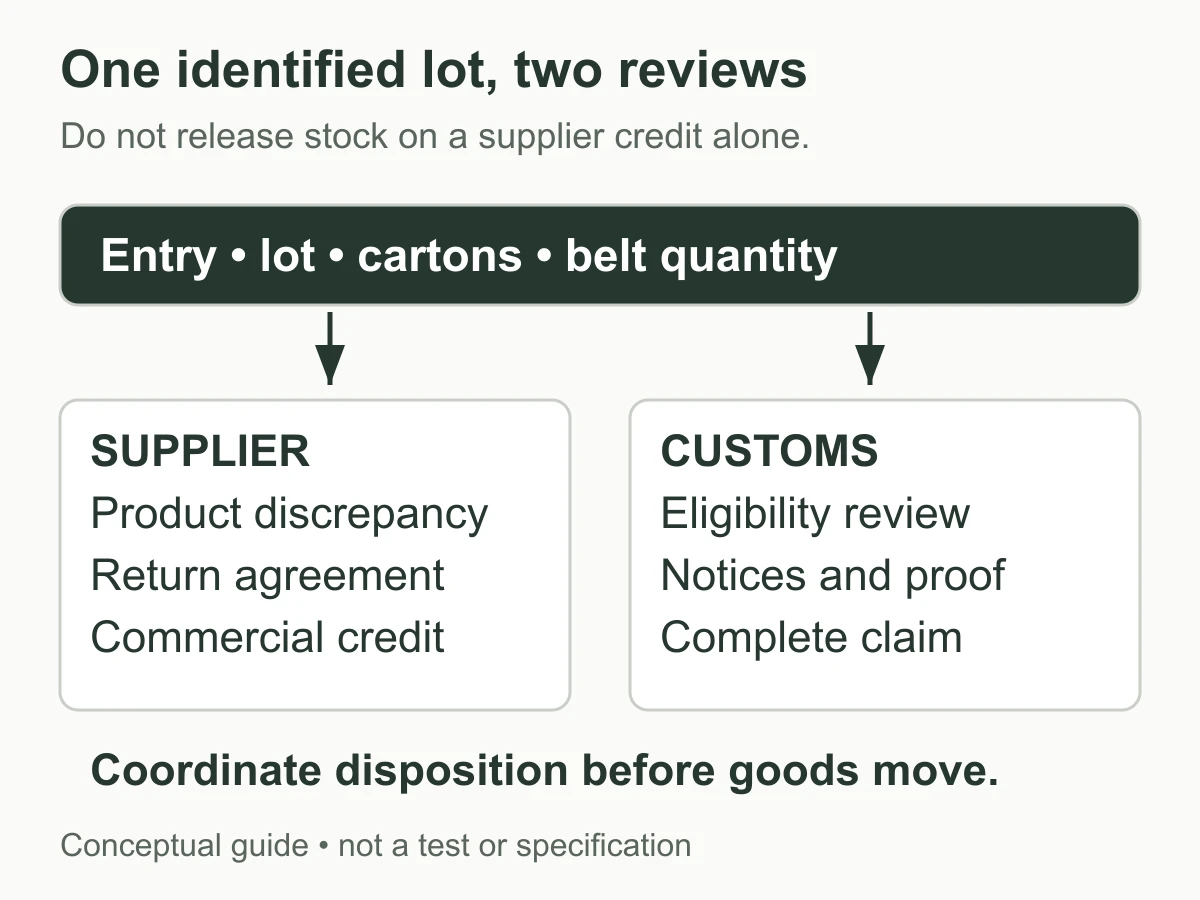
Give one named person control of disposition instructions. A return authorization should state whether it is merely commercial permission or whether the customs specialist has also cleared the required procedural steps. Keep the actual written advice and any CBP response; a warehouse note saying “broker informed” is not an adequate substitute.
Build the chain from entry line to rejected belt
Start with the entry number, entry line, import date, importer of record, product description, and quantity. Then connect these to the supplier invoice, purchase order, style, color, size, and carton or lot identifiers. A supplier’s style code alone may be insufficient when the same style appears in several entries. The goal is to follow the proposed claim quantity without silently switching shipments.
Belts create several opportunities for mistaken identity. The same black strap may be sold with two buckles; the same carton may hold several sizes; and a replacement delivery may reuse an earlier purchase order number. Preserve the original labels and record internal relabeling. If goods moved between warehouses, document the transfer rather than relying on the current location to imply their origin.
A practical evidence index can use four linked identifiers: entry line, supplier lot, warehouse location, and rejection record. Each document then has a defined job. The entry establishes the import transaction; the approved specification establishes the ordered requirement; inspection records describe the observed discrepancy; inventory movements explain where the quantity went.
If the proposed claimant is not the importer, flag that immediately. 19 CFR 190.42 includes additional statements for certain non-importer claims concerning other claims on the merchandise. Ownership changes are therefore not just an accounting detail. Ask the specialist which parties must provide records or statements before relying on a recoverable amount.
Describe the defect against an approved requirement
Replace “poor quality” with an observable comparison. For a width complaint, identify the agreed measurement location and the applicable specification revision. For a buckle-color mismatch, retain the approved physical reference and identify the finish actually delivered. For delamination, record the location, affected construction, inspection stage, and whether the finding appeared before or after wear, rework, or storage changes.
Photographs help when they show the same identified item, a useful scale where relevant, and the specific discrepancy. A close-up of one loose edge cannot establish the affected quantity across an entire shipment. Keep the inspection record describing what was examined, how pieces were selected, and which cartons remain unexamined. Do not relabel a sample observation as a complete inspection.
Also retain evidence that does not support the initial hypothesis. If some sizes match the approved sample, preserve that distinction. If only cartons stored in one location show a problem, record the pattern. A narrower, supportable account is more useful than an inflated rejection that becomes impossible to reconcile with warehouse records.
When the requirement itself changed after shipment, preserve both versions and their approval dates. A new merchandising preference is not the same as failure against the ordered specification. Suppliers can still discuss commercial remedies, but the customs reviewer needs the original sequence rather than a rewritten specification that makes the shipment appear nonconforming retrospectively.
Reconcile quantities before arranging the return
Consider an illustrative shipment of 1,000 belts, not an actual HongDing order. The importer identifies 300 belts for investigation, releases 650 for ordinary sale, and retains 50 for a separate assessment. Within the 300, the current plan is to return 240 and hold 60 while the supplier proposes rework. The planned return quantity is therefore 240, not the original 1,000 and not automatically the full 300 under investigation.
If the warehouse later packs only 238 for export, investigate the missing two before preparing the final records. Perhaps they were retained as samples, perhaps a carton count was wrong, or perhaps they moved to another location. Each explanation has a different documentary consequence. Do not adjust the inventory number simply to match a carrier document.
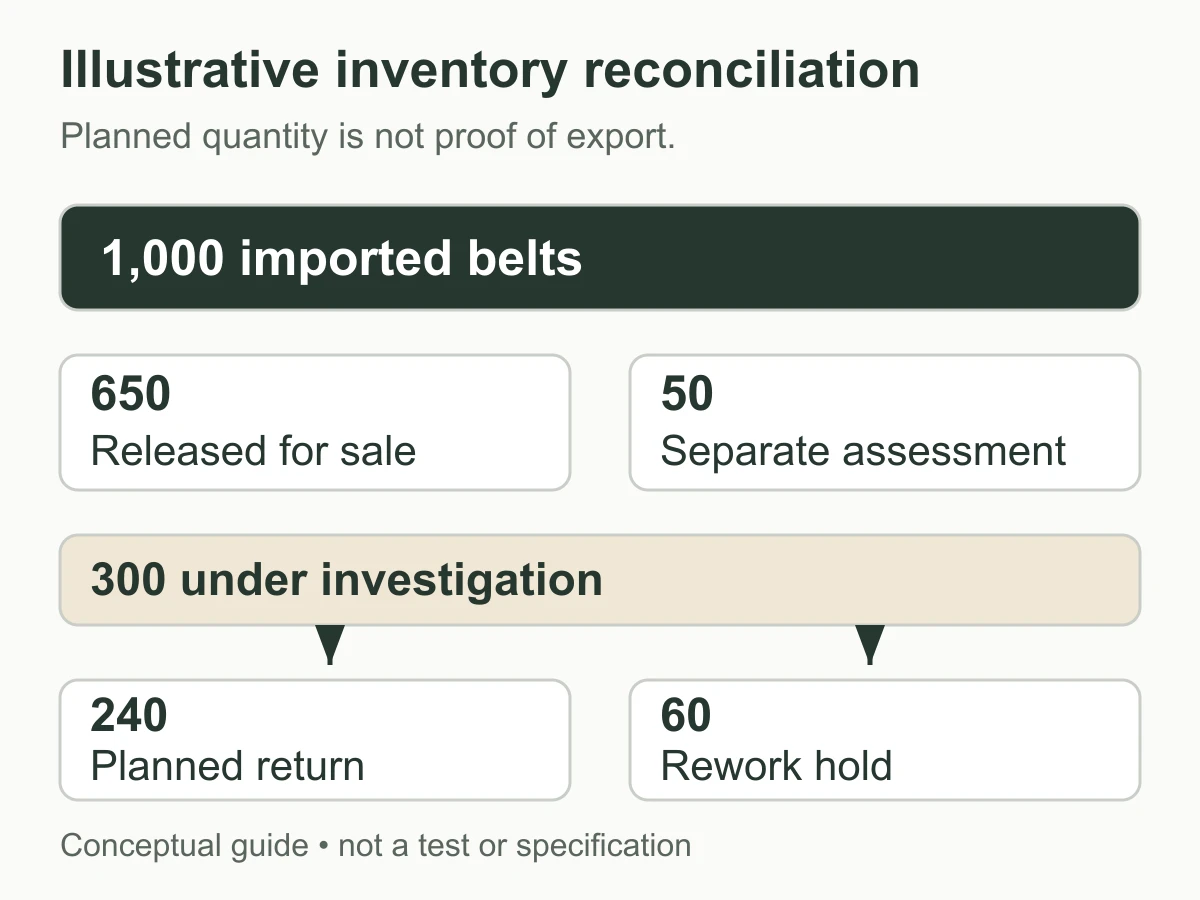
Keep the commercial and customs quantities visible in the reconciliation. A credit may cover packaging, a broader negotiated settlement, or a different unit basis. It should not be copied blindly into a claim worksheet. Similarly, a carrier’s carton count needs a documented connection to the belt quantities inside those cartons.
For mixed entries, split the proposed return by entry line and supporting identity. If that cannot be done reliably, do not invent a first-in-first-out allocation after the fact. Ask the specialist what evidence or permitted identification approach is required. Record unresolved quantities separately so they do not disappear inside a combined total.
Confirm the procedural route before disposition
The notice periods below concern different actions. They are not interchangeable “days before shipping” rules. Give the specialist the proposed physical sequence: current warehouse, intended return to CBP custody where applicable, export or destruction location, intended date, and any movement before that date.
| Proposed action | Rule to review | Operational implication |
|---|---|---|
| Rejected goods returned to CBP custody for export | Section 190.42(c): Form 7553 notice at least five working days before intended return to CBP custody | Confirm the correct port, examination arrangements, and any applicable approved waiver before movement. |
| Destruction under CBP supervision | Section 190.71: notice at least seven working days before intended destruction | Do not treat an ordinary disposal booking as authorization; confirm supervision and proof arrangements. |
| Complete drawback claim | Section 190.51 and 19 USC 1313(r): generally within five years of importation | Track the filing deadline independently from return negotiations and the disposition date. |
On a narrow screen, scroll the table horizontally to read every column.
For destruction, section 190.71 addresses CBP’s response and the supporting evidence needed if CBP does not attend. Have the specialist and disposal provider agree on the evidence before the event. A waste invoice saying “accessories disposed” may not connect the destroyed goods to the identified belts or establish the required facts.
An approved prior-notice waiver is a specific procedural authorization, not a blanket privilege obtained by hiring a broker. Check the actual approval and its scope under section 190.91. If the goods have already left or been destroyed, tell the specialist the true sequence immediately. Do not backdate notices, manufacture evidence, or assume a late procedural remedy will be available.
Prove the completed disposition and protect the filing clock
A return order is a plan; a booking is a transport arrangement. Neither alone proves that the identified goods were exported. Keep the export evidence, shipment identifiers, packing details, destination, and the link back to the reconciled merchandise. Section 190.72 sets out export-proof requirements. Let the specialist determine which available records establish the required facts for the particular movement.
For destruction, preserve the agreed records of the actual event, including the identified quantity and any required independent evidence. If material is recovered or sold, disclose that rather than describing the entire quantity as having no value. The treatment of recovered material is a customs calculation question, not something the warehouse should decide by deleting a salvage line.
The disposition limit and claim-filing limit must be checked separately. Under 19 USC 1313(c)(1)(D), qualifying export or destruction must occur within five years after importation or the applicable withdrawal. Under section 1313(r), the complete claim generally must be filed within five years after importation. Have the specialist calculate both dates, particularly where warehouse withdrawals are involved. Ask for both in writing instead of using “five years” as a single undifferentiated reminder.
A claim is not complete simply because someone started entering data. Section 190.51 addresses the entry and supporting material required for a complete claim. Obtain confirmation of what was accepted and what remains outstanding. Keep a responsibility list so a missing supplier document does not remain unnoticed until the deadline approaches.
Make the supplier’s contribution precise
A belt manufacturer can help identify the ordered construction, approved sample or specification, production lot, packing breakdown, and the technical issue being investigated. It can also document the commercial return agreement. It cannot decide US drawback eligibility or replace the importer’s entry records and customs representative.
At HongDing, a useful product-side discussion starts with the belt reference, the affected lot or cartons, the original approved requirement, and clear observations. If the product was developed from a reference sample rather than a formal tech pack, preserve that sample approval trail. Do not create a fictional complete specification after the dispute; explain which details were agreed and which were not.
Keep any proposed rework distinct from the rejected-condition record. Repairing a belt can change the evidence available for inspection, so coordinate before altering the identified stock. A replacement shipment should receive its own identity and documentation rather than being merged into the original disputed quantity.
Questions before a rejected belt shipment moves
Does a supplier credit make the belts eligible?
No. It records a commercial outcome. Eligibility, identification, disposition, notices, and filing requirements still need separate review against the applicable customs route.
Can we use the same file for retail returns?
Some source records may be useful, but retail-return provisions have their own conditions. Do not apply those provisions to an ordinary bulk rejection, or assume mixed consumer returns can be treated as one identified import lot.
Is the belt’s tariff classification enough to identify it?
No. Classification describes a customs category, not the complete identity of a shipment. Our Guide des codes SH pour ceintures en cuir addresses classification; this file also needs the entry, style, quantity, and movement connections.
Need help identifying the product-side discrepancy?
Contacter HongDing with the belt reference, approved sample or specification, affected quantity, and photographs of the observed issue. For US drawback eligibility and disposition instructions, involve your customs specialist before returning or destroying the goods.