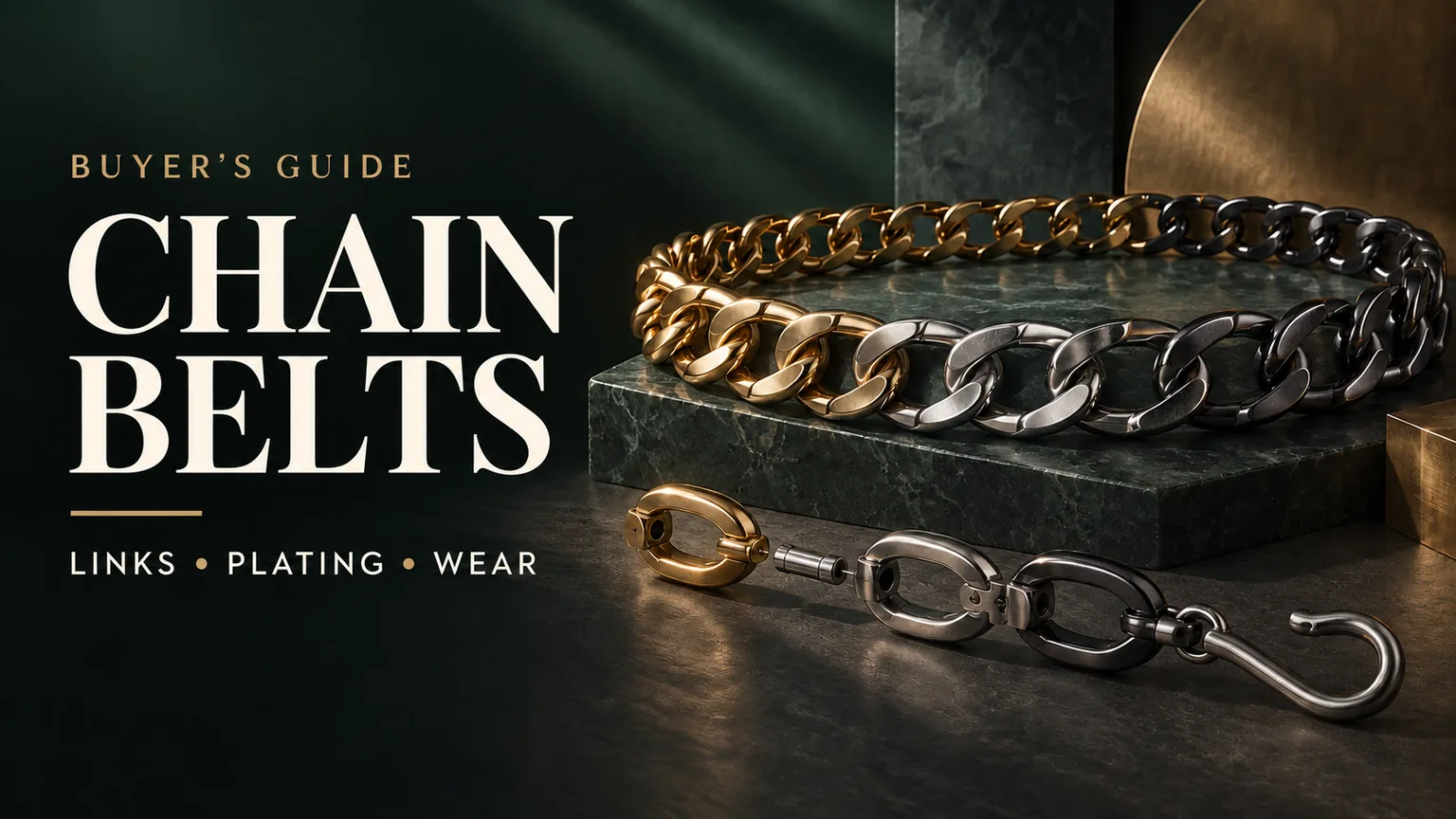
A chain belt should be specified as a moving assembly, not as “gold chain, as sample.” Buyers need a component map that identifies every link, connector, closure, extender and decorative part; a wearing-position and adjustment range; a part-by-part material and coating record; and acceptance checks for articulation, snagging, joint security, surface wear and packing contact. The approved reference is the complete belt on the intended garment or fit form.
Points clés
- Link style is only the visible layer of the specification. Joint type, orientation and connector placement decide whether the belt hangs cleanly or twists.
- Do not call a chain belt “one size” without stating the usable closure range, wearing position, extender geometry and tail behaviour.
- Approve coating by part and by wear zone. A colour name does not define substrate, preparation, coating stack, texture or durability evidence.
- Map skin and garment contact before selecting chemical or wear tests. Market scope and actual contact determine which evidence is relevant.
- Inspect the assembled belt after handling and pack-out. Loose joints, rough edges, tangling and metal-to-metal abrasion can be invisible in a flat component tray.
Define the Product Layout Before Naming the Finish
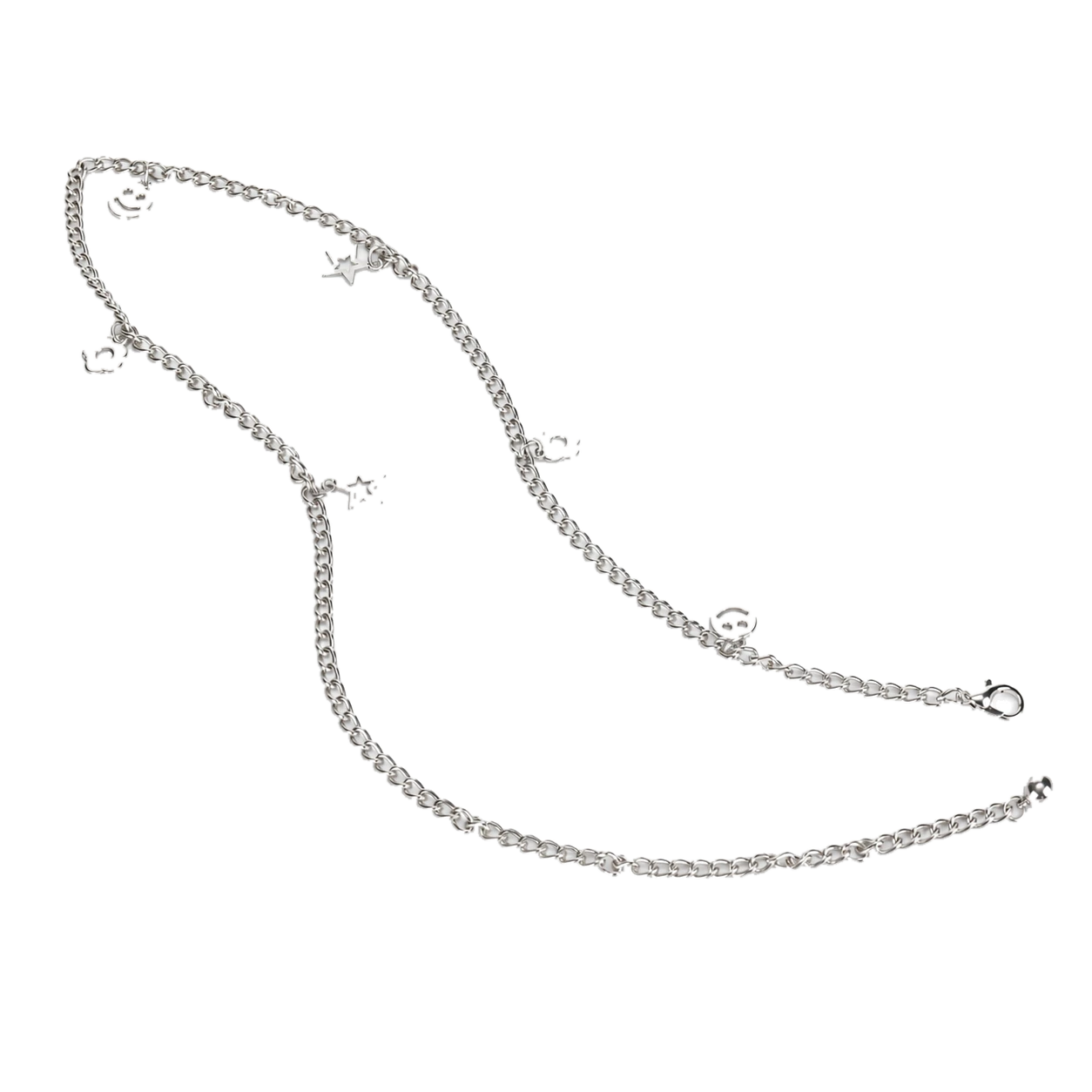
Begin with the silhouette and wearing position. A chain-only waist belt, a double-row hip belt, a charm chain, a medallion layout and a chain-and-leather style may share the same colour direction while behaving as different products. The drawing should show the body path, front and back orientation, drop lengths, closure side, extender, terminal part and any secondary strand. A front photograph alone hides the connection logic that production needs.
The buyer’s first decision is where the belt sits. A waist-level style follows a shorter body path and may need the decorative center to remain stable at the front. A low-hip style needs a different usable range and may rotate under the weight of a pendant or asymmetrical tail. Approve the layout on the garment category it will be sold with, because a chain that lies smoothly on a firm dress can enter an open knit, catch a looped yarn or sink into a soft waistband.
Utilisez le chain and metal belts collection to identify the visual family, then convert the selected direction into a dimensioned product map. Mark every repeating unit and every non-repeating junction. If two rows share one closure, show how their lengths are balanced when the belt is curved around the body. If a logo plate or charm creates a front center, give production a datum rather than asking operators to judge visual balance by eye.
| Layout | Main construction risk | What the drawing must show |
|---|---|---|
| Single-row chain | Twist or local link opening | Link sequence, orientation, joints and closure ends |
| Multi-strand | Rows crossing or pulling unevenly | Each row length, spacing and shared anchor geometry |
| Charm or medallion | Unbalanced drop and attachment fatigue | Attachment map, face direction and repeat position |
| Chain-and-leather | Hard part abrading or pulling the soft part | Connector, reinforcement, fold and contact surfaces |
| Logo plate | Plate rotates or sits off center | Datum, attachment points, face orientation and closure path |
Engineer Link Geometry, Articulation and Joints Together
A link name does not tell the factory enough. Record the visible length and width, section shape, surface profile, orientation and relationship to adjacent links. An oval link can be light and open or thick and compact. A curb-style link can lie flat only when the twist and assembly direction are consistent. A snake-style segment behaves more like a flexible tube than a sequence of open rings. These differences affect drape, local stiffness, finishing access and repairability.
Separate decorative links from joints. The decorative link controls rhythm and appearance; the jump ring, connector or joined link often controls the assembly. Open connectors must close to the approved gap and alignment. Soldered, welded or otherwise permanently joined parts need a defined route before coating, because heat or mechanical correction after finishing can mark the surface around the joint. The buyer does not need to prescribe a manufacturing process blindly, but the final BOM must identify which joints are intentionally openable and which are permanent.
Articulation is checked by moving the belt through the shapes it will experience, not by pulling it straight on a table. Curve it to the approved wearing circumference, allow the tail to hang, reverse the curve and pass the closure through its intended links. Look for a link that locks against its neighbour, a connector whose split turns toward fabric, or a decorative face that flips backward. Those are geometry problems; polishing them does not solve the mechanism.
The Chinese national standards record for GB/T 35777-2017 identifies a tensile-test method for metal-alloy adornment chains. It provides a relevant method route when the actual chain or representative specimen is within scope; the record does not establish a joint-specific method or one universal acceptance load for every finished fashion belt. The buyer and laboratory still have to confirm specimen eligibility, method, use case and project limit.
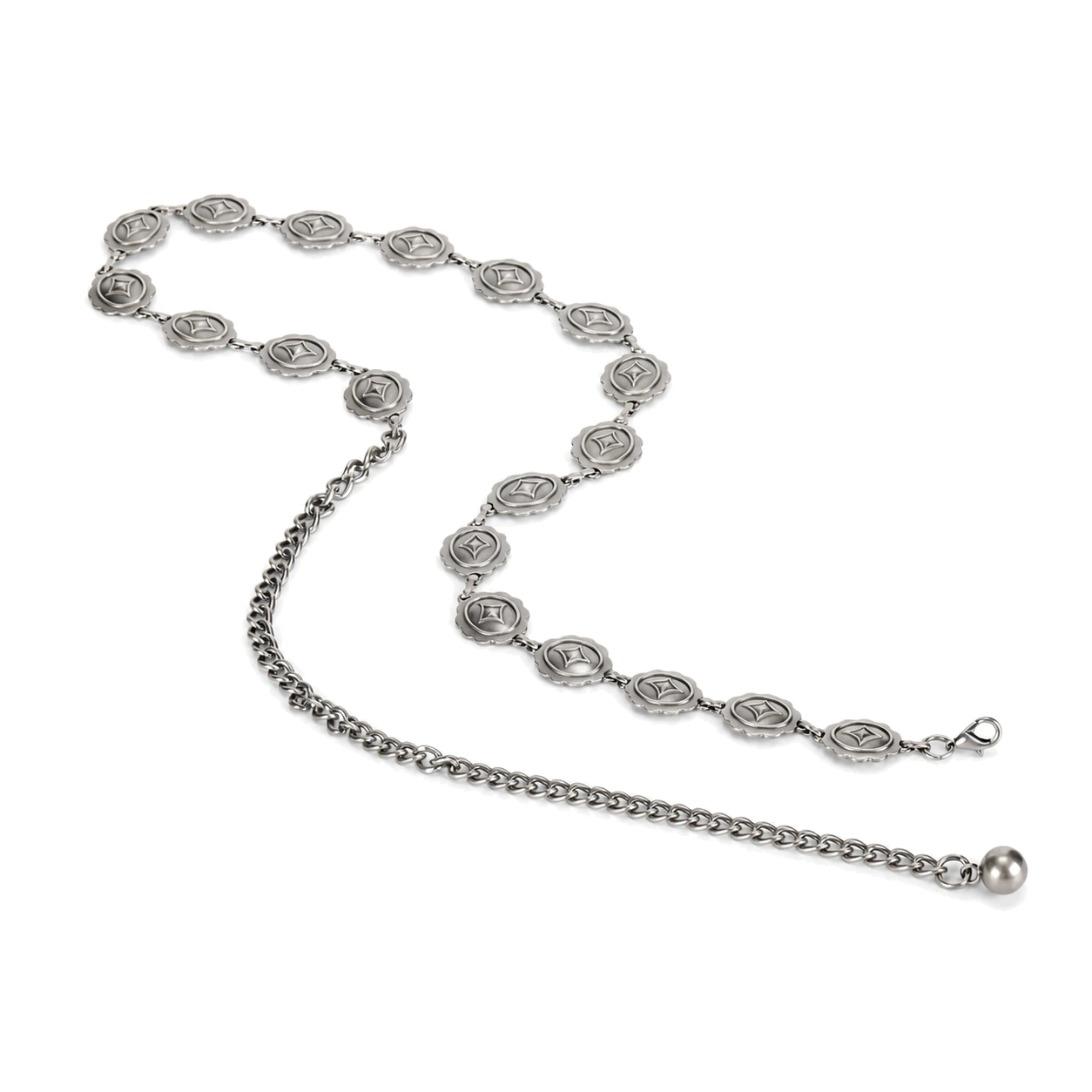
Control Weight, Drape and Garment Contact
Total mass matters, but distribution matters more to wearability. Two belts with equal mass can feel different when one spreads its links around the body and the other concentrates a plate, charm group or doubled rows at the front. Weigh the complete approved size with all closures and decorations, then review how that mass is supported at the intended wearing position. Do not infer comfort from an isolated chain sample.
For a multi-row style, set each row length on the body curve. Equal flat lengths can become unequal arcs when worn, causing the inner row to bow or the outer row to pull the anchors. Review the connection plate or shared ring under that curved load. The aim is not to make every strand taut; it is to preserve the approved separation and drape without one strand carrying the whole assembly.
Snag risk appears at more than sharp edges. A correctly rounded link can still enter loose knit structures, and a charm point can catch when it rotates. Use the target garment or a technically relevant fabric panel in the sample review. Move the belt through sitting, walking and removal motions, then inspect both the belt and textile. This is a comparative wearability check tied to the product use—not a claim that one informal trial proves every end-use condition.
Chain-and-leather constructions add a hard-to-soft interface. The connector may pull through a hole, crease a folded tab or rub the leather finish. Define reinforcement, hole or slot geometry, edge clearance and the face of every connector. The guide de construction de boucle de ceinture applies the same system principle: hardware is approved on the material it operates with, not as an attractive loose component.
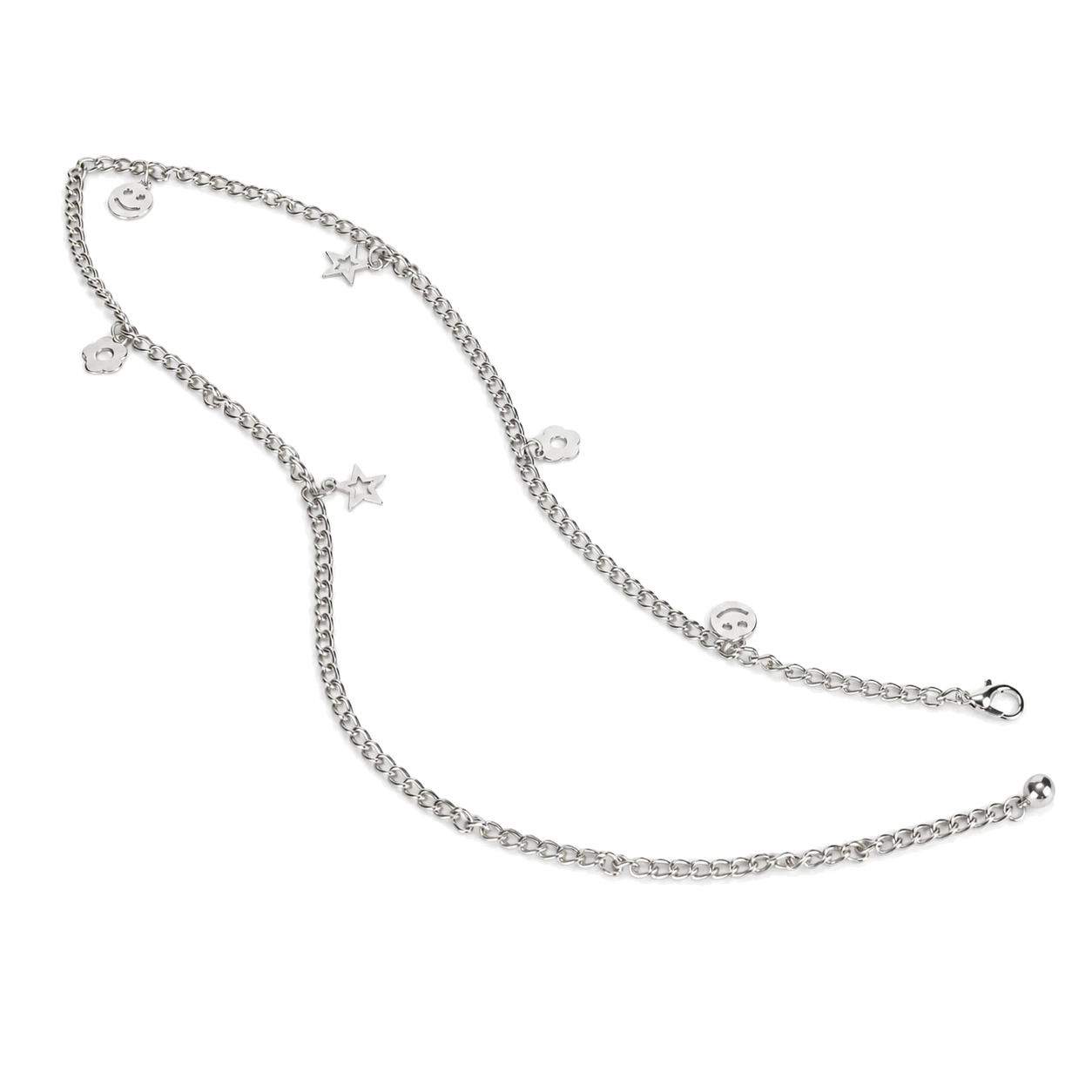
Specify the Closure and Usable Range
“Adjustable” is not a size specification. State the intended wearing position, minimum and maximum usable closure points, location of the decorative center at both limits, and how much tail remains. If the hook can close into any body link, confirm that the chosen link shape accepts it without forcing, permanent spreading or an awkward angle. If closure is limited to an extender, define the extender’s link sequence and terminal stop.
Clasp choice should follow the complete belt. A hook offers quick placement but needs a compatible receiving link and a shape that resists accidental release in the intended orientation. A lobster-style or spring closure adds a moving gate that must be accessible at the back or side and must close fully after finishing. A toggle depends on bar length, ring opening and the direction of pull. These are decision prompts, not a ranking: the best closure is the one that works with the approved link, mass, wearer action and price architecture.
Build the size review around usable range rather than nominal overall length. Overall length may include a decorative terminal that cannot serve as a closure point. Record the datum from the fixed end to each usable position, then verify the belt on a form or garment. Where the range crosses size labels, the buyer should decide whether one adjustable SKU is honest for the channel or whether separate lengths produce a better fit and front-center position.
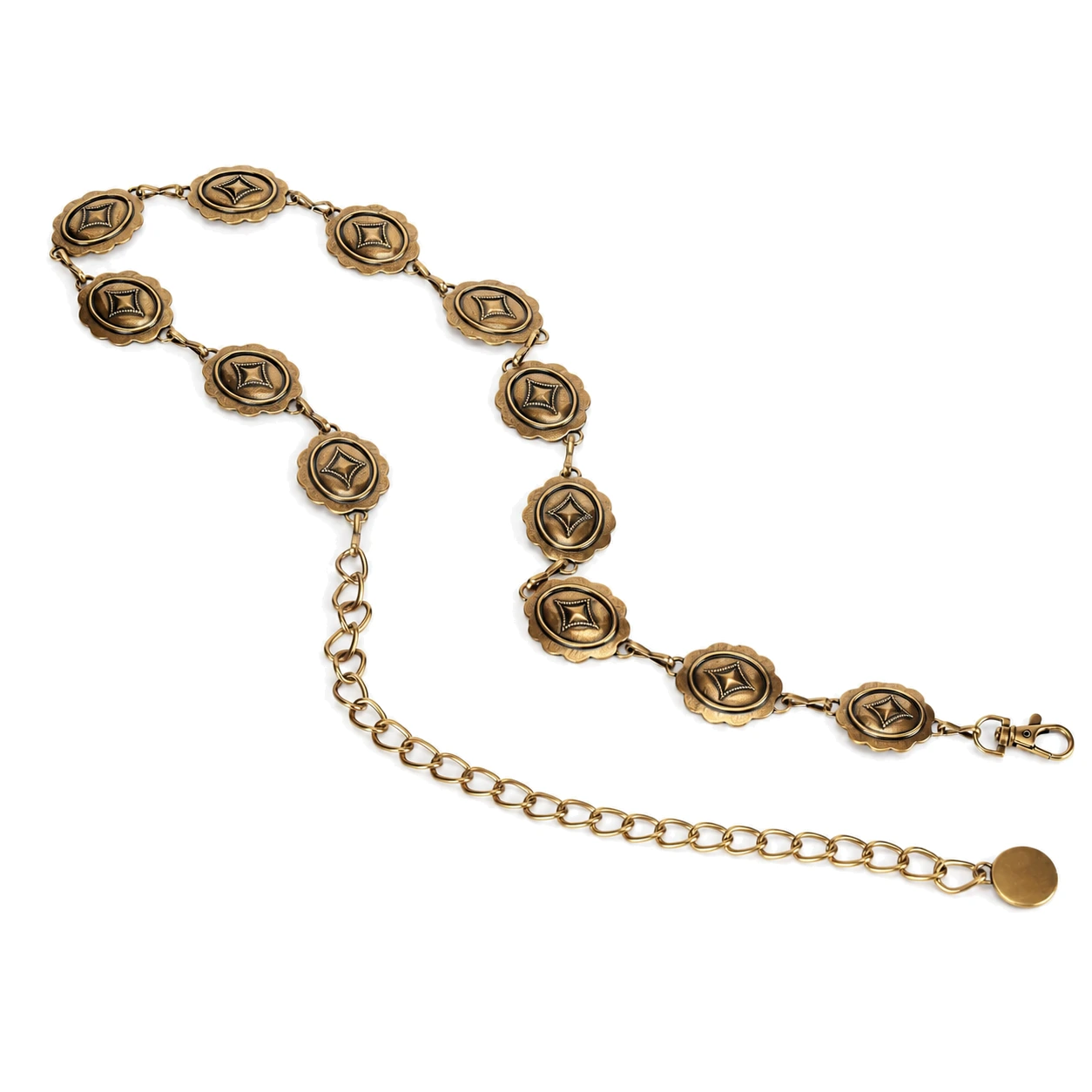
Control Plating as a Part-by-Part Surface System
A finish name such as gold, silver, gunmetal or antique is an appearance direction, not a coating specification. Identify the base material of each part, surface preparation, intermediate layers where applicable, colour layer or coating route, texture or antiquing operation, protective top finish where used, and the approved visual master. The chain body, closure, connector and logo part may come from different component routes; assuming one finish code produced one result is unsafe.
Review high-contact zones before choosing evidence. Link-to-link contact can polish raised edges while leaving recesses darker. A hook rubs the same receiving links repeatedly. A hanging medallion strikes adjacent links. A mixed-material belt can transfer metal marks to a light strap. These zones should drive the sample handling, abrasion or wear comparison and pack trial. Salt spray alone does not reproduce repeated link friction, and a rub test alone does not answer corrosion; the test plan must follow the actual failure mechanism.
Coating evidence must follow the stress being controlled: colour comparison, abrasion, corrosion, adhesion and chemical release are different questions. For declared gold or gold-alloy coatings within its scope, ISO 10713:2025 defines coating vocabulary and requirements including mass, thickness and fineness. That source still does not justify inventing a generic plating thickness for all chain belts.
Read the defect pattern before choosing a correction. Peeling, flaking or lifting means the coating separated at an interface, so the investigation should trace the substrate condition, cleaning and activation, contamination, underlayers, coating sequence and any post-treatment instead of simply adding more colour coat. ASTM B571-23 treats those separation signs as adhesion failure and requires the adhesion method to suit the coating and end use. Pores or discontinuities are a different route: they can expose the underlying layer or substrate to the contact environment. ISO 18332:2007 frames porosity testing around product and service application and warns that a porosity result alone does not establish corrosion performance. Polished raised faces with an intact interface point first toward contact wear, while bubbles, edge lift or exposed substrate call for adhesion, coating-stack and corrosion evidence. Ask for production-intent parts, before-and-after close views, the declared layer route and a suitable adhesion, wear, porosity or corrosion report; do not diagnose the root cause from one photograph.
Create a finish approval board from actual production-intent parts, not a screen image. Compare face, edge, recess, joint and moving surfaces under the agreed viewing condition. Record acceptable antiquing variation separately from peeling, exposed base material, blisters, sharp deposits or colour mismatch between components. The deeper test route is covered in the belt hardware plating test guide.
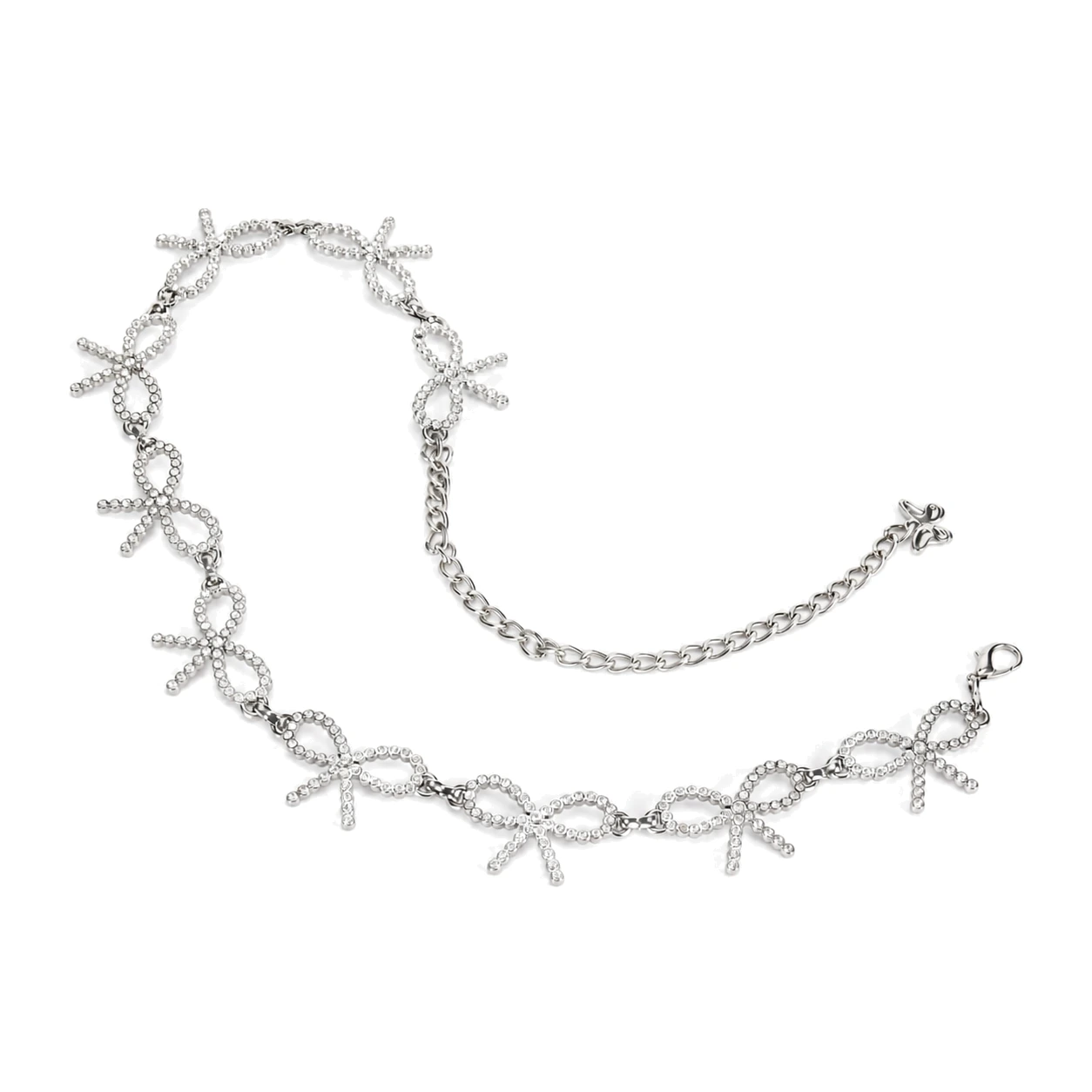
| Question | Evidence route | Ce que cela ne prouve pas |
|---|---|---|
| Does colour match? | Approved physical master and controlled visual comparison | Adhesion, wear life or chemical compliance |
| Does the surface survive link contact? | Defined movement or abrasion comparison at real contact zones | Corrosion performance in another environment |
| Is the coating stack as specified? | Supplier record and applicable thickness or composition method | Finished-belt comfort or snag resistance |
| Will coated contact parts meet nickel rules? | Market-specific release test after applicable wear simulation | All chemicals, all markets or non-contact parts |
| Will the pack preserve the finish? | Approved packed-sample handling and transport trial | Unrelated wearer abrasion |
Map Skin and Garment Contact Before Compliance Claims
Compliance starts with the target market and a contact map. Mark parts that can touch skin at the intended waist or hip position, parts normally separated by clothing, and parts that can move between those states. A low-slung chain worn over a dress presents a different contact pattern from a waist chain marketed for direct skin wear. The product description, styling images and foreseeable use should agree with the evidence scope.
For the European Union, REACH Annex XVII entry 27 in the 22 June 2026 consolidated text restricts nickel release from parts of articles intended for direct and prolonged skin contact. The legal text sets a limit of 0.5 micrograms per square centimetre per week for those parts. Where a non-nickel coating is relied upon, the coating must keep release within that limit for at least two years of normal use. This is a release requirement tied to contact and durability, not a blanket statement that “nickel-free plating” solves every part.
The European Commission’s Communication C/2023/1604 identifies EN 1811:2023 as the reference method for nickel release and EN 12472:2020 as the accelerated wear and corrosion method for coated items; it also records that EN 1811:2023 replaced EN 1811:2011+A1:2015. A useful laboratory brief therefore identifies the finished parts, coating condition, contact rationale, applicable method and report language. It does not send an unlabelled loose link and extrapolate the result to every component.
Other chemical, labelling or children’s-product requirements depend on market, age grade, materials and claims. Put those obligations in the compliance matrix for the actual program. This guide should not be used as a universal legal list. The defensible buying habit is to connect each requirement to its market, scope, specimen and current source.
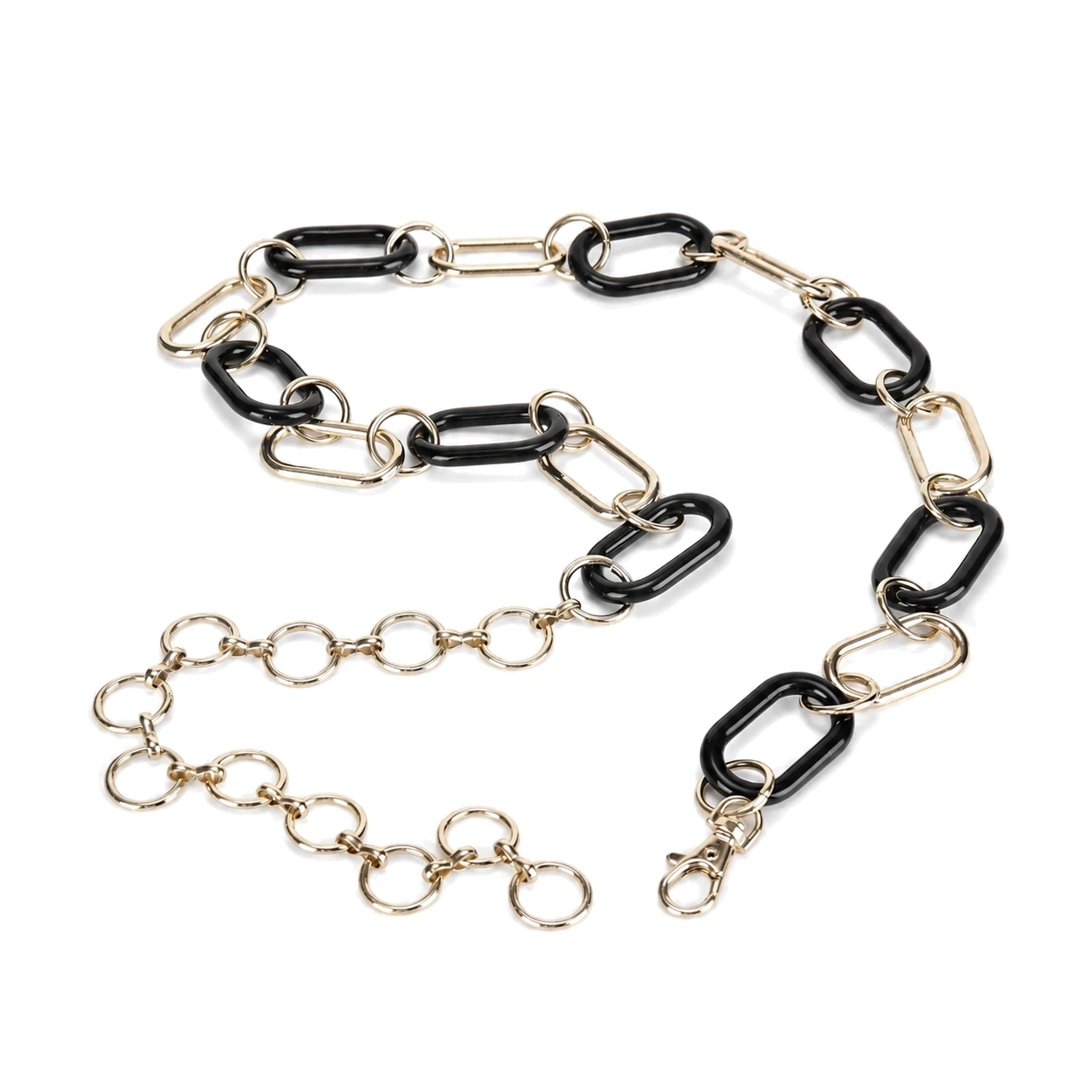
Inspect the Finished Belt, Not Only the Component Tray
Incoming component checks catch the wrong link, part count, gross finish mismatch and obvious damage. Finished-product checks reveal a different class of defect: reversed links, crossed strands, mispositioned charms, closure misalignment, an extender installed on the wrong side, local stiffness, or a connector opening toward the garment. The inspection plan needs both layers.
Start with identity. Compare the style, colourway, size or usable range, BOM revision and approved sample. Lay the belt in its defined presentation shape, then operate every closure and articulate the full length by hand. Check link orientation and connector closure from both faces. Apply the project-specified pull or tensile method to the defined critical joints; do not substitute an improvised force or an undisclosed sample count.
Continue with surface and contact zones. Compare colour and texture by part, inspect raised edges and recesses, then look specifically at hook receiving links, charm rings, row anchors and metal-to-leather interfaces. A slight mark hidden inside one link may be acceptable under the agreed limit; a similar exposed mark on a front medallion may fail the visual standard. Defect classification belongs in the inspection file, not in an inspector’s memory.
Finish with fit and pack-out. Close the belt at the minimum, middle and maximum approved positions, check center placement and tail behaviour, and confirm that the closure remains operable. Pack it according to the retail specification, unpack it and inspect for tangling, pressure marks and metal-to-metal rubbing. The private-label belt packaging guide explains how labels, barcode identity and protection belong to the same release decision.
| Gate | Check | Preuve de libération |
|---|---|---|
| Identité | Style, colourway, component map and revision | PO, BOM, drawing and approved sample agree |
| Assembly | Link direction, joints, charms, rows and terminals | No wrong orientation, unsafe gap or missing part |
| Fonction | Closure, extender, articulation and usable range | Defined positions operate on the intended body path |
| Surface | Colour, texture and high-contact wear zones | Within the approved master and defect limits |
| Product integrity | Critical joints under the named method | Specimen and result meet the project criterion |
| Pack-out | Tangle control, separators, labels and protection | Approved packed reference remains undamaged |
Use the site’s belt quality-control route to connect these checks to the approved reference and order documents. A clean inspection report should make the specimen, method, acceptance limit, result and disposition visible to a buyer who was not present in the sample room.
Freeze the RFQ, Sample and Bulk-Release Record
A quotation request should distinguish fixed requirements from development choices. Send the intended layout and wearing position, component drawing or marked reference, target range, colour direction, market, contact map, logo or charm artwork, packaging concept and required evidence. Ask the supplier to return a part-by-part proposal rather than one line reading “metal chain belt.” Material, finishing, tooling and order economics can then be discussed against the same product.
At sample stage, approve the exact component map, dimensions, usable closure range, total mass, drape, joint construction, surface master, contact zones, branding and pack-out. Record every provisional part. A sample made with a substitute clasp or unapproved chain cannot quietly become the golden reference because the silhouette looks right. The liste de contrôle de l’échantillon de pré-production shows how to link the physical belt to its BOM, artwork, testing and release authority.
HongDing’s business roots date to 2004, and the current company identity formed in 2010. That history is relevant only when it becomes useful project discipline: starting from a tech pack, reference or concept; coordinating hardware, material, sample revisions, branding and packaging; and transferring the approved construction into production controls. It is not a substitute for a complete buyer brief or current order confirmation.
The release package should contain the approved belt and colour master, current component map and BOM, dimension and range sheet, surface specification, test matrix and reports, inspection limits, artwork, packaging file and closed comment log. Reopen the affected approval whenever a link, closure, substrate, coating, artwork or pack changes. A small component change can move the contact map, weight distribution and wear zone at the same time.
Questions fréquentes
Is brass always better than zinc alloy for chain-belt parts?
No universal ranking is safe. Base material affects forming route, mass, cost, surface preparation and coating options, while geometry and joint design still control the finished part. Specify the material by part and approve the resulting component and belt.
Should an uncoated part marked “no skin contact” stay in the compliance matrix?
Yes. Record the part, intended location and contact rationale rather than deleting it. If the part can swing, rotate, migrate through an open garment or become a closure point, reassess foreseeable contact and include it in the relevant evidence scope.
How should a hook that closes into body links be specified?
Identify the permitted receiving zone, hook section and opening, link opening and orientation, engagement angle, usable positions and the allowed condition after repeated operation. Inspect both the hook and receiving links for spreading, edge marking and incomplete engagement.
What change reopens approval of a multi-strand anchor?
Review any change to strand count, row length, chain mass, link geometry, connector, anchor plate, permanent-joint route or coating stack. Recheck curved fit, load sharing, articulation and garment contact because one revised strand can move stress into the shared anchor.
What if the bulk chain uses a different finishing batch from the approved sample?
Keep the sample as the appearance baseline, then link the bulk finishing batch to its part identities and required evidence. Review representative first-off assemblies for component-to-component colour, adhesion or wear concerns and contact-path changes before treating the sample’s result as transferable.
Turn a Chain-Belt Concept Into a Reviewable Specification
Send the product reference or drawing, intended wearing position, target range, finish direction, market and packaging concept. HongDing can help map the links, joints, closure, coating and approval sequence before the program moves into a production-intent sample.
Source boundary: cited standards and regulations define their own scopes. Project acceptance limits, laboratory methods and market obligations must be confirmed for the actual product and order.