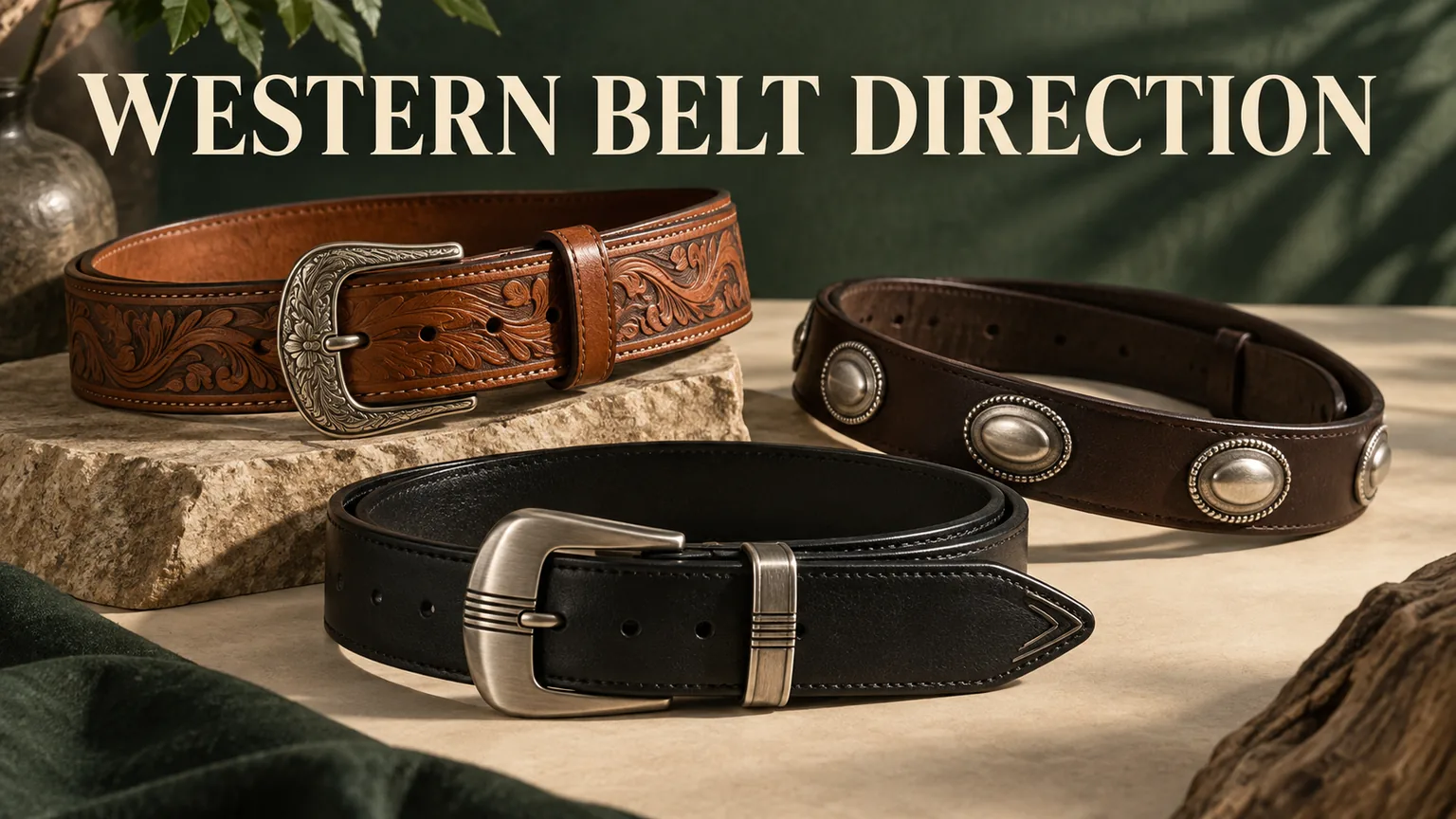
A useful Western belt direction for a 2026 collection starts by choosing a clear design signal—tactile tooling, repeated conchos, or a distinctive buckle-and-tip set—instead of stacking every motif on one strap. A current public assortment shows these options at different levels of decoration; it does not prove market-wide growth. For a brand, the practical question is which signal fits its customer and channel, and whether the leather, artwork and hardware can be sampled and repeated without losing the intended proportion.
Points clés
- Treat visible product assortments as design signals, not proof of sell-through or a universal forecast.
- Choose one lead feature—tooling, conchos or buckle—then let the other components support it.
- Set decoration rhythm around the buckle, keeper, holes and size range before cutting tools or ordering hardware.
- Design rights, fixing method and finished-belt comfort belong in the sample brief, not as afterthoughts.
What a current Western assortment can—and cannot—tell a buyer
As checked in September 2026, Stetson’s belt range includes tooled tabs, concho treatments, laced edges, tapered forms and plainer Western options. An individual tooled concho belt combines surface pattern, slider ornaments and a plaque buckle. That evidence has a specific use and limit:
- What is visible: several Western design languages are offered in one current public assortment, including combined and quieter treatments.
- What is not measured: the cited pages do not establish sell-through, category growth, market share or which SKU another brand will sell.
- What a brand can test: select a cue and compare its proportion, material and hardware behavior in an original sample for the intended channel.
This is a dated design observation, not a proprietary trend index. The assortment can inspire a design question; it cannot answer the commercial forecast for another label.
The useful distinction is between Western identity et decoration intensity. A belt can signal the category through a buckle silhouette and shaped tip with little surface ornament. Another can put tooling across the full strap. A third can use spaced conchos as the dominant line. Brands that treat all three as a single look often end up with an incoherent range: every SKU has a different width, metal tone, leather finish and price logic, so there is no recognizable collection grammar.
Start with the intended wearer, outfit context and shelf or online image scale. A narrow strap with restrained metal may work as an easy accessory in a fashion assortment. A robust jeans belt can support a stronger buckle and deeper surface treatment. A decorative waist belt needs different fit and wear tests from a trouser belt. These are design choices, not universal rules about gender or price. The purpose of the trend brief is to turn a visible motif into a product architecture that a team can evaluate.
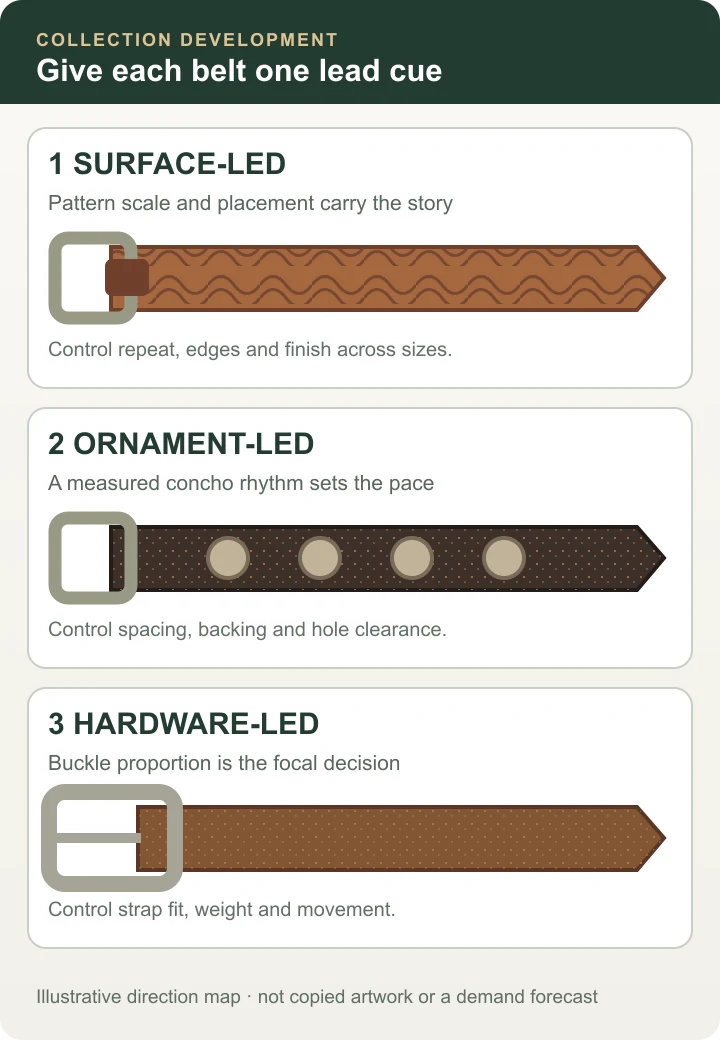
Three directions worth testing as distinct product stories
1. Texture-led: tooled leather as the hero
Use the surface pattern to provide identity while keeping buckle and keeper comparatively quiet. The tooling may be a continuous repeat, a framed center field or focused detail at the tip. The design decision is not merely which stamp looks attractive on a swatch. Repeat scale has to read across the actual strap width and in the cropped mobile product image; the last motif should resolve cleanly near the fold and tip. An overly large repeat can break awkwardly across small sizes, while very fine detail may disappear under a finish or in e-commerce photography.
Choose whether the desired look comes from genuine hand tooling, machine embossing, a pressed effect or another approved route. These methods differ in depth, consistency, cost structure and the feel of the leather. Do not call a machine-embossed pattern hand tooled. If the brand’s value proposition relies on an artisanal claim, the method and rights must be supportable. HongDing’s documented material and embossing scope can help translate a visual direction into sample options; a specific pattern, finish or process is not assumed feasible until assessed.
2. Ornament-led: conchos establish the rhythm
Conchos can act like punctuation along a strap: one statement piece, a paired arrangement, or a repeat. Their spacing changes when the strap is worn. A layout that looks even when laid flat may crowd at the buckle, disappear under a keeper or land on a hole. For a belt sold in several sizes, decide whether ornaments keep a fixed distance from the buckle, from the tip, or from the wearer’s front center. Each choice produces a different visual rhythm across sizes.
Concho design can also be culturally specific. A brand should use original or properly licensed artwork and describe inspiration accurately, especially where motifs relate to identifiable Indigenous or regional traditions. “Western” is not a blanket license to copy a recognizable artisan design. Keep the rights file connected to the artwork and tooling file; a supplier’s ability to reproduce a shape is separate from permission to use it.
3. Hardware-led: buckle and tip do the work
A shaped buckle, coordinated tip and keeper can carry Western character without covering the leather in decoration. This can be a useful bridge for a brand whose core range is clean and whose customer wants an accessory that works with both denim and simpler outfits. The challenge is proportion: an oversized buckle on a very soft or narrow strap can rotate or feel front-heavy; a heavy tip can change how the tail hangs. A photo mock-up cannot settle these interface questions. The finished sample must be worn and operated at the intended size.
| Lead cue | Control first | Watch in the sample |
|---|---|---|
| Tooled surface | Pattern scale, repeat, placement and finish reference | Motif visibility, edge interruptions and color consistency |
| Concho rhythm | Count, fixing route and datum across the size run | Movement, snagging, hardware backs and overlap with holes |
| Statement buckle | Strap width/thickness, buckle opening and weight balance | Rotation, fastening, wear comfort and keeper fit |
Tooled appearance starts with leather and pattern engineering
A pattern that appears crisp on one leather article may look shallow, uneven or overly glossy on another. Leather temper, surface finish and thickness affect how a design receives and retains relief. A sample should use the intended material route, or be explicitly marked as a visual trial. If a brand approves a tooling proof on a substitute leather, it should not treat the color, depth and wear appearance as settled for the final article.
Map the pattern on a full-size strap. Show its relationship to cut edge, stitching, holes, fold and buckle attachment. Some designs need a plain zone where holes are punched or where the leather bends. A line of deep relief crossing the same place on every size can become a structural or visual conflict. Whether that conflict matters depends on the pattern depth, leather and construction; an actual sample and wear review are more useful than a generalized rule that tooling must avoid all bends.
Finish selection changes the signal. A high-contrast antiqued effect can make relief conspicuous; a near-tone finish can produce a quieter, more premium surface. But antique effects need a controlled reference for color and variation. “Vintage brown” without an approved swatch or sample can conceal a wide interpretation range. A brand should ask what variation is intentional and what would be rejected, especially across a multi-SKU collection. The material article and finish route belong in the BOM, not only the creative mood board.
Engineer conchos as mounted components, not flat graphics
For each concho, specify visible diameter or shape, base material, finish, edge profile, fixing method and where the back sits against the wearer or garment. A screw-back, rivet or other attachment can alter the inside surface and the belt’s flex. A pretty front view may conceal a rough back, a protruding fastener or a rotation problem. The sampling question is whether the selected ornament remains secure and comfortable through normal fastening, bending and contact.
Placement must be checked on a worn sample in the actual size system. Conchos near the buckle can be hidden by the keeper; those near holes can complicate punching or adjustment. A large ornament at the belt’s side may rub against a chair arm, bag or garment. These interactions do not imply that conchos are unsuitable—only that the design needs a specific wear context. A decorative fashion belt and a hard-working jeans belt may make different choices.
If custom tooling is required, separate the creative artwork, production drawing, mold or die, sample and approved finished part. Who owns each asset, who may reuse it and what happens if the program stops belong in the commercial agreement. HongDing’s company materials describe buckle CAD, prototyping and hardware coordination as relevant capabilities; that supports a conversation about an integrated belt, not a promise to supply standalone buckle tooling on any terms. The brand should retain a revisioned approval of the actual component that goes into the belt.
Match buckle geometry and finish to the complete belt
“Silver” and “antique brass” are visual shorthand, not complete hardware specifications. A workable hardware brief records the base and finish route, shape, width of the strap passage, prong or fastening action, attachment and approved appearance reference. If metal ornaments and buckle share a palette, compare them under the same lighting and with the selected leather. A near match can appear more jarring than an intentionally mixed-metal treatment.
Pay attention to how the belt moves. The buckle must accept the finished strap thickness, not a leather swatch alone. The keeper needs clearance for the finished tip and its decoration. The tail should lie in a deliberate position when worn. A large buckle may change the apparent center of the design, so ornament spacing measured only from the tip can shift the visual balance. A sample should be fastened at more than one relevant hole or size position, particularly if the range spans varied bodies.
Surface appearance also has a durability question. A plating or coating sample can match the color target but not the project’s wear expectations. If the product promise calls for resistance to rubbing, sweat or corrosion, agree an appropriate test and acceptance criteria with the hardware route. Do not state that a named finish automatically passes a test. The buckle finish testing guide provides a separate path for defining evidence; this trend brief is about selecting the visual and functional direction first.
Build a compact collection, then test the interfaces
An illustrative first assortment could give each style a different job:
- Quieter entry style: use buckle shape or a small tooled detail to connect with the brand’s existing range.
- Texture-led core style: let the surface pattern carry the identity while keeping metal and color relationships controlled.
- Decorated statement style: use conchos or stronger hardware where the customer and wear context can support them.
These are roles to test, not a recommended SKU count or sales mix. A narrow channel may need fewer styles; a retailer with established demand may need more variants. The principle is a shared design language across strap widths, leather color families, hardware tone and packaging rather than unrelated motifs grouped under one keyword.
Before requesting prices, decide which parts can be shared across styles and which need distinct tools or materials. A common buckle can simplify the range but may weaken the statement style. One leather article across all SKUs can support consistency yet may not accept the tooling depth or fold construction each requires. Treat those as design and cost tradeoffs, not assumptions that shared components are always cheaper or better. Separate initial tooling, component minimums and replenishment implications in the quotation once the range is defined.
For the first sample, review more than a front photo. Check the worn silhouette, fastening, buckle rotation, keeper passage, ornament backs, tip behavior, pattern placement and the intended retail photograph. Record any change against the current artwork, BOM and drawing. If a concho moves or the strap curls, changing only a decorative drawing will not solve a construction issue. A revised component or fixing route must be evaluated on the complete belt.
At the move to bulk, compare approved material, hardware and artwork identities with the incoming items; check a first assembled belt for spacing, finish and function; observe the relevant operations during production; and compare finished sizes and packaging with the release reference. When a deviation appears, identify affected work, correct or agree an exception, recheck and record who authorizes release. This is a model for repeatability, not a claim that every Western program uses identical inspection points. HongDing’s belt development and manufacturing scope supports coordinating material, hardware and samples, with the exact acceptance plan set for the project.
A brand can begin this process with inspiration photographs, a target wearer and one unanswered question about proportion or ornament. It does not need a completed technical file to have a useful conversation. It does need permission to use the selected artwork and a willingness to review the physical product rather than approving the trend mood board as if it were a belt.
Common questions
Are concho belts the only current Western direction?
No. The cited assortment also shows tooled leather, shaped tabs, laced edges and quieter buckle-led designs. The choice should reflect the customer’s wardrobe and the brand’s existing range; a public catalog does not prove a universal bestseller.
Can a Western pattern from a reference image be copied?
A reference can communicate a direction, but it does not establish usage rights. Use original or properly licensed artwork and agree the ownership and permitted reuse of tools and files before production.
What should a first Western belt sample prove?
It should answer the specific open questions in the brief—usually proportion, material/finish, buckle and keeper function, decoration placement and wear comfort. It need not claim that every later size, color or test is already approved.
Turn a Western reference into your own belt brief
Share the target customer or channel, a few authorized reference images and which cue—tooling, conchos or buckle—you want to lead. HongDing can discuss material and hardware directions and the questions an original sample should resolve; artwork rights and commercial terms are agreed for the actual project.