The right leather thickness for a belt is the thickness that lets the approved construction work: it must sit correctly in the buckle, bend at the fold, hold its edge and support the intended appearance and use. A hide’s “oz” label is only a starting measurement of leather substance. A single-layer strap, a lined dress belt and a padded fashion belt can start with different component thicknesses yet reach a similar finished profile. Specify where and how thickness is measured, then approve the complete belt rather than ordering by one generic number.
Points clés
- Distinguish hide or cut-strap substance from finished-belt thickness at the body, fold, holes, tip and padded areas.
- Use leather ounces as a conversion shorthand, not as evidence of finished weight, strength or a universal target for every belt.
- Choose a build around buckle clearance, bending, edge design, stitch or bonding plan and desired hand feel.
- Agree measurement locations, method, approved reference and tolerance only after a representative sample works.
First ask: thickness of which leather, at which point?
Leather suppliers commonly express substance in ounces. In this usage, one ounce corresponds approximately to one sixty-fourth of an inch, or about 0.4 mm; it is a thickness convention, not the mass of one finished belt. Both Tandy Leather et Weaver Leather Supply publish conversion guidance. A quoted range describes the stock being offered or sorted; it does not guarantee every point across a hide or every finished strap is identical.
A belt drawing can contain several legitimate thickness values. The supplier may specify leather before splitting. The cutting team may check the cut strap. The assembly team may thin a fold or end tab. The brand may measure the finished body, including lining, adhesive, padding, coating or edge build. Two records can disagree without either being false if they refer to different layers or locations. Label the state and location whenever a number is written down.
Likewise, thickness is not a shortcut for leather quality. Grain structure, tannage, fiber condition, finishing and cut position affect how a strap bends and holds shape. A thicker material can be too stiff for a small buckle, while a thinner but well-designed composite can perform appropriately for a dress application. Conversely, a soft hand feel does not prove a construction will retain its profile over use. Thickness should be judged alongside the material article and the finished design.
ISO 2589:2016 specifies a method for determining leather thickness on whole leathers and test samples. Its scope helps anchor a leather-substance measurement, but it does not by itself define how to measure a laminated, padded or edge-coated finished belt, nor does it supply a universal design target. The buyer’s specification must name the relevant product points and method for that build.
Choose a construction before choosing a final number
A single-layer belt exposes the leather’s own body and edge. It can suit a straightforward, robust-looking strap when the material, buckle and edge treatment support that direction. It does not mean “unprocessed”: the fold may still be skived, the edges may be beveled or finished, and the tip may be shaped. The visible face and reverse need deliberate treatment because there is no lining to hide the back.
A lined belt combines face and lining layers, and perhaps adhesive, edge treatment and stitching. The finished total is not necessarily the simple arithmetic sum of the original stock labels: layers may be split or skived, compressed during bonding, or built differently near the fold and edge. The lining can change hand feel, appearance and stability, while the bond or stitch route introduces new interfaces. The buyer should specify the face and lining materials separately and inspect a cut section or approved sample where the profile matters.
A padded or raised-center belt adds volume for a deliberate silhouette. The center may look thick while the buckle end must taper to fit the hardware. A uniform “finished thickness” for the whole belt would conceal that transition. If a heavily padded body abruptly meets a thin tip, the change can look accidental or concentrate bending at the step. A good drawing or physical master shows where the rise begins and ends, plus edge, stitch and buckle-fold treatment.
The table below is a decision aid, not a catalog of prescribed millimeters. It identifies where an otherwise plausible thickness selection can fail after assembly.
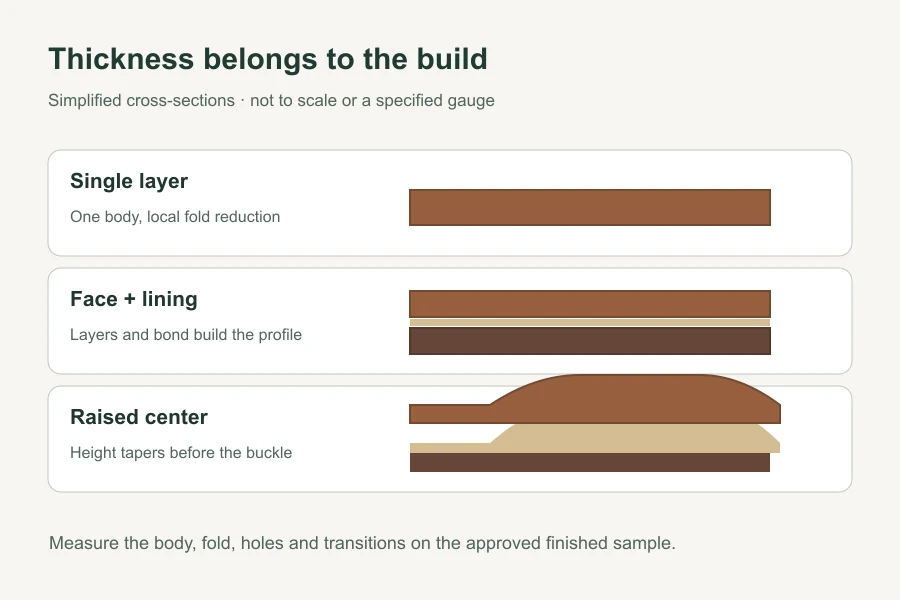
| Construction | What thickness must explain | Sample risk to inspect |
|---|---|---|
| Single-layer | Leather substance and finished body profile, plus local fold reduction | Too much stiffness or a fold that will not seat in the buckle. |
| Face and lining | Each layer, bonding or stitching, total body and tapered ends | Bulky edges, delamination or a visible step near the fold. |
| Padded or raised | Center height, shoulder transition, edge and buckle-end profile | A pleasing face that cannot thread through loops or hardware. |
| Réversible | Both face layers, central build, rotating hardware and tip | Thickness suits one face but prevents smooth reversal or closure. |
Do not select thickness solely by the intended dress code. “Formal” and “casual” each cover several silhouettes and buckle architectures. An understated narrow belt may need a different profile from a wide statement belt, even if both are sold as fashion accessories. A workwear-inspired belt may be designed for a firm hand but still needs a clearly bounded apparel use. If the product carries a load-bearing or protective claim, the project requires its own engineering and applicable compliance program; ordinary belt substance alone cannot establish safety performance.
Check the fold, holes, edge and garment before approval
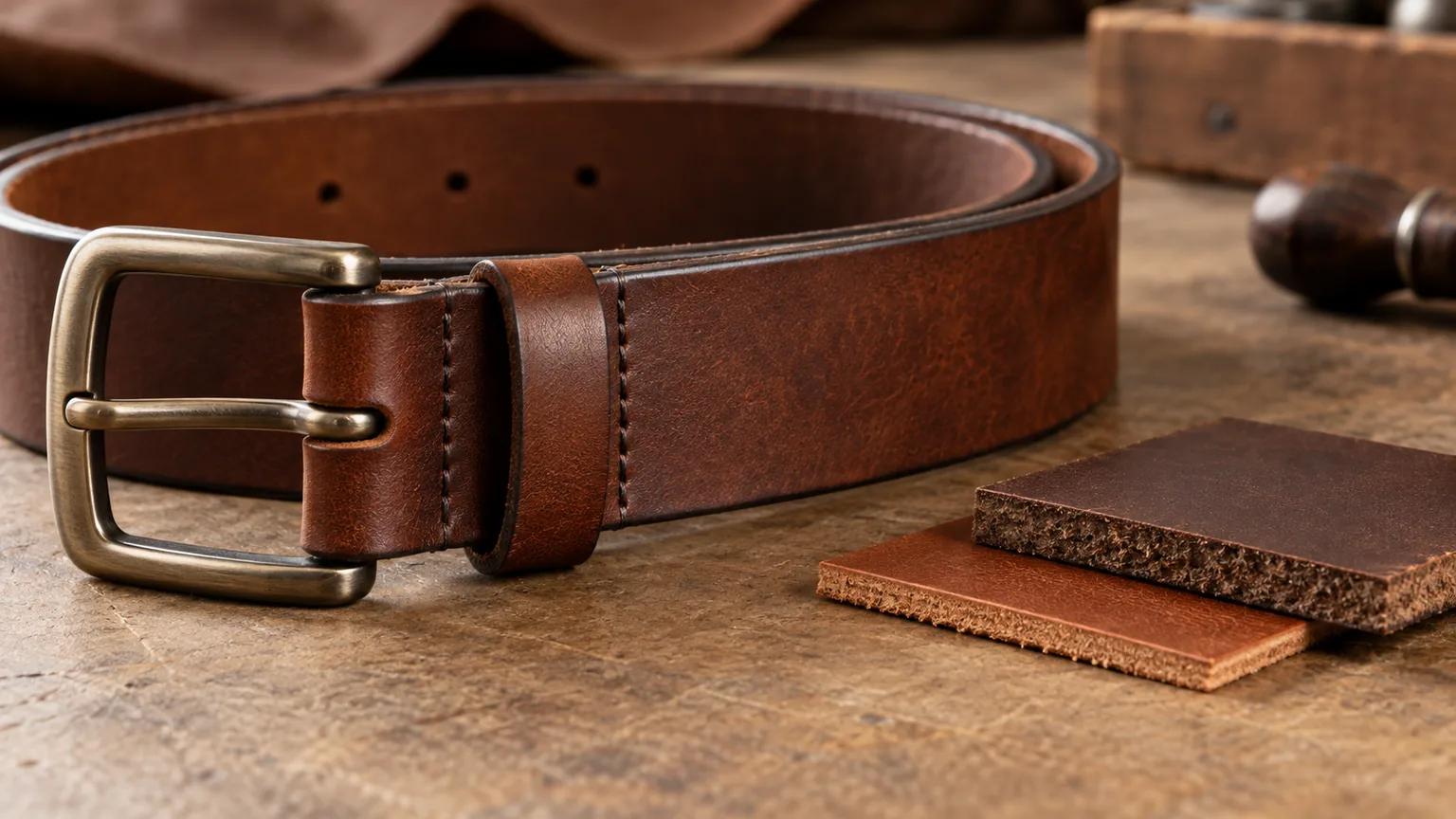
The buckle end is often where a thickness choice becomes visibly wrong. Leather wraps around a bar, then may be stitched, riveted, snapped or otherwise secured. The fold doubles the leather back on itself; local skiving can reduce the combined thickness without changing the fact that two surfaces meet. A body that feels right in the hand can create a bulky fold that pushes the buckle outward, limits prong movement or distorts the strap. Compare the actual buckle bar and frame with the production-intent folded sample, not with a flat leather swatch.
At the adjustment holes, a thick but soft strap can deform around the prong, while a stiffer strap may resist seating or create excessive pressure at the selected notch. Hole shape, spacing and finishing must be reviewed with the specific leather and buckle. The same thickness reading does not predict how two different material articles will behave. The assembled-belt pull-strength guide separates closure behavior from material tensile results; if retention is a concern, test the assembled interface rather than infer it from substance alone.
Edges alter perceived thickness. A rounded, burnished edge reads differently from a square painted edge or a stitched, rolled construction with a lining. Edge paint may create a visible lip even if the center thickness stays within target. A heavy bevel can make a thick body look slimmer, but may expose material transitions. Specify the edge profile and inspect it along the whole belt, especially where layers terminate or the strap enters a keeper.
Finally, test the belt on the garments or mannequins relevant to the assortment. Can it pass through intended loops without forcing? Does the tail sit cleanly in its keeper? Is the bend comfortable at the target size? Does a padded center create an unwanted ridge under an untucked top? These use checks can reveal a bad selection before a numerical thickness tolerance would. Measurement is necessary for repeatability; the wearing and appearance decision defines what is worth repeating.
Write a measurement plan a factory and buyer can reproduce
For development, identify at least the unassembled material article, finished strap body, any raised center, buckle fold, region near a selected hole, tip and keeper if each location affects fit or appearance. Some points are not suitable for the same instrument or pressure. A soft padded zone can compress; an uneven grain can produce a different reading when a small contact foot lands on a high spot. Record the instrument or measurement principle, contact point, applied pressure if relevant, number of readings and state of the sample. Do not present a number without its location and method.
A practical sequence is to define the target profile on the sample, measure that sample at marked locations, and then agree a production range that preserves fit and appearance. The range should reflect the material and process capability actually demonstrated—not an arbitrary decimal copied from another belt. Record whether the tolerance applies to each reading, an average, or a defined range across several points. Record how the team treats naturally variable leather texture and where variation is unacceptable, such as the buckle fold.
Keep leather-substance and finished-belt checks separate on the sheet. The first can reveal a raw-material lot shift; the second catches changes introduced by splitting, skiving, lining, adhesive, stitching or edge finish. If finished thickness drifts, investigate the layer or operation that changed before demanding a different raw hide. The HDBelt skiving and splitting guide explains how those removal operations serve different purposes. This guide concerns how the resulting profile is selected and controlled.
When an approved sample is signed off, preserve a physical reference and a cross-section photograph or drawing where relevant. Name the material article, component thicknesses, finished measurement points, buckle and assembly route. A later photo without a ruler, location or revision may document appearance but cannot resolve a thickness dispute. Conversely, a numerical sheet without the signed sample may approve a technically in-range belt that looks different because its profile transitions changed.
Worked example: two builds for one intended silhouette
Illustrative comparison, not a HongDing customer specification: a brand wants a medium-width leather belt that sits flat with casual trousers and has a clean edge. One proposal uses a single piece of firm leather with a reduced buckle fold. Another uses a thinner face leather and lining, joined to achieve a similar body profile. If the team asks only for “the same thickness,” both proposals may appear equivalent on a central reading.
The first build may show a more direct leather edge and simpler layer structure, but its stiffness and reverse appearance need approval. The second may offer a more refined reverse and controlled face selection, but bonding, edge build and layer termination need approval. The two builds may require different skive depths to fit the same buckle. Neither is automatically stronger, more premium or cheaper simply because of a thickness label; cost and performance depend on the actual material grades, yield, construction, hardware and production route.
To choose, make production-intent samples with the intended buckle, holes, keeper and edge. Compare central body profile, fold clearance, on-garment bend, edge appearance and how the tail lies after adjustment. If the lined version looks better but creates a bulky tip, revise its taper and resample. If the single-layer version bends well but the reverse is unsuitable for the brand, change the finish or choose the layered route. Only after that decision should the team convert observed sample values into approved measurement locations and ranges.
The sample-to-bulk handoff should preserve the reasoning: “This build was chosen because it seats in the buckle, lies flat and presents the desired edge.” That rationale helps a production team evaluate a substitution. A supplier offering a thicker hide that is “within the same ounce range” may still alter the fold and feel. A different lining may change final profile even if face leather is unchanged. The approved construction, not a single input number, is the actual product definition.
Control thickness without pretending leather is uniform
Incoming checks should confirm that the specified leather article and selected substance range are available for the intended cutting positions. During cutting and preparation, identify pieces outside the workable range or route them to a build where they remain acceptable—if the buyer’s specification permits. During assembly, verify the operations that shape profile: splitting, skiving, lining placement, adhesive amount, folding and edge finishing. Measure the finished sample at agreed points and compare it with both the signed range and visual master.
If a production belt measures outside range, do not automatically reject or accept based on a lone caliper reading. Verify the method and point, then assess the affected interface. A slight central-body difference might be visually and functionally acceptable while the same difference at the buckle fold prevents closure. A visually perfect belt might still be outside the approved range in a way that predicts inconsistency across the lot. The disposition should document which criterion applies and who approved any deviation.
Changes to leather article, lining, padding, buckle geometry or skiving route can reopen the thickness decision even if a catalog calls the result the same belt. The Guide des échantillons de pré-production describes the wider approval checkpoint, and the leather materials guide helps compare material families. HongDing’s documented sampling and belt-production capabilities can support that development loop; a specific thickness tolerance, performance claim or finished feel must be agreed for the project rather than assumed from a general article.
Frequently confused thickness questions
Is a leather ounce the finished belt’s weight?
No. In leather trading it is commonly a substance or thickness shorthand. The finished belt’s mass and profile depend on width, length, hardware and construction as well as leather.
Can one thickness number cover the whole belt?
Usually not when the fold, lining, padding or taper changes by location. Identify the measurement points that govern appearance and fit.
Does thicker always mean stronger or better?
No. Material condition, construction and the loaded interface matter. A thicker build may fail to bend or seat correctly in its buckle.
Specify the finished profile, not just the hide label
Share a reference belt or concept image, target leather appearance, buckle and width, and the fit or hand-feel you need. HongDing can compare practical constructions and develop a sample with measurement points that carry the approved profile into production.