
A belt carton label should tell the receiving team what is inside, whose order it belongs to and how that physical case relates to the approved packing list. The barcode must encode the identifier the buyer’s system expects. Do not print one generic “barcode” on every level: a retail belt, an orderable case and a logistics unit can require different identities. Start with the retailer’s routing and barcode specification, map each packaging level, approve artwork and a scanned proof, then verify the label against the packed carton before dispatch.
Points clés
- Separate retail-item identification, case content and logistics-unit identification before assigning codes.
- Make human-readable style, size, color and quantity agree with the encoded data and actual pack.
- Approve a physical label on the real carton; a clean PDF does not prove barcode readability or placement.
- Keep carton marks, packing list, PO and any shipment-level identifier linked to the same released assortment.
First identify the unit that each label describes
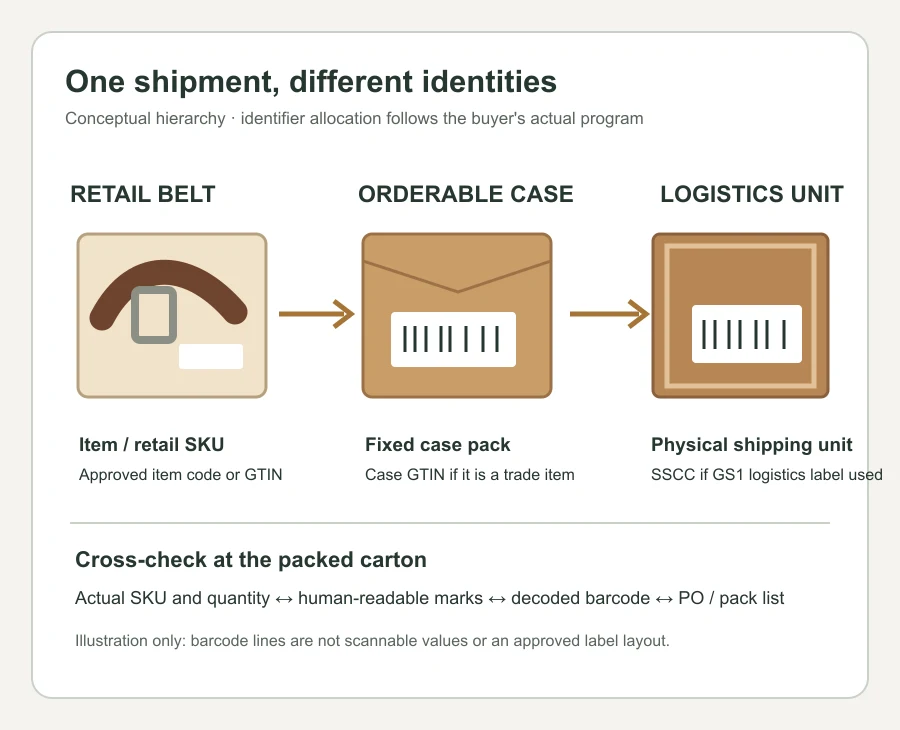
A private-label belt may move as a single retail unit, several units in an inner pack, a sealed outer carton and a pallet or parcel built for transport. Those are not interchangeable objects. A belt hangtag can identify the consumer SKU; an outer case label can describe a trade-item grouping; a logistics label can identify the uniquely built shipping unit. Some buyers use one carton as both an orderable case and a logistics unit, but the identity and placement rules still need to be stated separately.
GS1’s Logistic Label Guideline distinguishes cartons or outer cases identified as trade items by a GTIN from logistics units identified by an SSCC. A case label without an SSCC is not, merely by looking similar, a GS1 Logistic Label. That distinction matters when a warehouse expects to scan a shipment unit, not just learn what product class is inside. The buyer’s own implementation may add routing, PO, store or department data; those are partner requirements, not universal belt-industry rules.
Map the packaging hierarchy before an artist builds the label. Ask whether a case is a fixed, orderable quantity of one SKU or a mixed assortment; whether a pallet carries several case types; and which party generates the final shipment identifier. A change to the case quantity may affect the label even if the retail hangtag does not change. Conversely, a new pallet SSCC does not mean the belt’s retail GTIN changed. The design file should show this relationship explicitly, because a single ambiguous box marked “barcode” invites the wrong code at the wrong level.
| Physical level | What the buyer needs to know | Identifier question |
|---|---|---|
| Retail belt | Style, size, color and sellable unit | Which buyer-approved item code or GTIN belongs to this SKU? |
| Inner pack | Count and grouping rule, if one is used | Is it a separately identified trade item or only a handling pack? |
| Outer carton | Exact contents, quantity, PO and destination | Is this an orderable case with its own GTIN, a logistics unit with SSCC, or both? |
| Pallet or parcel | How cases are grouped for transport | Who assigns the logistics-unit SSCC and how is it linked to the dispatch record? |
Build a carton field list from the receiving task
A useful carton mark typically connects the goods to a transaction and a physical pack. The exact fields come from the buyer, carrier, destination and selected barcode standard. For a belt program, candidate fields may include purchase order, style or item number, color, size or size range, quantity, carton sequence, country-of-origin wording, destination and a coded identifier. Do not treat this list as a legal marking template. Country-of-origin obligations depend on the actual goods and market; the product label and the shipping carton can have different roles.
Separate values that are fixed for the style, fixed for the SKU, fixed for the order et unique to the physical logistics unit. Style name and artwork may be shared across several sizes. A GTIN may identify a particular traded packaging level. A PO and destination can vary by order. An SSCC identifies a particular logistics unit, so a copied SSCC cannot simply be printed on every carton. The allocation rules and data feed need an owner; leaving the printer to improvise is not a control plan.
Match text to real contents. If a carton says “brown, size M, 24 pieces” while the pack contains black or mixed sizes, a perfectly scannable barcode will still lead a receiver astray. Decide whether mixed cartons are permitted and, if so, how their contents are represented in the order and electronic data. For a heterogeneous logistics unit that is not itself a trade item, GS1’s guideline cautions against putting one included-item GTIN on its logistics label as though it described all contents; linking the SSCC to electronic content data is the more appropriate route. If the mixed unit is itself a defined, orderable trade item, its own GTIN is a different case—not a license to copy the GTIN of one belt SKU inside it. The buyer’s receiving specification determines the final implementation.
The carton label should also survive normal handling. The printed area needs enough contrast and quiet space for the selected symbol, should not cross a fold or tape seam, and must remain visible where the receiving process expects it. The exact symbol size and placement depend on the standard, scanner and carton geometry. A photo of an applied label and a scan of a production-quality proof answer more than a zoomed-in artwork file alone.
GTIN and SSCC answer different questions
La Global Trade Item Number (GTIN) identifies a type of item at a defined packaging level. The Serial Shipping Container Code (SSCC) identifies a specific logistics unit for transport or storage. GS1’s logistics-unit explanation uses a case, pallet or parcel as examples of logistics units. A case can, in some implementations, carry both a GTIN because it is an orderable trade item and an SSCC because it is being tracked as a shipping unit. The identifiers complement one another; neither is a decorative substitute for the other.
Ask the buyer which data must be scanned at which handoff. If the warehouse receives a fixed case pack and scans the case GTIN to know the SKU and standard quantity, the case needs the buyer’s approved trade-item code and symbol. If the receiving or transport process tracks each physical carton individually, an SSCC and the associated logistics data may be needed. The GS1 Logistic Label Guideline treats SSCC as the required element for a GS1 logistics label, not as a universal requirement that every belt carton everywhere must use one. Avoid turning a conditional standard into an across-the-board claim.
Then specify the symbology and encoded data, not just a row of digits. GS1 explains that cases may use an ITF-14, EAN/UPC or GS1-128 depending on the data and trade-item context. A GS1-128 symbol carrying an SSCC uses Application Identifier (00); other data require their own correct identifiers and formatting. The brand or its barcode owner should supply verified numbers and allocation instructions. A belt factory can coordinate artwork and label application, but it should not invent a GTIN or reissue the same SSCC across units to make a layout look complete.
Human-readable information is a second check, not an excuse to skip scan testing. Scan a printed proof with equipment and settings representative of the receiving operation, confirm the decoded value against the approved data file, and inspect the label on the actual carton. The goal is to catch a readable wrong code as well as an unreadable correct one. If multiple barcode symbols appear, make their purposes legible to staff so an operator does not scan the retail-item code when the process expects the logistics-unit identifier.
Approve the applied label, not merely the PDF
Artwork approval should connect four objects: the text and layout file, the encoded data file, a print proof and the packed carton. A PDF can be visually correct while the variable-data feed inserts a stale PO or the printer reduces the symbol below the usable size. A scanned print can decode correctly while the label sits under strapping or over a closure seam. Each problem has a different owner, so the approval should show which part has been checked.
- Freeze the field map. Mark each field’s source, owner, format and whether it varies by SKU, order, carton or logistics unit.
- Check the proof. Compare printed human-readable values and scanned barcode data with that field map; verify the intended symbology.
- Apply it to a packed sample. Check placement, legibility, carton orientation and whether tape, straps or handling marks obscure important information.
- Release the current version. Link artwork, data file, pack specification and buyer approval; obsolete the previous proof.
For a retailer with a routing guide, use that guide’s version and resolve deviations before printing production quantities. A “standard” label from a different retailer may be perfectly readable but still fail the current receiver’s field order or scan logic. If the buyer changes a PO, store destination or case pack after artwork approval, determine whether variable data alone changes or whether the label layout and testing need another review. Do not silently treat the first approved PDF as approval for every order.
HongDing’s documented scope includes retail labels, barcodes, protective packaging, carton marks and delivery information. That supports coordination of a belt-specific pack, but it does not imply that HongDing owns the buyer’s numbering system or independently certifies GS1 compliance. The private-label packaging guide covers retail-unit artwork and protection; this article focuses on the receiving-facing carton and logistics identification that follows.
Worked example: one belt style, multiple case identities
Illustrative scenario, not a HongDing shipment: a brand orders a brown leather belt in three sizes. Each size is a separate retail SKU with its own approved item identity. The brand wants each outer carton to contain one size only, with a fixed unit count. A retailer will receive by PO and scan a case-level code. A logistics provider also needs to track each physical carton. Before label design, the parties determine whether the fixed case pack is an orderable trade item with its own GTIN, whether each carton is assigned an SSCC, and who produces the receiving data linking those numbers to the PO.
Now imagine carton 07 is packed with the medium size but the variable-data file prints the large-size description. If the barcode also encodes the large-size case identity, the label is internally consistent yet wrong for the physical goods. If the barcode encodes the medium-size case while the text says large, a scan and a glance disagree. Both failures require a pack-to-label verification at the carton, not merely a check that the art file matches its spreadsheet. The remedy is to identify affected cartons, correct the data or pack, and recheck the result before release—not to cover the text with a sticker without controlling the barcode beneath it.
Suppose the next shipment changes to mixed-size cartons. The old single-size case GTIN and quantity statement should not be reused automatically. Revisit the packaging hierarchy and the buyer’s accepted data exchange. A unique SSCC can identify each mixed logistics unit while its content detail is linked through the agreed electronic record; the precise implementation follows the retailer’s program. This example shows why a carton label is an output of the packing plan, not a graphic added at the end.
Check the shipped goods against the released pack record
At the first packed carton, compare the physical belt SKU, quantity, retail label, case mark and scanned code against the current PO and approved pack sheet. During packing, check a defined selection of cartons across sizes and print runs according to the actual project plan. At final reconciliation, make sure the carton count and contents agree with the packing list and shipment data. If a printer ribbon, data file or pack mix changes, identify the cartons produced during the affected interval and decide what must be relabeled or rechecked.
Keep a record of the approved label revision and representative scan result for that order. The purpose is not to accumulate paperwork: it gives the buyer and factory a way to find what changed if a warehouse reports a mismatch. A label that scans in the factory still may fail if the destination system expects a different identifier, so the retailer’s acceptance method remains the governing reference. The finished-pack review can also reveal protective-wrap problems or buckle impressions that label testing alone misses.
The next order should reuse only what is genuinely unchanged. A repeated style may have a new PO, destination, carton sequence or logistics identifier. A changed color, size mix or case count may alter both visible marks and trade-item data. Carry forward the approved structure, then regenerate and verify the variable fields. That approach turns a shipping-mark checklist into a repeatable handoff rather than a one-time artwork exercise.
Questions before the printer starts
Does every belt carton need an SSCC?
No universal rule follows from the word “carton.” An SSCC is the identity used for a GS1 logistics unit. Whether a particular case also needs that logistics label depends on the receiving and transport process agreed for the order.
Can the retail belt barcode be copied onto the outer case?
Not automatically. The retail unit and case may be different trade items, and a logistics unit may need its own SSCC. Confirm the packaging hierarchy and the buyer’s scan requirement before choosing the case symbol.
What should a buyer provide at concept stage?
The intended retail-unit and case configuration, receiving destination and any retailer routing or barcode guide are enough to start a field map. Final numbers and variable-data ownership can be settled before artwork release.
Align carton data with the belt assortment
Share the proposed SKUs, case mix and the retailer’s receiving or routing guide. HongDing can help coordinate the belt packing specification, label artwork and sample proof; the brand and its trading partners remain responsible for assigning and approving the identifiers their systems require.
Contexte des normes : GS1 Logistic Label Guideline distinguishes case trade-item identification from logistics-unit identification; GS1’s logistics-unit resource explains the SSCC key. Retailer routing requirements and applicable destination rules must still be checked for the actual order.