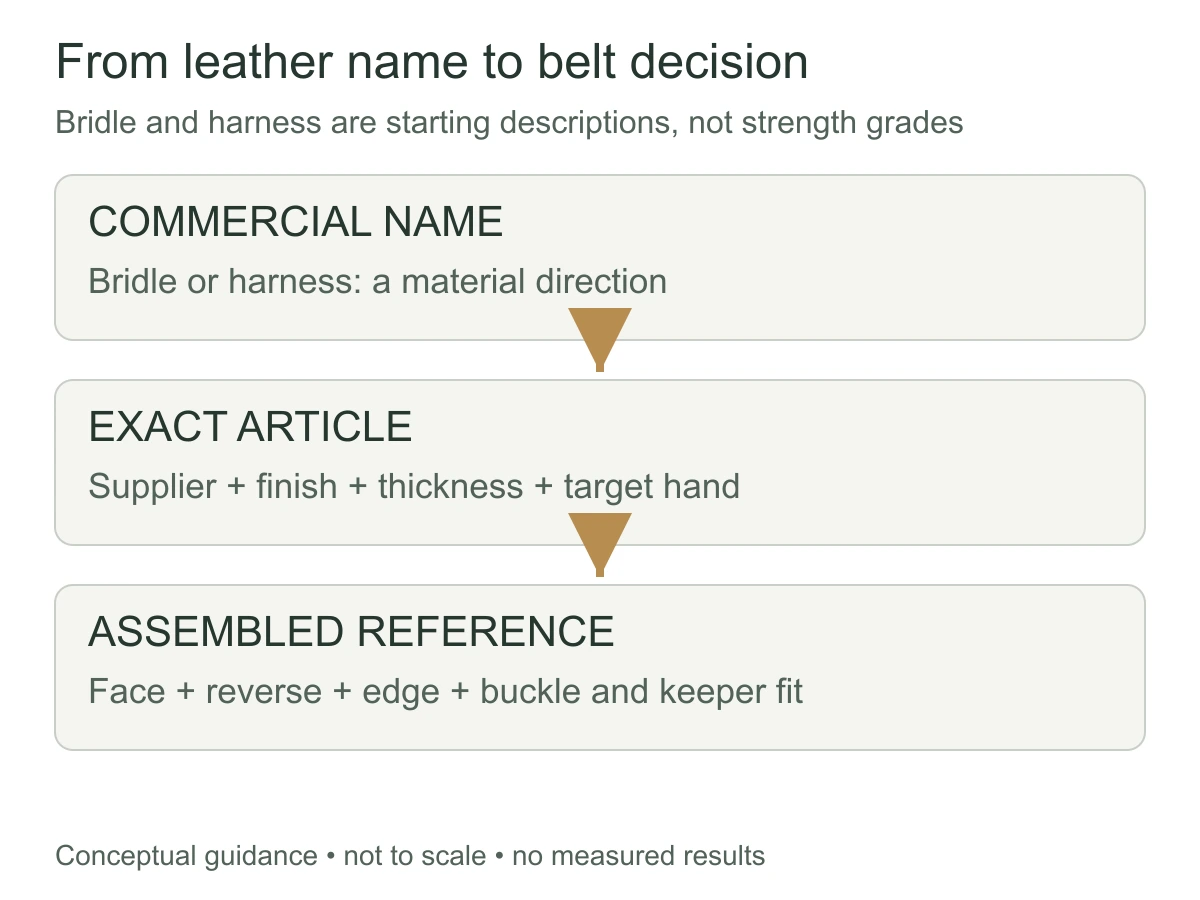
Bridle leather and harness leather are not two universal strength grades. Both names can describe vegetable-tanned leathers with substantial conditioning and finishing, but the recipe, surface, firmness and available thickness depend on the tannery’s specific article. For a belt collection, choose between actual samples with the intended construction and hardware—not between assumptions that bridle is always polished or harness is always softer, stronger or rougher.
A leather name can communicate a useful design direction. It cannot tell a product team whether the finished strap will fold neatly around its buckle, slide through its keeper or meet the intended appearance after use. This comparison concerns ordinary apparel belts. The heritage names do not establish suitability for safety equipment or load-bearing harnesses.
The useful distinction for belt buyers
- Compare an article, not a family name. Identify the tannery or supplier, product code and approved physical reference.
- Finish is not strength. Shine, oil content and a substantial hand do not prove a performance ranking.
- Match the test construction. Different thicknesses, linings or buckles can overwhelm the material comparison.
- Review the reverse and edges. A small face swatch misses important decisions in an unlined belt.
What the names do—and do not—tell you
Bridle and harness belong to leatherworking traditions, but commercial products within those traditions overlap. It is more useful to ask how a named article is tanned, conditioned and finished than to create a rigid dictionary in which every bridle product behaves one way and every harness product behaves another.
Wickett & Craig’s English Bridle page describes drum dyeing and hot stuffing with an even surface. Its Traditional Harness page describes hot stuffing with waxes, oils and tallows, followed by jack glazing to create gloss while retaining the natural grain. These are specific product descriptions, not recipes for every leather sold under either name.
That second example immediately challenges a common shortcut: harness leather is not necessarily matte. Similarly, “English Bridle” in a product name is not sufficient evidence of manufacturing country. Record origin separately if it is relevant to purchasing or a consumer-facing claim.
Other tanneries make the specification distinction equally important. Hermann Oak’s English Bridle description includes a finished flesh side, while its Drum-Dyed Harness description identifies vegetable tanning, conditioning with oils and tallows, and an aniline finish. Neither page establishes a universal bridle-versus-harness winner.
The tannery examples here explain terminology and variation. They are not endorsements, a claim that HongDing stocks those articles, or evidence of a commercial relationship with the named businesses. Availability and the proposed leather source belong in the actual development discussion.
Separate tannage, conditioning, finish and temper
These terms describe different parts of the material story. Tannage concerns the tanning route. Conditioning or stuffing describes the introduction of substances such as oils, waxes or fats in the supplier’s process. Finish concerns the surface treatment and appearance. Temper is the practical description of hand or firmness. One word cannot substitute for all four.
A buyer asking for “soft harness leather” has expressed a preference, not a complete specification. Soft relative to which sample, at what finished thickness, and in what construction? Likewise, a request for “firm bridle” does not settle whether the completed belt should hold a crisp curve, drape around the waist or show a particular bend appearance.
Processing after tanning can also change the hand. Wickett & Craig’s custom-options page, for example, describes mechanical softening options including milling and staking. The development implication is to confirm the ordered finishing route, not to assume that every article with the same family name has received the same treatment.
Use a physical reference to communicate the target hand, then evaluate the actual strap. A thick sample can feel more resistant to bending than a thinner one even when the thicker material is not intrinsically the “firmer leather.” If the comparison changes thickness and material simultaneously, it may still reveal which finished product the buyer prefers, but it cannot isolate the cause.
Compare the samples through the intended collection
For a clean, restrained dress-belt direction, a smooth, evenly finished bridle article may be a sensible first sample. For a casual collection seeking a rich conditioned appearance, a particular harness article may be worth exploring. Those are sampling directions, not exclusive uses: the actual surface and hand can move either article into the other design territory.
Show the supplier what the collection should look like after normal handling as well as when new. A surface that develops visible marks or changes appearance when bent may suit one brand and disappoint another. Do not use “premium patina” to excuse an appearance the buyer never approved, or reject all variation in a collection intentionally developed around natural character.
On mobile, scroll horizontally to compare the decision fields.
| Feature | What to compare | What the name cannot prove |
|---|---|---|
| Face appearance | Color range, gloss, grain visibility and marks after agreed handling | That harness is matte or bridle is uniformly glossy |
| Hand and bend | Finished thickness, temper and behavior in the intended strap | Which will feel softer in a different construction |
| Reverse side | Flesh finish, loose fibers, appearance and contact behavior | That every article arrives ready for an unlined belt |
| Edge result | The actual cut edge after the proposed finish | That a family name guarantees a polished edge |
| Performance | Project-specific tests and complete-belt checks | A strength rating, waterproof claim or guaranteed life |
Keep color and natural-mark acceptance separate from construction defects. A buyer may accept natural character on the visible face but still reject an incorrectly placed hole or poor edge finishing. Combining them under a vague “rustic look” makes sample feedback harder to interpret and repeat.
Why the buckle fold and keeper can change the answer
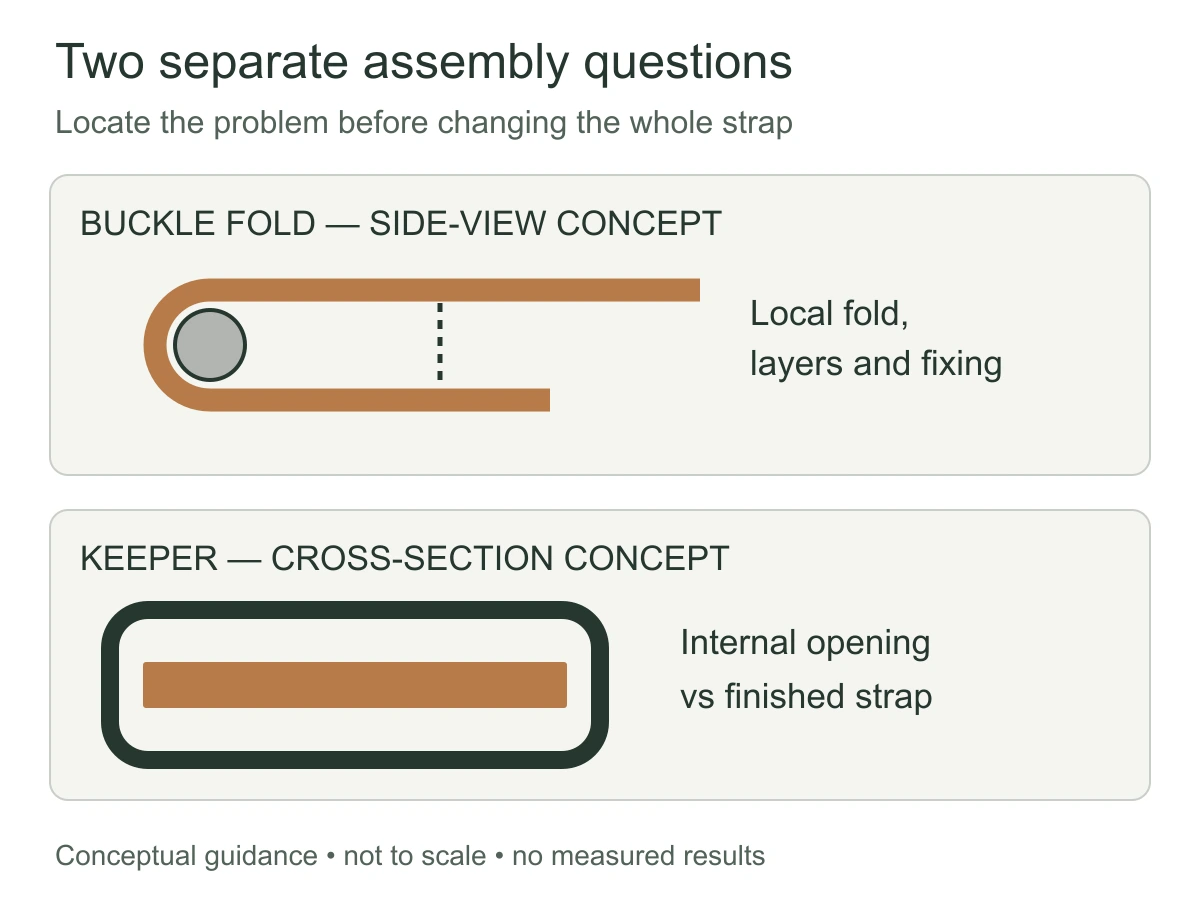
The buckle attachment puts leather into a different condition from the long, flat strap. It may be folded back, joined and held around hardware. The resulting thickness and bend behavior depend on the local construction, not merely the leather label. A material that feels attractive as a flat swatch can create too much bulk in the proposed attachment.
If the rest of the strap has the desired hand and passes through the hardware satisfactorily, but the fold is bulky, first review the local layer arrangement, fold and fastening. Local preparation may be a candidate, but it needs to be evaluated with the attachment—not prescribed as a universal thinning instruction. Reducing the entire strap can change the feel and proportions the buyer already approved.
If the whole belt is too stiff for its intended use, local fold adjustment may not address the main problem. Return to the actual article, finished thickness and construction. Compare an alternative material or finish route rather than repeatedly modifying one small area to compensate for the wrong overall hand.
The keeper introduces another relationship. Its available internal space must work with the finished strap as assembled, including any lining or edge buildup. When the tip passes through the buckle but jams at the keeper, compare those interfaces separately. Making a keeper larger may improve passage, but an excessively loose result can change how the tail is retained.
Check the revised sample through the intended adjustment sequence, then look again at the profile and tail retention. Our skiving and splitting guide explains local and overall thickness changes in more detail. The material decision here is whether the selected article can achieve the desired result without losing the approved character of the belt.
The flesh side and edge deserve their own approval
In an unlined belt, the underside is part of the finished product. Examine its appearance, surface treatment and interaction with the intended clothing-contact conditions. A neat face swatch does not reveal whether the reverse has loose fibers, an unacceptable feel or a finish the brand does not want against garments.
Ask for a representative strip rather than only a small square. A strip shows more of the material’s length, reverse and edges, and can be made into a useful assembly sample. It also makes it easier to compare natural variation across a longer visible area. The approved range should reflect the supplied article, not just the most attractive part of one swatch.
Edge treatment is another project choice. Some vegetable-tanned articles can support a burnished appearance, but the outcome still depends on the cut, preparation and finishing route. An uncoated edge, a colored edge and a painted edge create different visual and manufacturing requirements. Compare the intended edge on the exact article before choosing the leather because of a general reputation for easy finishing.
If a lining is added to solve a reverse-side concern, review the belt again as a changed construction. The lining can alter total thickness, hand, edge build and hardware fit. It also introduces a joining method that must suit the materials. An improvement on the underside should not quietly create a new assembly problem.
Oil, wax and contact behavior: avoid easy promises
Oils and waxes in a supplier’s description explain part of the leather’s processing, not the performance of every finished belt made from it. They do not justify calling the product waterproof, stain-free or immune to color transfer. Specify the actual performance needs separately from the desired rich appearance or feel.
For a belt intended to be worn with pale garments, discuss color-transfer evaluation under the relevant dry and wet contact conditions. Use the applicable method and acceptance criteria agreed for the project. A quick informal rub can help identify a concern during development, but it is not interchangeable with a defined test report.
Packaging contact is a different question from rubbing against clothing. A mark appearing after prolonged contact with a lining or packing material may require investigation of material transfer, pressure and the contact conditions. Keep a clean comparison and identify the contacting materials; do not diagnose every mark as “too much oil.” The oil-migration guide covers that investigation without treating a material name as a diagnosis.
Similarly, a white surface deposit cannot be identified safely from the words “bridle” or “harness.” Ask the supplier to assess the actual condition and its handling history. Avoid polishing an unexplained deposit away merely to make an incoming batch resemble the approved sample.
Run a useful two-sample comparison
Consider an illustrative casual-belt development: the brand likes the even appearance of one bridle article and the richer surface of one harness article. The fair first comparison uses the same nominal strap geometry, intended finished thickness, hardware and construction, with any remaining differences recorded rather than ignored.
- Establish identity. Record the supplier’s article, color, finish route and sample identification for each candidate. Keep any claimed source or tannage documentation with the corresponding sample.
- Compare the finished surfaces. Look at face, reverse, edges and bend appearance under comparable viewing conditions. Record preferences and unacceptable changes separately.
- Operate the assembly. Check buckle fold, fastening, adjustment holes, tip passage and keeper retention. Note where the issue occurs rather than labeling the whole material unsuitable.
- Resolve the meaningful difference. If only the fold is problematic, evaluate a local construction change. If the entire hand is wrong, revisit article or thickness. Recheck what was already satisfactory after the change.
Suppose the harness sample has the preferred face but its reverse is unsuitable for the unlined design. The decision is not automatically “choose bridle.” The team could investigate a different flesh finish or a lining, then compare the cost and construction consequences. If those changes erase the desired feel or introduce unnecessary complexity, the other article may be the better overall choice.
Conversely, if the bridle sample looks too uniform for the collection but performs well in the assembly, explore the surface direction before changing every specification. The best next sample tests one meaningful proposal. Changing material, thickness, hardware and edge finish together can produce a good belt, but it makes the reason for improvement difficult to understand.
Turn the selected sample into a reorderable specification
Once the team chooses a route, keep the family name as a description and make the actual article the purchasing reference. Record the supplier article or agreed equivalent-control process, color reference, finished thickness and measuring basis, target hand, face and reverse finish, edge treatment and complete-belt sample.
Do not invent tolerances from the approved sample alone. Agree the measurable requirements and acceptable appearance range with the responsible technical team. If supply requires a proposed substitute, review the characteristics that matter to the belt rather than approving it solely because it is also called bridle or harness.
HongDing can support material and hardware coordination, sampling, revisions and the transition into manufacturing. Its business roots date to 2004, with the current Hong Ding company identity established in 2010. In material selection, that experience is best applied by connecting the leather choice to the actual construction and sample feedback—not by promising that a heritage name guarantees the finished result.
Questions that remain after the comparison
Is harness leather always more durable?
No universal ranking follows from the name. Define the relevant wear or strength requirement and compare the actual leather and complete-belt construction using suitable evidence. A heavier-looking sample is not a test result.
Can either leather be used for a dress belt?
Potentially. The exact surface, thickness, hand, edge and hardware proportions determine whether the result suits the collection. Start with a representative finished sample rather than excluding a family by name.
Do the two names replace full-grain or tannage information?
No. They do not fully specify grain treatment, tannage, selection or finish. Keep those facts separate and obtain the supplier’s description for the exact article being proposed.
Bring the material direction into a belt sample
Share a reference image or existing belt and describe the surface, hand and appearance you want to retain or change. If you already have material samples, include their article details. HongDing can discuss the open material and construction decisions; an unfinished concept is a valid starting point.