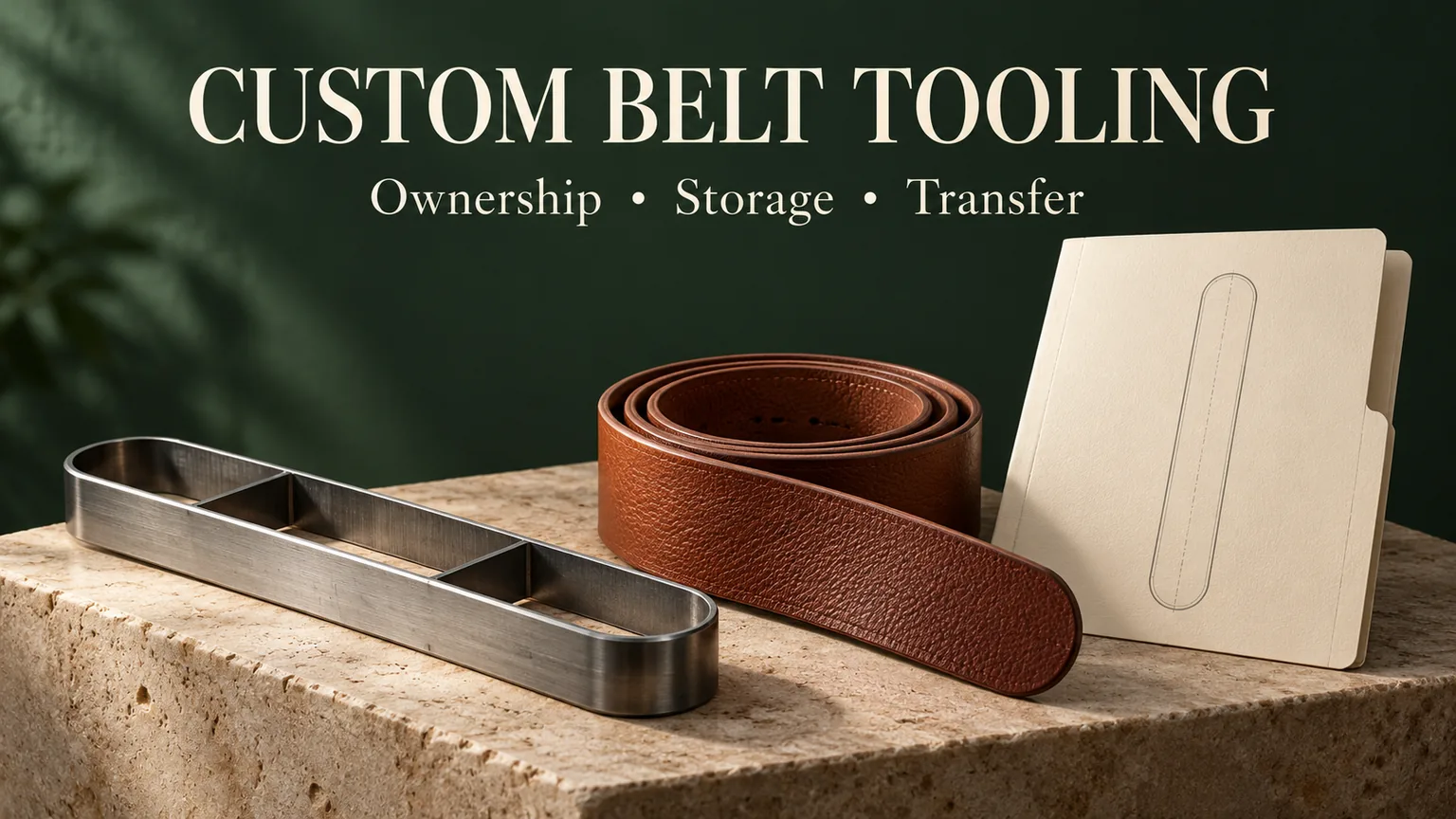
Paying a tooling charge is not enough information to know who may use, move, modify or retain a custom belt tool. Agree the asset being purchased, when ownership passes, who holds it, what use is permitted and how it can be returned. Physical tooling, design files and intellectual-property rights need separate treatment. This guide is a practical sourcing framework for finished-belt projects, not a ready-to-sign contract or a statement of HongDing’s standard commercial terms.
A belt program may involve a cutting die, an embossing plate, a logo stamp, a fixture or tooling for a custom hardware component. Those assets can have different owners and custodians even when the buyer receives one development invoice. Sorting that out before production is easier than trying to reconstruct the arrangement when a reorder is urgent or a supplier change is already underway.
Start with the actual assets, not “the mold”
Ask the development team to separate dedicated tools from standard equipment and reusable supplier platforms. A customer-specific insert may sit inside a supplier-owned base. A custom logo plate may belong to a separate operation from the die that cuts the strap outline. Ownership of one item does not describe the rest of the system.
The distinction matters operationally as well as commercially. A buyer may receive a removable insert but still need a compatible base at the receiving factory. A cutting die can embody the outline without carrying the complete product specification. A hardware mold does not by itself reproduce polishing, plating, assembly or the approved finished belt.
- Dedicated physical assets: list the individual die, plate, insert, mold or fixture, with an identifying description and image.
- Shared or standard assets: identify supplier equipment, standard bases and tools that are not being sold to the buyer.
- Technical information: separately identify drawings, CAD, artwork, settings and inspection references required for future use.
- Product references: retain the approved component and complete-belt sample, linked to the relevant revision.
A useful asset boundary answers a simple question: if this program ended today, what precisely could be packed for transfer, and what would remain behind? If neither party can describe that package, a single line reading “customer tooling” leaves too much unresolved.
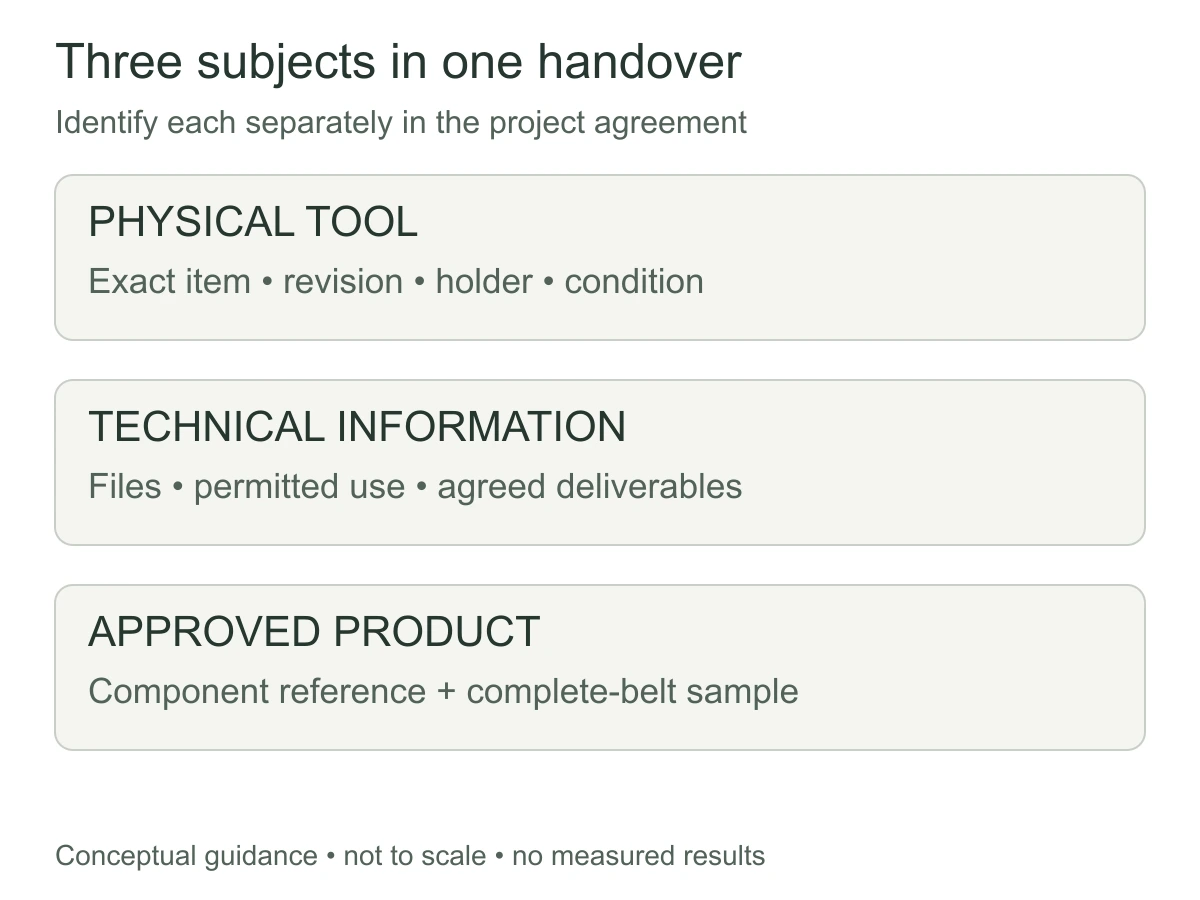
Separate payment, ownership and permission to use
First identify what the quoted fee covers. It might pay for engineering, samples, a dedicated tool, an insert or a contribution toward development. Ask whether any amount is recovered through the piece price and whether outstanding recovery affects release. A deposit, paid invoice and accepted tool are different events; the agreement should say which event, if any, transfers title.
Next distinguish ownership from the permissions needed to continue manufacturing. A brand might own a logo but not a supplier’s pre-existing mechanism or process know-how. Conversely, a factory may hold the physical tool while the buyer owns it. The parties should define use, copying, modification and access in terms that fit the actual assets.
For intellectual property, WIPO’s guidance on assignment and licensing distinguishes transferring ownership from allowing another party to use IP while retaining ownership. That distinction is useful when discussing drawings and technical information; it does not establish who owns a particular belt tool.
Do not infer exclusivity from a tooling charge. If the buyer expects a dedicated design not to be used for other customers, identify the protected design and permitted users explicitly. Standard supplier components may need a different arrangement. Discuss how rejected samples, spare inserts and obsolete copies will be handled so that a restriction on one named tool does not leave the rest of the design uncontrolled.
Create a record someone else could actually use
The asset record should connect the object on a shelf to the product it makes. Use a stable tool identifier and record product, component and revision separately. If a die is modified, retaining the same tool number may be sensible, but its revision and approval history must show the change. A photograph alone cannot distinguish two outwardly similar tools with different functional geometry.
Scroll horizontally on a narrow screen to view the record and its purpose.
| Record field | What to identify | Pourquoi c’est important |
|---|---|---|
| Asset and revision | Tool ID, component, drawing revision and identifying photos | Prevents release or reuse of the wrong version |
| Base commerciale | Fee scope, ownership event and relevant agreement | Separates payment records from agreed rights |
| Custody | Actual holder, physical location and contact | Makes access and retrieval practical |
| Permitted use | Products, users, copying and modification permissions | Clarifies the intended boundaries of use |
| Condition | Last use, inspection, repair and current status | Distinguishes available tooling from usable tooling |
| Exit package | Tools, agreed files, references and transfer responsibilities | Connects physical release to a workable restart |
Use the same identifier in the quote, approval, storage record and transfer list. If an older identifier already exists, record the cross-reference instead of renaming the object without explanation. The aim is not a complicated database; it is a record that the buyer, supplier and actual custodian can reconcile.
For example, an illustrative asset entry could read: “Tip die T-17, component TIP-A, drawing revision C, held at the named cutting subcontractor; revision B retired.” This does not specify ownership by itself. It makes the subject of the ownership and use agreement recognizable.
Know who physically holds the tool
The company that coordinates the belt order may not be the company storing every tool. Hardware tooling may remain with a specialist, while a logo plate stays with another operation. Ask the contracting supplier to identify the actual custody route and explain how the agreed requirements reach that custodian.
This is not an accusation that subcontracting is improper. It is a continuity issue. A return promise from one company may be difficult to execute if the physical holder has never acknowledged the asset, believes it is shared or has different release conditions. Resolve those inconsistencies while the project is active.
Practical questions include who may relocate the tool, what notice is required, how a location change is recorded and who is responsible if the holder changes. Where identification marking is appropriate, agree a method that does not damage a cutting edge, working surface or other functional feature. A label on a storage box should still correspond to the tool inside.
Published industrial purchasing terms can illustrate how explicitly these subjects are treated. For example, sections 16–18 of Bosch’s February 2026 North American purchasing terms separately address buyer property, tooling and intellectual property. They cannot be imported wholesale into a belt order. A large buyer’s requirements may differ from the terms a small brand and its manufacturing partner actually agree. Use examples to find missing topics, then settle the project’s own arrangement.
Storage and maintenance are part of future usability
“We will keep the tool” answers location only partly and says little about condition. Discuss how the specific tool should be protected, how it is identified while inactive and what happens before it returns to production. Preservation methods should come from the toolmaker or responsible technical team; a cutting die, metal mold and engraving plate do not necessarily need the same treatment.
Separate routine upkeep from repair, refurbishment and replacement. Routine care may be included in production pricing, while damage repair or a design change may require approval and a new charge. Record who can authorize each type of work and how the decision is communicated. Avoid a situation in which a supplier changes a tool to keep production moving but the buyer later assumes the original geometry is intact.
Tool life should be discussed in relation to its actual use and condition, not as an unsupported promise of unlimited orders. Relevant records may include production use, inspection findings and repair history, depending on the tool. A count can be useful where it is meaningful and reliably tracked, but a number without the definition of a cycle or operation is weak evidence.
Before a dormant tool is reused, compare trial output with the current approved reference. Time in storage is not proof that the tool is defective, and a clean-looking tool is not proof that it still produces acceptable parts. The useful question is whether the resulting component meets the released requirements after the agreed setup.
Make design changes visible in the tooling history
A belt revision can affect more than the tool that first attracted attention. Changing strap thickness may alter the relationship with a buckle, keeper or attachment. Enlarging a decorative feature can affect its clearance from an edge or stitch line. The team should identify the tools and product references affected by the proposed change before authorizing work.
Keep the commercial and technical approvals connected. A buyer can approve a modification charge without having approved the resulting sample; equally, approving a sample does not automatically settle the cost of destroying or replacing the old tool. Record both decisions in their appropriate places.
For an illustrative revision, suppose a brand changes the tip outline but wants the existing hole layout and buckle attachment retained. The release should identify the revised tip, the features held unchanged and the sample used for acceptance. Once the new route is accepted, mark the superseded tool or file so that a reorder cannot silently return to the previous design.
HongDing supports design, material and hardware coordination, samples and revisions for complete belt programs. That gives the team a practical role in identifying which component and assembly decisions need to move together. It does not mean every project includes customer ownership, unrestricted transfer or a fixed tooling price; those terms require project-specific agreement.
Plan transfer as a restart, not merely a shipment
Begin with a condition and identity check before the tool leaves its current holder. Reconcile the tool list, revision, photos, accessories and agreed technical information. If something is missing or damaged, establish the discrepancy before packing so that the receiving team does not have to guess when it occurred.
Ask the receiving manufacturer to review compatibility before transport. A tool may require a particular mounting arrangement, machine capability, supporting fixture or operating information. Weaver’s custom leather-die guidance, for instance, calls for actual-size patterns and offers different die heights and thicknesses. Those are supplier-specific options, not universal dimensions. Owning the object does not establish that another factory can run it immediately or achieve the same result. If adaptation is needed, agree who will approve it and whether it changes the original tool or requires a separate asset.
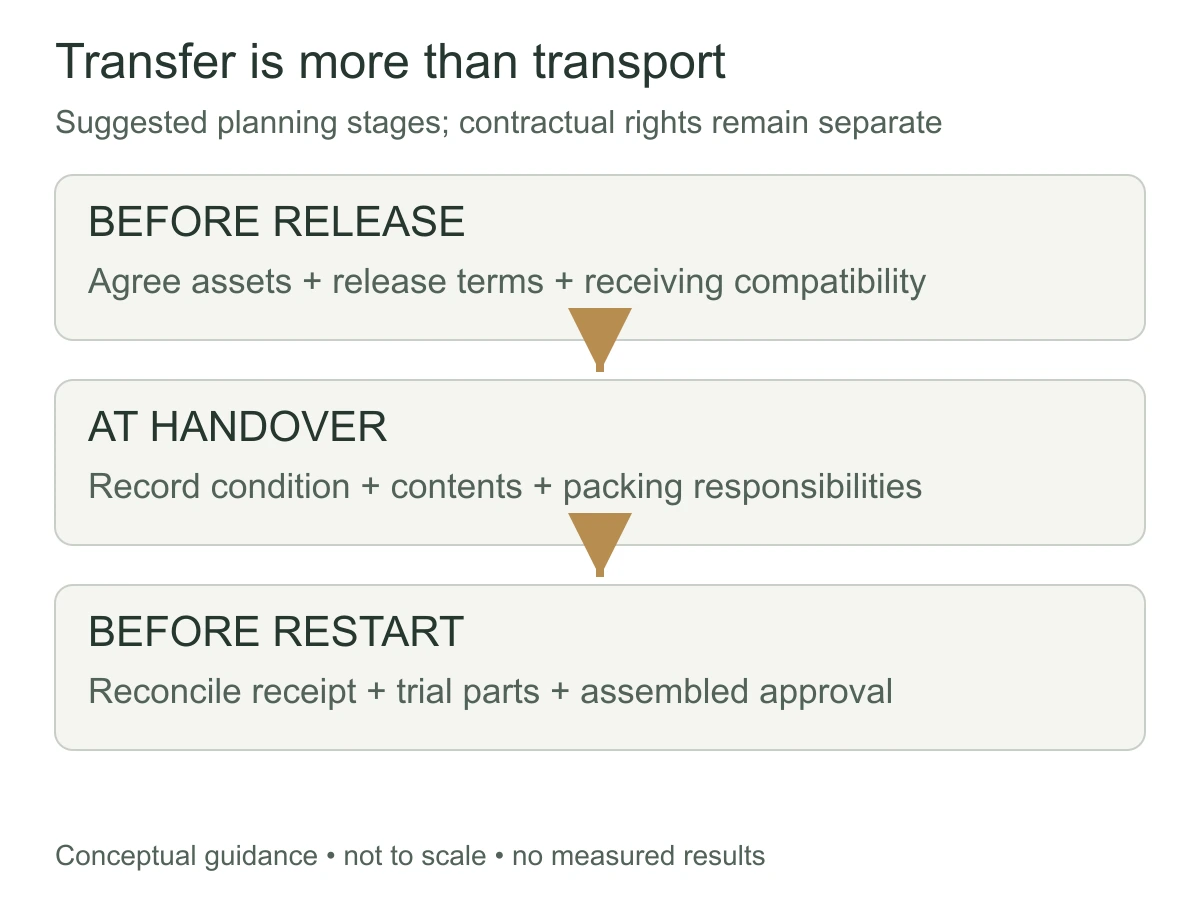
- Agree release conditions. Clarify notice, outstanding amounts, authorized recipient and the agreed list of assets and information.
- Check the receiving route. Review compatibility, required adaptations and responsibilities before the tool travels.
- Record and pack. Document condition and contents, use suitable protection and allocate freight, insurance and any customs responsibilities.
- Receive and trial. Reconcile the delivery, investigate discrepancies and evaluate output against the approved component and complete-belt references.
Include the timing of the last old-route order and the first new-route sample in the plan. If the tool is unavailable during shipment or adaptation, the buyer needs a realistic continuity arrangement. Do not assume that a completed transfer creates immediate capacity or that the former supplier can continue producing without the transferred asset.
The first new-route output should be held for the agreed checks. If a component differs, separate tool condition, machine setup, material and downstream finishing as possible contributors. Resolve and recheck the relevant issue before approving the new route. This protects the approved product without pretending that every transfer should reproduce every process setting identically.
Decide what happens when the program ends
An inactive program can end in continued storage, return, sale, retirement or destruction, depending on the agreement. Set a review point and a contact route rather than relying on indefinite silence. Discuss storage charges, notices and who may authorize disposal before the tool becomes an unclaimed item.
If destruction is selected, define what must be destroyed and what record will be supplied. A photo of a broken plate does not settle the treatment of spare inserts, drawings or digital files. Those should follow the applicable ownership, confidentiality and retention arrangements. Product samples and commercially required records may also have different retention needs from working tools.
Keep the closeout decision linked to the asset identifier and final revision. That allows a later team to tell the difference between a tool available for reorder and a design that would need fresh development. The small amount of clarity at closeout can prevent a future launch plan from depending on something that no longer exists.
Common buyer questions
Is a photo of the tool enough proof of ownership?
No. It can help identify an object and its apparent condition, but it does not establish all ownership, access or use rights. Connect the photo to the asset record and applicable agreement.
Can a supplier keep a copy after returning the tool?
The answer depends on the agreed rights and applicable law. Address physical duplicates, spare inserts and digital copies separately; do not assume returning one object settles all of them.
Should every belt project use custom tooling?
No. Existing components or a different production route may meet the design need. Compare the benefit of a dedicated feature with its development, maintenance and continuity implications before committing.
Clarify the tooling part of your belt brief
Send the belt reference or current drawing and identify the feature you want customized. If tooling already exists, share its description and the rights or transfer questions you need resolved, without sending confidential third-party files you are not entitled to share. HongDing can discuss how the component fits the complete belt and what needs project-specific confirmation.
For the wider development relationship, see OEM versus ODM belt development; for the current project, discuss the tooling and sampling brief.