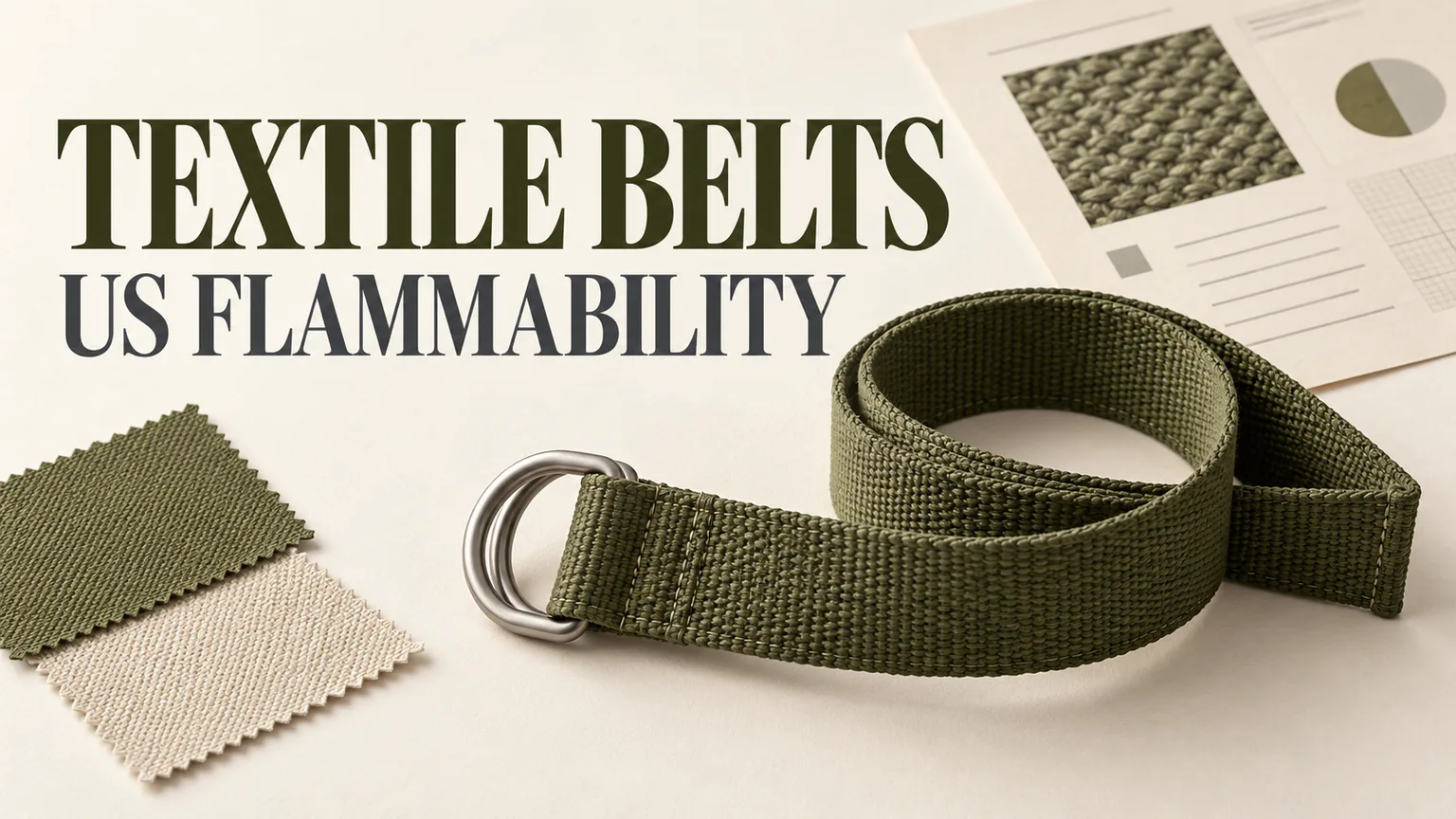
Do textile belts need US flammability testing? There is no reliable yes-or-no answer based only on the word “belt.” For an ordinary adult fashion belt, establish the applicable product and material scope first, then consider any fabric-testing exemption and the separate certification position. A narrow strap, a heavy fabric and an adult product raise different questions.
This guide is for brands, importers and retail sourcing teams preparing a US compliance decision. It explains the federal clothing-textile framework and what product information makes a laboratory consultation useful. It is not a product-specific legal clearance, and it does not cover protective equipment, flame-resistant workwear claims or the separate requirements for children’s products.
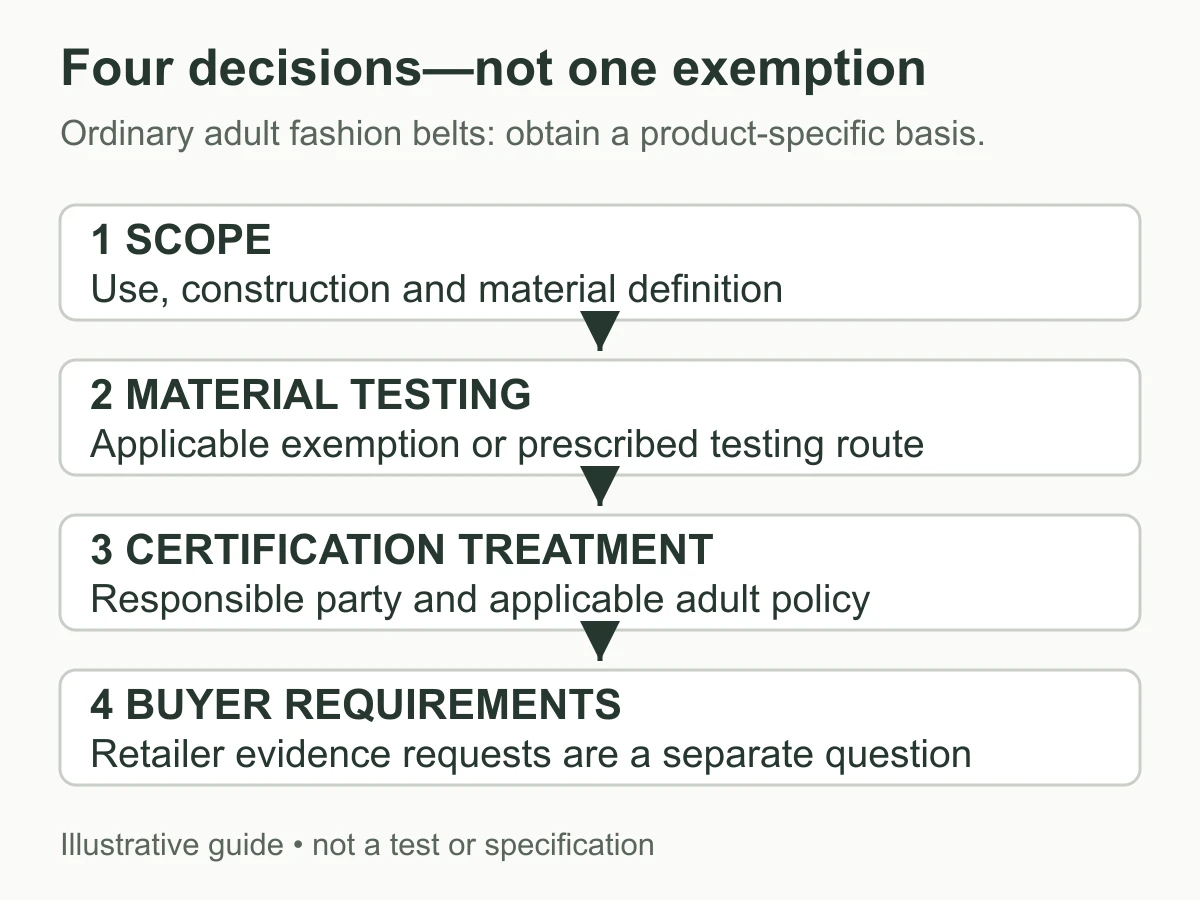
Separate four questions before requesting a test
The federal standard in 16 CFR Part 1610 addresses flammability of clothing textiles. Its named exceptions include certain hats, gloves, footwear and interlinings. The list does not contain a general exception for belts. However, that observation is only a starting point: the actual material definition, dimensions, construction and use still need to be considered.
First ask whether the product and relevant materials fall within the rule being considered. Second ask whether the material qualifies for an exemption from testing under that rule. Third establish the applicable certification responsibility and any current enforcement policy. Finally compare the resulting file with the retailer’s own buying requirements. A purchaser may ask for information beyond the federal minimum, but its checklist does not rewrite the regulation.
Mixing these questions creates avoidable errors. “No test required” might mean a documented material exemption, an issue preparing the prescribed specimen, or simply that a seller has never commissioned a test. Those are not equivalent answers. Ask the party making the decision to state its basis and identify the exact material or product revision to which it applies.
The two material-testing exemption routes
Section 1610.1(d) provides two alternative routes. The first concerns plain-surface fabrics weighing at least 2.6 ounces per square yard; CPSC expresses this as 88.2 grams per square meter. Fiber content does not restrict that route. The second covers plain- and raised-surface fabrics made entirely from acrylic, modacrylic, nylon, olefin, polyester, wool, or combinations of those listed fibers, regardless of weight.
The word “entirely” matters. Cotton/polyester is not composed only of listed fibers. Neither is a nylon/elastane blend, because elastane is not on that list. Such a blend may still meet the separate plain-surface weight route if the facts support it. “Synthetic” is therefore too imprecise to use as the exemption rationale, and a small unlisted fiber content should not be silently ignored.
Surface classification is equally important. A plain surface is not simply a fabric that feels smooth in a quick handling check; construction and processing determine whether it has a raised fiber surface. A brushing or napping operation can change the relevant description even when the purchase order still calls the material cotton webbing. Ask for the finishing state of the material actually entering production.
| Material description | Potential route to examine | Evidence still needed |
|---|---|---|
| Plain-surface cotton fabric | Plain-surface weight route | Actual surface classification and fabric areal weight |
| Raised-surface cotton fabric | Neither listed-fiber route nor plain-surface weight route follows from this description | Applicable testing route and representative finished material |
| Fabric entirely of polyester and nylon | Listed-fibers-only route | Complete composition and identity of relevant exposed materials |
| Nylon/elastane elastic fabric | Possibly the separate plain-surface weight route | Not eligible solely by the listed-fiber route; confirm surface, weight and build |
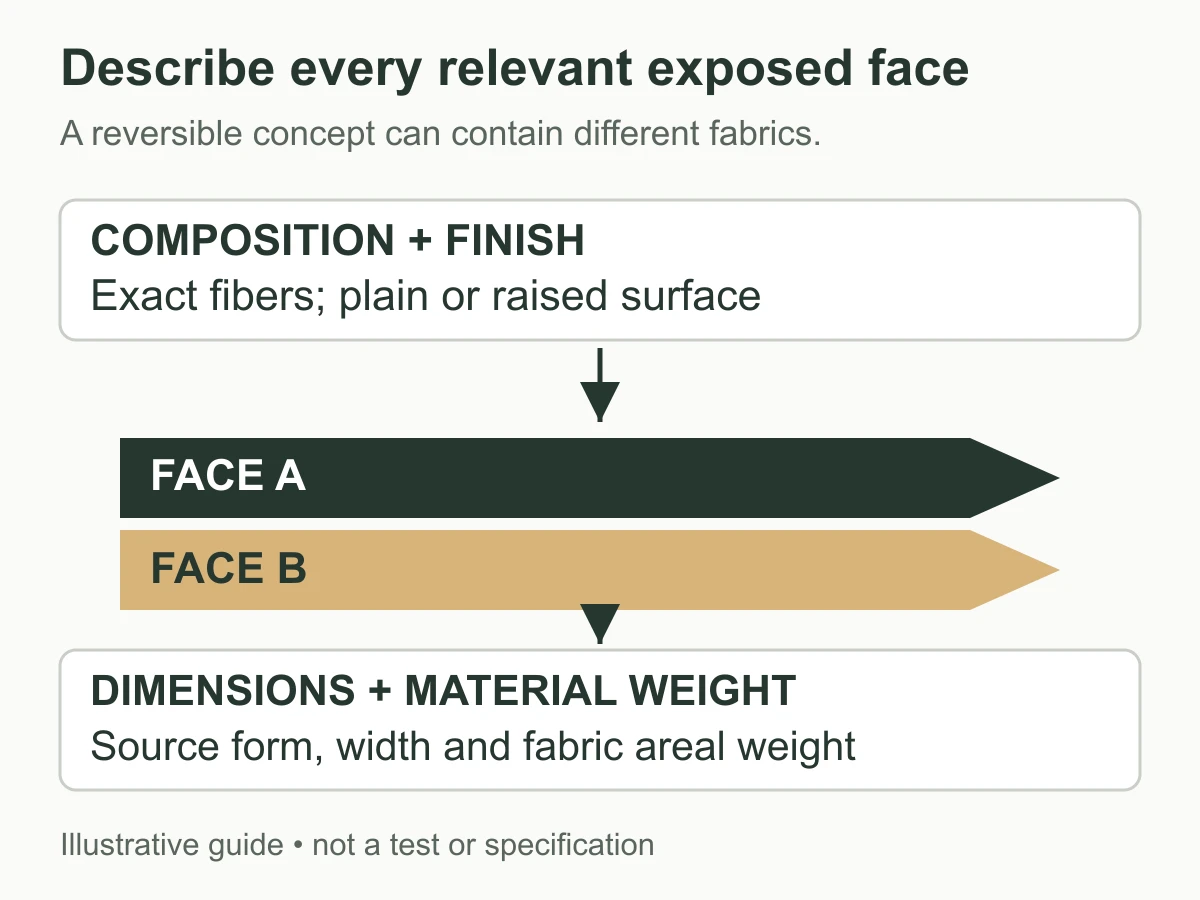
| Reversible belt with different faces | Review each relevant exposed fabric | Both faces and actual normal-wear exposure |
Scroll horizontally on a phone to read the evidence column.
Use fabric areal weight, not the total mass of the assembled belt. A buckle, dense backing or several folded layers do not establish the weight of an exposed fabric. For example, weighing a complete belt and dividing by its visible length and width combines components that do not belong in the same material measurement. Ask the supplier or laboratory to identify the appropriate fabric specimen and measurement basis.
These exemptions concern testing; they are not permission to supply dangerously flammable clothing textiles. The CPSC clothing guidance expressly separates material-testing exemptions from the overall requirements. Keep the evidence supporting the route, rather than replacing it with a purchase-order note saying “exempt belt.”
Narrow belts: a real scope issue, not an automatic shortcut
Width deserves careful attention. Section 1610.2(r) defines textile fabric using a width of 50 mm, or 2 inches, or more. Section 1610.2(o) describes the test specimen as 50 by 150 mm. Those provisions explain why a narrow construction creates a meaningful question. They do not justify citing Section 1610.36 as a belt exemption; that section does not contain such an exemption.
Provide both the finished dimensions and the source-material form. Narrow goods woven directly to strap width, a strip cut from wider cloth, and a wide textile folded into a narrower belt present different facts. A finished product photograph may conceal that distinction. Include an unfolded construction drawing or representative material when needed, and explain whether a specimen can be obtained without altering the fabric being evaluated.
La CPSC laboratory test manual dated October 2008, section 8, addresses items from which the required specimen cannot be prepared. It is staff guidance, not a replacement for the regulation or a categorical ruling on every narrow belt. Ask the responsible compliance professional or laboratory for a written, product-specific basis connecting the construction to the applicable scope and method.
Do not tape several narrow strips together, change the assembly or improvise a flame exposure and then label the outcome a standard-compliant result. Such an exercise may answer a different question from the prescribed method. If a laboratory proposes an adaptation, ask what it establishes, which deviations will be reported, and whether the result supports the decision your importer or retailer actually needs.
Assess the surfaces people actually wear exposed
A belt’s sales photograph is not a complete exposure map. The front, reverse side of a reversible belt, projecting tail and decorative textile parts may present different surfaces in normal wear. A hidden interlining is not the same thing as a backing that can become exposed. Part 1610 contains provisions addressing exposed portions and particular constructions; show the laboratory the complete belt rather than sending only the easiest fabric to identify.
For a reversible style, an exemption rationale for one face does not automatically describe the other. Consider an illustrative combination of a polyester face and a cotton face: the listed-fiber route may be relevant to one, while the other needs its own surface and weight assessment. The correct file explains those differences. It does not average the two materials or treat the preferred outward-facing side as the only possible use.
Coatings and laminations need disclosure too. Part 1610 includes specific provisions concerning coated and uncovered fabrics, while vinyl plastic film has a separate standard, Part 1611. Do not classify a belt solely from the words PU, PVC or textile. Submit the layer description and ask which provisions apply to that particular build; a coating does not automatically place the whole belt exclusively under one route.
Adult certification is a separate decision
For adult wearing apparel requiring compliance certification, the General Certificate of Conformity, or GCC, is not the same document as a laboratory report. A report provides evidence about identified samples. Under CPSC’s GCC guidance, the US importer is responsible for certification of imported products; the domestic manufacturer is responsible for products made in the United States. A supplier’s test report does not transfer that responsibility. CPSC guidance states that adult apparel testing does not have to be conducted by a CPSC-accepted third-party laboratory, unlike specified children’s-product testing requirements.
There is an important adult-apparel policy distinction. CPSC’s 2016 enforcement-discretion statement, still linked from its clothing guidance when checked for this article, concerns GCC failures for adult apparel exempt from testing under Section 1610.1(d). It is a defined enforcement policy, not repeal of the certification statute or a universal release from flammability obligations.
Keep the policy decision alongside the factual exemption rationale, and check current requirements when the product is placed on the market. The adult policy should not be extended to children’s belts or unrelated rules. If the intended age group changes, reopen the compliance review rather than treating it as a size-only change. Our separate children’s belt CPSIA guide addresses that different starting point.
What a useful laboratory brief contains
Start with the decision you need: an applicability opinion, confirmation of a material-testing exemption basis, or testing of a defined non-exempt material. Identify the adult fashion use, intended US market and any retailer specification. Sending only “test belt for USA” leaves the laboratory to reconstruct the question and can produce a report that does not answer the importer’s actual concern.
Attach the complete construction and current material references. Include fiber composition, surface treatment, layer arrangement, dimensions and which portions are exposed in normal use. Supply the fabric-weight evidence if relying on that route, and explain any narrow-goods issue before cutting samples. The lab should confirm sampling and preparation under the relevant method rather than the buyer guessing how many strips are sufficient.
Finally, identify the ordered revision and planned variations. A black sample may represent one material and finishing state, not every future color, backing or supplier substitution. Ask how the evidence applies to the proposed range and what changes would trigger reassessment. This is more useful than asking for a generic certificate with the company name but no traceable connection to the production belt.
Read the result as a material decision, not a marketing badge
Part 1610 distinguishes flammability classes. Class 1 denotes normal flammability within that framework; it does not mean fireproof, suitable for firefighting or safe around industrial heat. Class 2 is associated with the regulation’s treatment of raised-surface textiles, and Class 3 describes dangerously flammable textiles. Leave the actual classification to the prescribed assessment, not a workshop lighter demonstration.
When reviewing a report, match the sample description, material reference and finishing state to the purchase specification. Check the method, reported preparation and result, and resolve any qualifications or deviations with the laboratory. If the report identifies only a fabric trade name, request enough supporting detail to establish why it represents the material used on the belt. A document can be genuine and still concern the wrong construction.
A practical release decision records both the conclusion and its limits. For example, an illustrative project might retain a plain-surface weight rationale for one defined cotton fabric and require a new review before introducing a brushed version. That is not a prediction that brushing causes failure. It recognizes that the facts supporting the original route have changed, so the old rationale cannot simply be copied forward.
Apply the same logic to a new elastic blend, an exposed backing or a substituted coating. Keep material and finishing revisions visible to purchasing, development and quality teams. This turns compliance from a last-minute document request into a controlled relationship between the belt being ordered and the evidence being relied on.
How HongDing can support the product-information side
HongDing develops leather, textile and elastic belt constructions and can coordinate materials, hardware, samples and manufacturing information. For this question, that support helps turn an early concept into a description a compliance specialist can assess. It is not a claim that every construction has already passed a named test or that HongDing can issue a blanket US regulatory clearance.
A reference image, existing sample or material direction can start the discussion; a completed technical pack is not required. Share the intended adult use, sales market, open material choices and any retailer requirements. We can help identify the construction questions and sample revisions, while the responsible compliance party establishes the applicable legal and testing basis.
Common sourcing questions
Does a heavy cotton belt automatically avoid testing?
No. Examine the relevant fabric’s surface and areal weight, after scope review. Total assembled belt weight is not the material measurement, and raised cotton cannot use the plain-surface route just because it is heavy.
Can a retailer request a report for an exempt material?
A purchasing specification can request additional evidence. Clarify what question the report must answer and distinguish that commercial request from the federal testing basis.
Is “CPSC certified belt” the right description?
Do not use it as a generic badge. Identify the actual applicable requirement, evidence and responsible certification document instead of implying that CPSC approved the individual belt.