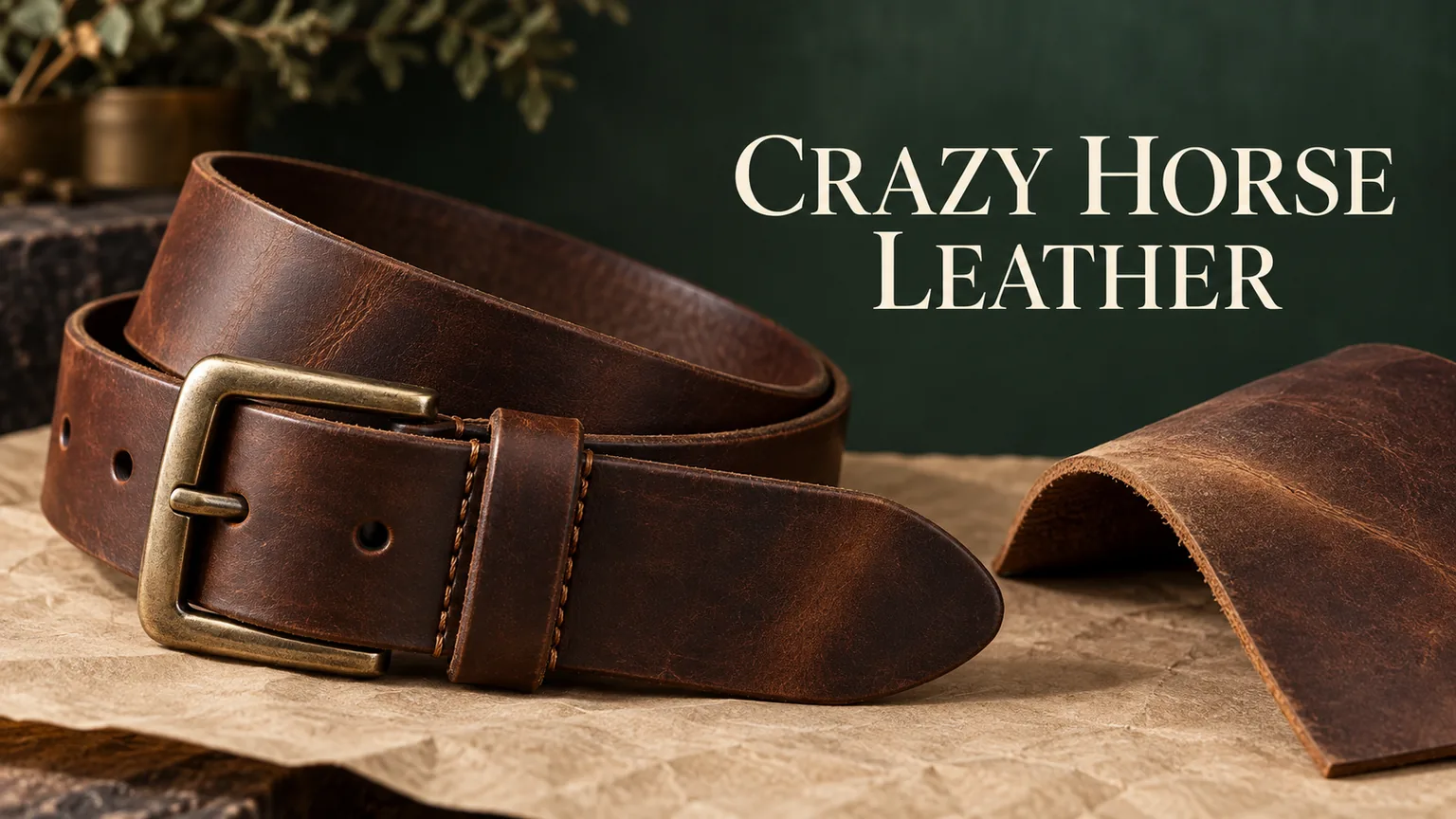
A “Crazy Horse” leather belt is usually being sold for a wax- or oil-rich pull-up appearance: the surface shifts in tone where it is bent or rubbed, creating a deliberately lived-in look. The name is not proof that the hide came from a horse, that it is a particular grain grade, or that the finished belt meets a durability or water-resistance standard. For a brand, the useful specification is the actual leather article, its visible pull-up response, the belt construction and the range of change customers will accept after wear.
Points clés
- Specify “Crazy Horse” as a desired surface behavior, then identify the actual hide and finish supplied.
- Approve color and pull-up on a finished belt, including the buckle fold, holes and edges—not only a flat swatch.
- Distinguish attractive patina from dye transfer, finish failure or inconsistent color between retail units.
- Keep care language tied to the chosen leather and finish; a general waxed-leather tip is not a universal product guarantee.
What does “Crazy Horse leather” actually tell a buyer?
The term points to a visual finish family, not a complete leather identity. Wax and/or oil in a pull-up finish redistribute or reveal tonal difference when the material bends, creases or is rubbed. A supplier of leather-finishing chemicals, Quimser, describes Crazy Horse effects using wax and pull-up oil combinations on several crust-leather articles. That is evidence of a finishing route, not evidence that every leather sold under the term shares one recipe. A specific consumer example from Dr. Martens describes its own buffed cowhide with oil and wax layers. Its specification should not be copied as a universal definition for another supplier’s belt material.
Ask for the material’s species, grain or split construction, supplier/article identification, color, finish, thickness range and intended use. If a brief requires full-grain cowhide, say so expressly; the style name alone does not establish it. Likewise, a seller may use “pull-up,” “oiled,” “waxed,” “saddle” or “vintage” for overlapping visual directions, but the words do not prove identical composition or performance. An approved swatch and written material identity are more useful than choosing a romantic name.
There is no reason to make a customer choose a laboratory formula at concept stage. A brand can begin with an authorized reference image, desired color depth and the amount of visible wear it wants. The development team can then compare actual leather options and explain what remains open. HongDing’s documented scope includes leather-finish coordination and belt sampling, with Pro Pelli identified as a leather/crust finishing facility in its broader collaboration network. That supports discussion of finish routes, not a claim that every HongDing belt uses Pro Pelli or that it is a tannery.
Understand the pull-up effect before approving the color
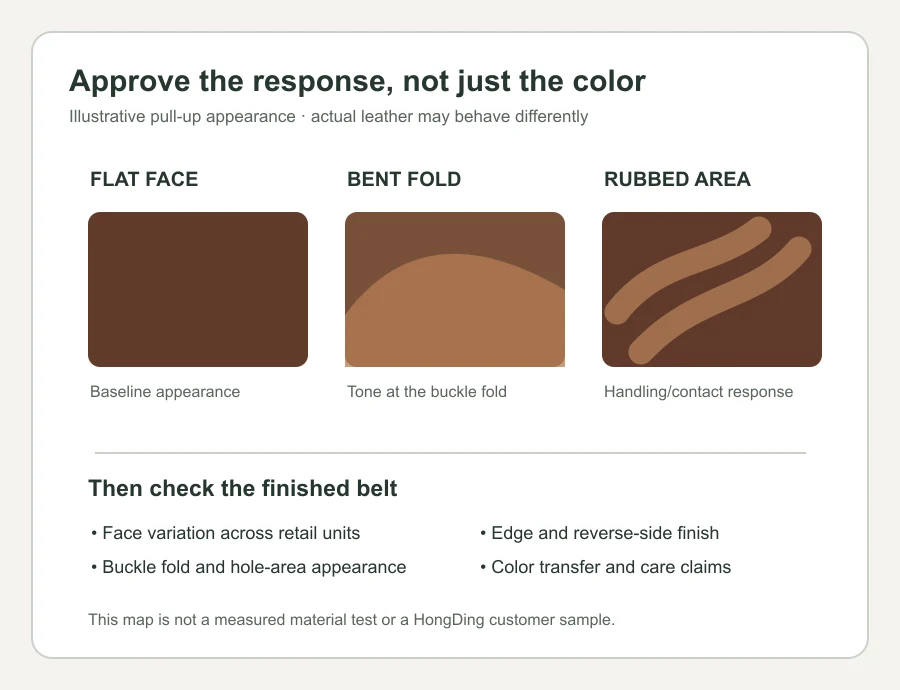
On a flat swatch, a brown may look even and deep. Bend it around a small radius and the stressed area may become lighter; rub or warm it and the appearance may shift again. The magnitude and reversibility depend on the chosen leather and finish. On a belt, that means the buckle fold, hole row, keeper contact and the section that bends around the waist can develop visibly different tone. A catalog photograph taken before wear does not describe all those states.
Define at least three appearances: the untouched face, the bent surface and a controlled rubbed area. Compare them under a consistent light with a physical reference rather than a phone image alone. The buyer can then choose whether the effect should be subtle enough for a clean casual line or pronounced for a heritage-inspired collection. It is reasonable to accept deliberate variation; it is not reasonable to discover after production that one carton reads as a different color family because no range was approved.
Natural variation and manufacturing inconsistency need different treatment. Variation within an approved visual range can be part of the look. A sudden pale strip caused by a different finish application, a tacky area, persistent color transfer or a surface that flakes may be a defect. Location matters: a tonal mark at the buckle fold may be expected while a blotch in a broad front-facing area may disrupt the design. State what the brand accepts on the exposed face, back, edge and hardware-contact areas.
A useful trial pairs the material with the real belt geometry. Bend the finished strap at its intended buckle route, pass the tip through the keeper and fasten at several holes. Observe whether the pull-up reinforces the design or makes the belt look prematurely damaged. If the buyer wants a uniform, almost opaque color, a more stable finish may fit better than a dramatic wax/oil pull-up. Conversely, heavy pigment chosen only to suppress tonal change can defeat the very character the brand requested.
| Direction | Visual behavior to approve | Trade-off to discuss |
|---|---|---|
| Subtle pull-up | Limited lightening at bends; relatively calm shelf appearance | May not deliver a strongly distressed heritage look |
| Pronounced pull-up | Clear tonal movement at flex and contact points | Variation and marks need explicit retail acceptance criteria |
| Stable coated look | More even color is the design target | Different hand and aging behavior; finish flexibility must still be evaluated |
The finish and the belt structure have to work together
Even a desirable leather swatch can disappoint when built into a belt. The strap may be single-layer, lined, backed or locally reinforced. Each construction changes the way the face flexes and the buckle end folds. If the face has a rich pull-up effect but the lining is stiff, the belt may bend differently from the swatch. If the face is thinned across the entire body to make the fold easy, it may lose the hand the buyer chose. The better question is where thickness or reinforcement is actually needed.
At the buckle end, compare the assembled stack: face, possible lining, fold, keeper and attachment. Local skiving can reduce bulk near a fold; it is not the same decision as splitting the whole strap to a lower thickness. The skiving and splitting article explains the distinction. When sampling a pull-up face, a local change should also be checked visually: a fold that functions well but develops an objectionable light band is not an approved solution.
At the edges, the brand must choose whether it wants a burnished, folded, painted or other finish compatible with the actual material and construction. A pale cut edge can appear intentional on one rustic style and unfinished on another. An edge coating may create a cleaner line but its appearance and adhesion should be judged against the flex and handling the belt will see. Do not infer that a waxed face automatically protects the edge or the reverse side.
The buckle finish also changes the product impression. Warm antique hardware can reinforce the patina; a polished modern buckle can make the same leather look more contemporary. More importantly, the metal contact, prong and keeper can create concentrated wear. A design review should include the assembled belt from front and back, not only a material board. HongDing’s material and hardware coordination is relevant because these choices must meet at the sample, rather than arriving as unrelated supplier quotations.
Write a brief that a manufacturer can reproduce
Do not write “Crazy Horse leather, brown” as the only material line. That phrasing leaves the supplier to choose the hide, finish and accepted variation. A useful early brief has two layers: fixed design intent and open technical choices. The initial fixed intent might include a dark brown casual belt with visible but moderate pull-up, a specific width direction, an antique-tone frame buckle and a planned retail customer. Open items might include material article, lining, edge treatment and the exact pull-up range.
For a development sample, record the following in the material and component sheet:
- Identity. Supplier/article code, hide description, color reference and revision once selected.
- Visual response. Approved flat, bent and rubbed references; which zones and degree of variation are acceptable.
- Construction. Face, lining or backing, nominal body and assembled-fold thickness where relevant, edge route and buckle attachment.
- Retail presentation. Size system, exposed-face appearance, label/care text, packaging contact and any required color-transfer evaluation.
- Status. Mark proposed items separately from an approved sample and from a bulk-approved material lot.
A written reference does not have to become a bureaucratic obstacle. It prevents two people from approving different “brown Crazy Horse” leathers under the same style code. If a later source change is proposed, compare the new article against the approved belt for color, pull-up, hand, thickness, edge behavior and assembly. A supplier’s statement that the alternative is “equivalent” is a proposal, not the comparison itself.
An illustrative example—not a HongDing customer specification—could read: “Brown pull-up leather candidate B, moderate lightening when bent at buckle; visual range against approved sample 02; face leather identity pending supplier confirmation; no water-resistance claim; finish and edge to be evaluated on assembled sample.” It is deliberately incomplete but honest. After sampling, replace “candidate” and “pending” with the approved references or retain the issue as open before bulk release. The belt tech-pack guide shows how a BOM, drawing and sample version remain linked.
Judge the finished sample, then control the bulk comparison
Begin with a material swatch to compare options, then move to an assembled belt. On the first physical sample, examine front-face variation, buckle-fold response, hole edges, keeper passage, reverse-side appearance and the feel when fastened. Photograph useful details, but keep a physical reference because screen color and gloss vary. Ask whether the sample expresses the intended aesthetic and also functions with the chosen hardware.
Separate appearance approval from performance questions. A beautiful patina does not demonstrate colorfastness, finish adhesion or suitability for every environment. If a claim or retailer protocol requires testing, choose a relevant method and accepted outcome for the exact leather article. ASTM D6182-23, for example, addresses how a finished leather surface responds to repeated flexing; it does not prescribe a universal acceptable result for this belt or establish that HongDing has tested a particular order. A color-transfer question requires its own agreed method. Do not turn an untested waxed finish into an automatic waterproof or scratch-proof claim.
For a bulk order, the approved sample is the comparison point, not a promise that every hide will look identical. At incoming review, identify the supplied leather article and compare representative material with the approved range. At first-piece assembly, check the buckle fold, edge and visible surface. During production, watch for drift in the features that matter to this style. If a lot falls outside the agreed range, separate it for a decision and recheck any correction before release. Inspection frequency and thresholds belong to the actual order agreement; this sequence is a control method, not a claim that every HongDing order follows one fixed plan.
Packaging should protect the belt without accidentally marking the face. A tightly bent retail presentation, a metal buckle pressed into the leather or incompatible protective material may change the surface before a customer sees it. Test the packed sample after a relevant holding and handling trial chosen for the project. If the brand celebrates early marks, its product photography and care copy should prepare buyers for them. If it requires an immaculate shelf appearance, the package and finish direction may need to change.
Sell the character honestly
“Develops character with wear” is a design statement if the chosen reference and customer expectation support it. “Waterproof,” “scratch-proof,” “will last a lifetime,” and “all marks buff out” are performance promises that need much stronger evidence. A pull-up leather can visibly mark because that is part of its finish behavior; a deep cut, color transfer or finish separation is not necessarily the same phenomenon. Care advice should follow the actual leather supplier’s instructions and the brand’s tested product, not a generic internet recipe.
Names also need care. The word “horse” is part of a style term; it does not establish animal species. A brand should state the material truthfully in product information. If it wants to claim a particular grade, source, environmental property or certification, obtain the relevant article-specific evidence and check the claim’s scope. Pro Pelli’s documented finish capability cannot be converted into a claim that all HongDing leather has one origin or rating.
Common buyer questions
Is Crazy Horse always full-grain leather?
No. The trade name describes a look or finish direction, not a reliable proof of grain grade. Ask for the specific leather article and its construction before making a retail material claim.
Will every scratch disappear if rubbed?
Do not promise that. A light mark caused by wax movement may soften, while a cut or finish failure is different. Evaluate the actual leather and give care advice consistent with its supplier.
Can we start development with a photograph?
Yes, if you have the right to use it as a reference. Add the intended customer, color and amount of pull-up you want; material identity and construction can be compared in samples rather than guessed from the image.
Compare a finish on the belt you intend to sell
Share an authorized visual reference, desired color and how much tonal change fits your brand. HongDing can discuss leather and hardware options for an assembled sample, with open material and care claims resolved before the product is approved for a retail range.
Material context: Quimser’s finishing examples demonstrate that wax/oil routes can create a Crazy Horse effect; Dr. Martens’ product material description is one specific article, not a universal material definition. ASTM D6182-23 describes a finish-flex test method, not a passing result for this belt.