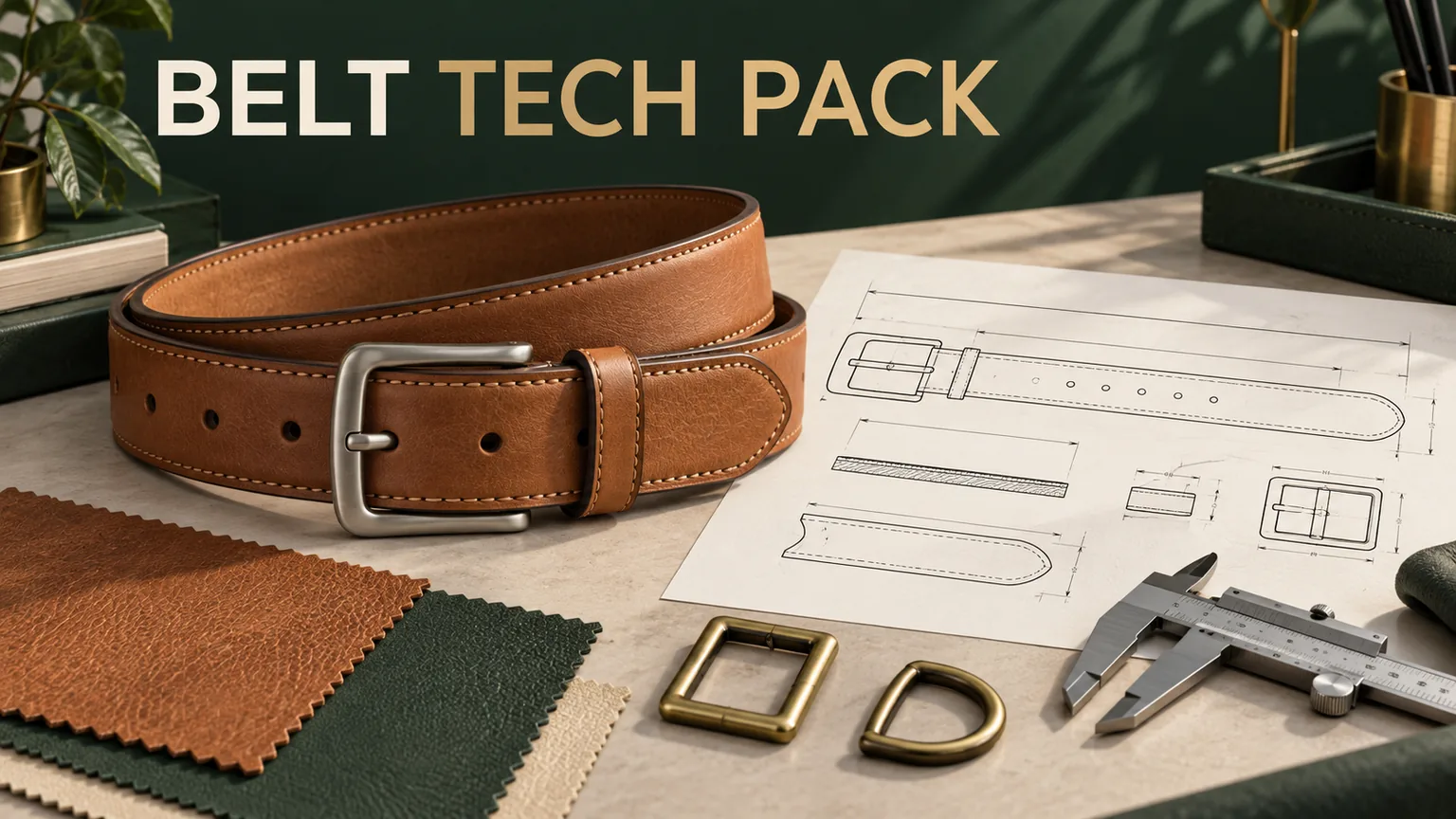
A useful belt tech pack is a controlled decision file, not just a drawing with a leather name. It connects the intended appearance to measurable strap and hardware relationships, a component-level bill of materials (BOM), construction instructions, sample acceptance points and a named approval version. An early concept does not need all those answers before a manufacturer can talk with you. The pack becomes progressively more precise as a design moves toward sampling and production.
Points clés
- Start with the belt’s use and visual reference; mark unknown specifications as open rather than inventing them.
- Show where each dimension is measured. “Width 35 mm” without a location or tolerance does not control a tapered or decorated belt.
- List face, lining, reinforcement, buckle, keeper, thread, edge and packaging as separate BOM decisions when the construction uses them.
- Approve a physical sample against a numbered file revision; a beautiful sample is not permission to substitute a material in bulk.
A tech pack can begin before every detail is decided
A founder may have a photograph of the silhouette, an authorized sketch and a target customer. A developed brand may send a complete CAD file, approved sample and component numbers. Both are valid starts. The difference is the status of the information. A reference image describes a desired effect; it does not establish the exact leather article, buckle dimensions, fold construction or ownership of the artwork. If a factory treats the reference as a full production instruction, the missing choices will be made implicitly, often by whoever handles the sample.
Give every item one of three statuses: approved requirement, proposed option or open question. A fourth status, not applicable, prevents a blank cell being mistaken for an oversight. This lets a manufacturer discuss feasibility without pretending an early sketch is production-ready. HongDing’s documented development route can start from a concept, picture, reference sample or tech pack and progress through material and hardware coordination and sampling. That is support for developing the file, not a promise that any reference can be copied or produced unchanged.
The first page should make the file identifiable and show which decisions still need work:
- Identify the style. Record a style code, product name, intended customer or channel, size system and colorway.
- Control the issue. Add the issue date, revision number and named approval owner; mark proposed materials or hardware as provisional.
- Connect the evidence. List the drawing, BOM, artwork, measurement schedule and physical sample that belong to this revision.
If several people exchange versions by email, a file named “final_final” is not a control system. A simple document index can prevent two different “approved” files circulating; expensive PLM software is not a prerequisite. For larger programs, the same relationship can live in a system. Lectra’s product-data documentation separates measurements, BOM, construction, colorway, SKU and tech pack within one style record—useful evidence of why these fields should not drift apart.
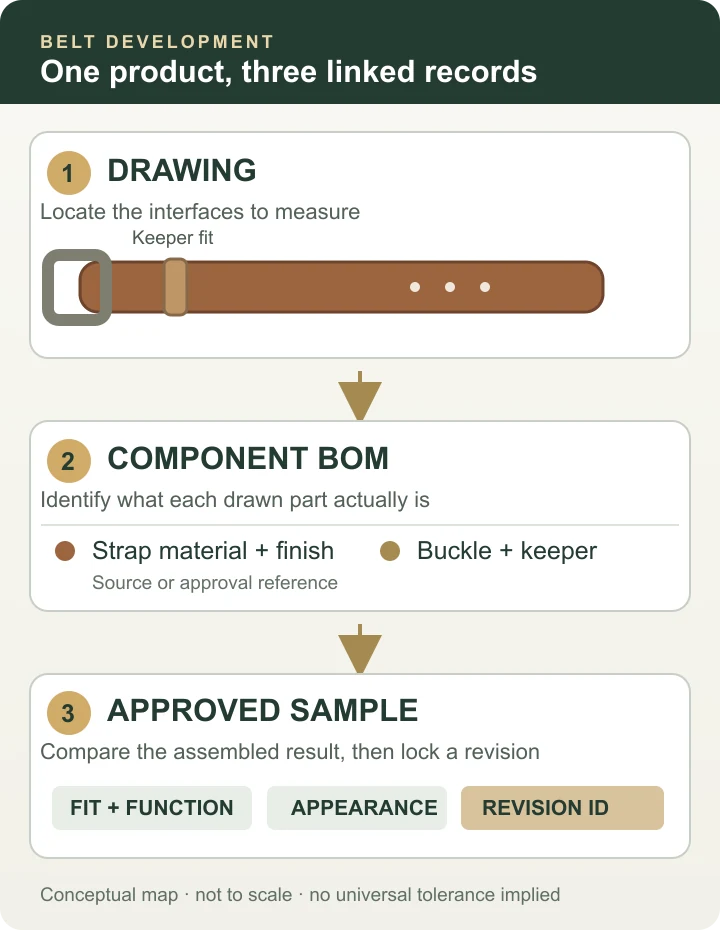
Draw the belt as a set of interfaces, not one attractive front view
At minimum, show a flat full-length view, a buckle-end detail, a tip-and-hole detail and a section through the body if the belt has multiple layers. Add a rear view when the lining, attachment or branding differs from the face. A Western or embellished belt may need a repeat layout so decorations do not collide with holes, the keeper or the wearer’s center front. A ratchet or reversible design needs its mechanism and mating strap described, not borrowed from a prong-buckle drawing.
Label the datum—the point from which a measurement is taken. Belt sizing is especially vulnerable to ambiguous endpoints. “Length 100 cm” could mean tip-to-tip, buckle end to center hole, or something else. The pack should state the actual route, including whether measurement begins at the buckle pin, buckle frame, folded edge or another agreed feature. The belt size guide can help a team align retail sizing language, but the production drawing still needs its own measured endpoints.
| Champ | Show on the drawing | Pourquoi c’est important |
|---|---|---|
| Strap width | Measurement station along the strap, including any taper | Controls buckle and keeper fit as well as appearance |
| Size/holes | Named sizing datum, hole count, position and spacing | Prevents a sample size convention from becoming an unexamined size run |
| Buckle end | Fold length, attachment method and assembled thickness | Determines whether the fold closes and the hardware moves properly |
| Tip | Shape, edge treatment and position of decoration | Affects keeper passage, wear and visual balance |
| Marquage de marque | Artwork version, location, orientation and method | Distinguishes a visual mock-up from an approved production mark |
Do not use a render to imply hidden construction. A cross-section should identify face, possible reinforcement, lining and finished edge only where those layers actually exist in the proposed style. When a material or layer is still provisional, label it as such. This prevents a common mismatch: the buyer approves a smooth exterior while the supplier interprets the interior stack differently.
Build a BOM that distinguishes material identity from appearance
“Brown leather” is a color description, not a reproducible material identity. A BOM line should identify the material route, supplier/article reference if known, color/finish reference, nominal thickness or other relevant specification, component location and approval status. For a multi-layer belt, separate face, lining and reinforcement. For a single-layer strap, state that no lining is intended; do not leave a blank that another team might fill with a cheaper substitute. If the leather is not yet selected, list two candidate articles and the sample question each is meant to answer.
An illustrative face-material entry could read: Face leather — brown candidate A; finish reference photo 03; body thickness to be confirmed on the assembled sample; approved for prototype appearance only; bulk article pending approval. The field values are examples, not a HongDing order or a material specification. This wording exposes what the sample can answer while preventing “brown leather” from becoming a silent bulk substitute.
The buckle line should separate shape, dimensions, base material, surface finish, attachment and any custom-tooling status. “Antique silver” describes appearance but not the substrate, plating system or test plan. A prototype buckle can establish proportion while its final metal and finish remain open. Similarly, a keeper may be self-material, a different leather, metal or a fitted component. Give it a specific line item because keeper clearance can change when the belt body gains lining or edge build-up.
Thread, adhesive and edge material need not be specified with laboratory detail on day one, but they cannot remain invisible if they govern visible finish or performance. A stitched belt should show thread color, stitch location and appearance reference. A painted edge needs an approved edge appearance and an agreed way to judge cracks, peeling or color variation. A folded edge needs the fold route and local thinning plan. Packaging belongs in the BOM or a linked pack specification when barcode, label or protection affects the sellable SKU. HongDing’s documented scope includes material/hardware coordination, belt manufacturing stages and retail packaging support; the exact component route remains a project decision.
Each line should say whether substitutions are permitted and who approves them. This is not bureaucracy for its own sake. A leather article can change while the color name stays the same; a buckle can retain its profile while its finish or attachment changes. Both changes may alter hand feel, visual consistency, assembly and cost. A quote based on one BOM should not silently become production under another.
Set tolerances where variation affects fit, assembly or appearance
A tolerance is an agreed acceptance range around a named measurement; it is not a decorative “±” symbol placed beside every dimension. First identify what can go wrong for this style. A buckle may not accept the assembled strap, a keeper may be too tight after edge finishing, hole positions may shift the effective size, or decoration may crowd a hole. Those interfaces deserve explicit measurement points and acceptance methods. A purely cosmetic dimension may need a visual reference instead of a false precision number.
For each critical dimension, document the target, unit, measurement datum, sample condition, instrument or comparison method, permitted range and decision owner. The correct range depends on material behavior, construction, size grading, customer expectations and the measurement method. There is no responsible universal leather-belt tolerance table. A rigid metal component and a flexible leather assembly should not be assigned identical numbers simply because a template has one column.
Measure the assembled belt where the buyer experiences it. If the strap body is a nominal thickness, a folded buckle end can stack more material. If a keeper looks generous before assembly, the finished edge and lining may still block the tip. The specification should identify both relevant component dimensions and the functional check—passing through the buckle and keeper, fastening at the intended holes and lying as designed. The Guide des échantillons de pré-production explains how sample evidence becomes a release decision rather than a photograph of an approved look.
Performance or compliance claims need their own method and acceptance rule. A visual sample approval does not establish colorfastness, buckle plating durability, pull strength or restricted-substance compliance. If the selling claim or destination market requires such evidence, name the applicable test method, sample identity, laboratory or responsible party and decision threshold in the project file. Do not retroactively treat a good-looking sample as a passed test. Keep test results linked to the exact materials and hardware tested.
Control the handoff from drawing to sample to bulk
The first sample has a purpose. It might establish proportion and fit while leather color is provisional; another might confirm final material, hardware and workmanship. Write that purpose on the request so the reviewer does not accidentally approve what was never evaluated. Turn feedback into a short, ordered revision record:
- Describe the observation. Identify the sample version, the difference seen and the desired change.
- Trace the dependency. Name the affected drawing, BOM, measurement or artwork lines and the person who will resolve them.
- Choose the evidence. State whether a photograph can show the result or whether a new assembled sample is needed before approval.
Close each comment with evidence. A changed buckle can require a revised strap width, fold, keeper and packaging insert. A changed leather thickness can affect the local skive, needle setup, finished edge and hardware clearance. Version control is a network of dependent decisions, not a renamed PDF. Supersede old views and component references; do not leave two “approved” alternatives in circulation without a clear SKU distinction.
Before bulk release, connect the approved physical reference to the current drawing, BOM, artwork, size schedule, packaging proof and acceptance criteria. At incoming material review, compare material and hardware identities with that reference; at first-piece assembly, check the critical measurements and operation; during production, observe the relevant changing features; at completion, check SKU, label and pack against the approved configuration. When a deviation is found, identify the affected work, decide on correction or concession through the agreed authority, then recheck before release. This sequence is a practical control model, not a claim that a particular order has already passed it.
A quotation also needs the same revision reference. If Supplier A quotes a lined, edge-painted belt with a custom buckle and Supplier B quotes an unlined strap with stock hardware, the numbers are not comparable. The supplier quote comparison guide covers commercial normalization; the tech pack supplies the technical baseline that makes that comparison possible.
Worked example: resolve a premium casual-belt brief without inventing certainty
Illustrative development scenario, not a HongDing order: a brand sends a photograph of a softly structured brown belt, asks for a low-profile buckle and wants it to pass through a narrow trouser loop. The first file records those as design intent, not measurements. It marks leather article, internal reinforcement and metal finish as proposed. It also names the buyer’s target fit system and the approval owner.
The development team produces a front view and a section through the body and buckle fold. It measures the intended trouser-loop constraint and proposes a strap width and finished thickness for sample evaluation. The BOM lists the face leather candidate, lining candidate, thread, edge route, buckle and keeper as distinct items. The sample request asks three questions: does the finished belt pass through the loop; does the buckle end fold without a bulky ridge; and does the tip pass smoothly through the assembled keeper? No numerical tolerance is frozen until the measurement method and physical result are reviewed.
If the first sample catches at the keeper but fastens well, the team should compare the assembled keeper opening with the finished tip and edge build-up before thinning the entire body. Reducing body thickness everywhere could change the hand feel the buyer liked while leaving the keeper interface unresolved. If the fold is bulky but the main strap is right, a local fold construction change may be more targeted. The revised sample and technical file must record which feature changed and which prior approvals remain valid. This is how a pack supports a decision rather than merely accumulating fields.
Minimum release checklist
The two gates are deliberately different:
- Before sampling: name the product and revision, intended use, current views, size datum, principal dimensions, material and hardware direction, construction, artwork and packaging status, open questions and sample approval owner.
- Before bulk: replace provisional items with agreed references or formally accepted exceptions; link the physical sample, test evidence where required, BOM and measurement schedule to one release.
A concept can enter discussion with a reference image. Production cannot rely on an undocumented assumption, and a sample approval should state exactly which questions that sample settled.
Common questions
Do I need a completed tech pack to ask a belt manufacturer for help?
No. A sketch, concept, reference image or existing belt can start a development discussion. Be clear about what is your design intent, what is an authorized reference and what remains open. A controlled pack is built as decisions are made.
Should a belt tech pack specify every manufacturing setting?
It should control the product and the acceptance outcome. Machine settings may be internal process instructions and can change with the approved material and equipment. Record settings only when they are necessary to reproduce an agreed result or are part of the commercial scope.
Can one approved sample cover all sizes and colors?
Not automatically. The sample proves only the configuration and checks actually reviewed. A size run or colorway may need its own measurement, material or appearance evidence, especially when hardware, decoration or finish differs.
Turn your current input into a sampling question
Send HongDing a sketch, authorized reference, existing sample or current tech pack, plus the intended wearer and the decisions you most need the first sample to answer. The team can discuss material, construction and hardware questions and identify which fields need agreement before the next development step.