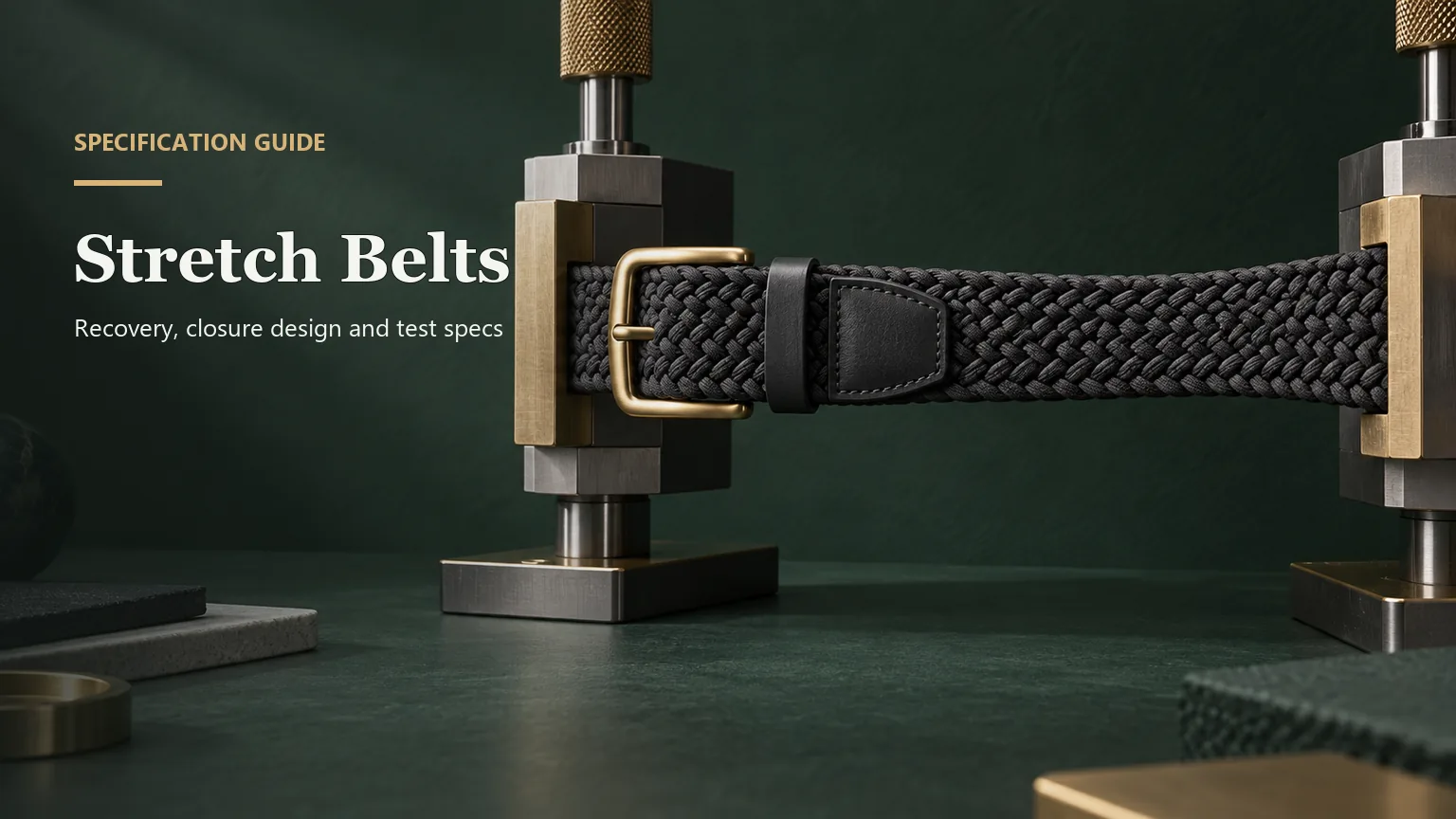
A stretch belt needs a coordinated specification for the elastic body, closure, rigid end sections and intended fit. Select it by the force needed at the wearing position, recovery after movement and stability of the finished assembly. Maximum stretch alone cannot answer those questions.
For a buyer, the difficult moment comes when two samples look alike but feel different around the waist. One pulls firmly; another lengthens easily but allows the buckle to move. A third feels right until its tab joint distorts. The purchasing decision sits at those interfaces, where textile behavior meets belt construction.
Points clés
- Specify force at the intended wearing extension, then check movement and recovery around that position.
- Separate standardized elastic-material testing from a project-specific finished-belt test.
- Freeze measurement datums and active elastic length before grading the size range.
- Diagnose strap growth, closure slip and joint movement separately; they can produce similar loose-fit complaints.
- Approve the material, hardware and sewing combination together before transferring the design into production.
Choose the Construction Before the Colorway
This guide covers fashion and everyday elastic belts, including woven straps and braided constructions. It does not cover restraint equipment or medical support products. Begin with how the wearer will fasten and adjust the belt, because that choice determines where the elastic can work.
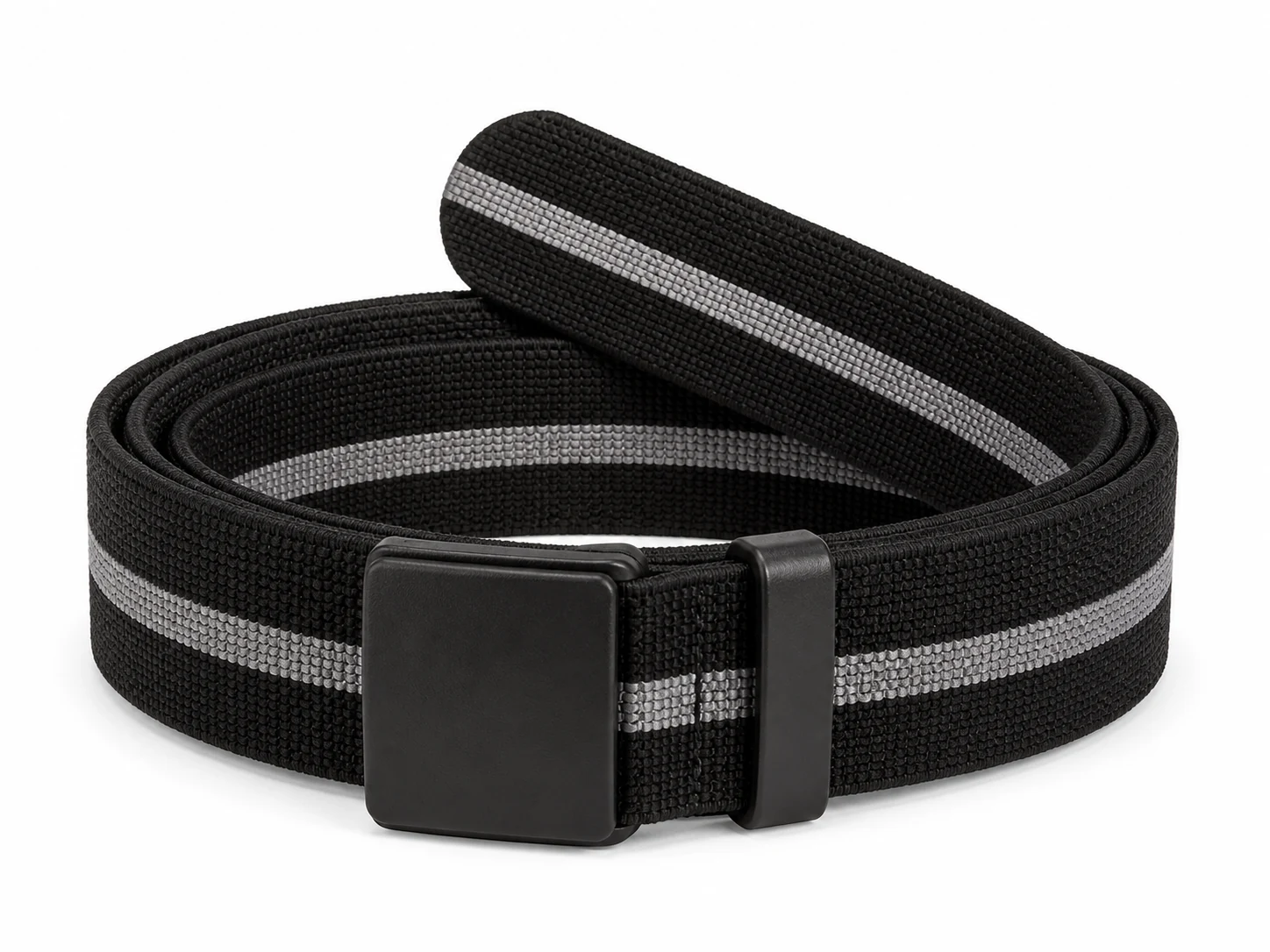
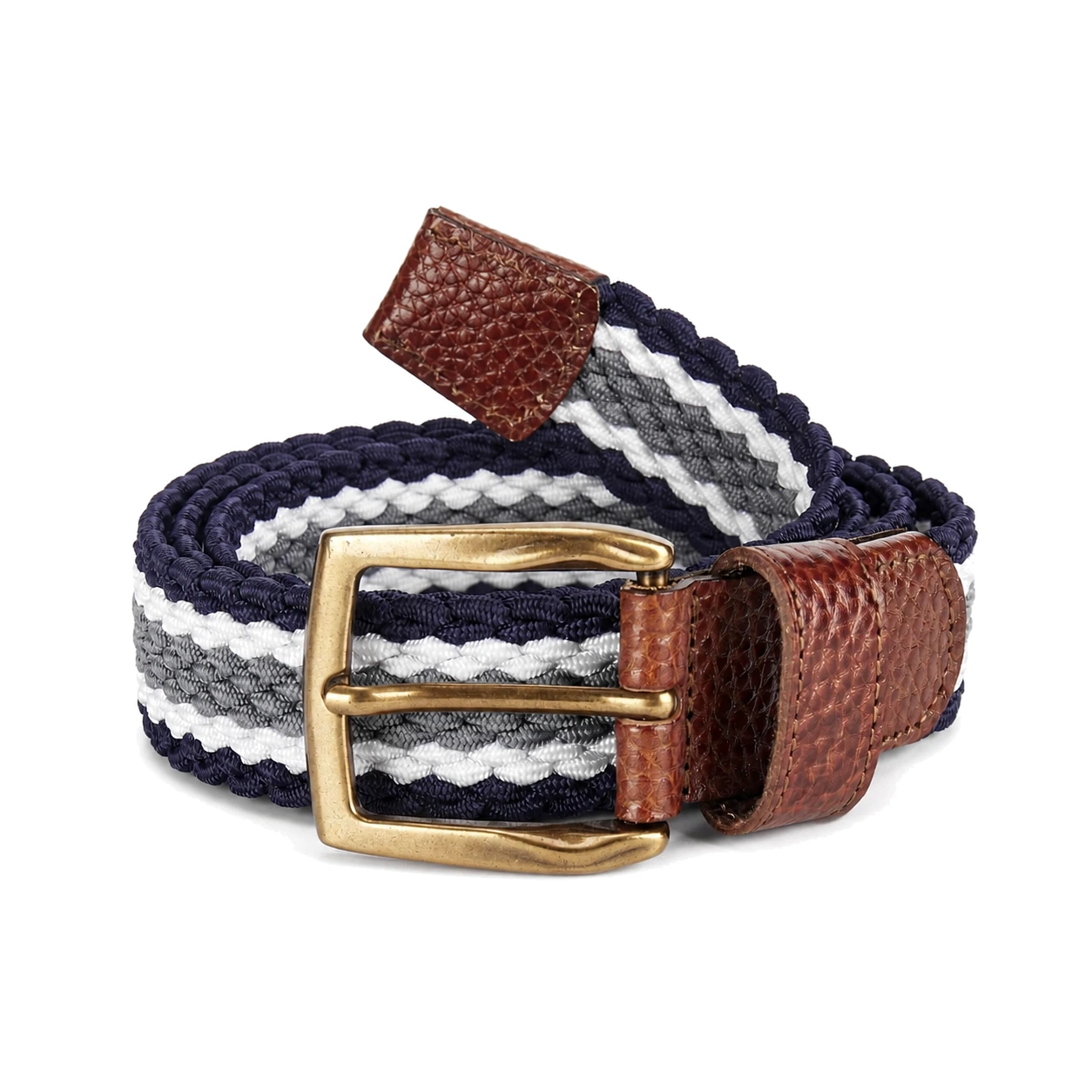
A prong-through-braid design offers adjustment between the cords instead of using a fixed row of punched holes. It suits a brief where flexible positioning matters, provided the braid accepts the prong cleanly. A flat elastic strap with a perforated end tab gives more familiar hole-based adjustment. Here, the tab defines the fastening positions while the textile supplies movement.
A clamp or slide closure changes the question again: can it hold the selected textile without damaging its surface? Review the actual contact faces, strap route and folded thickness. Do not choose the buckle from its external dimensions and assume that a strap of the same nominal width will fit.
The material description should identify the elastic yarn system, covering yarns, construction reference and finish through the supplier’s specification. A fiber name alone cannot establish the finished belt’s pull, recovery or surface behavior. Request matching physical swatches and assembled samples so that the proposed material can be compared in both forms.
Read the Behavior Behind the Pull
Extension describes how much a specimen lengthens from a stated starting length. Force describes how hard it must be pulled to reach that position. Recovery describes what happens after unloading. A useful buying specification keeps these results separate instead of condensing them into a single “good elasticity” judgment.
Consider two candidate straps at the same wearing extension. If one develops more force, the samples will not feel equivalent even if both can stretch to the same maximum length. Ask for force readings at agreed points within the intended working range, alongside a wearer-fit review. A laboratory reading helps compare candidates; it does not measure comfort directly.
Also distinguish growth during a sustained load from residual length after release. For a project comparison, record the length while loaded, immediately after unloading and after the agreed rest interval. Those observations tell you whether the concern is movement under load, slow return or persistent length change. Keep the timing identical across candidates.
The active elastic section matters more than total tip-to-tip length for this interpretation. A buckle, leather tab and captured fold do not necessarily extend with the free strap. If those rigid or restrained sections change, the same overall belt length can place a different extension demand on the elastic.
Freeze the Measurement Datums Before Grading
A datum is a defined reference point. Put the chosen datums on a drawing or marked sample: for example, the buckle’s effective bearing point and the center of the reference fastening hole. State whether the buckle is included. A supplier measuring to the tip and a buyer measuring to the middle hole can both report accurately while describing different dimensions.
For a hole-free braid, specify the usable fastening region and the intended wearing position within it. Do not label the entire strap as usable adjustment space: the end tab, keeper and required tail overlap can restrict practical fastening. Check the shortest and longest intended wearing positions with the complete belt threaded correctly.
Record relaxed length after a defined rest, with no hand stretching to make the strap lie straight. Then record the target fitted path around the garment and the active elastic length. Nominal size is the label connecting these measurements to the customer; it should not replace them.
When grading, verify the end sizes as well as the development size. Adding the same length increment without reviewing rigid sections, fastening positions and force at fit can change the experience across the range. Retain the agreed relationship between relaxed dimensions, intended extension and usable adjustment, then confirm it on size samples.
A Worked Example of Fit Geometry
Suppose a sample’s relaxed effective fastening path is 800 mm, measured between the agreed datums. Within that path, 700 mm is free elastic and 100 mm is treated as rigid for this simplified model. The intended fitted path is 840 mm. The elastic therefore supplies 40 mm of extension.
Its working extension is 40 ÷ 700 × 100 = 5.7%. Calculating 40 ÷ 800 gives 5.0%, but that uses the entire fastening path and understates the extension assigned to the active elastic in this model.
Now change the design to longer rigid tabs while keeping the same 800 mm relaxed path. If only 600 mm remains active, the same 40 mm movement requires 6.7% extension. The belt has the same nominal length, yet the textile operates at a different point. Its measured force at that point determines whether the revised sample still meets the fit brief.
The practical decision is to compare both assemblies at their actual wearing geometry. If the longer-tab version pulls too firmly, investigate active length, material response or fastening position together. Simply shortening or lengthening the label size may conceal the underlying construction change. This calculation is a development model; actual folds, slippage and deformation must be checked on the sample.
Match the Closure to Its Load Path
Follow the pulling force from the buckle through the tab, stitching and textile. Each transition needs enough grip and freedom of movement for its role. The aim is not to make every section equally flexible; it is to avoid an untested transition becoming the point where movement concentrates.
With a prong-through-braid design, inspect insertion, removal and repeated fastening around the preferred wearing position. Review the prong tip and the opening it creates. A visibly displaced cord is a reason to investigate prong geometry and braid compatibility, not automatically to tighten the braid or sharpen the prong.
For stitched end tabs, compare the overlap, stitch path and material stack with the intended pull direction. A neat seam can still restrict movement abruptly at the tab edge. Review the joint from both sides under extension, looking for yarn damage, lifting edges and localized distortion.
| Construction | Useful design feature | Development check |
|---|---|---|
| Prong through braid | Flexible fastening position | Insertion, snagging and repeated local opening |
| Perforated end tab | Defined hole positions | Hole alignment and elastic-to-tab transition |
| Clamp closure | Adjustment without punched holes | Retention, release and textile marking |
| Slide adjuster | Adjustable strap path | Threading clarity and movement under repeated loading |
Keepers deserve their own fit check. Evaluate the tail passing through the keeper at the actual folded thickness, then check whether it stays captured during movement. A keeper that looks proportional on a flat photograph may obstruct adjustment or leave the tail unstable when worn.
Control What Changes Between Sample and Bulk
A production specification should preserve the variables that made the sample work: material reference, width and thickness, braid or weave construction, buckle contact geometry, tab overlap and sewing arrangement. If a replacement material looks similar, compare its behavior before accepting it as interchangeable.
Watch how elastic is handled during cutting and sewing. For a repeatability trial, record whether it is relaxed or deliberately extended at each operation. If one sample is assembled under a different extension state, compare its relaxed dimensions and joint appearance before blaming the incoming material.
Needle choice is particularly important where the seam passes through textile and a stiffer tab. Groz-Beckert’s needle-selection guidance identifies needle size, point shape and thread compatibility as application choices. Its troubleshooting guidance also identifies damaged points and machine contact surfaces as possible sources of material damage. A mixed belt joint therefore needs a sewing trial on its actual stack, not a needle choice borrowed unexamined from leather-only work.
Separate seam extensibility from thread strength. Coats’ guidance on stretch seams connects thread selection and seam construction with extension, strength and softness. For a belt, determine which part of the seam is intended to move. A stronger thread alone does not establish that the joint will follow the required movement.
Think about dimensional variation as an assembly problem. A belt can combine an elastic cut length at one end of its tolerance, deeper tab capture and a changed buckle bearing point. Each component may look acceptable separately while the effective fastening path shifts. Review the combined geometry and allocate component limits accordingly, rather than assigning every part an unrelated tolerance.
For a repeat order, compare current incoming material with the retained reference before making replacement samples. Keep the same measurement state and method. If force at fit changes while dimensions remain comparable, investigate the material response. If the response matches but fit changes, examine the assembled geometry and closure position.
Separate Material Testing From Assembly Testing
Route 1: characterize the elastic material
Use a method appropriate to the supplied textile form. ISO 20932-3:2018 addresses narrow-fabric elasticity, with methods for quality assurance and performance in use. ISO also lists Amendment 1:2025. Record the exact edition, amendment and method in the laboratory request; do not specify only “ISO stretch test.”
ASTM D4964-96(2020) measures tension and elongation of elastic fabrics using constant-rate-of-extension equipment. Its public scope requires agreement on measurement points and on laundering conditions when used. It also warns that machine setup affects comparability. The laboratory should use the full selected method, rather than treating this purchasing guide as a test procedure.
Route 2: evaluate the finished belt
Use a separate, agreed functional protocol for the complete product. Include the buckle, tabs, keeper and normal strap threading. Define the wearing position, movement applied, cycling, hold and recovery sequence. Record closure slip and joint movement separately from elastic length change.
Mark reference positions beside the closure and at the joint so movement can be located. If the belt becomes longer but the material gauge marks return, investigate movement elsewhere in the assembly. A textile test report cannot by itself approve buckle retention or a stitched tab.
These two purchasing routes are not the Method A and Method B designations within ISO 20932-3. Name them distinctly in the specification. Report any modified or project-specific setup as such; do not describe it as full standard compliance without the laboratory confirming that claim.
Turn the Requirements Into a Test Record
Use the following blank record for the buyer, developer and laboratory to complete together. It is a project worksheet, not a replacement for a standard. Keep the material and finished-assembly records separate even when they share the same style reference.
| Champ | Complete before testing | Retain with results |
|---|---|---|
| Identité | Style, revision, size, color, material lot: ___ | Sample IDs and photographs |
| Route and specimen | Material / assembly; form and count: ___ | Individual specimen records |
| Méthode | Standard, edition, amendment or project protocol: ___ | Deviations and fixture details |
| Preparation | Conditioning, prior exposure and rest: ___ | Actual conditions and sequence |
| Starting geometry | Datums, gauge length and preload: ___ | Original measured lengths |
| Movement | Force or extension, rate, hold and cycles: ___ | Applied values and observations |
| Recovery | Rest interval and measurement definition: ___ | Before/after lengths and calculation |
| Performance acceptance | Metric, units and agreed limits: ___ | Individual values, not only pass/fail |
| Appearance acceptance | Approved reference and defect limits: ___ | Joint, braid and closure photographs |
Where residual growth is defined as a percentage, state its denominator and measurement state. A project may define it as recovered length minus original length, divided by original length, multiplied by 100. Use identical datums and preload. This explicit definition avoids confusing residual growth with extension under load.
Set product limits from the intended fit and development evidence. A standard designation does not supply a universal acceptable force or growth percentage for every stretch belt. Include appearance criteria because a numerically acceptable strap may still show distorted braid, damaged yarn or a twisted tab.
Locate the Failure Before Changing Materials
“The belt becomes loose” is a symptom with several possible causes. Compare the material marks, closure marks and joint position before choosing a remedy. Changing the elastic without locating the movement can leave a slipping closure unresolved.
| Observation | Possible route | Next comparison |
|---|---|---|
| Loose after movement | Material growth, slip or joint movement | Compare each set of reference marks |
| Damage beside stitches | Needle damage or concentrated local strain | Compare unsewn textile and sewn stack |
| Braid opens at fastening | Prong and braid incompatibility | Repeat fastening with the proposed hardware |
| One size feels firmer | Different working extension or material response | Check active length and force at fit |
These are investigation routes, not diagnoses from appearance alone. Preserve an unworked material sample and an approved assembly for comparison. For production release, connect the agreed checks to the belt inspection plan, including sampling and disposition of failures. Development approval and shipment inspection answer different questions.
Give Development a Complete Starting Brief
HongDing’s belt-business roots date to 2004, with its current company identity formed in 2010. Our development role includes coordinating material and hardware choices, samples and revisions. For stretch belts, that means discussing the strap and closure together rather than treating the buckle as a finishing detail.
Send a visual reference, target wearer and use, width, size range, preferred fastening route, quantity mix and packaging needs. Identify what is fixed and what needs development. Include the fit geometry and test worksheet where available, and prioritize the failures that matter: uncomfortable pull, size drift, buckle slip, yarn damage or an unstable tail.
Make quotation alternatives explicit. If one proposal changes the buckle, shortens the tabs or uses a different elastic reference, list the change beside the price. An apparent saving is only comparable after its effect on fit, appearance and verification has been reviewed. Ask suppliers to separate the base build from optional development, tooling, testing and packaging charges where those apply.
For a range with several colors and sizes, identify which components are shared and which differ. Shared hardware can simplify the specification, but it should not force unsuitable strap thickness or an awkward keeper fit. Group proposed variants by construction and risk so the sampling discussion addresses meaningful differences rather than producing many visually similar samples.
La elastic belt range helps frame construction options. Through design and development coordination, those inputs can become a sample with defined material, hardware and dimensions. Confirm commercial terms and the proposed test route for that build, including who performs each test and what evidence is required.
Questions fréquentes
Can a new color use the existing approval?
Do not assume it automatically. Compare the material reference and processing route with the approved version. Ask the material supplier and laboratory which checks need repeating, especially where the new color changes finishing or other relevant inputs.
Can laundering be specified for the textile alone?
Yes, for a textile comparison. A finished-belt care claim also needs consideration of the tabs, hardware and complete assembly. Do not turn a strap-only washing result into an instruction to wash the whole belt.
Does an identical replacement buckle need another trial?
Check more than its face appearance. Compare the strap path, contact geometry, clearance and retention on the actual textile. Recheck the affected assembly functions if those features or the material pairing change.
What if two laboratories report different results?
Compare specimen identity, equipment, setup and reporting definitions first. ASTM D4964 discusses comparative testing when acceptance results disagree. Resolve the cause or agreed interpretation before using either result to release disputed material.
Develop the Strap and Closure Together
Bring your reference sample, intended fit, size range and closure direction. HongDing can coordinate the material, hardware and sampling discussion around those requirements, with open construction and testing decisions identified before production transfer.