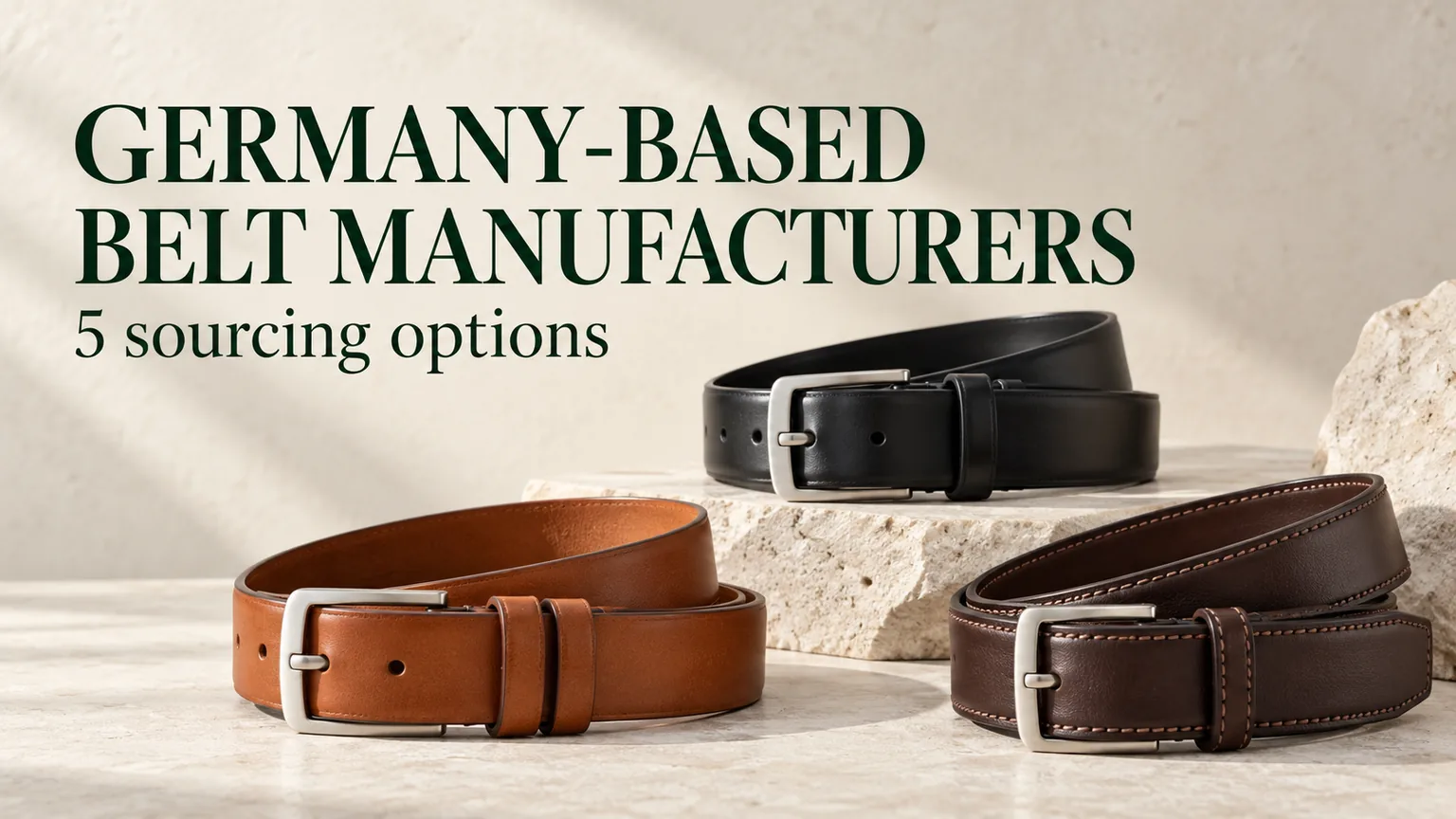
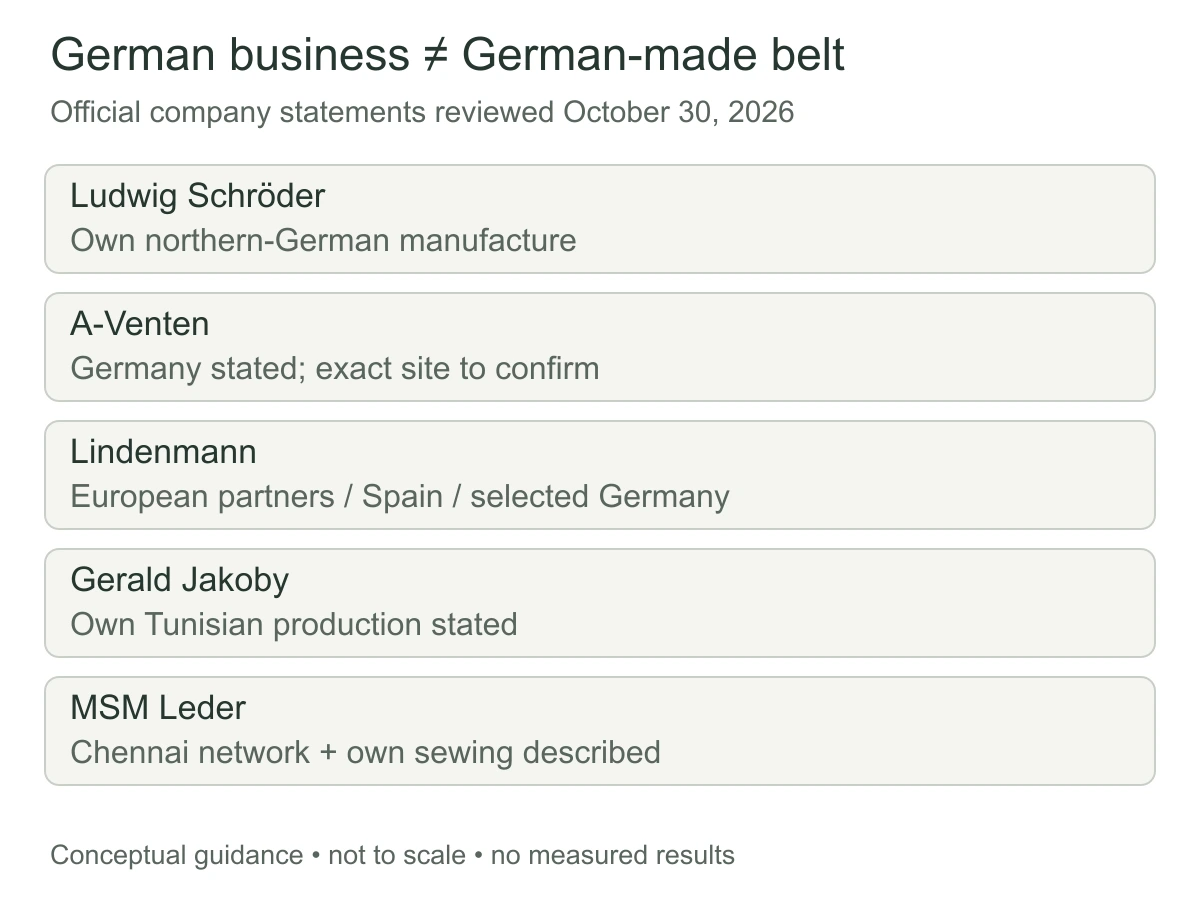
Five Germany-based leather belt manufacturing businesses worth comparing are Ludwig Schröder, A-Venten, Lindenmann, Gerald Jakoby and MSM Leder. They do not represent five interchangeable German factories. Their disclosed routes include German manufacture, European partner production, a Tunisian operation and manufacture in Chennai. Choose the route that matches your product and origin requirements before comparing a headline price.
Here, Top 5 means an editorial shortlist, not a ranking by sales, capacity or tested quality. We reviewed official company pages on October 30, 2026, looking for finished leather belts, a German business presence, a disclosed manufacturing role and a business-to-business route. Public descriptions are a starting point for qualification, not a factory audit or an offer to accept your particular order.
HongDing publishes this guide as a belt development and manufacturing business with a commercial interest in the category. We are not one of the five German companies and are not presented as an independent testing organization. The comparison below separates supplier statements from our recommendations for evaluating a belt program.
Compare production routes before company names
“A German supplier,” “made in Germany” and “German leather” describe different things. A German contracting company can organize overseas production; a belt assembled in Germany can use imported leather or hardware. If domestic manufacture is a non-negotiable part of your brand promise, ask about the exact product and manufacturing operations at the outset. Do not wait until the artwork for an origin label is already approved.
| Business | Production disclosure | B2B route to explore |
|---|---|---|
| Ludwig Schröder | Own northern-German manufacture | Private-label development and series production |
| A-Venten | German manufacture stated; exact factory site to confirm | Wholesale, OEM and private label |
| Lindenmann | European partners; Handcrafted Selection in Spain; selected German-made models | Retail collections and a separately scoped private-label inquiry |
| Gerald Jakoby | Own production in Tunisia stated | Private-label belt collections |
| MSM Leder | Chennai production; network plus own sewing described | White-label products and private-label development |
The table describes manufacturing businesses, including managed production networks; it does not say that each company owns every factory involved. Each business is counted once, not again for its collections or brands. Commercial availability, manufacturing allocation and order terms still need to be confirmed for the proposed belt.
1. Ludwig Schröder: a German private-label manufacturing route
Publicly described scope. Ludwig Schröder’s B2B page offers leather-belt development and manufacture in its own northern-German operation. It describes support from design and material sourcing through samples and series production, including different edge and layered belt constructions. The company therefore supplies a more specific starting point than a retail catalogue alone.
When to investigate it. This is a relevant candidate when domestic production and a developed leather construction matter to the brief. For example, a dress-belt program may need its edge profile, stitching and finished thickness reviewed together. Ask for a sample that represents that complete construction, rather than choosing from an attractive leather swatch and leaving assembly until later.
What to settle early. Separate the parts of your design that are fixed from the parts the manufacturer can propose. If an existing reference is being adapted, describe which appearance and handling features must survive the adaptation. This makes the sample comparison more useful than an instruction to make a “premium” belt.
The company’s domestic manufacturing statement does not establish the origin of every component in your order. If leather provenance or hardware origin matters separately, include those questions in the specification. Likewise, a published general service description does not settle design ownership, dedicated tooling arrangements or repeat-order material availability.
2. A-Venten: defined belt options with OEM and private-label inquiries
Publicly described scope. A-Venten’s official site identifies the business as a leather-belt manufacturer, states German production and lists wholesale, private-label and OEM services. It also offers customization such as logo embossing and special sizes. The website groups products by leather descriptions and widths, giving buyers a catalogue-based starting point.
When to investigate it. Consider this route when your brief starts with a recognizable strap format and needs controlled changes to branding, dimensions or design. A useful inquiry could identify the closest existing model and then list the required changes, rather than presenting a long collection of unrelated inspiration images.
What to settle early. Translate catalogue labels into the actual construction you are buying: face material, backing if present, edge treatment, thickness, buckle and fastening arrangement. A broad leather name does not describe the complete belt or establish the performance of the assembled product.
The company imprint gives a Cologne business address; do not treat that address as an independently verified factory location. Confirm the producing site for the quoted program. Also distinguish a B2B proposal from the website checkout: its online-shop terms address consumer transactions. A retail listing is not a substitute for an agreed OEM quotation, specification and commercial terms.
3. Lindenmann: collection supply and a disclosed European production network
Publicly described scope. Lindenmann’s manufacturing page distinguishes European partner facilities, its Handcrafted Selection produced in Spain and selected German-made models. That is the important sourcing distinction: the German company name does not make every model German-manufactured. Its company history also describes private-label development.
When to investigate it. This business warrants consideration when a retailer is comparing established belt collections and replenishment arrangements, while keeping bespoke development as a separate conversation. The company’s EDI service information describes integration of business documents such as orders, shipping advice and invoices. That is operationally relevant to a retail program, but does not itself prove stock availability or delivery performance.
What to settle early. Decide whether you want to purchase a collection, adapt a product under your brand or commission a new design. Those routes can require different approvals and documents. Do not assume that every model available through one channel is also available for private-label production.
For a multi-style assortment, record the manufacturing route by SKU rather than once at supplier level. Then align the product description, packaging statement and purchase file with each approved model. If a later substitution changes the producing country or construction, it should return for review instead of inheriting the approval of a visually similar belt.
4. Gerald Jakoby: private-label development with Tunisian production
Publicly described scope. Gerald Jakoby Accessories describes a focus on private-label leather products and belt collections. Its separate production page states that its own manufacturing is in Tunisia. Buyers should therefore evaluate a German business with a disclosed overseas production route, not a German-made belt by default.
When to investigate it. This route is relevant when the brand needs collection development and accepts Tunisian production. The inquiry should make that acceptance explicit so that design discussions are not interrupted later by an incompatible country-of-manufacture requirement.
What to settle early. Ask how design decisions and sample feedback are transferred to the producing team. The useful answer is not merely that communication is close. It is which version the sample represents, who approves deviations and how a revised edge, keeper or buckle becomes the production reference.
A cross-border development route can work well when those responsibilities are clear. It should not be assumed to be slower, cheaper or less consistent solely because production is outside Germany. Compare the actual proposed scope, material readiness, approval milestones and delivery basis. Public references to manufacturing know-how are not a substitute for assessing the construction your brand intends to order.
5. MSM Leder: German commercial coordination and Chennai manufacture
Publicly described scope. MSM’s leather-belt page describes a single-piece, vegetable-tanned full-grain belt with a brass buckle, identifies Chennai as its production location and offers white-label or private-label routes. The company homepage explains a Chennai network supplemented by its own sewing and leather-braiding activities, with a German contracting business in Sindelfingen.
When to investigate it. This is a candidate when an existing leather-belt model could provide the starting point, or when the buyer wants to discuss a new design through a German counterparty while accepting Indian manufacture. An existing product can help define the initial comparison, but it does not prove that a proposed material or hardware substitution will work unchanged.
What to settle early. Distinguish “use the existing product with our branding” from “develop a new product.” For the first route, identify the permitted branding and specification changes. For the second, establish what needs sampling and which construction details remain open.
Do not read “German standards” as “made in Germany,” and do not turn vegetable tanning into a blanket environmental or durability ranking. Any testing or compliance documents offered for a project need to match the actual article and components. The stated mix of partner manufacturing and own activities also means that the production plan should name who performs the relevant work, rather than assuming every step occurs in one company-owned factory.
Make the shortlist specific to the belt you need
Supplier discovery becomes useful when it removes incompatible routes. Before sending the same vague inquiry to all five businesses, make three decisions that materially change what a suitable proposal looks like.
Is country of manufacture fixed, or is the commercial interface the priority?
If the collection must be manufactured in Germany, begin with a supplier’s documented domestic route and confirm the exact proposed model. Do not treat a selected German-made line as a statement about its whole catalogue. If the priority is a German business relationship rather than domestic manufacture, cross-border routes can remain in the comparison with their locations clearly stated.
Are you choosing a catalogue belt or developing a construction?
An existing model lets you examine a tangible reference early. A custom development allows more decisions to remain open, but the quote needs to identify the work required to resolve them. A new buckle, lining or layered profile should not be described as a simple logo change. Conversely, do not pay for a fully new development process when an existing permitted construction meets the brief.
Which material and assembly details affect acceptance?
For a single-layer casual belt, discuss the reverse, edge appearance and feel of the actual strap. For a layered dress belt, examine the finished profile, stitching, edge and buckle fold as one assembly. These are review priorities, not claims that one construction is inherently better. A material swatch can establish a direction; it cannot show every feature of the completed belt.
Define which differences would cause you to reject a sample. “Smooth edge, low-profile fold and consistent visible stitching” is more actionable than “luxury finish,” provided the approved sample then makes those descriptions concrete. Leave unsupported numerical tolerances open for agreement instead of copying values from an unrelated product.
Check whether the approved sample can become a repeatable order
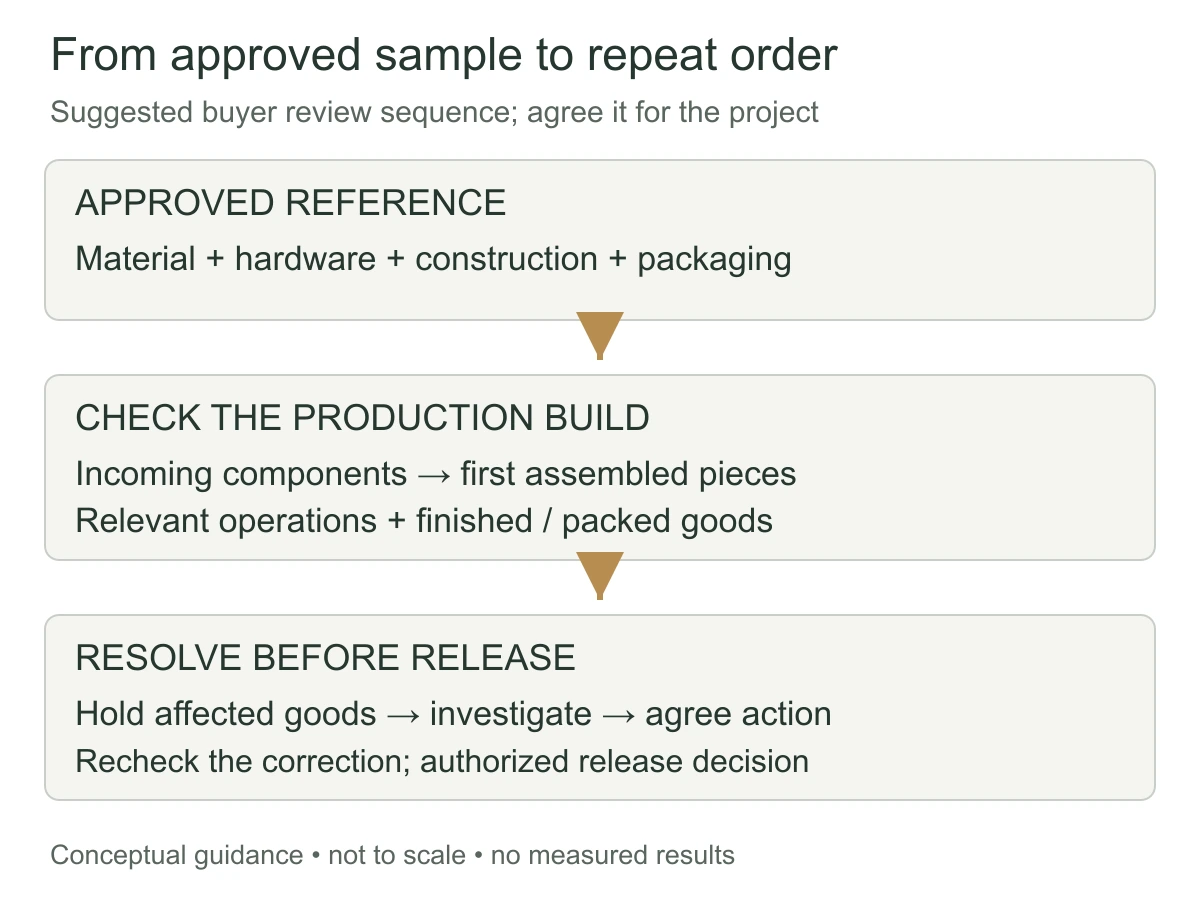
A convincing sample answers whether a construction can be made. A production review asks how the same configuration will be maintained across the order. Keep the discussion concrete enough that a supplier can show how your reference, components and checks connect.
- Freeze the reference. Identify the accepted sample and its material, hardware, size convention, edge finish and packaging. List open items separately so silence is not mistaken for approval.
- Match incoming components. Ask how the proposed leather article, shade and buckle are compared with that reference. A different component should be identified before it becomes indistinguishable inside finished goods.
- Review first assembled pieces. Compare the agreed measuring points, hole or adjustment layout, buckle fold, keeper fit and appearance. Confirm that the sample’s successful features survived the production setup.
- Follow the relevant operations. For this construction, identify where a change could affect the result: cutting, local thinning, stitching, edge finishing or hardware attachment. The inspection should look for those changes, not merely tick a generic quality box.
- Resolve deviations before release. Define who holds affected goods, investigates the scope, approves the response and checks the corrected product. Complete the relevant final and packing checks against the approved configuration.
Ask for a practical explanation of this route for your belt, not confidential documents from another customer’s order. The sampling plan, tests and acceptance criteria need agreement; a polished sample or a photograph of machinery does not establish them. For wider factory evaluation, our manufacturer evaluation guide expands the supplier-qualification questions.
Send an inquiry that produces comparable answers
A concept-stage inquiry can begin with authorized reference images and an intended use. It does not need a finished technical pack. Make clear which elements are inspiration and which are required so that suppliers do not assume you are asking for an exact copy of another brand’s product.
Once you are comparing quotations, use the same input for each candidate. Include the proposed style, construction direction, size range and approximate quantity mix if known. Explain any country-of-manufacture requirement, branding and packing needs. Ask suppliers to identify what is included, what remains provisional and what would change the quotation.
Compare the responses in separate columns for development, product supply and delivery. An apparently lower belt price may omit a sample stage, branded packaging or a component change included elsewhere. That is a scope difference until you reconcile it, not automatically evidence that one manufacturer is more efficient.
For repeat orders, ask what identifies the approved version and what happens if a leather article, buckle or pack is no longer available. A written substitution process is more useful than an assumption that an old product code guarantees identical inputs forever. Agree how the replacement will be evaluated before it is released into the order.
Questions about this Germany shortlist
Are all five belts manufactured in Germany?
No. The list covers Germany-based manufacturing businesses and explicitly distinguishes their production routes. A requirement for German manufacture must be checked against the exact offered product.
Which company has the lowest MOQ or price?
This review does not establish comparable current terms. Request quotations for the same construction and quantity mix. A website number without its material, customization and packaging scope is not a reliable comparison.
Does inclusion mean the supplier passed an audit?
No. Eligibility is based on public official descriptions. Factory capability, order readiness and product evidence still require buyer qualification. None of the positions is a quality ranking.
How does this differ from a European supplier list?
The focus is these five German businesses and their distinct production and cooperation routes. For a wider geographical search, see our European private-label research list.
Comparing a China-based development route as well?
HongDing sits outside this German shortlist. Our business roots extend to 2004, with the current company identity formed in 2010. We support brand-focused belt development, material and hardware coordination, sampling and manufacturing discussions. If production need not be in Germany, our OEM and ODM route offers a separate option to evaluate against the same product brief.
Share a reference image or sample, the intended market and the changes you want to explore. We can discuss the construction and next sample questions; production allocation, commercial terms and timing require project-specific confirmation.