Five leather belt manufacturers in Poland worth contacting are AM Leather for a buyer-owned line, BREMI for comparing wholesale trouser belts, GRACIO for choosing between private label and branded stock, CEZMAR for vegetable-tanned bovine leather belts, and BRODOWICZ for a shop buying finished classic belts. Start with the two that already make something close to your intended product. The first sample should answer the question that would otherwise stop you placing an order.
A fashion label developing a raised dress belt and a retailer replenishing a black jeans belt can both use a Polish manufacturer. Their first emails should look quite different. The fashion label needs someone who can reproduce a particular profile under its name. The retailer needs a model number, available waist sizes and a reliable route back to the same style when its middle sizes sell through.
Which Polish belt maker fits your order?
We chose five separate businesses whose own pages describe finished leather waist belts, manufacturing in Poland and a route to a trade or development inquiry. “Top 5” is an editorial shortlist organized by buying use. The evidence comes from the companies’ public descriptions, reviewed in November 2026. We have no comparable audit of their capacity, workmanship or sales. HDBelt makes belts separately and has no place among the five Polish candidates.
Match the first inquiry to the product
On a small screen, swipe to read all three columns.
| Polish manufacturer | Evidence to start from | What to settle first |
|---|---|---|
| AM Leather | Near Warsaw. Names individual belt constructions and welcomes own-brand inquiries. | Which sample, buckle and construction will define your production style? |
| BREMI | Workshop in Wielogóra. A wholesale catalog lists leather trouser belts by model code. | Which widths, colors and sizes can you reorder under the same code? |
| GRACIO | Publishes distinct private-label and branded wholesale offers. Reports Polish production for most belts. | Where will your selected style be made, and which changes belong to your brand? |
| CEZMAR | Lists a producer contact in Łęczyca and describes its production line and vegetable-tanned leather belts. | Which leather finish and buckle will appear on the quoted model? |
| BRODOWICZ | Describes production in Poland and features the B-0040 classic leather belt. Lists a wholesale distributor. | Who confirms material, stock and replenishment for your chosen belt? |
AM Leather for a private-label dress or casual belt
AM Leather is run under the name Wyroby ze skóry – Marek Antoniak, with a business address in Raszyn. The company says it produces belts near Warsaw, makes small lines for individual inquiries as well as larger classic lines, and invites customers developing their own brand to contact it. A useful feature of its English-language catalog is the construction detail. Model M4011 is a flat, full-grain belt with rounded, burnished edges. M3505 has a raised profile, a corrected leather face and a screw-mounted satin-finish buckle. See the model descriptions and AM Leather’s production and custom-line offer.
For a dress trouser program, send a side view of the profile you want. A raised center can create a neat ridge beneath a jacket, yet the section that folds around the buckle still needs to bend and lie close to the body. A frontal photo hides that transition. Ask for the supplier’s proposal for the body and fold separately, with a short cut section if you need to approve a particular build. M3505 gives the conversation a specific starting point without committing either party to an unseen internal construction.
Pay particular attention to the hardware approval. AM Leather’s catalog says the buckle supplied can differ slightly from the picture. That may be acceptable when buying for a small independent shop. It matters much more when the jacket buttons, shoe hardware and belt buckle must share a finish in a campaign. Put the accepted buckle code, finish and approval photograph on the order. Ask who will contact you if that component runs out before the next size run. AM Leather catalog.
BREMI for wholesale trouser belts selected by model
BREMI identifies its belt production facility in Wielogóra, near Radom. Its B2B catalog lets wholesale customers and fashion companies select models for a tailored quotation. The catalog lists several brown 35 mm leather belts, including 0279M and 0280M, as well as black options such as 0283M. It also links to Beltman as its online shop. Treat the manufacturer and that shop as one sourcing lead. BREMI’s production location and wholesale model selection.
This is a useful route for a retailer whose buyer can point to an existing belt. Send a short list of model codes and request the actual size curve for each. A row of similar dark belts on a screen says little about what can ship together. Try the two closest models on the trousers they will accompany. An extra-wide frame may strike the front loop when the wearer sits. A darker edge can make two brown belts look like different colors on adjacent hangers even when their faces look similar.
If one model works, ask how the code behaves over time. Does it name the finished belt including buckle and finish, or could the buckle change while the style number stays the same? Request the supplier’s preferred reorder reference and retain a sample with its hangtag. If you need your label embossed or packaging printed, list that as a separate request. BREMI’s published model-quotation route gives you a way to ask. The cost, ownership and availability of a particular alteration belong in the written offer.
GRACIO when the brand on the finished belt matters
GRACIO offers two clearly described routes. One lets a business develop a leather goods line with its own logo. The other supplies existing GRACIO products to shops. The business, GRACIO Paweł Łukaszewski, lists a contact in Licheń Stary. It says it began its own belt production in 2019 and makes 99 percent of its belts in Poland. That percentage leaves a practical question for anyone planning to print a country claim on a wrap or swing tag. Ask for confirmation for the precise style and order before sending the artwork to print. GRACIO’s two B2B routes and its production statement.
Use the private-label route when presentation is part of the product. Specify whether your mark goes on the inside of the strap, the box, the buckle or more than one of these. Those choices involve different components and approval steps. An inside stamp can become faint on a heavily textured surface. A deep impression on a thin strap can show through to the front. Ask for the mark on the chosen leather at actual size, then check the reverse in daylight. A digital logo proof cannot answer those questions.
A shop starting with GRACIO-branded stock needs different terms. Ask which sizes can be reordered individually and who supplies the style descriptions, image permissions and product codes for your selling channel. For a later own-brand release, ask which assets you can retain from the trial. Retail photography carrying the original maker’s mark and a size card printed for its collection may both need replacing, even if you choose to keep a similar shape.
CEZMAR for a vegetable-tanned leather trouser belt
CEZMAR describes a belt production line, identifies vegetable-tanned bovine leather trouser belts as its core product and says it works with domestic and foreign tanneries. The producer contact is Cezary Marczewski in Łęczyca. Its account also describes working with manufacturers of leather goods fittings. Those are useful distinctions when the buyer wants Polish belt manufacture, a specific leather and a particular buckle. Ask the producer to identify the finishing and assembly location for the quoted belt, then record the leather source and hardware separately. CEZMAR’s manufacturing description and named producer contact.
One useful reference for a women’s trouser range is PD-3-94, a navy leather belt which CEZMAR identifies as its own Polish production. The listing gives a width range of 2.8 to 3 cm. A garment team working with a narrow waistband can use that range to decide whether to request the widest permitted sample for a loop check. The wholesale site displays a preview-mode notice, so confirm availability and quantity with the producer.
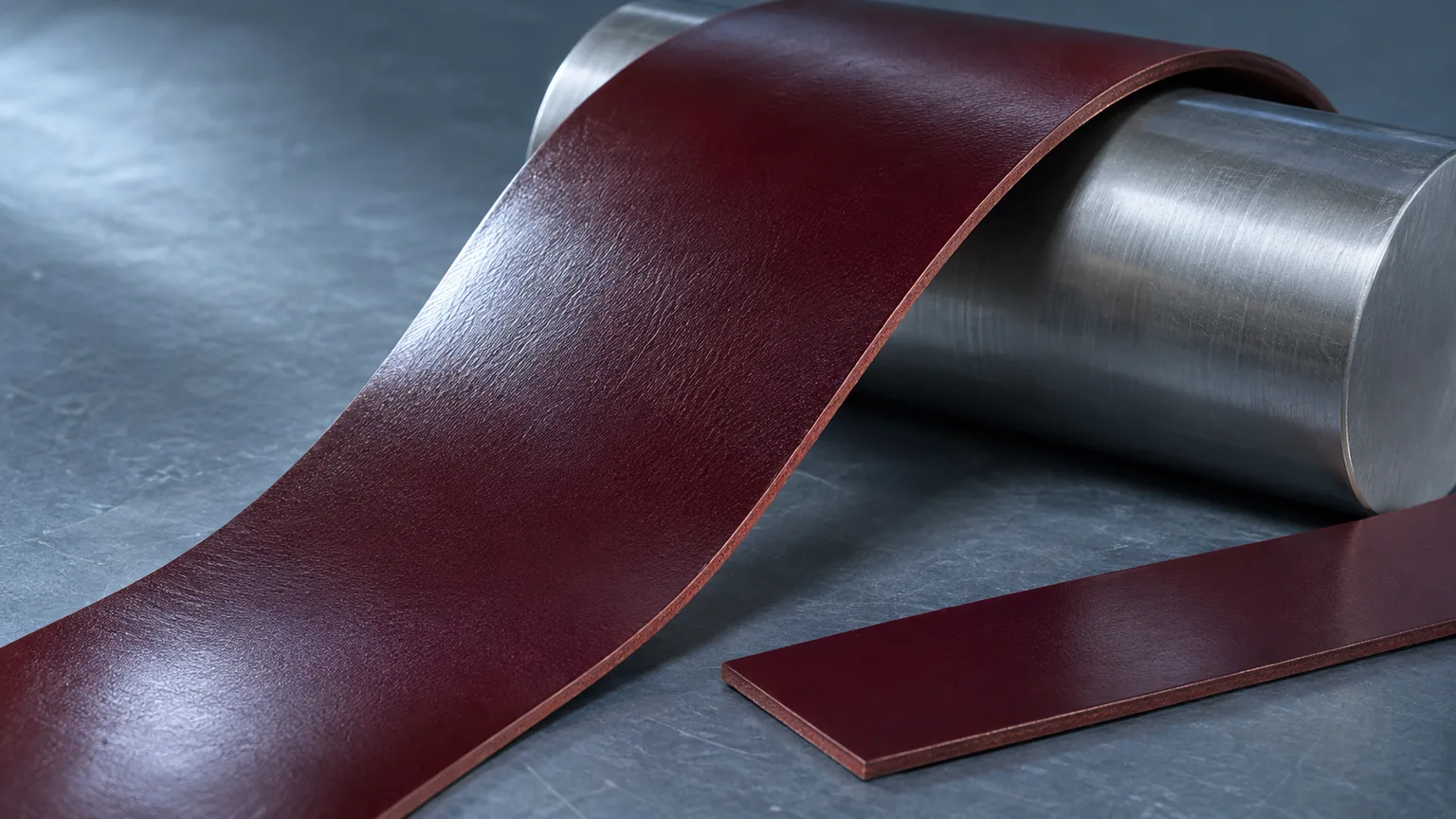
“Vegetable-tanned” identifies a tanning method. It leaves open the finish, temper, variation across hides and what the belt will look like after its first few bends. For a light tan range, send a garment swatch and request a few finished strips showing the lightest and darkest shades the producer would put in one delivery. Fold one around the actual buckle bar and examine the face in that position. A tonal change may be welcome in a heritage collection and distracting when dozens of belts hang beside identical chinos.
For a custom buckle, ask what an existing fitting could achieve before commissioning a new one. A frame already available in the right inside width may need only a finish approval. An exclusive outline brings questions about tooling, minimum order and replacement parts. Find out who keeps the tool and what reference identifies the approved finish. Even if CEZMAR assembles the belt, a replacement run of metal parts may follow the fitting supplier’s calendar. Ask for the two dates separately in the quotation.
BRODOWICZ for a retailer testing a classic leather belt
BRODOWICZ describes producing its leather goods in Poland and lists a classic leather belt, B-0040, alongside its other accessories. It distinguishes leather and imitation materials across the wider range and invites retailers to carry its products. A wholesale contact is listed through its principal distributor, GR4 in Tychy. Tychy is the distributor address shown on the page. Use the wholesale route for an assortment quote and request the manufacturing details for the model you buy. BRODOWICZ product and wholesale information.
A retailer can make good use of that distinction. Ask for the selected belt’s material description, a photo of its marking, the relevant stock codes and a list of sizes available in each color. If you are merchandising the belt beside a matching document case or wallet, request the two physical pieces together. Leather thickness, surface texture and reflected light can make the same color name look quite different across accessories. Decide whether the range promises an exact match or a coordinated palette before your product photographer shoots it.
BRODOWICZ’s public offer supports a conversation about carrying its assortment. If your launch needs an exclusive shape or an unbranded strap, first establish whether a development inquiry can reach the maker through the distributor. A retailer with an opening date can often make its decision sooner by fixing the material and finish of one available model, then negotiating replenishment for the sizes that sell. A buyer who owns the pattern needs a named contact authorized to accept changes.
What should the first samples settle?
Send each shortlisted maker the same garment or the measured dimensions of its smallest usable belt loop. Specify the strap width, where the waistband sits and the point from which your size label is measured. A narrow dress belt that slides easily through the side loops can still catch at the front because the folded buckle end and keeper occupy more space than the single strap. Test the finished sample on the actual garment, including the size worn most tightly. Record which hole was used and how much tail reached the next trouser loop.

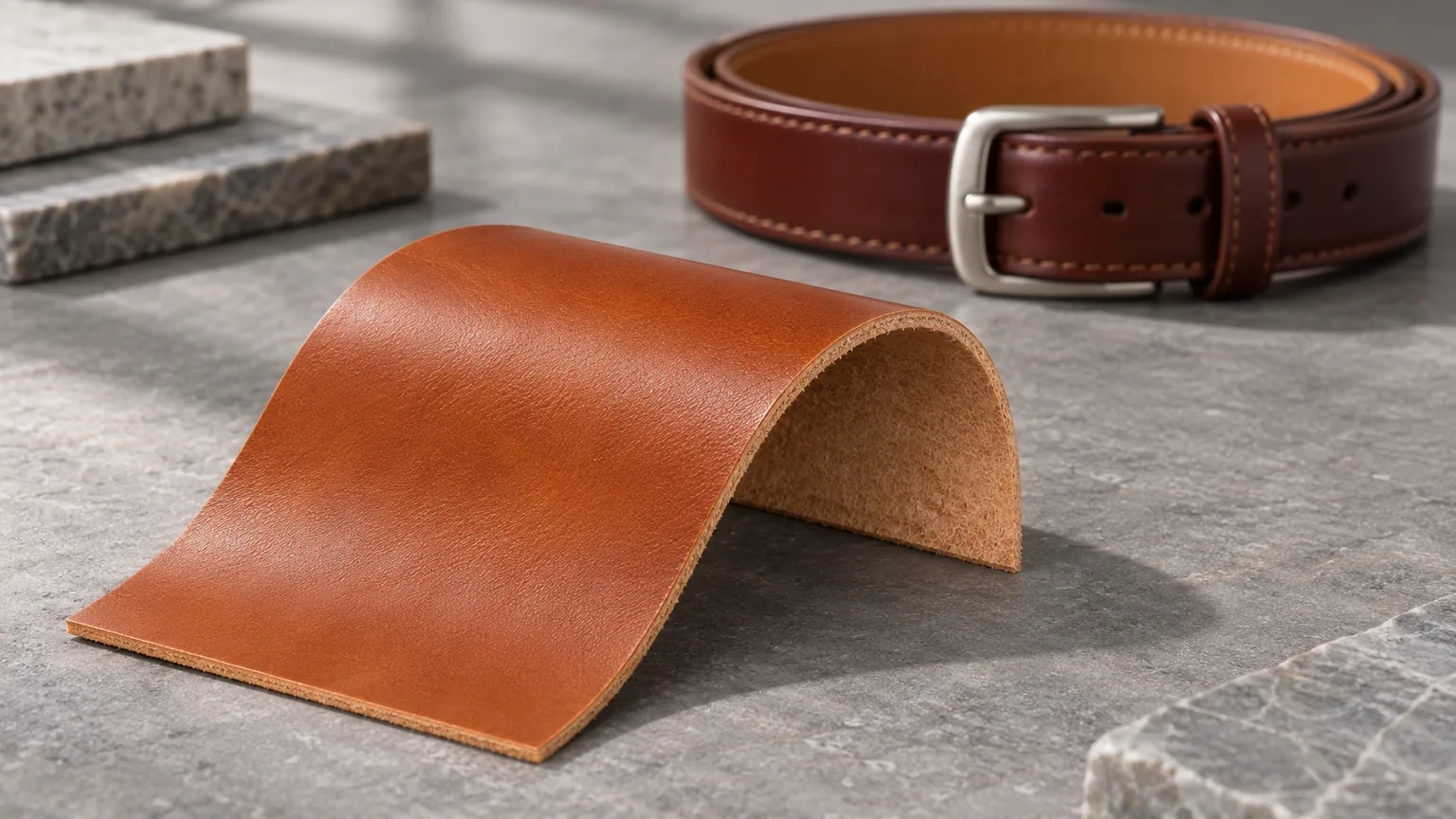
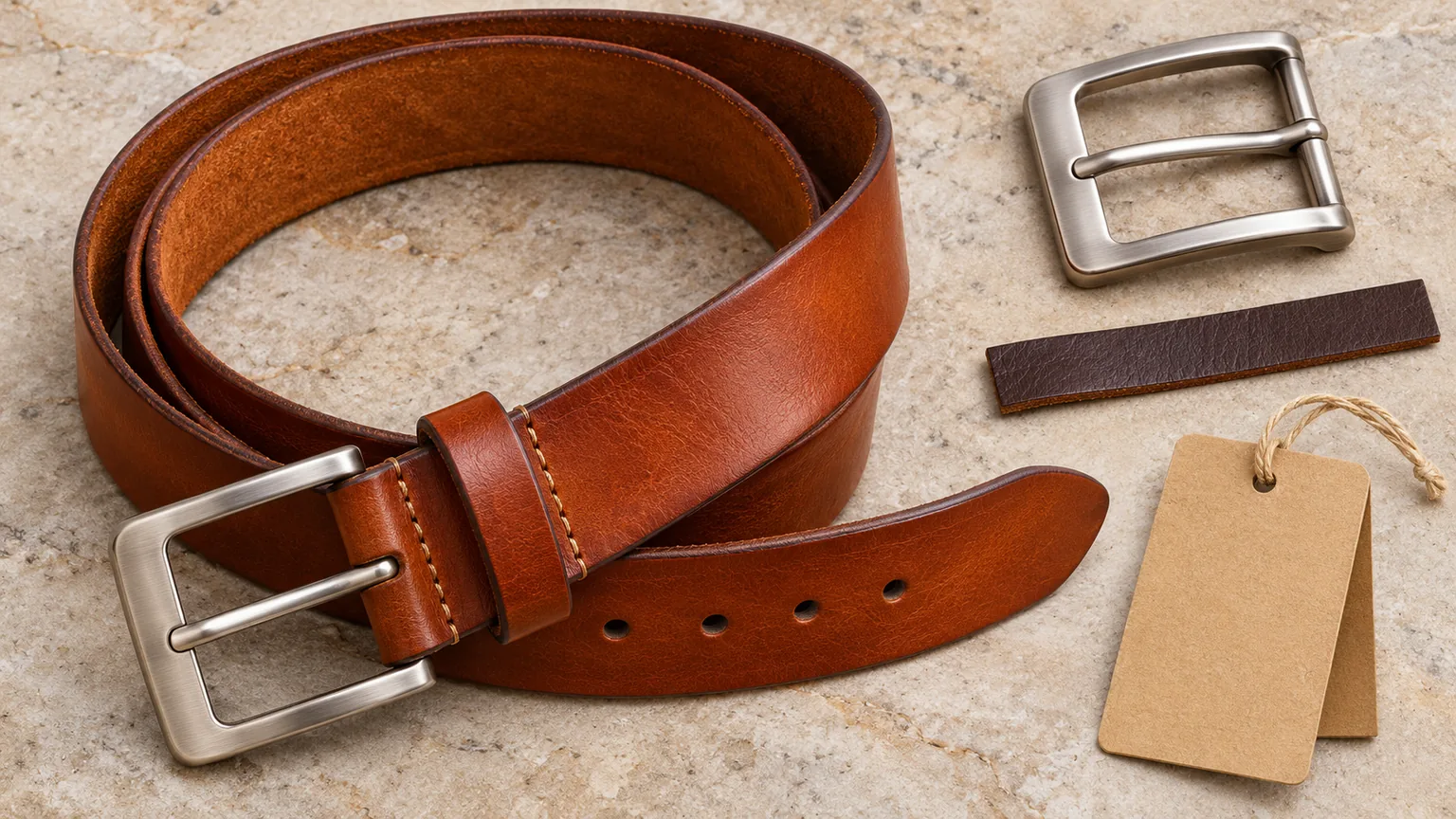
Keep three items together for the sample review: a face swatch, a section through the strap and an assembled belt with the proposed buckle. The swatch shows the grain and finish. The cut edge reveals whether the visible face continues through the strap or is backed with other layers. The assembled sample shows how those layers behave at the holes and fold. Ask each producer to name the layers in plain language and note which one will carry the buyer’s mark. A polished edge can otherwise hide a construction change between two visually similar offers.
Look at the back where the buckle hardware presses against the garment. A screw post must suit the thickness of the folded stack. If it stands proud, it can rub the waistband. If it barely engages, the buyer should ask the maker to revisit the fitting. Pass the tail through the keeper with the sample fastened. Thick decorative hardware or a pronounced fold can alter that path even when the nominal strap width is correct. Record the physical finding and send a photograph of the contact point so the supplier can propose a specific change.

Compare two offers against the same size curve
Imagine a shop wants 120 belts for a trouser launch. Its allocation is 60 black and 60 brown. Within each color it wants 12 small, 30 medium and 18 large. One maker proposes existing branded stock with a price for each belt. Another proposes a private-label run with a charge for the logo die and a separate minimum for each color. Send both the six quantities. Ask each to quote the number it would actually invoice and deliver against those rows.
Suppose, purely for this example, that the custom offer requires 80 units per color. The buyer would be committing to 160 belts, including 40 for which it has no opening allocation. Dividing the die charge by 160 makes the unit price look attractive, but the store still has to pay for the extra stock. Ask whether both colors can share leather or hardware commitments, whether one color can launch first, and whether the quoted minimum attaches to the strap, buckle finish or printed box. Each answer changes a different part of the order.
A wholesale offer can have the opposite difficulty. Stock may be sufficient in total while the medium size is nearly gone. Ask for a dated allocation and the expected replenishment window for the missing row. Compare the opening order value, setup charges, packing, freight basis and number of sellable opening sets. Record the currency and whether the amounts include applicable taxes. Once both offers describe the same delivery, the buyer can decide how much control over branding is worth relative to the cost of an incomplete size run.
What will let you reorder the same belt?
Keep one signed or otherwise clearly identified sample with the order reference. Attach the agreed measuring diagram, material description, available shade range, buckle reference, logo position and packaging artwork. Ask the supplier to mark which items already exist and which must be purchased or made specifically for you. When a best-selling size needs a repeat, that distinction tells you whether the maker can cut more straps from available material or must first reorder a matching component.
Ask separately about country information. A company can manufacture a belt in Poland while buying its hides, tanning services or fittings elsewhere. If a Polish production claim will be printed on your packaging, request a written account for the selected style, identify the entity that will invoice it and have your labeling team check the intended wording for the destination market. If the production route or supplying entity changes on a reorder, get the new details before reusing older packaging.
For a Polish program, take the closest model code from this shortlist and send the maker a reference photo, target garment, expected quantities by size and color, sales market and the changes that need a quote. Ask for one physical sample and a dated offer tied to that sample. If your sourcing brief is open to manufacturing outside Poland, HDBelt can discuss a separate development route from the same reference or an existing sample. Discuss a belt project with HDBelt’s OEM/ODM team.