By Kevin · Technical review by HongDing Sourcing and Quality Team · Published 2026-09-15 · Publisher profile · Review scope: sourcing and quality evidence
Use this U.S. list as a claim map, not a league table. Nine entries have live company pages; the tenth is retained only as a dated catalog lead. Each profile separates an American address or market presence from the still-unproven origin of the belt offered for your program.
The search phrase U.S. belt manufacturers hides several business models. A direct factory, a small workshop, a brand with a manufacturing claim, a wholesaler, and a sourcing company can all appear beside one another. This guide labels the public model instead of flattening those differences. It also connects supplier discovery to HongDing’s manufacturer evaluation workflow, so the list becomes an auditable process rather than a collection of names.
The Direct Answer for Buyers
The FTC says an unqualified Made in USA claim requires a product to be all or virtually all made in the United States. A U.S. address alone does not establish that standard. The useful question is not “Which name is best?” It is “Which candidate can prove that the proposed entity, facility, process, sample, evidence file, and commercial terms match this order?”
This edition includes ten profiles because each had a relevant official-company page or a clearly labelled industry-directory record when checked. Inclusion is not approval. The page does not claim that HongDing visited, audited, tested, ordered from, or reference-checked the listed businesses. Read the list as a research queue and validate it against the current FTC Made in USA guidance and destination-market advice.
What This Research Covers
How the Ten Supplier Leads Were Screened
For the current-site group, a page had to name the business, show a belt offer, expose a business contact or location, and indicate wholesale, custom, private-label, or production work. A search snippet did not qualify. The Tory Leather catalog remains visible for historical context only and is dated in both the profile and source ledger.
We excluded promotional adjectives from the comparison. Claims about domestic manufacture, materials, lead times, capacity, customers, or testing remain self-reported until matched to the proposed SKU and current records. The table records only the observable sales model and the origin or operating question the buyer still has to close.
The output is an American-market research queue. Approval would require entity and address validation, an origin bill for the actual belt, facility or subcontractor disclosure, a controlled development sample, commercial terms, and an inspection plan tied to measurable workmanship criteria.
Compare the Ten Public Supplier Profiles
Read the right-hand column as the first origin or production question to send, not as a defect score. Two companies can use similar U.S. language while relying on materially different cutting, sewing, hardware, finishing, or import routes.
| Company or lead | Public place or structure | Public model | First unresolved check |
|---|---|---|---|
| Amano Goods | United States; workshop location to confirm | Small-studio wholesale and private-label supplier claim | Confirm workshop address, realistic batch size, hardware source, and whether all belt operations occur at the stated U.S. site. |
| Leather Works Ltd. | Stockton, Missouri | Wholesale-only manufacturer claim | Confirm which belt models accept private labeling, the production steps performed in Missouri, and the evidence supporting the origin claim. |
| Leon Leather | Edgewater, Florida | Wholesale belt manufacturer claim | Confirm private-label availability, current style range, leather terminology, order minimums, and written product-origin substantiation. |
| Magna Leather Corporation | El Paso, Texas | Private-label manufacturer and leather wholesaler claim | Confirm the exact facility and process route for the proposed belt, current material availability, buckle sourcing, and sample-to-bulk controls. |
| NYC Belts / Universal Elliot Corp. | United States; production site to confirm | Custom manufacturer claim | Confirm the current production address, factory ownership, private-label services, and which constructions are made internally or sourced. |
| Phoenix Leather Belts | Cincinnati, Ohio | Wholesale and private-label supplier claim | Confirm workshop identity, material and hardware origin, labeling scope, style-level minimums, and proof behind domestic-production wording. |
| Pioneer Fit | Texas | Manufacturer with wholesale and custom programs | Confirm whether the target is a fashion, work, sporting, or weightlifting belt and validate construction, test, and labeling needs for that use. |
| Saddlebelt | United States; workshop route to confirm | Wholesale, custom, and private-label supplier claim | Confirm which production workshops make the order, exact leather grade, hardware source, sample status, and the current commercial terms in writing. |
| Tannare | San Antonio, Texas | Handmade workshop and private-label production claim | Confirm the private-label product range, capacity, exotic-material legality and documentation where relevant, and repeat-order controls. |
| Tory Leather | United States; facility details to confirm | Historical catalog lead for special projects and private label | This is the one dated catalog lead, not a current-site profile. Reconfirm that the company, program, facility, materials, styles, and contact route remain current. |
Ten Official-Source Profiles
The U.S. entries run A to T. “Made,” “manufacturer,” “wholesale,” and similar labels are preserved as the source uses them; none should be read as HDBelt certification of domestic origin, factory ownership, or present capacity.
1. Amano Goods
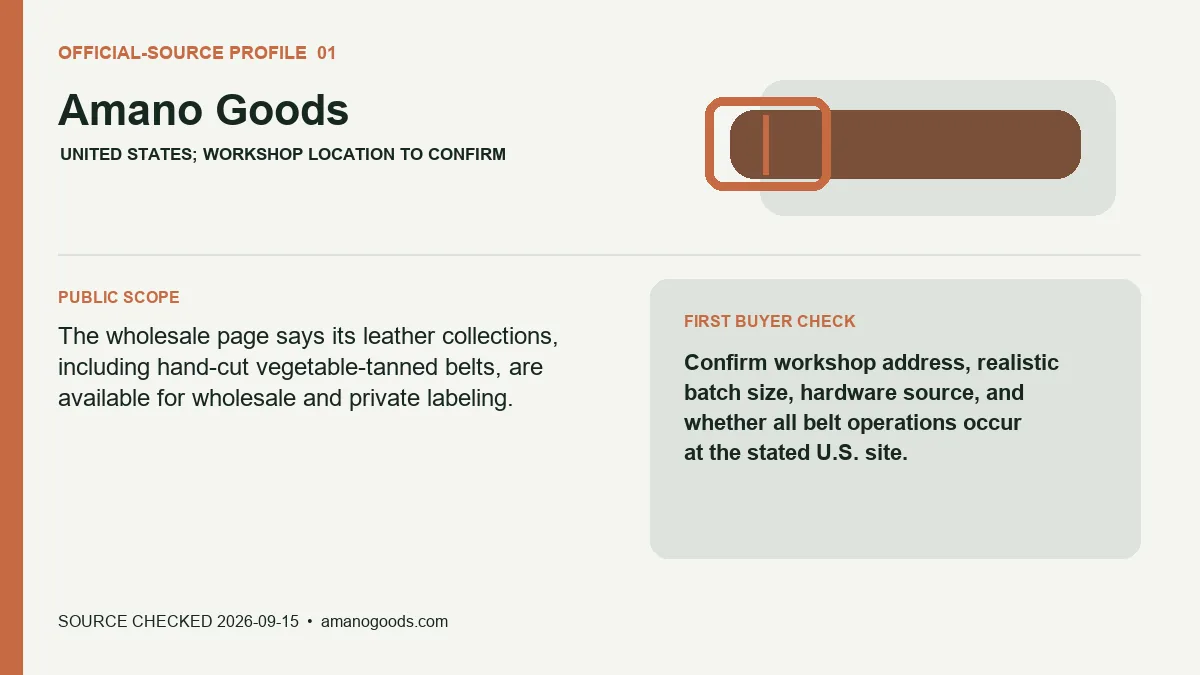
What the public page supports: The wholesale page says its leather collections, including hand-cut vegetable-tanned belts, are available for wholesale and private labeling.
What it does not prove: Confirm workshop address, realistic batch size, hardware source, and whether all belt operations occur at the stated U.S. site.
Official page reviewed: https://amanogoods.com/pages/wholesale · 2026-09-15
2. Leather Works Ltd.
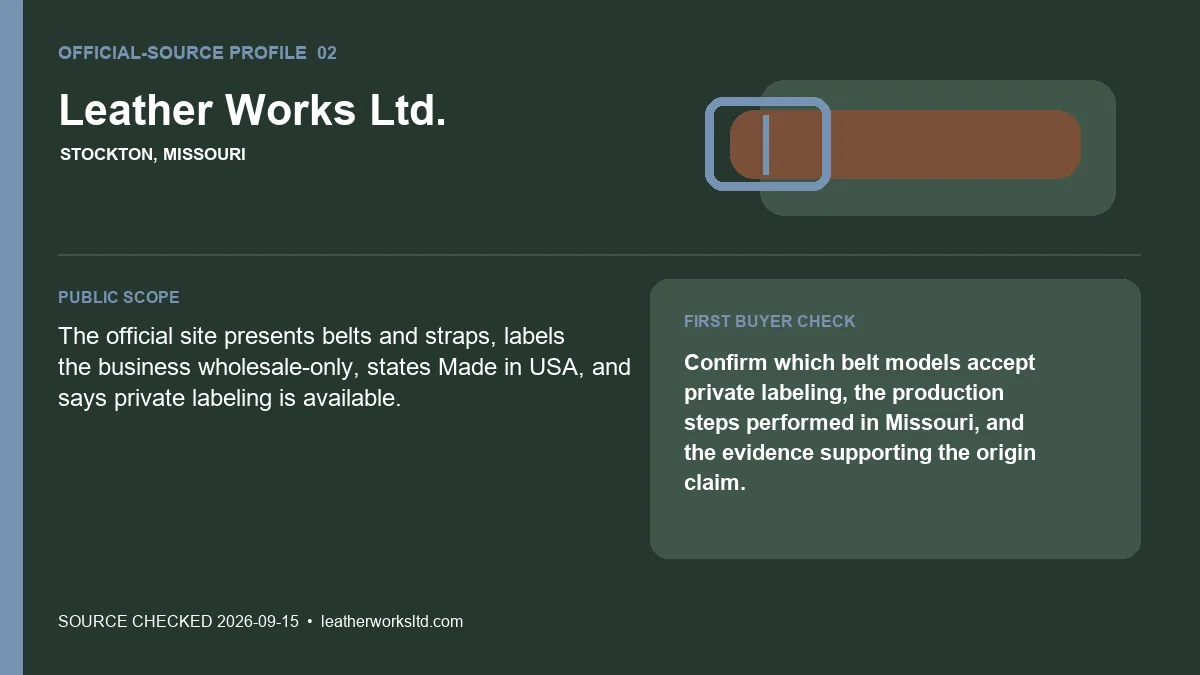
What the public page supports: The official site presents belts and straps, labels the business wholesale-only, states Made in USA, and says private labeling is available.
What it does not prove: Confirm which belt models accept private labeling, the production steps performed in Missouri, and the evidence supporting the origin claim.
Official page reviewed: https://leatherworksltd.com/ · 2026-09-15
3. Leon Leather
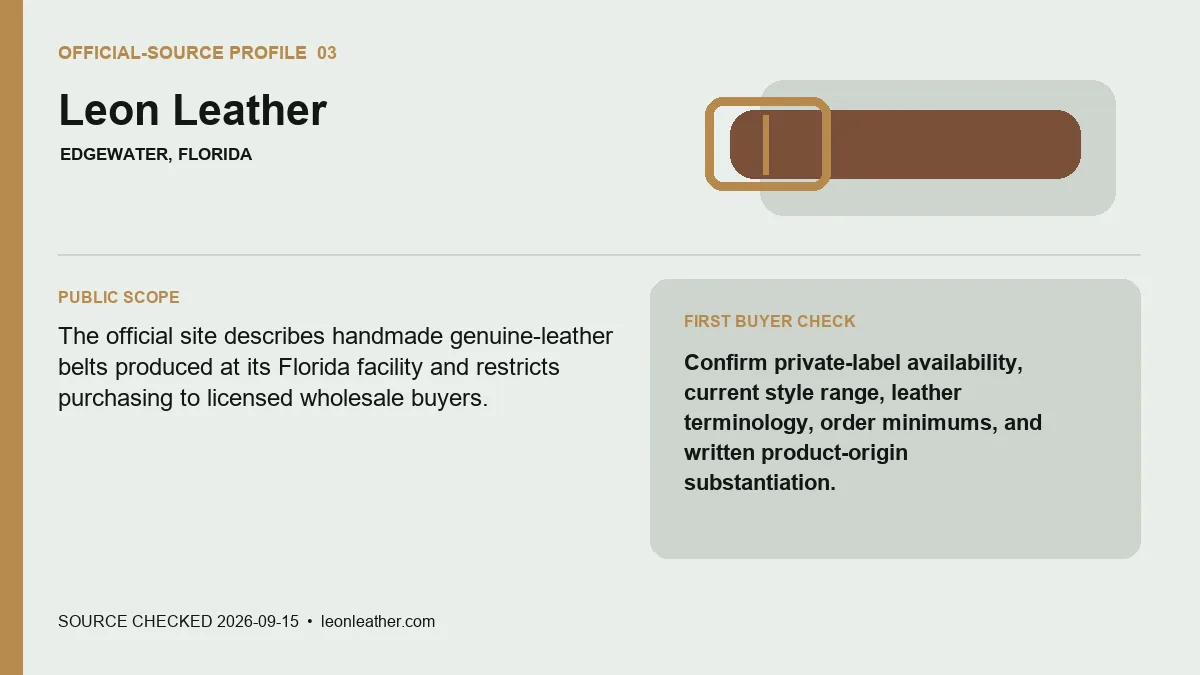
What the public page supports: The official site describes handmade genuine-leather belts produced at its Florida facility and restricts purchasing to licensed wholesale buyers.
What it does not prove: Confirm private-label availability, current style range, leather terminology, order minimums, and written product-origin substantiation.
Official page reviewed: https://leonleather.com/ · 2026-09-15
4. Magna Leather Corporation
What the public page supports: Its official page describes U.S. private-label belt manufacturing, leather finishing in El Paso, and dress, casual, western, and custom design options.
What it does not prove: Confirm the exact facility and process route for the proposed belt, current material availability, buckle sourcing, and sample-to-bulk controls.
Official page reviewed: https://www.alligatorbeltsbymagna.com/ · 2026-09-15
5. NYC Belts / Universal Elliot Corp.
What the public page supports: The company site presents custom manufacture of fabric and leather belts and related accessories for brands.
What it does not prove: Confirm the current production address, factory ownership, private-label services, and which constructions are made internally or sourced.
Official page reviewed: https://nycbelts.com/ · 2026-09-15
6. Phoenix Leather Belts
What the public page supports: Its wholesale page states that belts are handcrafted in the United States and offers private-label branding for retailers.
What it does not prove: Confirm workshop identity, material and hardware origin, labeling scope, style-level minimums, and proof behind domestic-production wording.
Official page reviewed: https://phoenixleatherbelts.com/ · 2026-09-15
7. Pioneer Fit
What the public page supports: The wholesale page states that leather and nylon belts are handmade in Texas and invites custom or private-label manufacturing inquiries.
What it does not prove: Confirm whether the target is a fashion, work, sporting, or weightlifting belt and validate construction, test, and labeling needs for that use.
Official page reviewed: https://pioneerfit.com/pages/wholesale · 2026-09-15
8. Saddlebelt
What the public page supports: The official wholesale page offers full-grain leather belts, debossing, private label, packaging, and custom specifications for qualifying orders.
What it does not prove: Confirm which production workshops make the order, exact leather grade, hardware source, sample status, and the current commercial terms in writing.
Official page reviewed: https://saddlebelt.com/pages/wholesale · 2026-09-15
9. Tannare
What the public page supports: The company site states that leather belts are handmade in its San Antonio workshop and advertises custom-made and private-label production.
What it does not prove: Confirm the private-label product range, capacity, exotic-material legality and documentation where relevant, and repeat-order controls.
Official page reviewed: https://www.tannare.com/ · 2026-09-15
10. Tory Leather
What the public page supports: The company's 2022 belt catalog describes special-project and private-label opportunities for buyer-designed or adapted products.
What it does not prove: This is the one dated catalog lead, not a current-site profile. Reconfirm that the company, program, facility, materials, styles, and contact route remain current.
Official page reviewed: https://toryleather.com/catalogs/belt_catalog_2022.pdf · 2022 catalog, checked 2026-09-15
Domestic-Production Claims Need a Product-Level Check
For this search, the first split is not large factory versus small workshop. It is a product made in the United States versus a supplier located in the United States that may source elsewhere. Both models can work. They create different evidence requests, lead-time assumptions, country-of-origin statements, and cost structures.
The Federal Trade Commission’s Made in USA framework applies to product claims, not simply to company identity. Its current business guidance explains that an unqualified claim calls for the product to be all or virtually all made in the United States. Buyers should ask a supplier to state which belt styles, materials, hardware, and operations the claim covers rather than carrying a homepage badge into packaging copy.
A practical RFQ should use one line for the contracting company, one for the proposed production site, and one for the product-origin claim the supplier is willing to support. If buckle casting, leather finishing, sewing, packaging, or final assembly takes place elsewhere, record that route before approving labels or marketing text.
A Five-Stage Verification Flow Before Supplier Approval
Locate the operation
Request the legal company name, workshop or factory address, and the exact site proposed for sampling and bulk production.
Define the belt scope
Separate fashion, western, work, weightlifting, fabric, and exotic-skin belts. Equipment and material skills do not transfer automatically across those constructions.
Test the origin wording
Ask for the factual basis behind Made in USA, handcrafted in USA, assembled in USA, or U.S.-based language for the exact SKU.
Freeze a reference sample
Approve leather, width, thickness, edge, stitching, hardware, keeper, holes, markings, and packaging as one controlled reference.
Confirm repeatability
Ask how leather lots, buckle sources, color standards, subcontractors, and inspection records are controlled for reorders.
Close origin and identity questions first because later sample and inspection records are useful only when they refer to the same contracting party and production route. Freeze construction, buckle, finish, packaging, claim language, tolerances, and approved reference before bulk release; record any proposed substitution as a controlled change.
Turn the Longlist into Comparable Belt Quotations
Issue one U.S.-program pack: a dimensioned belt specification and bill of materials; an origin worksheet naming leather, buckle, fasteners, packaging, and each processing location; and a priced response form covering samples, tooling, testing, inspection, freight, duties, and payment. Ask the vendor to mark every field it cannot yet confirm.
Normalize the commercial boundary before comparing unit prices. The belt supplier quote framework exposes excluded charges, while HongDing’s private-label routes clarify whether the request is a stock modification, full development, or another production model.
A credible response names the entity, planned location, accountable contact, evidence owner, and validity date. Treat an unconditional “yes” without traceable origin records, a specific material route, or a sample-control owner as an open issue rather than a sourcing advantage.
Common Buyer Questions
Does a U.S. office prove a belt is made in the USA?
No. Company location and product origin are separate facts. Ask where the named SKU is cut, sewn, finished, assembled, and packed, then review the basis for any origin claim.
Are these U.S. belt manufacturers ranked?
No. The entries are alphabetized official-source research leads. Inclusion records a public manufacturing or wholesale signal, not verified quality or superiority.
What should a private-label belt RFQ include?
Include the belt drawing, material and construction specification, buckle and finish, size architecture, branding, packaging, quantity by SKU, approval plan, and destination-market requirements.
How should buyers compare workshops with larger manufacturers?
Compare against the same product brief and evidence request. Capacity, process ownership, development support, traceability, and reorder control matter more than company size alone.
What proof supports a Made in USA claim?
Ask the supplier for a product-specific explanation of domestic and imported inputs and operations. Packaging language should be reviewed against current FTC guidance and legal advice where needed.
Build a Supplier File You Can Defend
Keep the U.S. shortlist as a dated chain of proof. Archive the source page, origin worksheet, clarifications, approved sample, inspection record, and every component change together. That file—not the marketing phrase on a homepage—is what lets a team defend its origin language and repeat the order consistently.
Need a benchmark for your belt specification?
HongDing can provide a non-U.S. development benchmark for construction, hardware, packaging, quality controls, and landed-cost assumptions. Send the intended origin claim and SKU brief so the response distinguishes product engineering evidence from country-of-origin evidence.