By Kevin · Published 2026-09-06 · Updated 2026-09-06
Belt manufacturing does not begin when a strip reaches a cutting table. It begins when a factory receives a released product definition: the belt construction, material articles, dimensions, hardware revision, artwork, appearance reference, packaging files, and acceptance rules that production is expected to repeat.
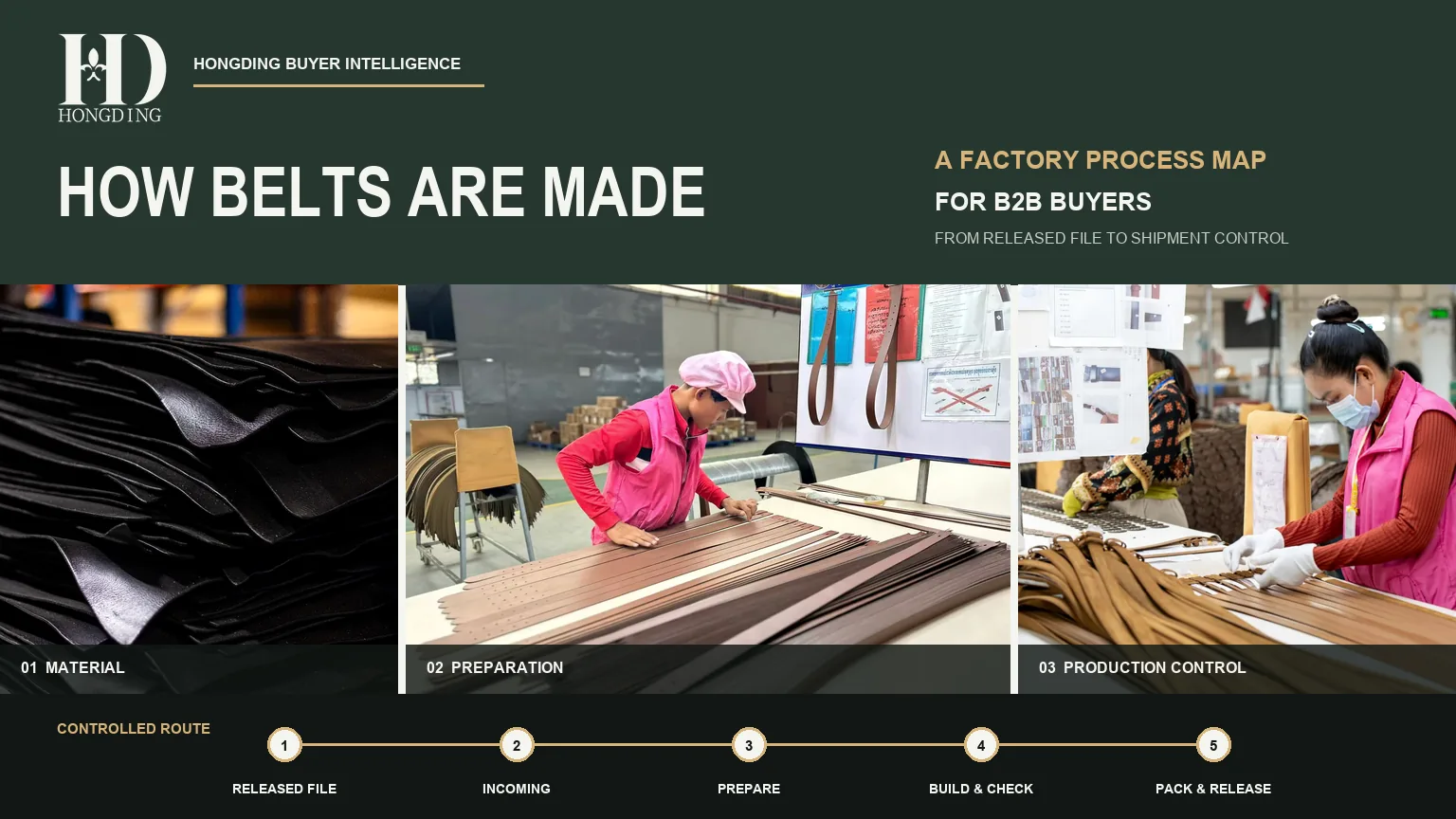
From that point, the factory route usually moves through incoming material control, strap preparation, construction, hardware and branding, inspection, packing, and shipment release. The exact sequence changes with the product. A single-layer leather belt, a lined dress belt, a braided textile belt, an elastic style, a reversible belt, and a ratchet belt do not pass through the same operations.
This guide from HongDing answers “how are belts made?” from a B2B buyer’s point of view. It maps each factory stage to the input that authorizes work, the output that proves the stage was controlled, and the condition that should stop work. That makes the map useful for supplier briefs, sample-to-bulk transfer, factory reviews, and root-cause discussions.
Map the Complete Factory Route
A useful belt manufacturing process map has more than a row of machine names. It shows what must be approved before a stage starts, what the operation changes, what record or sample permits work to continue, and what discrepancy causes a hold. Without those links, a factory can execute every visible step and still make the wrong product.
The route below is a control model, not a promise that every belt uses every operation. The approved construction decides which stages apply. That is why the manufacturing capability review should be based on the actual belt rather than a broad category label.

Separate Leather Making From Belt Making
The phrase “leather belt factory” can hide two different supply-chain scopes. Leather manufacturing converts and finishes hide material. Belt manufacturing cuts and constructs that material into a finished accessory. Some groups coordinate both scopes; other factories buy finished leather from a nominated source.
The Leather Working Group audit scope distinguishes raw-to-tanned, raw-to-crust, tanned-to-finished, and crust-to-finished operations. The American Leather resource on how leather is made likewise describes tanning as stabilization of raw hide, followed by post-tanning and finishing. Those are upstream transformations, not alternate names for cutting a belt strap.
This boundary matters during sourcing. A buyer should know who controls the leather article, finishing recipe, color reference, surface effect, testing evidence, and lot traceability before the belt factory begins cutting. HongDing describes Pro Pelli as a leather-finishing facility within its operating network. That does not mean every program starts with raw hide or uses the same leather route. The applicable scope must be confirmed for the named article.
The same principle applies to coated synthetics, webbing, elastic, and other materials. Upstream material manufacture and downstream belt conversion need separate specifications and separate evidence. Material names are not sufficient purchasing specifications; composition, construction, finish, and claim language must be frozen together.
Release Materials and Components
A factory cannot inspect an incoming lot against an adjective such as “premium,” “soft,” or “antique.” It needs an identifiable material article and an approved comparison point. The released BOM should connect every visible and hidden component to a supplier, revision, color or finish direction, and relevant acceptance requirement.
Incoming control is not limited to the face material. Linings, reinforcements, thread, adhesives, edge materials, buckles, keepers, mechanisms, snaps, rivets, labels, and packaging components can change the finished fit or appearance. A buckle revision can alter tongue clearance. A backing change can alter flexibility. A label change can turn the correct belt into the wrong SKU at receiving.
| Product route | Incoming definition to freeze | Typical incoming concern |
|---|---|---|
| Leather | Leather article, finish and color reference, thickness locations, backing or lining direction | Lot identity, shade, grain or surface variation, usable placement |
| Coated synthetic | Face composition, backing, surface emboss or finish, color reference | Layer identity, surface consistency, adhesion or flex-related evidence required by the project |
| Woven or braided | Fiber or strand specification, weave or braid construction, width, color arrangement | Pattern repeat, edge behavior, tension, width, component compatibility |
| Elastic | Elastic construction, recovery requirement, width, end treatment, closure interface | Recovery, distortion, attachment behavior, lot consistency |
| Mechanism-led belt | Track or closure revision, buckle mechanism, strap interface, function criteria | Mixed revisions, engagement, release, alignment, component damage |
Cut and Prepare the Strap
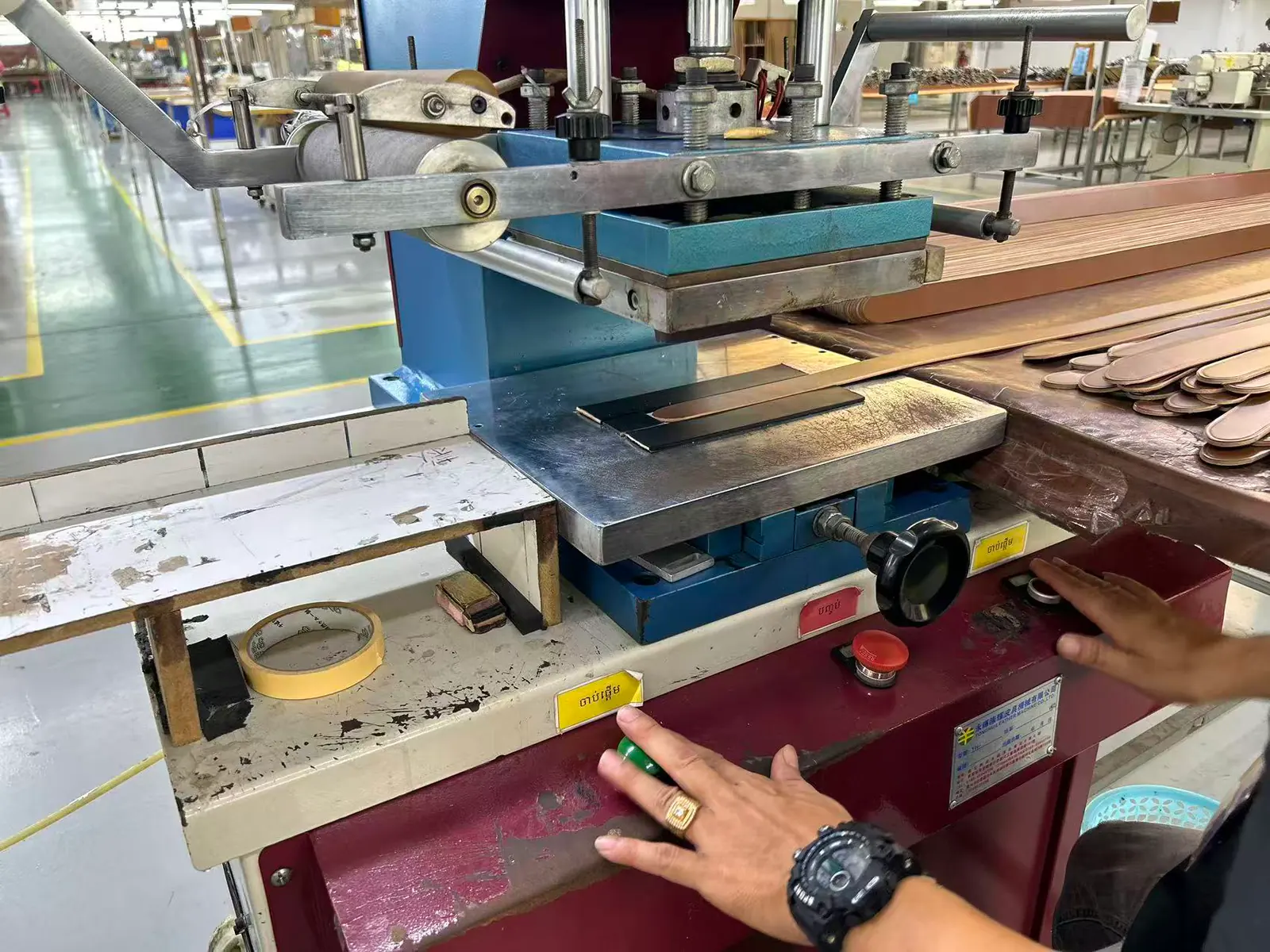
After materials are released, the belt route becomes physical. Patterns and measurement datums guide cutting. Depending on the construction, preparation can include strip cutting, splitting, skiving, lining, reinforcement, lamination, tip shaping, or preparation for folded edges. Natural leather also requires placement decisions because the usable surface is not visually identical across a hide.
A published Bhutan government leather-belt project profile gives one representative lined-leather sequence: material selection, strap cutting, edge skiving, lining preparation, folding and pasting, stitching and trimming, buckle attachment, edge setting, punching, inspection, and packing. That sequence is useful evidence of a common route, but it is not universal. An unlined strap, a reversible construction, or a woven product needs a different map.
The first-off check should occur before a full batch inherits a preparation error. The reviewer compares the first production piece with the current drawing, BOM, approved construction, and physical reference. Dimensions alone are not enough. The team also checks layer order, tip form, reinforcement position, surface orientation, and the allowance needed by downstream edge and hardware operations.

Build Edges and Join Layers
Edge work is one of the clearest signals that “a belt” is not one manufacturing route. A leather edge may be cut and burnished, coated in repeated controlled applications, folded over a lining, or enclosed by another construction. Synthetic and textile routes can require sealed, folded, stitched, or bound edges. Each method has its own preparation order and its own failure paths.
Layer joining is equally conditional. A lined dress belt may combine face material, reinforcement, lining, adhesive, and stitching. A single-layer work belt may avoid several of those steps. A woven belt creates its body through strand construction, while a braided style must preserve pattern and tension through cutting and end finishing. The work instruction must name the actual route rather than copy a generic leather-belt checklist. The types of belts guide helps separate the main construction and closure routes before a process sheet is released.
In-line inspection belongs immediately before defects become difficult to see or expensive to reverse. That can mean checking layer position before closure, edge preparation before coating, stitch placement before long runs continue, or reinforcement before hardware covers it. The control point should protect the feature at risk, not simply satisfy a fixed inspection schedule.
Install Hardware and Branding
A buckle and strap should be approved as one working system. The factory must align strap width, thickness profile, fold or attachment construction, keeper position, hole or track route, and closure clearance. Hardware identity also includes finish, geometry, moving parts, and revision. A visually similar substitution can still change function or fit.
Installation can involve punching, slotting, folding, stitching, riveting, snapping, clamping, or mechanism assembly. The correct operation depends on the closure. A pin buckle needs a different relationship between tongue, holes, buckle frame, and keeper than a ratchet system needs between track and release mechanism. A reversible buckle adds face orientation and switching function to the check.
Branding needs the same discipline. The product file should define the logo method, artwork revision, size, placement datum, orientation, color or finish, and approved appearance. Embossing, debossing, printing, metal marks, woven labels, and packaging graphics do not produce interchangeable results. Production should stop when the artwork or placement reference is unclear rather than interpret a low-resolution image on the line.
Control Production at Named Gates
HongDing’s documented workflow uses incoming, first-off, in-line, and final checks. These are separate gates because each answers a different question. Incoming control asks whether the correct materials arrived. First-off asks whether the released file can be reproduced on the production route. In-line control protects construction while work is under way. Final inspection asks whether completed and packed goods meet the agreed release basis.
| Control gate | Primary question | Useful evidence | Buyer review point |
|---|---|---|---|
| Incoming | Are these the approved material and component identities? | Lot and article references, receiving status, comparison records | Trace the accepted lot to the BOM and supplier article |
| First-off | Does the first production piece match the released construction? | Measurements, appearance and construction review, approval status | Confirm the reviewer used current files and the approved reference |
| In-line | Are critical operations remaining controlled during the run? | Named checks at edge, seam, layer, hole, hardware, or function stages | Look at a record tied to the actual lot and workstation |
| Final | Do finished goods and packs meet the release basis? | Inspection result, pack audit, authorized deviations, release status | Confirm defects and deviations were dispositioned before shipment |
A golden sample is powerful when it sits beside current written records. It can communicate hand feel, proportion, edge appearance, buckle relationship, and overall workmanship. It cannot preserve a hidden material identity, a numeric dimension, an artwork revision, or an acceptance rule by itself. For a deeper review of inspection planning and evidence, use the belt quality-control guide and the related AQL inspection guide for belts.

Pack the Correct Product Identity
Packing is not an administrative afterthought. It is the last operation that touches the product and the point where physical belts are connected to retail identity. Labels, barcodes, size marks, SKU references, pack ratios, protective materials, presentation requirements, and carton marks must all come from released files.
A belt can pass workmanship inspection and still fail the order if it receives the wrong size label, barcode, buckle protection, or assortment. Tight packing can mark a surface or allow hardware to scratch adjacent goods. Loose identity control can mix colors, constructions, or customer programs that look similar at a distance.
The pack audit should reconcile the product, label, pack configuration, and carton identification before shipment release. Records should show what was checked, against which revision, for which lot, and how any deviation was authorized. This is especially important for multi-SKU retail programs, where product differences may be smaller than the commercial consequences of a receiving error.

Audit a Belt Factory Route
A factory tour can show that machines and operators exist. It does not prove that a buyer’s product is controlled. The stronger audit follows one representative SKU from the released file to the floor and then back through records. Ask the factory to show the current BOM, drawing, approved sample, work instruction, incoming identity, first-off decision, in-line evidence, final result, and pack status for the same order.
Next, compare what the documents say with what operators are using. Check whether component revisions match, whether samples are clearly identified, and whether a hidden layer can be traced before it disappears into construction. Review a closed nonconformance or approved deviation. A real case reveals who can stop work, who decides disposition, and how affected goods are contained.
Scope also needs a direct question: which operations occur at this site, which occur at another company facility, and which are performed by an external supplier? A leather-finishing operation, belt assembly line, testing laboratory, and packing site may not be the same location. The buyer should map responsibility without assuming that a group relationship makes every process automatically applicable to every order.
- Choose a SKU that represents the actual construction and risk, not the easiest sample in the showroom.
- Trace released inputs and evidence from one order rather than collecting unrelated records.
- Ask where work stops when identity, construction, appearance, or function does not match.
- Confirm how an approved sample transfers into repeat production and reorder control.
- Record which leather, component, belt, inspection, and packing scopes belong to each site.
If the program includes custom development as well as production, compare this process map with the OEM and ODM project route and the related OEM belt approval guide. Product-development decisions must be closed before manufacturing controls can repeat them.
Frequently Asked Questions
What are the main stages of belt manufacturing?
A controlled route moves from the released product file through incoming materials, cutting and preparation, construction, hardware and branding, inspection, packing, and shipment release. The exact operations change with the belt design.
Does a leather belt factory also tan hides?
Not necessarily. Tanning and leather finishing are upstream leather-manufacturing scopes. A belt factory may buy finished leather or work with a separate finishing facility before cutting and assembling belts.
Is the manufacturing process the same for every belt?
No. A single-layer leather belt, lined dress belt, woven belt, elastic belt, reversible belt, and ratchet belt require different operations, control points, and functional checks.
What is a golden sample in belt production?
A golden sample is the approved physical reference used with the current BOM, drawing, artwork, and packaging files. It guides production but does not replace written dimensions, material identity, or acceptance rules.
What should a buyer send before a factory review?
Send the belt type, target market, tech pack or reference, material and hardware direction, estimated SKU mix, branding, packaging, testing needs, target timing, and destination.
Conclusion
The best answer to “how are belts made?” is not a fixed row of craft steps. It is a route controlled by the product that the buyer has actually approved. Leather origin and finishing, strap construction, edge method, closure system, branding, inspection, and retail packing each introduce separate decisions. The belt manufacturing plan should connect those decisions before a production lot begins.
For the next program, keep four practical decisions visible:
- Define the finished belt with written files and an approved physical reference.
- Separate upstream material scope from finished-belt conversion responsibility.
- Place control gates before errors become concealed, repeated, or irreversible.
- Release the shipment only after product identity and packing records reconcile.
A buyer does not need to prescribe every machine setting. The buyer does need to know what is fixed, who owns each process, what evidence permits the next stage, and what stops the line. If your current brief leaves those points open, send HongDing the belt type, reference, market, material and hardware direction, packaging, tests, destination, and target timing. The review can then start with the missing decisions instead of a generic quotation.