The most useful leather belt manufacturer in Spain is the one whose production and commercial model fit your collection. A private-label development partner, a wholesale catalogue supplier and a corporate-gift manufacturer may all make leather belts, but they do not answer the same buying brief.
This shortlist covers five independent businesses with official evidence of finished leather belts, Spanish production and a business-to-business route: Possum, Valtico, Párraga & Pielini, Vaello and Global Leather Goods. Their routes differ, and the comparison preserves those differences instead of assigning everyone an identical “OEM” label.
“Top 5” means an editorial shortlist, not a ranking by output, revenue, quality or audit score. We checked the cited official pages on October 18, 2026; their descriptions are manufacturer statements, not independent factory inspections. HongDing publishes this guide as a belt manufacturer and discusses its own alternative development route separately, outside the five Spanish businesses.
Five manufacturers, with different buying routes
| Manufacturer | Official production evidence | Relevant buying route | First point to resolve |
|---|---|---|---|
| Possum | Own facilities in Sax, Alicante | Private-label collection development | How the proposed material and hardware choices move into an approved production reference |
| Valtico | Spain manufacturing with an integrated process; Finestrat operational contact | Professional catalogue and own-brand belts | Catalogue configuration or a new construction? |
| Párraga & Pielini | Factory in Écija, Sevilla | Client-specific and repeat retail programmes | How specification and order records are maintained across repeat runs |
| Vaello | Production at its Valencia plant; Paterna contact | Manufacturer collections and commercial supply enquiry | Whether the requested private-label or customization route is offered |
| Global Leather Goods | Spain belt-production statement; leather-goods workshop history in Prado del Rey | Customized corporate-gift belts | Exact production site, branding scope and adjustment format |
On mobile, scroll sideways to see each supplier’s buying route and first question.
1. Possum: a stated private-label development route
Possum describes belt and accessory production in its own facilities in Sax, Alicante. Its private-label page specifically addresses third-party brands, including development from a technical sheet or concept, prototypes and revisions. Leather, braided and reversible belts appear within that stated offer. The site connects the brand to J. J. GIL; verify the current contracting name on the quotation rather than treating a brand name as the purchase entity.
This is a relevant starting point when a brand wants to develop a collection rather than merely place a logo on a stock belt. The useful enquiry explains which design features are fixed and which need development support. An image can communicate buckle proportion and silhouette, but it does not define strap thickness, lining, edge construction or the fit between the strap and hardware.
Ask for a sample-development proposal that separates material selection, hardware decisions and final approval. If a custom buckle is involved, establish the tooling terms and how its dimensions will be checked against the complete belt. The public development description is a reason to open that conversation, not proof of a particular minimum order, price, capacity or delivery date.
2. Valtico: compare catalogue supply with own-brand development
Valtico presents both professional wholesale belt collections and an own-brand development route. Its site describes a complete manufacturing sequence in its facilities and identifies its belts as made in Spain. The operational contact is in Finestrat, Alicante; the legal notice identifies GS LEATHER STYLE, S.L.U. with a registered address in Villajoyosa. Those addresses should not be described as two independently verified factories.
The important buying choice is whether to start from an existing catalogue model or request a materially different construction. A familiar silhouette can still involve a different lining, buckle attachment or edge treatment. If the buyer assumes “our logo” includes all those changes while the supplier quotes a catalogue configuration, the two sides are pricing different projects.
For an established model, identify the available adjustments and the components that remain fixed. For a new design, describe the visual reference and functional requirements without pretending every detail is already engineered. Request a quotation that labels the route explicitly. This makes it easier to compare development work and production supply without confusing a wholesale purchase with a new-product programme.
3. Párraga & Pielini: a repeat-programme conversation
Párraga & Pielini identifies its factory in Écija, Sevilla, and describes manufacturing completed leather belts. Its process page discusses in-house production, article-level records, design resources and repeat orders. Its company description also addresses chain-store and department-store customers. These are useful indications of the business model, not independently measured evidence of capacity or consistency.
For a retail programme, the strongest enquiry goes beyond the first sample. Explain how the size range, colors and packaging will be repeated, and ask how a later order is connected to the approved construction. A reference retained from the first run is useful only if its material and assembly decisions remain identifiable when suppliers, personnel or order timing change.
Discuss how a proposed substitution is submitted for approval and how deviations are handled before goods are packed. A repeat-order process should make changes visible rather than rely on “same as last time.” Do not infer a guaranteed delivery window or a certification from general website language; request current, order-relevant evidence for any condition essential to your purchase.
4. Vaello: manufacturer collections, with customization to confirm
Vaello describes belt and suspender production at its Valencia plant. Its design and production page includes natural leather among a broader material range, and its commercial contact page gives an operational address in Paterna. The finished-leather-belt evidence supports inclusion here, but it does not mean every item in the wider catalogue is leather.
Vaello is relevant to a buyer exploring a manufacturer’s collections and discussing a supply arrangement. General open-ended private-label acceptance was not established by the reviewed pages. Ask the commercial department whether the proposed purchase is manufacturer-brand stock, a selected configuration or a custom programme before building a private-label launch around it.
Also confirm the invoicing and contracting entity: the site uses differing company suffixes across its pages. That is a due-diligence point to resolve, not evidence of poor manufacturing. The practical rule is to keep the brand, commercial contact, contract party and production route consistent in the order file, particularly when a distributor or agent participates.
5. Global Leather Goods: a corporate-gift belt route
Global Leather Goods’ belt page states production in Spain and offers customized corporate-gift belts, including an adjustable reversible leather model. Its company history identifies Global Leather Goods, S.L.U. and describes the integration of leather-goods workshops in Prado del Rey, Cádiz, with a local partner. Valencia is the headquarters location; confirm which workshop and production steps would handle the actual belt order.
This route is especially relevant when the product accompanies a corporate programme and branding, presentation and recipient adjustment matter alongside the belt itself. It is not automatically equivalent to developing a full seasonal fashion range. The website also presents non-leather alternatives, so identify the specific leather construction rather than treating the entire range as one material category.
For an adjustable model, ask how the recipient changes the length, what instructions are supplied and which size range the proposed configuration is intended to serve. “Adjustable” should not become an unsupported promise of universal fit. Review the complete belt and presentation sample together, including logo placement and packing, before comparing its quote with a conventional multi-size retail belt.
What “manufactured in Spain” should mean in your enquiry
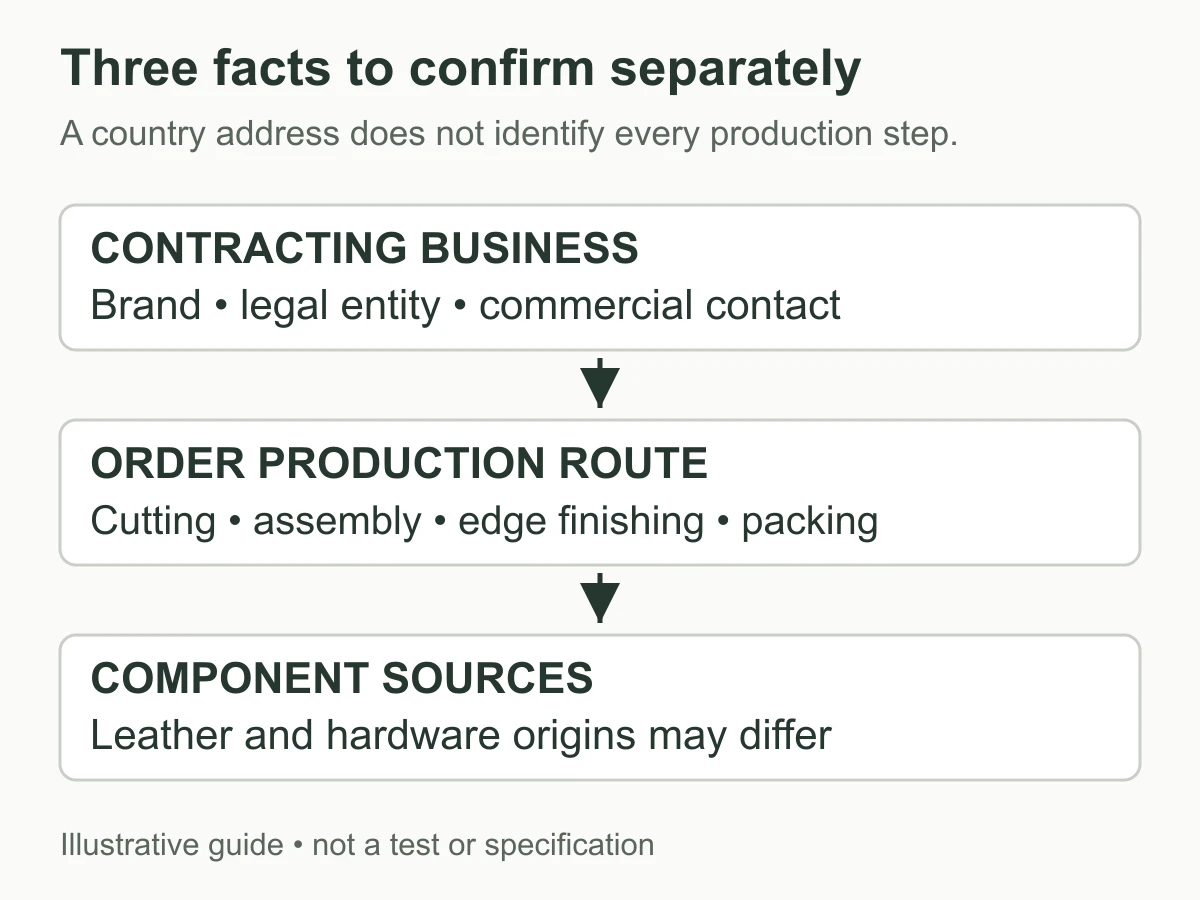
A Spanish business address is not enough to establish where a belt is made. This shortlist uses explicit manufacturing statements, but the actual order still needs a defined route. Ask where the strap is cut, assembled, edge-finished, fitted with hardware and packed, and which steps are performed by the named manufacturer or another party. Record the answer against the proposed product rather than assuming it covers every catalogue line.
Separate the finished belt’s production route from the origin of leather, buckles and other inputs. A supplier may assemble a belt in Spain using components sourced elsewhere. That does not, by itself, settle the legal origin marking for your destination or establish that every input is Spanish. If country-of-origin labeling is central to the collection, obtain the relevant documentation and destination-specific advice instead of using this editorial list as a customs determination.
The same precision helps with factory evaluation. An office visit, a showroom sample and a workshop walkthrough answer different questions. If a visit or audit is part of your sourcing process, define the site and operations you need to observe. A headquarters address should not silently substitute for the production location, and a partner workshop should not be presented as wholly owned without evidence.
Send one comparable brief, while allowing different solutions
Suppose a brand is developing a leather belt for tailored trousers. This is an illustrative brief, not a reported order or quotation. The fixed points could be the intended wearer, overall visual direction, target size system and required retail presentation. Open points could include the lining, edge route and whether an existing buckle can achieve the desired proportion. That is enough to begin a useful development discussion.
Provide a reference image or sample and annotate what matters. A photograph may be inspiration for color or silhouette rather than permission to copy a protected design. State which features should remain and where alternatives are welcome. If a complete technical pack is available, identify its current revision and unresolved fields; if not, ask the supplier to make its assumptions explicit in the proposal.
The measurement convention deserves early attention. A size label alone does not define the distance from the buckle reference to the fitting hole, the total strap length or the amount of tail. Share a sketch showing the intended reference points. Otherwise two attractive samples can carry the same nominal size while fitting differently, and a quote comparison may conceal a different quantity of material.
Keep the brief commercially useful without inventing certainty. Share the intended order structure, markets and target timing, and distinguish a launch estimate from a confirmed commitment. Ask suppliers to identify material availability, development dependencies and any minimums in their own proposals. Do not lift a minimum quantity or lead time from an unrelated catalogue product and apply it to a custom construction.
Compare the belt construction before comparing the quote
Two quotes for a “leather belt” may cover different products. One may use a single strap with a finished reverse; another may combine face leather, backing and reinforcement. Those choices change the feel, thickness and assembly work. They also affect how the belt bends around the buckle and how its edge is presented. The supplier should describe the construction rather than leave the buyer to infer it from the material name.
Consider edge treatment in that context. A painted edge, a turned construction and another finished-edge route require different preparation and produce different visual boundaries. The appropriate choice depends on the leather, layers, design and intended use. Do not accept “premium edge” as the only specification. Review a sample that shows the proposed edge around the tip, holes and buckle fold, where the construction becomes more apparent.
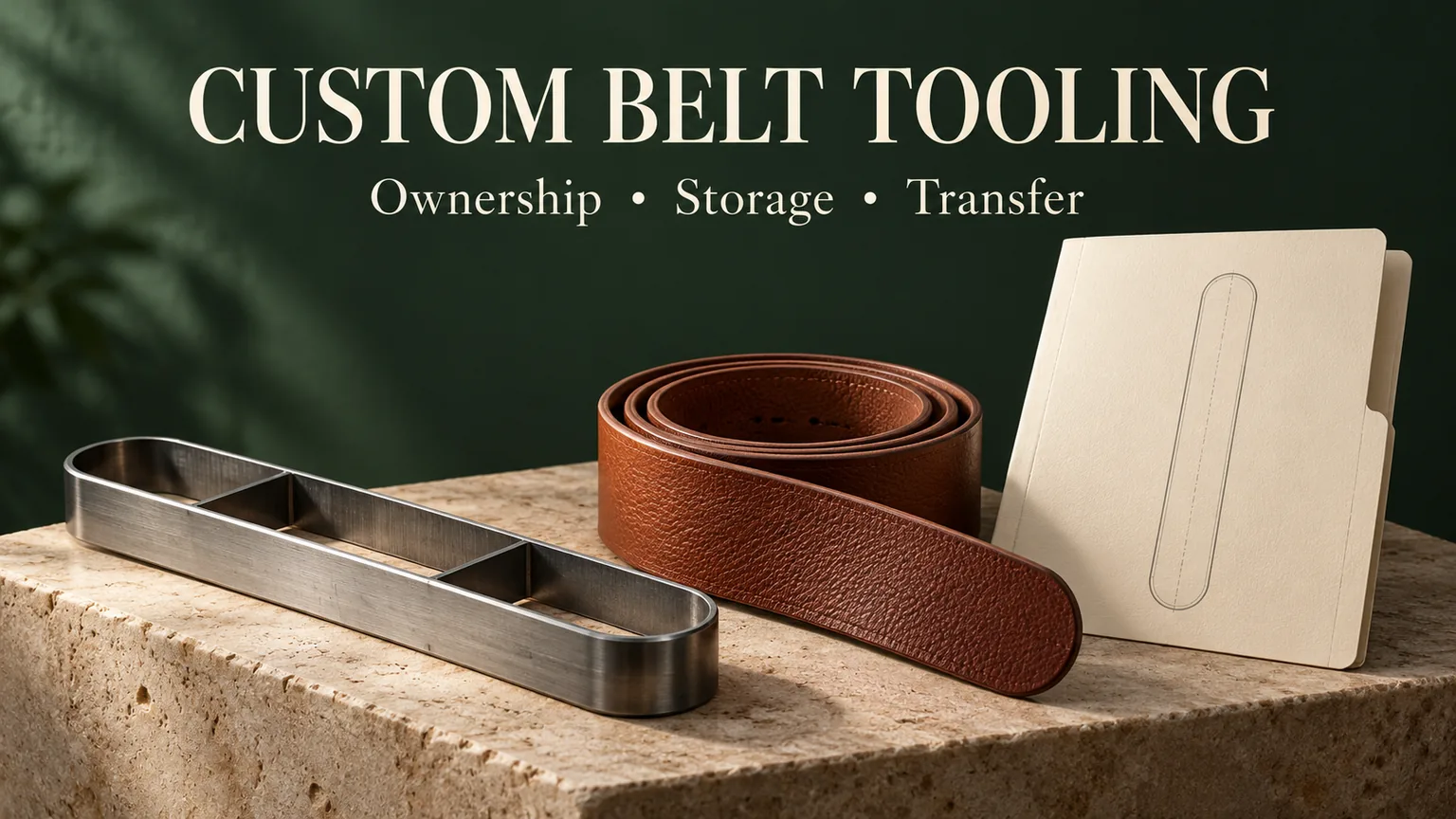
Hardware belongs in the same comparison. A buckle may look proportionate in isolation but interact poorly with the proposed strap thickness or keeper arrangement. Ask whether the quote uses an existing component, a modified component or a new tool, and what development and ownership terms apply. A lower unit price is not directly comparable if the other proposal includes tooling, different hardware or additional sample work.
Finally align the included supply scope: belt specification, branding, size identification, packaging, inspection basis and delivery terms. Separate one-time development costs from recurring product costs. Compare proposals only after differences are visible, then decide which differences matter to the collection. Country reputation cannot substitute for this product-level comparison, and the cheapest headline number may simply exclude work another supplier has included.
Turn sample approval into a repeatable production reference
The sample is the point where design choices become tangible, but appearance approval alone is incomplete. Retain an identified reference and the agreed construction record. Connect material and color references, strap dimensions, hardware, stitching or edge treatment, logo position and packaging to that reference. If an approval leaves one item open, record the open item rather than letting a photographed sample imply it was settled.
Review the assembled belt in use as well as flat on a table. Pass the strap through the buckle and keeper, observe the tail and inspect the bend locations. These checks reveal whether the selected components work together; they are not substitutes for any agreed laboratory testing. A belt that photographs well can still need an adjustment to thickness, fold construction or keeper clearance.
For the first production run, agree how the manufacturer will compare production output with the approved reference and communicate discrepancies. The relevant stages may include incoming material, cut strap dimensions, assembly and final packing, depending on the construction. Ask for a practical control proposal tied to the product rather than a generic statement that all goods receive quality control.
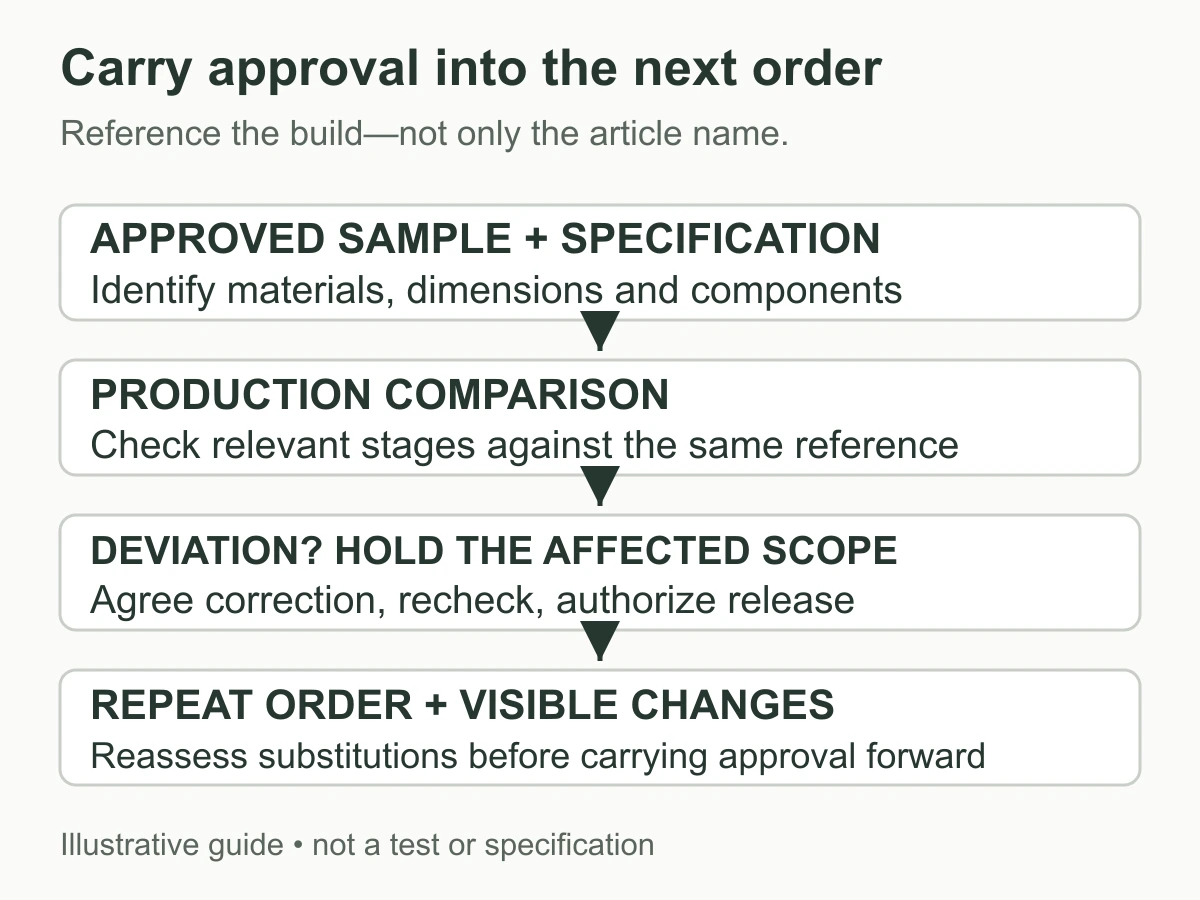
Agree a response for discrepancies before production release. Identify the affected material or production range and hold that scope while the parties decide between rework, replacement or an explicitly authorized deviation. Recheck the selected correction against the same reference, then have the agreed responsible party authorize release. This is a recommended buyer control, not a claim that every shortlisted factory follows this procedure.
A repeat order introduces its own decision: does the existing approval still represent the proposed materials and operations? If a buckle source or lining changes, request a comparison focused on that change and its interactions. Not every change requires starting development from zero, but every relevant substitution should have a visible acceptance path. Quietly replacing a component while keeping the old article code undermines the value of the approved sample.
Keep size and packing requirements in the same release discussion. Correctly made belts can still create retail problems if size labels, SKU assortments or presentation do not match the order. Verify the agreed packing arrangement and identifying information on the production sample. This connects manufacturing consistency to the customer’s receiving and merchandising needs instead of treating packaging as an afterthought.
Where HongDing fits—and where it does not
HongDing is not one of the Spanish manufacturers in this list. If Spanish production is a non-negotiable condition, use the five enquiries above and verify the order route. If you are also evaluating an alternative development and manufacturing route, HongDing can discuss custom belts with brands, retailers and sourcing teams, with project-specific production arrangements confirmed separately.
Our business origins date to 2004, with the current Hong Ding company identity established in 2010. We support design discussion, material and hardware coordination, samples and revisions, production transfer and packaging coordination. Those capabilities describe how a project can progress; they do not establish an objective global ranking, a universal minimum order or a guaranteed delivery time.
You can begin with a concept, reference image, existing sample or technical pack. The useful first step is to identify the decisions already fixed and those needing development. See our manufacturing overview for the broader process, or our European private-label manufacturer guide for a different geographical comparison.
Questions before contacting the shortlist
Do all five offer private-label OEM?
No uniform claim is supported. Possum and Valtico explicitly describe own-brand development. Other routes include client programmes, manufacturer collections and corporate gifts. Confirm the requested customization and contract model with each business.
Are their minimums, prices and lead times comparable?
Not without matching the construction and supply scope. This guide does not publish unverified commercial figures. Request current proposals for the same brief, with assumptions and one-time costs identified.
Does the list verify factory quality?
No. It verifies a public-source basis for inclusion, not production performance. Samples, current documentation, site evaluation and order-specific controls remain part of the buyer’s due diligence.