Key takeaways
- Approve the strap and buckle as one mechanism; matching catalog dimensions is not enough.
- A rotary route concentrates risk in the pivot, stop and attachment. A detachable route concentrates risk in repeatable release and retention.
- Both faces need their own color, surface, edge and hardware-contact approval.
- No universal cycle count or clearance belongs in an RFQ; the program sets values against its use case.
Start with the two mechanism families
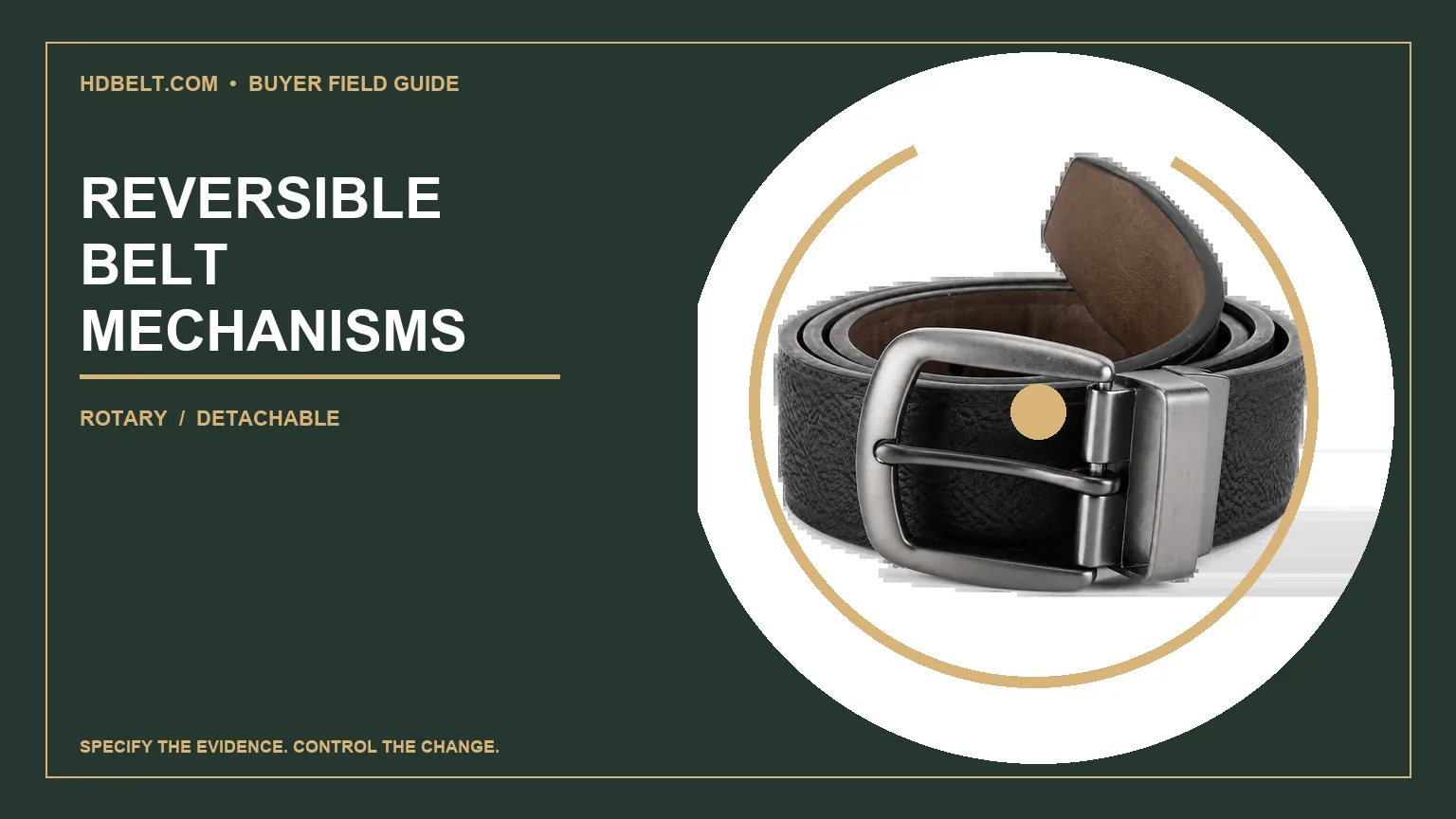
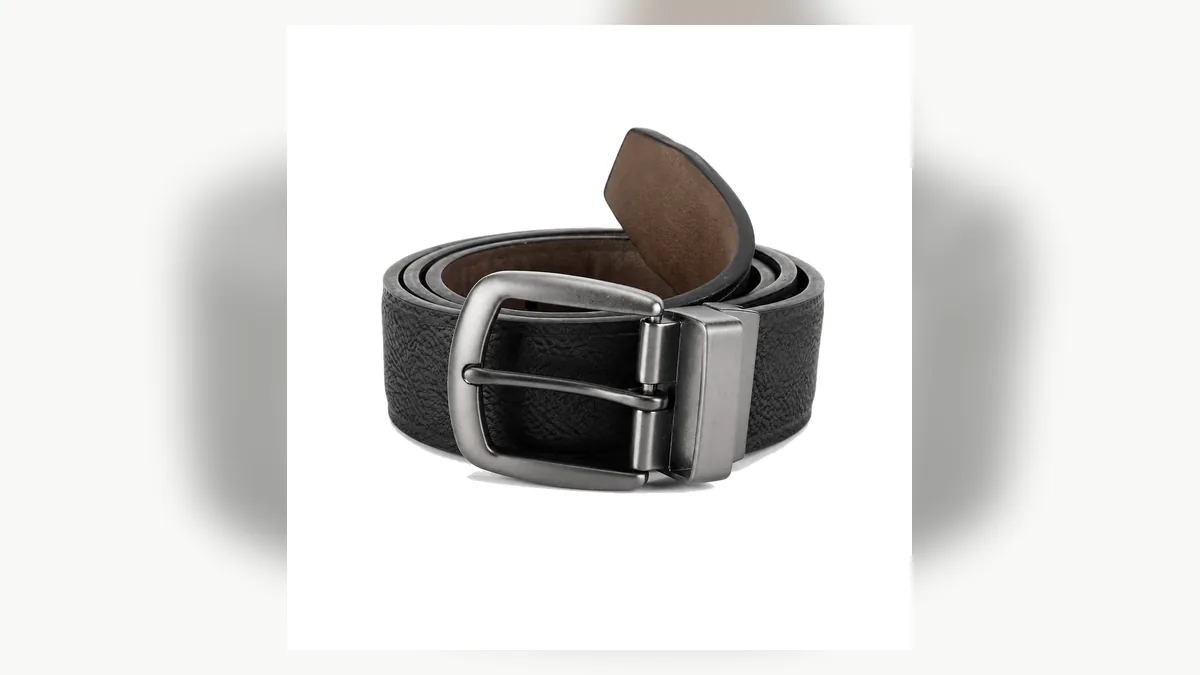
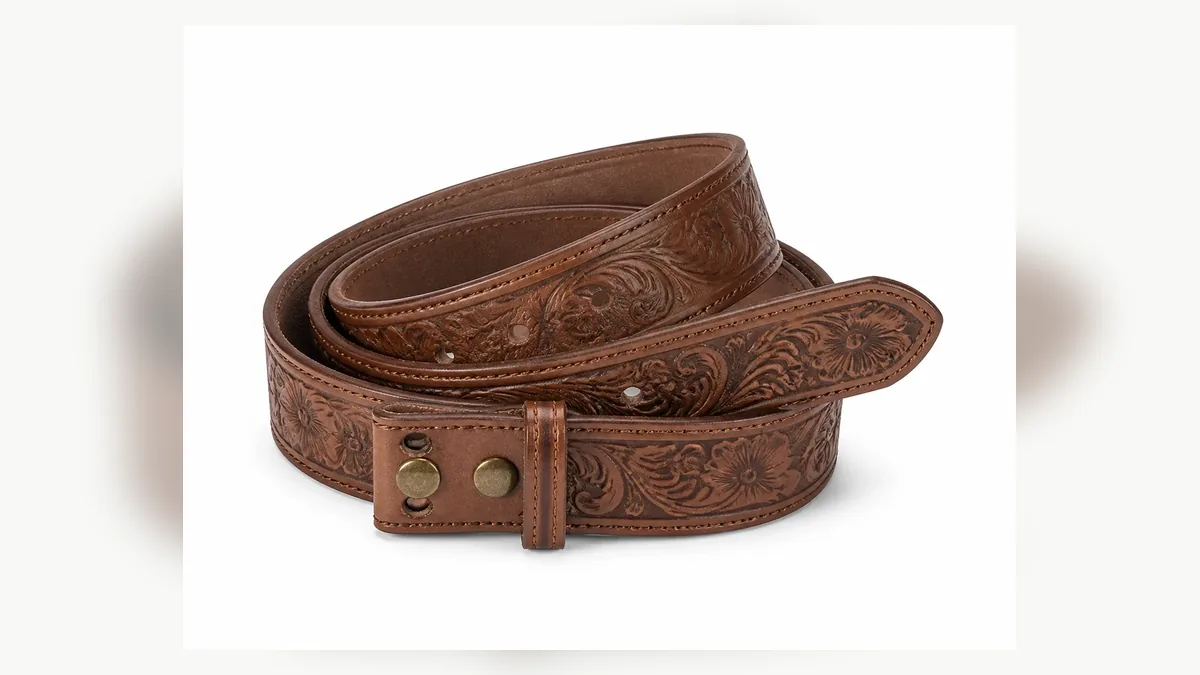
A rotary reversible buckle stays connected to the strap while a pivoting part turns the buckle or strap relationship. The user changes the visible face without removing the strap from its attachment. A detachable construction opens a clamp, latch, screw, snap or other retainer, releases the strap, and reconnects it after reversal. The difference is not cosmetic. It changes which part carries repeated handling.
The patent record for US10980319B1 describes the same broad distinction: earlier belts may detach the strap and turn it through 180 degrees, while another family keeps the buckle attached and provides a rotating mechanism. That source proves the existence of the two construction routes. It does not establish a universal durability result for any HDBelt product. In practical terms, rotary evidence centers on pivot, stop and attachment behavior; detachable evidence centers on release, reconnection and retention.
Design both strap faces as one stack
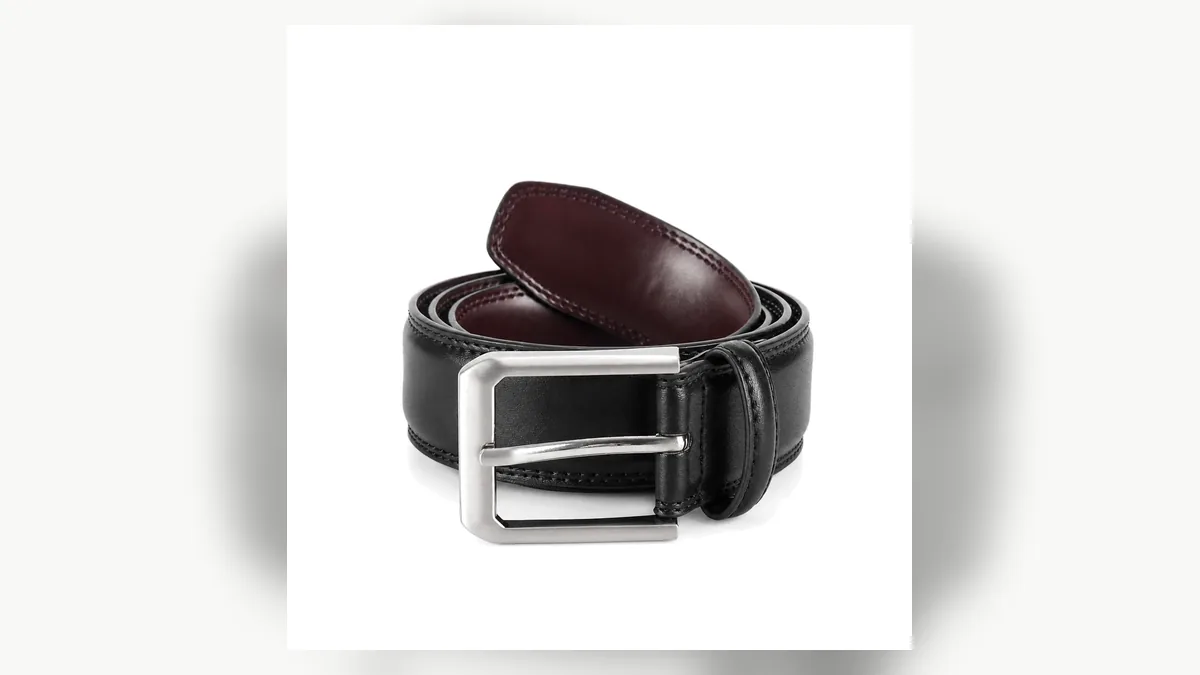
A reversible strap is not simply two colors. The buyer must define whether it is one double-finished leather article, two layers laminated or stitched together, or another approved build. Face A and Face B can react differently to bending, edge paint, adhesives, hole punching and buckle contact. The specification should name each layer and every bonding or stitching operation.
Inspect both faces after flexing around the buckle bar and after the free end passes through the keeper. A clean face at sample approval can pick up pressure marks when the reverse side becomes the inside face. If the program combines different surface systems, approve thickness and bend behavior on the full stack, not on loose swatches.
Control the hardware and strap interface
The narrowest hardware path must accept the thickest approved strap condition without scraping an edge or blocking rotation. The thinnest approved strap must still remain secure in the attachment. Record finished strap width and compressed thickness, the hardware opening, the attachment geometry and the approved physical assembly.
Rotary hardware needs a defined stop so the user does not load the pivot in an unintended direction. Detachable hardware needs a clear locked state that can be checked after reconnection. A buyer should reject any design where the secure state depends on visual guesswork or where the strap can sit partly engaged and still appear closed.
Review failure modes before styling
For a rotary buckle, inspect pivot looseness, axial play, stop deformation, finish wear at moving contact points, strap twist and attachment pullout. For a detachable buckle, inspect latch wear, tooth marks, screw loosening, clamp damage, incorrect reassembly and strap-end distortion. The mechanism directs the test plan.
Surface damage deserves separate attention. A dark face may hide hardware rub that becomes obvious on a light reverse. Edge paint can also crack differently when the belt bends in both directions. Write the visible acceptance standard for each face and retain photographs under controlled lighting.
| Risk | Rotary | Detachable | Evidence |
|---|---|---|---|
| Retention | Pull | Pull | Load, duration, failure mode |
| Operation | Torque/stop/play | Force/locked-state | Method and sample |
| Appearance | Pivot/bar marks | Clamp/tooth impressions | Face photos |
| Assembly | Pivot orientation | Correct reattachment | Instruction/control sample |
Build a mechanism-specific validation plan
Do not borrow a cycle count from another buckle and call it a standard. Define the user motion, load condition, inspection interval and failure criteria for the program. Record whether the belt is loaded during reversal, because that can create a different stress state from an unloaded demonstration.
Run checks on finished belts made with production-intent strap and hardware. A loose-buckle bench test cannot show edge rubbing, keeper interference or hole alignment. After operation testing, repeat the retention and appearance checks so the buyer sees both mechanical change and visible change.
Add a user-handling review after the engineering check. The switching motion should be clear without forcing the strap, and the secure state should remain visible after an ordinary reversal. Packaging must not preload the pivot or clamp in a way that changes the first-use feel. Photograph the packed orientation and place the operating instruction in the approved packaging file.
| Test-record field | Rotary evidence | Detachable evidence | Buyer-set release rule |
|---|---|---|---|
| User motion | Direction, travel and stop | Release, reverse and reconnect sequence | Approved instruction is repeatable |
| Precondition / load | Loaded or unloaded reversal | Load during release and reconnection | Condition named before testing |
| Operation target | Buyer-set cycles; no universal count claimed | Buyer-set reconnect cycles; no universal count claimed | Target and inspection interval recorded |
| Mechanical result | Free play, stop, pivot and attachment | Latch, clamp, screw or snap plus locked state | No defined functional failure |
| Post-operation retention | Pull result after cycling | Pull result after reconnection cycling | Method, load and duration recorded |
| Appearance | Both faces, edges and contact points | Both faces, strap end and clamp marks | Paired photos within approved limits |
Freeze the sample in three gates
First approve the mechanism sample: intended travel, secure state, hardware finish and attachment concept. Next approve the full strap stack with both faces, edges, holes and keeper. Last approve the production-intent belt and its packaging orientation. Each gate closes a different risk.
HongDing’s documented service route covers material and hardware sourcing, physical sampling, manufacturing and quality control. Use that route to preserve a bill of materials, hardware reference, control sample and change record. A supplier change to the pivot, latch, strap thickness or adhesive reopens the affected gate.
Write an RFQ that exposes assumptions
- Rotary or detachable mechanism, with drawing or reference sample
- Face A and Face B material, color and finish
- Layer build, bonding or stitching, edge and hole treatment
- Finished width and compressed-thickness limits
- Hardware material, finish, mechanism and secure-state definition
- Operation, retention, appearance and packaging tests
- Approved control sample and change-notification rule
A quote against the phrase “reversible leather belt” is not comparable. One supplier may assume a simple rotating stock buckle; another may price custom detachable hardware and a two-layer strap. Ask each supplier to return the same assumption sheet with exclusions stated.
Include the intended size range and hole pattern because strap length changes the contact path through keepers and packaging. State whether the buckle must be replaceable in service and whether the strap end may carry visible attachment marks. These fields prevent a prototype built for one display size from becoming the untested reference for the full range.
Choose by risk ownership, not novelty
Choose rotary construction when quick reversal matters and the pivot can be validated as a controlled mechanism. Choose detachable construction when replaceability, modularity or a simpler buckle frame matters and the reconnection state is unmistakable. Neither route wins every program.
For example, a business-travel dress belt that must switch faces quickly and pack compactly may favor a rotary route, provided the pivot, stop and both contact faces pass the recorded operation plan. A modular program that sells replacement straps may favor a detachable route, but only when the locked state is obvious and retention is rechecked after repeated reconnection. If either route leaves clamp or bar marks outside the approved face limits, the mechanism is rejected even when it still operates.
Use HongDing’s reversible belt development page to frame the commercial brief. The belt buckle construction guide, pre-production sample checklist and buckle finish test guide cover the adjacent approval work.
Verified source notes
Frequently asked questions
Are all reversible belt buckles rotary?
No. A reversible belt may use an attached rotating mechanism or a detachable system that releases the strap for reversal.
Which construction is more durable?
Durability depends on the actual pivot or retention design, strap stack, hardware material and validation method. The route name alone does not prove service life.
Can the two faces use different leathers?
They can, but the combined thickness, bend behavior, bonding, edge finish and hardware marking must be approved on the finished strap.
What should the control sample include?
Keep the approved finished belt, both face references, hardware reference, bill of materials, test record and packaging orientation together.