White leather belts can yellow because the leather or finish changes with exposure, because substances move from an adjoining component, or because the packaging environment introduces contamination. The first useful decision is not which cleaner to buy. It is whether the change follows exposed surfaces, assembly interfaces or packing contact. Preserve an unchanged reference and compare those routes separately before changing the leather, adhesive or packaging specification.
For a brand developing a white belt, an attractive approval sample is only a starting point. The material must also work with the lining, edge finish, buckle attachment and retail pack. This guide explains how to organize a discoloration investigation and turn the findings into a controlled sample revision. It does not diagnose a particular shipment from its photographs.
Key takeaways
- A yellow area is an observation, not the name of a chemical cause.
- Compare material, assembly and packaging separately, then retest the finished combination.
- Light resistance, contact compatibility and phenolic yellowing are different test questions.
- Approve the corrective change against both color stability and the belt features already accepted.
Start with a location map, not a replacement material
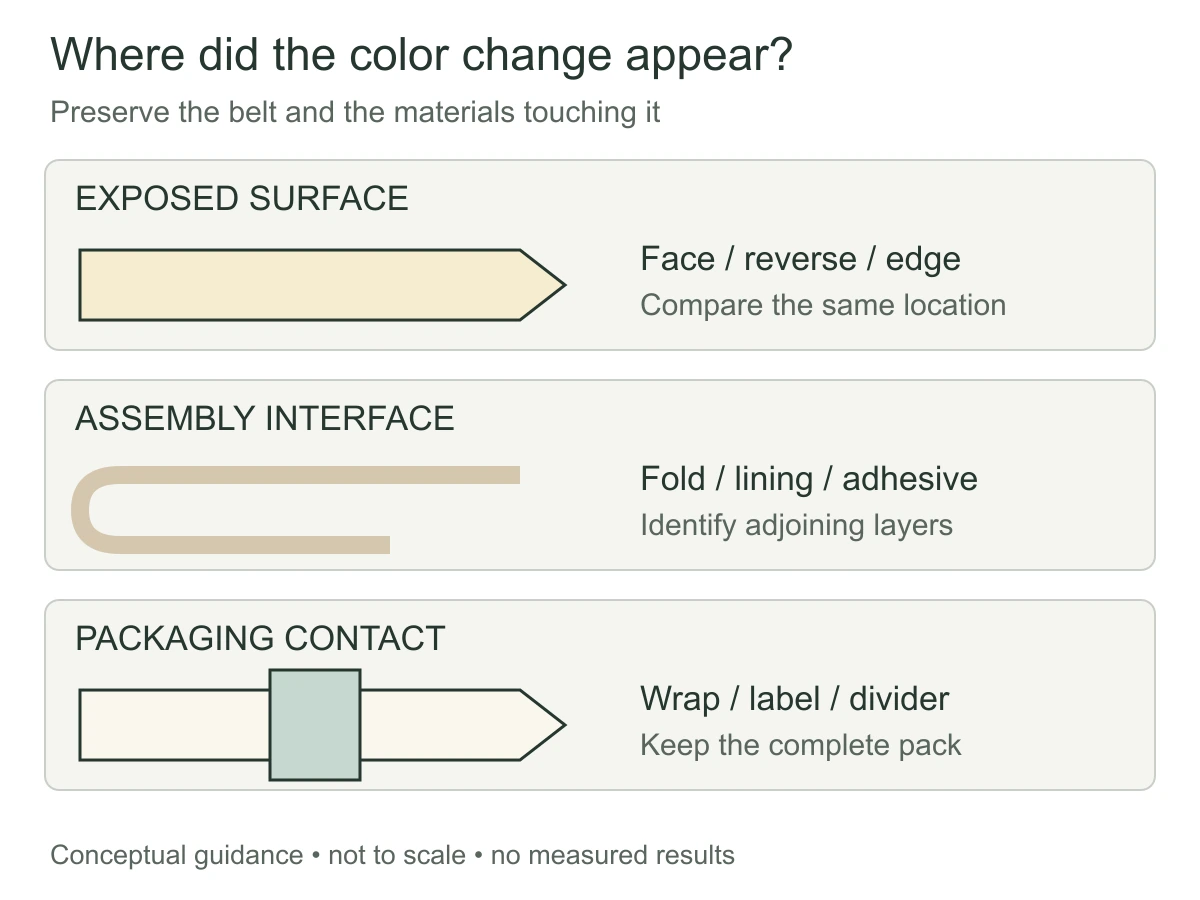
Lay out the affected belt without cleaning or polishing it. Record the face, reverse, edges, buckle fold, keeper contact and any area that rested against a label, tissue or neighboring belt. Photograph the same locations on an unaffected belt under the same lighting. Include the packaging in the investigation rather than disposing of it as soon as the goods are unpacked.
Then reconstruct when the difference became visible: before assembly, after packing, at receiving, after display or after wear. These stages narrow the next comparison. A change present on unassembled material asks a different question from a mark first found under a printed band. Neither observation alone establishes who caused the defect or which ingredient is responsible.
| Observed pattern | Useful next comparison | Do not conclude yet |
|---|---|---|
| Exposed face differs from covered face | Matched material under controlled light exposure and protected storage | That sunlight is the only variable |
| Mark follows a wrap or divider | Same belt material with the suspect pack, an alternative pack and a no-contact control | That all paper or all plastic is unsuitable |
| Change near a bonded or folded area | Unbonded material against matched assembly variants | That the adhesive alone is responsible |
| Several areas change during storage | Traceable retained material, assembled belt and complete package | That changing the outer carton will solve it |
Note whether the change is a uniform warm cast, a localized stain or an apparent difference caused by gloss and viewing angle. If people disagree about the color, stabilize the viewing conditions before debating the formulation. A phone photo with automatic exposure is useful for locating a mark, but it is a weak basis for accepting a subtle white shade.
Separate material change from transferred contamination
Light, heat and storage can affect the material itself
Royal Smit & Zoon’s leather guidance describes oxidation involving susceptible compounds under the influence of air, warmth, light and time. It also identifies leather constituents and processing auxiliaries as relevant to yellowing. A white finish therefore cannot be judged solely by its initial brightness or by whether the hide is described as premium.
The practical question for the material supplier is which exact article and finish were approved, and whether the changed belt represents that combination. Keep the supplier article code, shade reference and finish revision together. If the sample and production material have different identities, a comparison of their appearance cannot isolate an aging problem from a specification change.
The assembled belt adds interfaces that a swatch does not contain
The public abstract of the SLTC paper on leather yellowing identifies several possible contributors, including finish sensitivity, pigment or additive instability and migration involving fats, plasticizers or glues. That supports investigating more than the visible top surface; it does not identify the cause of an individual return.
For a laminated belt, compare a retained piece of face leather with the relevant bonded construction. If only the assembled version changes, that makes the assembly route worth investigating; it does not justify blaming whichever component is easiest to replace. Prepare variants that differ in one planned component or process condition, with the supplier controlling the remaining construction.
A buckle fold also brings surfaces together differently from the straight body. Inspect which face contacts which layer and whether the mark follows that contact. A drawing of the actual stack can be more useful than another photograph of the entire belt. For a broader discussion of migration and bonding, see our guide to oil migration in leather belts.
Packaging belongs in the material review
SATRA’s discussion of footwear cartons notes that BHT or similar antioxidants can occur in cardboard, plastic bags and tissue, and that mobile chemicals can cause discoloration. This is a relevant packaging risk to discuss for pale leather goods, not proof that a particular belt pack contains BHT. Do not transfer that article’s footwear specification or acceptance values into a belt order without a suitable agreed basis.
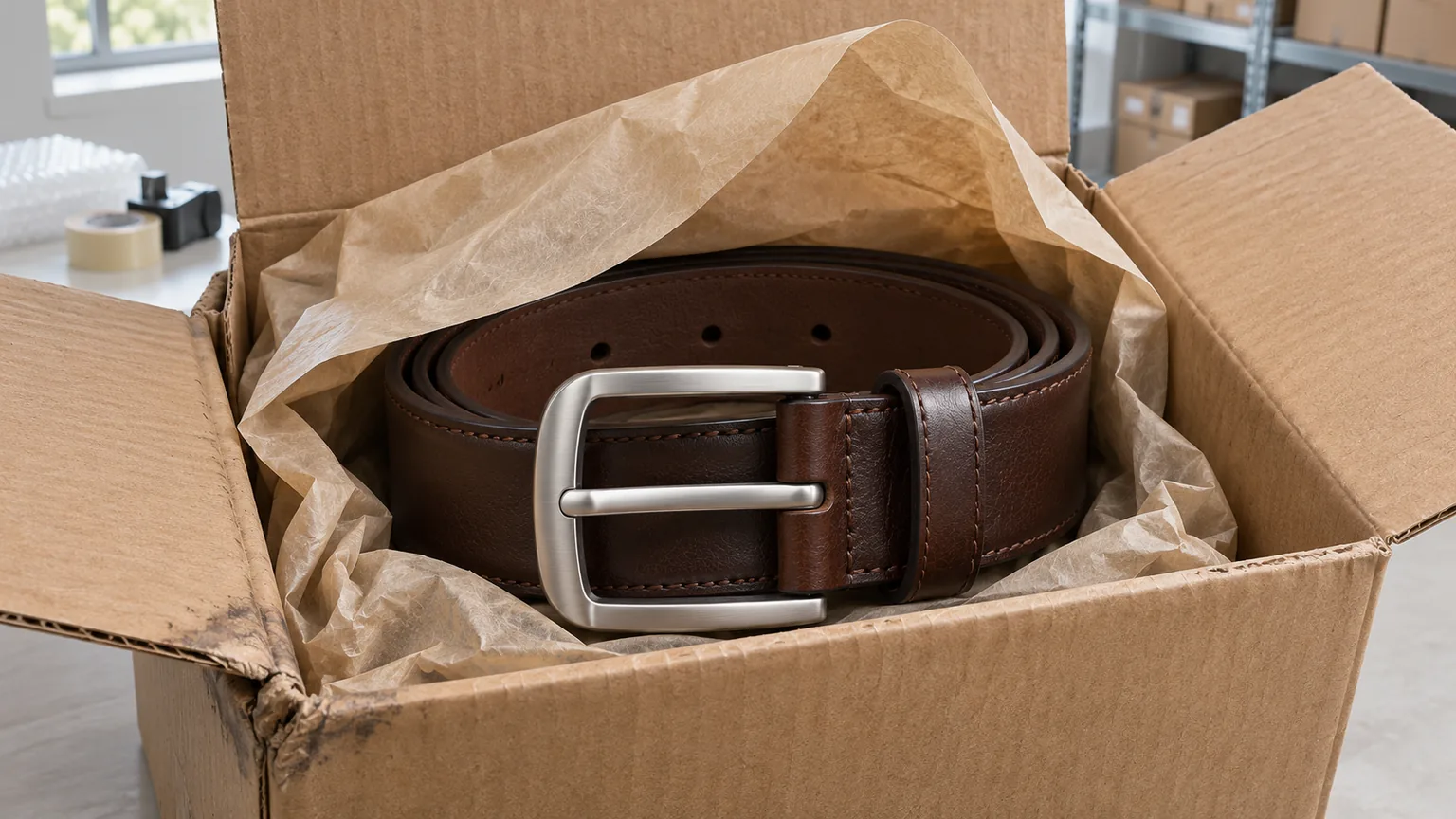
Retain the complete packing combination, including protective sleeves, printed inserts, dividers and outer packaging. Replacing just the material that visibly touches the belt may leave another source unchanged. Conversely, a contact outline is a reason for a controlled comparison, not a reason to ban an entire packaging category.
Build a comparison that can answer one question
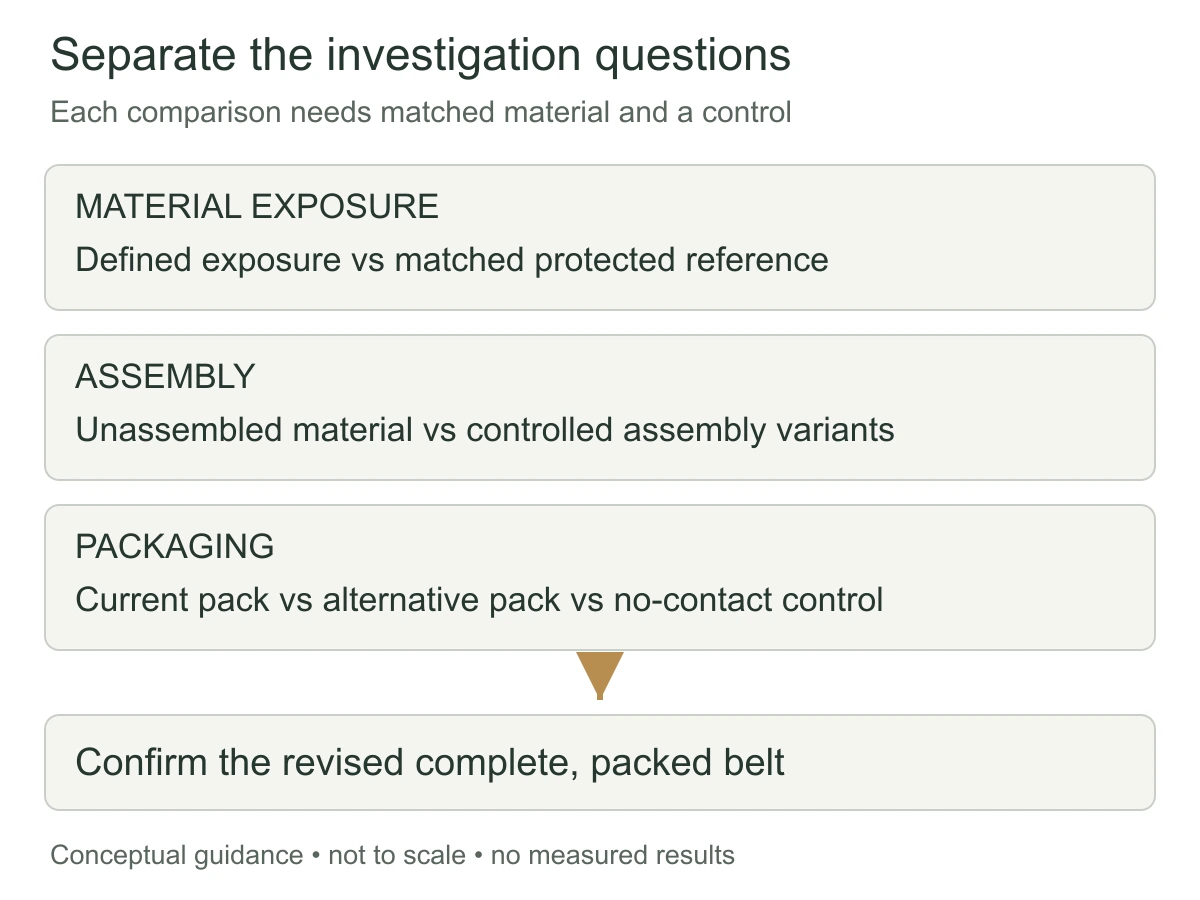
A useful investigation needs a stable reference and a clear difference between variants. Decide the question before asking a laboratory for a general “anti-yellowing test.” The following sequence is a buyer-side investigation plan, not a standardized test method or a substitute for laboratory instructions.
- Identify the specimens. Link each belt or component to its material lot, assembly revision and pack version. Separate suspect goods from retained references.
- Document the starting appearance. Agree the viewing setup and the areas to compare. Record existing marks so they are not mistaken for changes created during evaluation.
- Select the variable. Compare light exposure, a contact material or an assembly change in a defined series. Do not change all three at once.
- Keep a control. Preserve a matched unexposed or no-contact specimen as appropriate. Ask the laboratory how to control other conditions relevant to its method.
- Compare the result to the question. Record where change occurred and which variants differ. A result that does not distinguish the candidates calls for another hypothesis, not a stronger claim.
For a packaging question, a useful comparison could include the current wrap, a proposed alternative and a specimen without that wrap, all with the same identified leather construction. For an assembly question, compare the unassembled material and controlled assembly variants. Include a finished, packed belt before accepting the final correction: a component result does not cover every interface in the finished product.
Use enough traceable specimens for the agreed evaluation and retain material for follow-up. The quantity, exposure conditions and assessment method belong in the test plan; inventing a universal number would make unlike investigations appear equivalent. Avoid repeated handling of a single sample as the only reference for every decision.
Choose the test route by the suspected mechanism
SATRA’s discoloration service description distinguishes chemical causes from poor light resistance and describes xenon-arc exposure for light-fastness work. A light test can help assess that exposure route. It cannot, by itself, establish whether a specific wrapper or adhesive is compatible with the belt.
Phenolic yellowing is a narrower question. The public scope of SATRA TM260 addresses susceptibility to contamination by certain phenols present in some packaging and states applicability to white and pastel-colored materials. Discuss specimen suitability and the current procedure with the testing provider rather than reconstructing the method from its web summary.
ISO 105-X18:2007, by contrast, describes assessment of phenolic yellowing potential in textile materials and explicitly excludes other causes of yellow discoloration. Its name is not a blanket leather-belt qualification. If it appears in a customer’s specification, clarify the intended component and scope with the customer and laboratory.
Keep the test request readable: identify the belt construction, the observed problem, relevant contact materials, the decision to be made and the agreed reporting basis. A report saying a specimen met one criterion should not become a promise that the finished white belt will never change color. The relevant comparison may be against an approved reference, an agreed visual assessment or an instrumental color measurement, but its conditions must be named.
Choose the smallest supported revision
The most economical correction is not necessarily the cheapest replacement component. It is the change that addresses the supported cause while preserving the product’s accepted performance and appearance. Replacing the whole leather article may restart shade, hand and construction approval. Replacing the packaging may alter scratch protection or the retail presentation. Both can be appropriate, but neither should be automatic.
- If the material route is implicated: ask the material supplier for a revised article or finish option, then compare the new white tone, gloss, feel and belt construction as well as the relevant color-change result.
- If an assembly interface is implicated: compare a controlled adhesive, lining or processing revision. Recheck the bond and the assembled fold rather than judging only an unbonded swatch.
- If a packing combination is implicated: evaluate a replacement complete pack. Confirm that the proposed protection still avoids unwanted contact and supports the intended packing arrangement.
- If results remain mixed: retain the affected scope on hold and narrow the comparison. Do not turn an uncertain result into a broad supplier accusation or an unsupported release.
These are decision paths, not diagnoses. A change that improves one comparison can still be unsuitable for the product. Agree who approves the revised sample and how the revised material or packaging identity will be carried into the purchase specification.
Illustrative example: a mark beneath a retail band
Suppose a brand finds a yellow band on white belts after storage, while its loose approval sample remains visually unchanged. This is a hypothetical investigation, not a HongDing order result. The buyer first preserves unopened packs and records the position of the band. It then asks for comparisons using the same belt construction with the current band, a proposed alternative and a suitable no-band control.
If the controlled comparison separates the current-band variant from the others, the band system becomes a stronger investigation lead. It still may require chemical analysis or additional comparison before the mechanism is named. If all variants change similarly, the team should revisit the common material and conditions instead of declaring the alternative pack successful.
Before release, the selected change is checked on the complete packed belt. The sample record names what changed, what remained fixed and which review supports acceptance. This prevents the visually successful trial from being lost when production uses an older packaging code.
Carry the decision into production and receiving
Record the approved leather article, shade, assembly revision and packaging components in one product file. At incoming review, compare their identities with that file. At the first assembled and packed pieces, check that the intended combination is actually present. During production, substitutions affecting those interfaces should return for review rather than being accepted because the replacement looks white.
Retained samples are most useful when their history is known. Keep the date, lot, pack version and storage context with them, and distinguish an untouched control from a sample opened repeatedly for discussion. At receiving, link a complaint to the same identifiers. Without that connection, a good laboratory comparison may not establish which delivered goods it represents.
HongDing’s belt quality-control approach connects the approved specification with incoming, in-process and final checks. For a white-belt program, we can discuss the material, assembly and packing references that need to remain linked. The test scope, acceptance criteria and release responsibilities are agreed for the project, not inferred from the color name.
Questions buyers ask
Does yellowing mean the leather is fake?
No. Discoloration does not identify the substrate. Confirm material identity from the product specification and appropriate supporting evidence; investigate the color change separately.
Will passing a rub test prevent yellowing?
Not necessarily. Rubbing evaluates a different exposure from storage or light. Our leather colorfastness guide explains transfer-focused questions; choose additional work for the actual discoloration concern.
Should every white belt use the same acceptance limit?
No universal limit is supplied here. Agree the method, specimen, viewing or measurement conditions and acceptable change for the intended program before interpreting the result.
Bring the affected combination into the discussion
Share clear location photographs, the sample or order reference and what the belt contacted during packing or use. If you are still developing the product, a white-shade direction and proposed construction are enough to begin discussing the material and packaging questions.