A PU belt hydrolysis report shows how the identified specimens performed after a stated moisture-and-heat exposure and subsequent assessment. It does not, by itself, establish a number of years the belt will last. To use the result in development, connect the tested material to the proposed belt construction, compare treated and untreated performance, and investigate where any change occurred before selecting a revision.
Two materials can both be sold as “PU leather” yet use different coatings, carriers and layer combinations. A report for one supplier article cannot automatically qualify another article with the same color or grain. Likewise, a material swatch can answer a useful question without proving the behavior of the complete belt around a buckle fold, stitched edge or adjustment hole.
This guide is for brand and product teams deciding what aging evidence can support before approving a PU belt. It is not a general ranking of synthetic and animal-derived materials. For the broader product-development route, see PU and vegan belt manufacturing; the animal-free claim requires its own complete-product review.
Key takeaways
- Peeling is an observation. It does not identify hydrolysis as the cause.
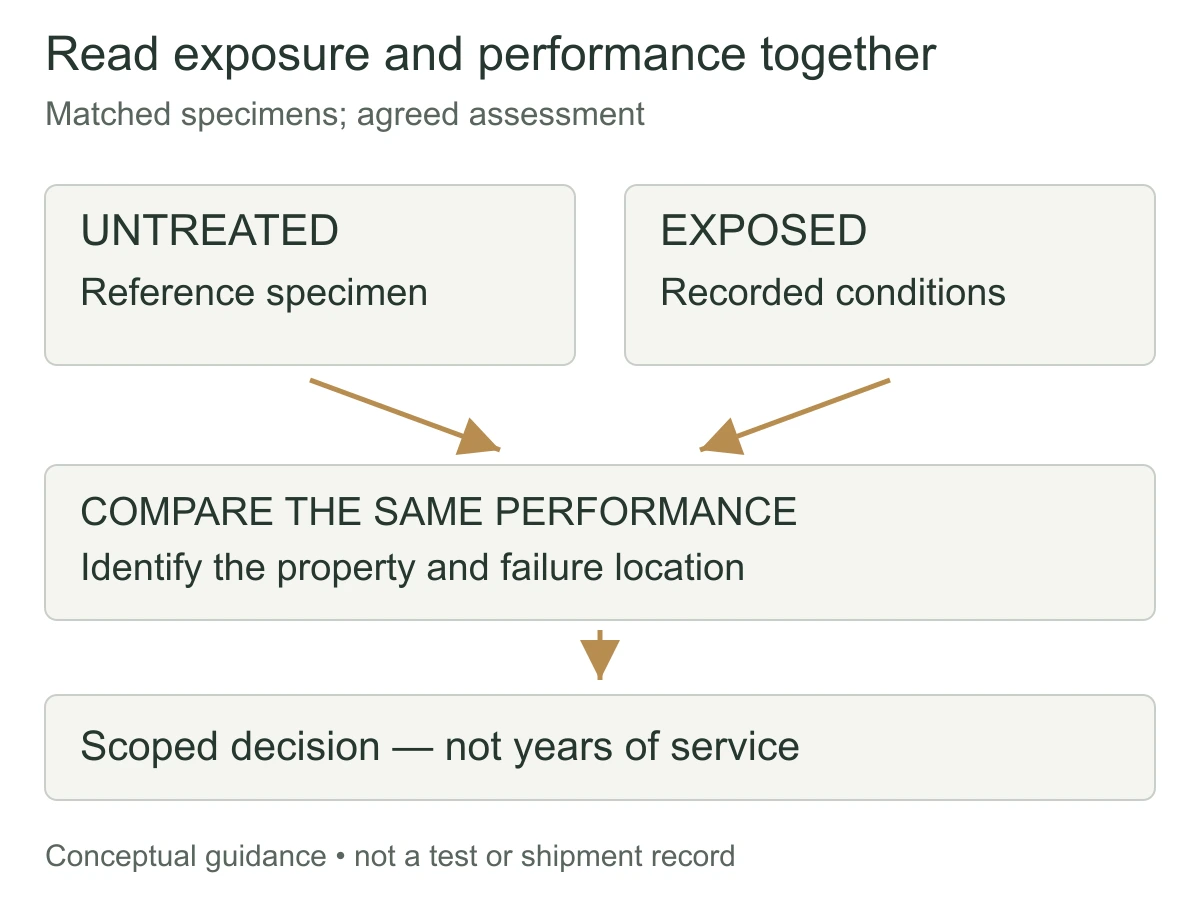
- The exposure conditions and the performance measured afterward belong together.
- A passing sheet result does not cover every adhesive, fold and edge in an assembled belt.
- A useful material revision retains the desired appearance and function as well as improving the investigated weakness.
What hydrolysis changes—and what a photograph cannot tell you
Hydrolysis is a chemical degradation route involving water. In susceptible polyurethane systems, it can break polymer chains and reduce mechanical properties. BASF’s technical explanation for Elastollan TPU describes irreversible degradation of polyester-based material during prolonged hot-water, moisture-vapor or tropical exposure, and different hydrolysis resistance for its polyether-based materials. That supports the importance of chemistry; it does not supply a performance rating for an unidentified belt coating.
The manufacturing question is therefore more specific than whether PU is “good” or “bad.” Which supplier article and coating system are being considered? What carrier supports the surface? Which layers have been combined in the belt? A chemistry description can help a material specialist choose candidates, but the actual candidate and relevant construction still need evaluation.
Surface flaking, cracking, tackiness or loss of adhesion may prompt investigation, but a visual description alone cannot distinguish every cause. A face coating might lose cohesion; a bond between layers might separate; a surface might be damaged by abrasion or an unsuitable cleaning treatment. Those conditions can look similar in a customer photograph while requiring different corrective actions.
Start by locating the change. Is it spread across the strap, concentrated at an outer bend, along a cut edge or at one bonded interface? Compare affected and unaffected areas without cleaning away the evidence first. Record the material identity, time and storage or use history where known. These observations guide sampling; they do not replace laboratory interpretation of the failure.
Separate coating deterioration from an assembly problem
Map the proposed construction before choosing specimens. A belt may combine a coated face material with reinforcement, adhesive and lining; another design may use fewer layers. Do not assume that every PU belt has the same stack. The useful map names the actual materials and joins, then identifies which of them is represented in the available report.

If a coating breaks within itself while the carrier remains attached, that observation directs attention toward the coating and its condition. If an added lining separates from the back of the face material, investigate the bonded interface as well. Identify what remains on each separated surface and compare it with an untreated reference. A laboratory can then advise which examination or performance test will distinguish the competing explanations.
Location also matters mechanically. The outer surface of a tight fold experiences a different deformation from a flat swatch. A thick reinforcement or stiff lining can change how the complete belt bends even when the face material is unchanged. If damage occurs only at an assembly feature, a flat-material result should not close the investigation. Compare the same material in the relevant construction and retain the feature that produced the concern.
That does not justify immediately thinning the belt or changing the adhesive. Either action could alter the buckle attachment, edge profile or handle the buyer already approved. First determine whether the weakness belongs to the supplied material, an added bond, the construction geometry or a combination. Then propose the smallest change that addresses the supported explanation.
Read the method as exposure plus assessment
The official public summary for SATRA TM344, revised February 2022, describes warm, humid storage followed by mechanical testing of treated and untreated specimens. It primarily addresses polyurethane footwear solings and upper materials, while allowing other materials susceptible to hydrolytic attack. For upper materials, its examples include flex cracking, coating adhesion and rubbing colorfastness.
A sentence saying “TM344 passed” is therefore an incomplete basis for a belt decision. Read which specimens were exposed, the documented conditions and period, what was measured afterward and the acceptance basis used. Ask the testing provider to confirm applicability to the particular coated material and belt question. The public summary is a method-selection aid, not a substitute for the full procedure.
ISO 1419:2019 concerns accelerated aging of rubber- or plastics-coated fabrics. Its scope provides methods, not one universal PU belt grade. Where a report refers to ISO 1419, identify the selected method and subsequent assessment rather than treating the standard number as a complete test specification.
The buying team should agree the decision before the test begins. Is the purpose to screen two candidate face materials, investigate a returned belt, or evaluate an assembled revision? The answer changes the specimen selection and the significance of the result. A material comparison and a complaint investigation can both use aging evidence, but they should not silently become the same exercise.
Keep three questions separate:
- Exposure: What environment and duration were applied, and how were the specimens handled before and after it?
- Performance: What property or observation was assessed using which stated method?
- Acceptance: What project requirement determines whether the result is sufficient for this decision?
A laboratory report may contain all three, or only the first two. If the buyer has not agreed a relevant acceptance basis, the team can still learn from a comparison, but should not invent a passing threshold after seeing the results. Resolve that gap before claiming the product is qualified.
A practical way to read the report
Begin with specimen identity rather than the conclusion box. Match the supplier article, finish, color, carrier and any construction details that could affect the result. The report date alone cannot establish that today’s material is the same. Ask whether a later formulation, supplier or process change affects the evidence being relied upon.
Use these fields to connect a report to a belt decision. Scroll horizontally on a narrow screen.
| Report element | Useful interpretation | Gap to resolve |
|---|---|---|
| Specimen identity | Which material or assembly the result describes. | Anonymous “black PU” does not establish a match to the proposed belt. |
| Exposure details | Which accelerated condition was evaluated. | A duration alone cannot define a comparable exposure. |
| Untreated reference | Whether the selected performance changed after exposure. | A treated result without a baseline can hide the starting condition. |
| Observed failure location | Which layer or join needs further investigation. | “Peeling” without location is not a root-cause conclusion. |
| Acceptance and scope | Whether the reported result meets the agreed decision criteria. | A material-only pass does not automatically release the complete belt. |
Compare like with like when ranking candidates. Different exposure conditions, mechanical methods or specimen preparation can make a longer reported duration less informative than it appears. If the methods differ, ask the laboratory to explain whether a meaningful comparison is possible. Do not normalize unlike reports by simply dividing each result by its number of days.
Where the results permit a retained-property calculation, keep the underlying values and method alongside the calculation. A percentage can hide an initially weak material: retaining a large proportion of a low starting value may still be inadequate. Conversely, a material may change visibly while a particular mechanical result remains acceptable. Assess the appearance and functions that matter to the program instead of selecting whichever single number looks best.
Why accelerated weeks are not service years
The Association for Contract Textiles’ hydrolysis guidance explicitly cautions against a direct conversion from test weeks to years of service. Its application is coated upholstery, so its recommended furniture threshold should not become a belt requirement. The relevant lesson is that a controlled exposure result does not establish a universal field-life conversion.
A belt moves through storage, transport, retail display and intermittent wear. Moisture, temperature, bending, contact and cleaning vary between those stages. A test deliberately controls selected conditions; it cannot represent every possible combination merely by running longer. Any proposed service-life model needs supporting validation for the particular material, failure mechanism and use environment.
For buyer communication, report what was actually evaluated. “The identified material was assessed after the stated accelerated exposure, with the reported results” preserves useful information. “Guaranteed for five years because it passed five weeks” adds a time conversion and commercial promise that the test alone does not supply. A warranty is a separate business commitment and should not be disguised as a laboratory conclusion.
Illustrative report review: a swatch pass and a lifting lining
Suppose a brand receives an aging report for a proposed PU face material. The reported assessment meets the project’s material criterion. A later assembled sample, however, shows lifting between that material and an added lining after the agreed investigation exposure. This hypothetical example illustrates how to scope the next decision; it is not a test result from HongDing.
The first question is whether the face material in the belt actually matches the report. If it does not, the earlier report cannot resolve the sample’s behavior. If it does match, preserve the distinction between the face-material result and the added interface. Examine the separated surfaces, identify the bonding materials and process, and compare an untreated assembled reference before choosing a correction.
A replacement adhesive might be a candidate if the investigation points toward the bond, but it needs a comparison on the actual adjoining materials. A formulation change to the face coating might be more relevant if the weakness is within that coating. Changing both at once could improve the sample while leaving the reason unclear, making future substitutions harder to evaluate.
After a supported revision, review the complete belt for the properties the brand needs to retain: bend and recovery around the intended buckle, edge appearance, lining feel and the relevant bond or coating performance. A stronger bond that produces an unacceptable handle is not a complete development solution. The next sample should answer both the investigated aging concern and the original product brief.
Keep the approved material connected to production
An accepted sample establishes a reference, not automatic control of later supply. Record the approved material article and relevant construction revision so incoming material can be checked against it. If a supplier proposes an equivalent-looking replacement, review whether the prior aging evidence still applies before treating it as interchangeable.
At the start of assembly, compare first pieces with the approved belt, focusing on the joins and bends involved in the development concern. During production, keep relevant material lots and assembly revisions traceable. If a change or repeated defect appears, identify the affected scope, hold the relevant goods for review and recheck the agreed correction before release. This is a proposed control sequence, not a claim that visual inspection detects chemical stability.
HongDing supports material coordination, samples and revisions, and project-specific quality planning. That makes it possible to connect a material question to the belt’s construction and agreed verification scope. It does not mean every PU article shares the same test result, acceptance level or available chemistry.
Two remaining questions
Can better packaging make an unsuitable PU material acceptable?
Packaging can address a particular distribution exposure or contact condition, but it cannot establish that a material meets the belt’s intended use requirement. Evaluate the proposed packing alongside the material and finished construction; do not use it to explain away an unresolved performance failure.
Does a clean-looking aged specimen mean testing is complete?
Only if the agreed decision was limited to that appearance assessment. Where coating adhesion, flexing or another property matters, read the corresponding result. A photograph cannot substitute for a performance assessment that was part of the test brief.
Bring the material and the belt question together
Share the proposed PU article or reference sample, the intended belt construction and any existing report or observed problem. Open material choices are welcome. HongDing can discuss the sample revision and project-specific verification scope needed to move the development forward.