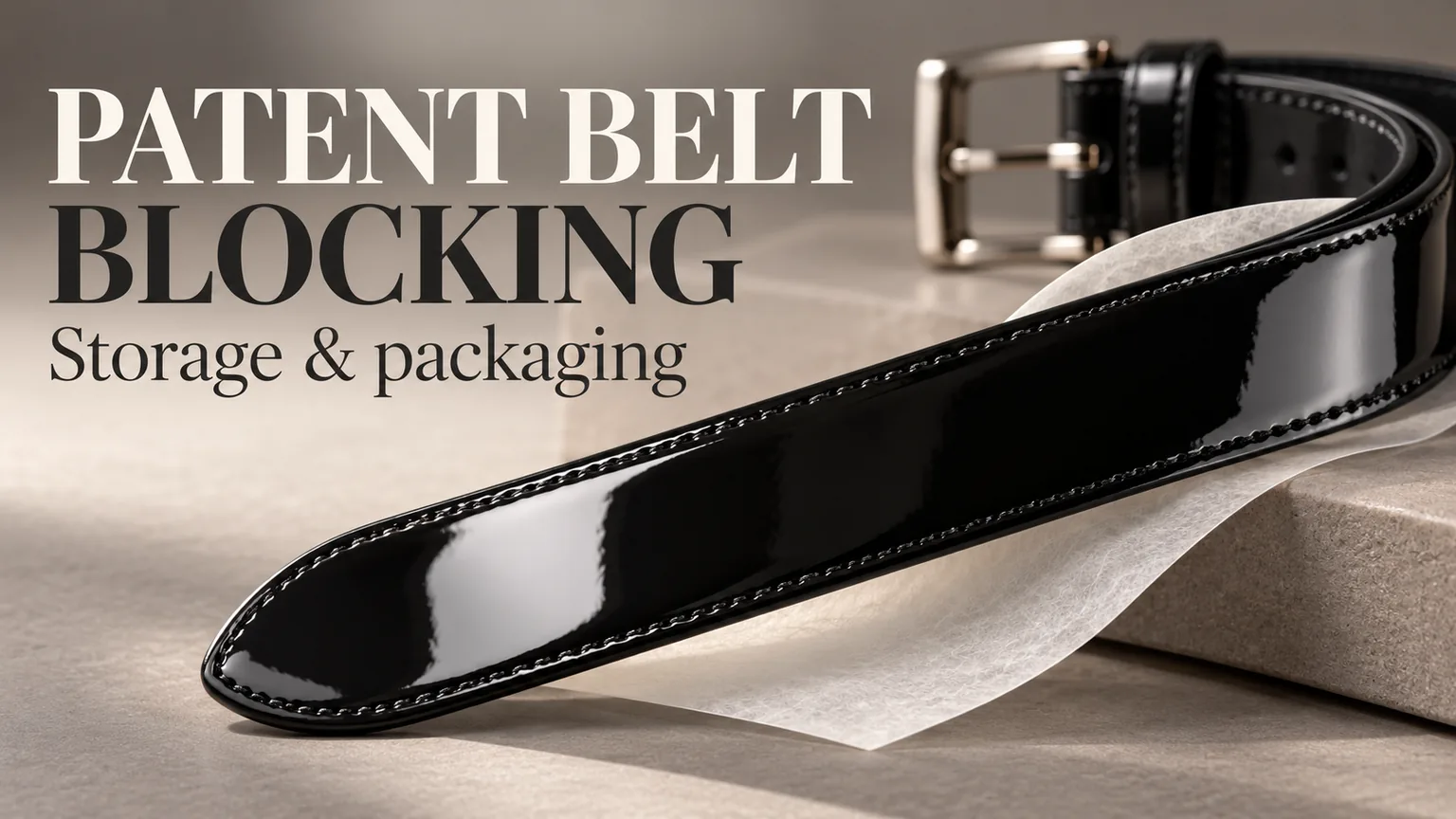
A patent leather belt can look correct at sample approval and still be difficult to unpack after storage. The missing information is often the contact: which surface pressed against the glossy finish, for how long, and in what packing arrangement. Solving that problem requires more than choosing a softer tissue or asking for a “better coating.”
For a brand developing glossy belts, the useful distinction is between a material that adheres to itself and a finished belt that reacts badly with its packaging. Those questions overlap, but they are not interchangeable. This guide explains how to separate them, compare corrective options and approve a pack that preserves the intended appearance.
Start with the contact, not the word “patent”
Patent describes a glossy appearance, not a single coating recipe. Stahl’s leather protection portfolio, for example, includes patent applications among different finishing systems and identifies blocking resistance as a property that can be influenced through finishing chemistry. That does not establish which system is on your belt. It explains why two visually similar samples should not automatically share the same packing approval.
The immediate mechanism of blocking is adhesion between surfaces that were expected to separate. Whether separation leaves damage depends on more than how sticky the contact feels: the finish must also remain attached to its own substrate. If pulling the surfaces apart lifts a film, the investigation now includes finish integrity as well as the original contact. A photograph of a peeled patch cannot establish the coating formulation or identify the initiating cause.
Temperature, compression and contact duration belong in the investigation because they define the exposure. A cool sample briefly touched by hand has not experienced the same situation as a belt held in an overlapping pack. The relationship is product-specific; do not assume every finish becomes tacky at the same temperature or that a short, hotter exposure is equivalent to a long distribution period.
First draw the packed belt as it actually sits. A coil may place the glossy face against the lining, not against another glossy face. A folded tail may create the face-to-face overlap. A buckle may press through a sleeve at one small location. These distinctions tell the laboratory which pairs to compare and tell the packaging team where a barrier would have to remain in place.

Describe the damage before choosing the remedy
“The leather is sticking” is too broad for a useful corrective-action request. Record what happens during separation and what remains afterward. Does the pair release cleanly with slight resistance? Is there a change in gloss without visible transfer? Does the separator leave fibers? Is a colored patch present even where the surfaces release freely? Preserve an unopened example when possible, because cleaning and repeated peeling can remove the evidence needed to distinguish these outcomes.
| Observation | Question to investigate | What it does not prove |
|---|---|---|
| Glossy faces resist separation | Does the finish show self-blocking under the agreed exposure? | That every alternative pack will also fail |
| Paper or film adheres to the belt | Is this exact contact pair compatible? | That a different material with the same generic name is safe |
| Finish lifts during opening | How do contact adhesion and finish integrity interact? | The cause from a photograph alone |
| A seam or buckle outline remains | Where is the load concentrated; is texture or shape imprinted? | That sticking or color migration occurred |
| Color transfers without sticking | Which material is transferring color, and in which direction? | A blocking failure or a specific chemical identity |
On a phone, scroll horizontally to compare all three columns.
Color movement deserves its own route. ISO 15701:2022 addresses migration of leather colorants into a contacting white polymeric material. Its public abstract does not make it a universal test for everything that might transfer from a printed package onto leather. A blocking result and a color-migration result answer different questions; neither should be used as a substitute for the other.
Choose between a finish change and a packing change
A finish change addresses the material’s behavior. A packing change addresses the contacts and loads imposed on it. If the finish blocks against itself under relevant agreed conditions, simply adding tissue may hide an unresolved material risk wherever the barrier shifts or a customer later coils the belt differently. Conversely, if self-contact performs acceptably but a particular sleeve adheres, replacing the entire leather specification may be unnecessary.
Ask the finishing supplier to evaluate its own formulation and process rather than prescribing additives from a generic article. A revision intended to improve release still has to preserve the approved gloss, color, flexibility and hand. A harder-looking sample is not automatically the better belt: the buyer still needs to see how that finish behaves around the buckle fold and during ordinary bending. Material approval therefore follows the revised sample, not merely the name of the new chemical system.
A separator can remove a problematic interface, but only where it provides continuous coverage. Specify the actual material and contacting side, including any coating, print, embossing, seam or adhesive zone. “White tissue” and “clear bag” describe appearances, not compatibility. If a supplier changes the paper grade or film treatment while keeping the same purchase description, the original comparison may no longer represent production.
Geometry is another lever. Moving a buckle away from the visible face can reduce localized contact; restraining the tail can prevent a glossy overlap; reducing compression can alter the storage exposure. Each creates a tradeoff. A looser pack may permit movement and scuffing, while a larger divider may increase carton volume. Assess these consequences together rather than solving adhesion by creating an uncontrolled transport problem.
Use two levels of validation
First isolate the contact pair
Begin with retained material and exact candidate contact materials. Keep an unchanged reference alongside the revised pair. Compare the glossy face with itself, with the production backing where relevant, and with the proposed separator. Change one identified variable at a time where practical. If finish, sleeve, folding direction and carton loading all change together, a better outcome does not show which change was responsible or which can safely be removed later.
Laboratory method selection matters here. The public scope of SATRA TM271 concerns coated material adhering to itself, including finished leather. Its published principle uses face-to-face contact under specified pressure and temperature followed by assessment. The summary distinguishes methods intended mainly for coated fabrics and finished leather. It does not publish the full operating conditions or establish a universal buyer acceptance threshold.
Ask the laboratory which licensed method, version and assessment fit the material question. A bespoke belt-to-sleeve comparison may be valuable, but it should be identified as an agreed project comparison rather than silently presented as an unmodified standard method. A test name alone does not establish that the production packing arrangement was examined.
Then validate the complete pack
After screening a promising combination, assemble the actual retail pack and representative shipping arrangement. This second level introduces the features a flat pair cannot reproduce: buckle location, folds, separator movement, sleeve seams and load transmitted through neighboring products. Choose exposure scenarios with the supplier and laboratory using the intended storage and delivery route, including available information about handling and dwell time.
The importance of describing exposure is not unique to leather. Smithers’ packaging blocking service describes controlled contact conditions for packaging materials. Its method context is different from a leather self-blocking method. The useful lesson for a belt project is to define the complete comparison, not transplant another material’s procedure or assume that any accelerated exposure represents the intended route.

A worked comparison: separating a sleeve problem from a finish problem
Consider an illustrative development project, not a reported HongDing order. A glossy belt releases from its backing but leaves an impression where a sleeve seam crosses the visible face. The first response should not be a blanket demand for “non-stick leather.” Retain the affected pack and prepare an unchanged reference, a pack with the seam repositioned, and a pack using a candidate separator while retaining the original finish.
If the seam change removes the localized impression under the agreed comparison but the face-to-face pair still adheres, there are two findings: the geometry change helped that pressure location, while self-contact remains unresolved. The revised pack may still be unsuitable if the tail can move into a glossy overlap. If only the new separator improves release, keep its exact identity in the specification rather than recording simply “add paper.”
These are conditional interpretations, not predicted results. The development team should decide what each outcome would mean before running the comparison. That prevents the successful-looking sample from being selected after the fact while inconvenient observations are ignored. The objective is a repeatable decision about a defined construction, not a demonstration designed to produce a pass.
Make the approval reproducible for production
An approval should identify the leather and finish revision, belt construction, contact materials and packing drawing or photographs. Include the material supplier’s relevant handling and release guidance. “Dry to touch” should not become a substitute for that guidance: it is an observation at one moment, not evidence that every finishing process has reached its required condition for packing.
Record the agreed exposure, sample preparation, separation procedure and assessment timing with the results. Photograph the same locations before and after under consistent viewing conditions. Assess clean release, finish lift, gloss change, texture imprint and color transfer separately. If a visual reference is used, retain it and define how borderline differences will be judged. Do not invent a force limit or temperature threshold because another customer used one on a different finish.
The production control is then specific: preserve the approved material identities and contact geometry, and reopen the comparison when a relevant variable changes. A new finish batch does not automatically require a complete redevelopment, but a different coating system, substituted separator or revised pack layout needs an explicit review of whether the existing evidence still applies. Purchasing, packing and quality teams need the same revision reference.
For goods already affected, isolate the implicated lots and pack versions while the team assesses the extent. Compare carton locations and contact patterns before assuming every belt has the same condition. Avoid bulk application of oil, powder, solvent or polish as an undocumented release treatment; it changes the product being investigated and introduces another contact material. Any proposed rework needs its own sample approval and confirmation that appearance and function remain acceptable.
Bring the finish and packaging teams into the same conversation
At HongDing, material and hardware coordination, sample development and packaging coordination can be considered together. Our business origins date to 2004; the current Hong Ding company identity dates to 2010. The practical value of that manufacturing perspective is not a claim that every glossy finish will behave alike. It is recognizing that a belt’s material approval and its packed condition cannot be disconnected.
For this issue, send the intended glossy appearance, a reference sample or image, the packing arrangement and any observed contact marks. If a technical pack is not ready, those inputs are enough to begin discussing the open decisions. We can coordinate sample and packaging options; a named test, acceptance criterion or compliance claim still needs project-specific agreement and evidence.
See our quality-control approach for the broader inspection context. For boxes, labels and presentation choices, use the separate private-label belt packaging guide. Neither replaces compatibility evaluation of the actual patent finish and pack.
Questions buyers ask
Is tissue paper always safer than a plastic sleeve?
No universal comparison is justified. Paper can leave texture or fibers; a film has its own contacting surface and seam. Compare the exact candidates against the approved finish and check whether their coverage stays in place.
Does a blocking test also prove colorfastness?
No. Adhesion and color transfer are distinct observations. Select the relevant method or project comparison for each question and do not infer one result from the other.
What storage temperature should we specify?
Obtain guidance for the actual finishing system, then agree conditions appropriate to the distribution route. This article does not establish a universal safe temperature, humidity, stacking height or storage duration.