
For leather formaldehyde testing that needs a precise quantitative answer, specify the applicable HPLC method, ISO 17226-1:2021. The colorimetric alternative, ISO 17226-2:2018, has a selectivity limitation: substances extracted alongside formaldehyde can affect the optical measurement. A disagreement between reports therefore needs a method-and-specimen investigation before a purchasing decision.
The immediate question is not which laboratory produced the lower number. It is whether the laboratories measured the same thing, from equivalent material, under the method required for the decision. Changing the analytical route, the sampled layer or the reporting limit can change what the two documents actually allow you to conclude.
This guide helps belt brands, importers and retail sourcing teams choose a testing brief and resolve conflicting results. It covers leather extraction tests and their interpretation, rather than providing a laboratory operating procedure or a universal acceptance limit.
Define the measurement before comparing the number
ISO 17226-1 and ISO 17226-2 concern free formaldehyde and formaldehyde released through hydrolysis into a water extract under defined conditions. The result is tied to that extraction, not an inventory of every chemical bond containing formaldehyde in the original material. Both official abstracts define this boundary; the laboratory needs the full method to perform the work.
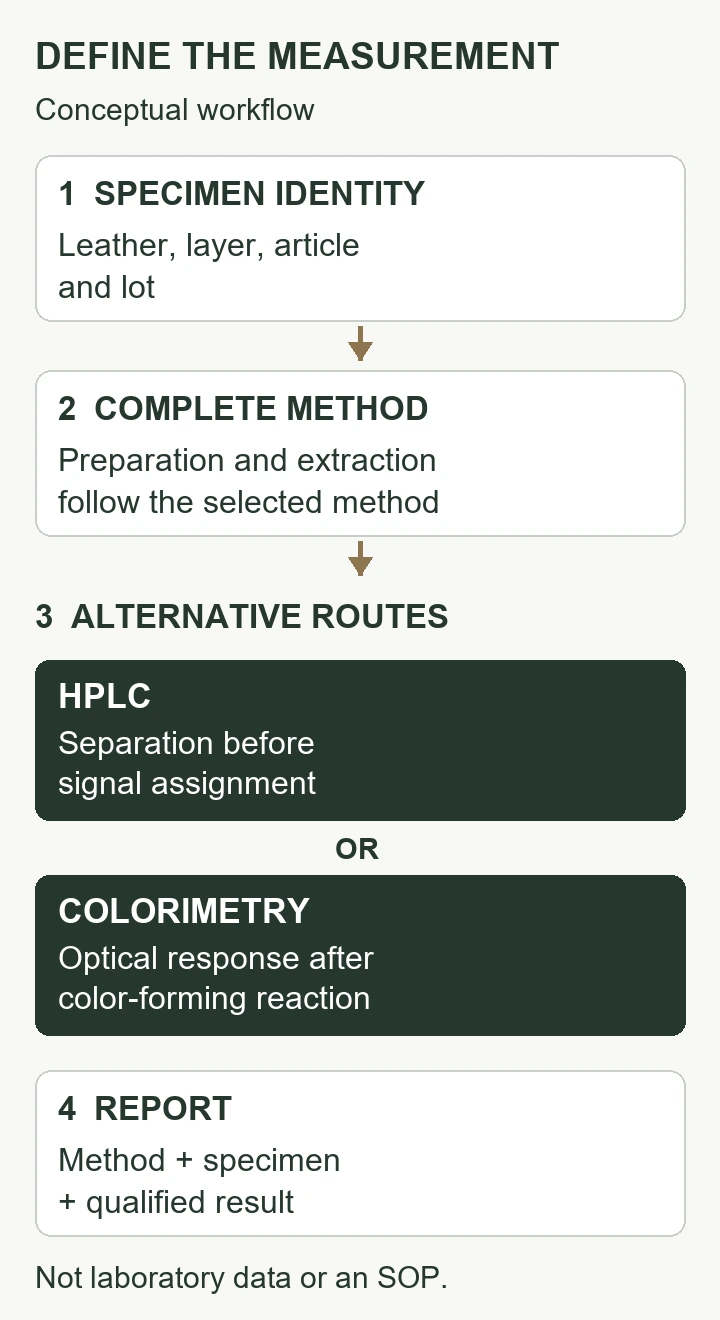
For a buyer, the distinction separates three decisions. First comes specimen identity: face leather, leather lining, or some other specified portion of the belt. Next comes preparation and extraction: how the laboratory obtains the liquid to analyze. Last comes analytical measurement: how the target substance is distinguished and quantified in that liquid. Merely writing “formaldehyde test” leaves all three unresolved.
A belt assembled from leather, reinforcement, adhesive and a lining is not interchangeable with an unassembled leather cutting. Combining components also changes the meaning of a mass-based result. Ask the laboratory to define an appropriate specimen for the named requirement; do not instruct it to mix materials simply because the whole product fits in one sample bag.
For example, a supplier’s face-leather report cannot establish the result for a different lining. Equally, a result from a composite cut cannot identify which constituent contributed to it. Component selection should follow the question being investigated. This is a sampling distinction before it becomes an instrument comparison.
What changes between HPLC and colorimetry?
Colorimetry measures an optical response
In its technical explanation of formaldehyde analysis, SATRA describes a reaction with acetylacetone followed by measurement of the resulting color intensity. Its article dates from 2016 and cites older standard editions; the chemistry explanation is useful, but those edition numbers should not be copied into a new test instruction.
The current Part 2 abstract identifies possible interference from extracted dyes at 412 nm and says the method is not intended for precise quantification. The relevant color is in the extract, not simply the visible shade of the finished belt. A black belt is not proof that interference occurred, and a pale belt is not proof that the analytical response is specific. That judgment belongs with the laboratory’s observations and method controls.
HPLC adds a separation step
Chromatography separates compounds before the analytical signal is assigned. A 2019 JALCA study of chromatographic conditions examined, among other factors, separation of the formaldehyde-associated peak from residual DNPH reagent. This illustrates why separation quality matters; it does not supply a universal detection limit or a shortcut to the full current procedure.
The practical advantage is a more selective measurement when the sample extract contains other substances. It does not make HPLC a remedy for a mislabeled specimen, an unsuitable test scope or a report copied from another leather lot. A selective instrument route still needs correct preparation, appropriate laboratory controls and a traceable sample.
Method choice for the buyer’s decision
On a small screen, swipe the table sideways to compare both methods.
| Decision point | HPLC: Part 1 | Colorimetry: Part 2 |
|---|---|---|
| Published edition checked | 2021 | 2018; confirmed in 2025 |
| Analytical purpose | Precise quantitative determination | Not intended for precise quantification |
| Extract color | Selective route specified by ISO | Potential optical interference |
| Before commissioning | Match method to the required decision | Confirm the intended use is accepted |
| A different result | Investigate comparability | Do not assume a fixed correction |
The ISO publication pages were checked on November 10, 2026. This comparison uses their public scope statements, not an assertion that the full standards were reviewed. Laboratory execution requires the complete applicable documents.
Why two reports may disagree
Start with differences that could make the comparison invalid. A supplier may describe two submissions as “the same brown leather” even though one came from development stock and the other from bulk material. The trade description can remain unchanged while the article code, color recipe, finish, supplier or sampled component changes. Record those identities before drawing a chemical conclusion.
Then compare the method designation and any declared deviations. “ISO 17226” without a part number does not identify the analytical route. “HPLC” alone is also incomplete. Different editions or laboratory modifications are questions to resolve with the laboratory; a buyer should neither assume equivalence nor reject an older report solely because its date is earlier.
Finally, examine how results are expressed. A numerical concentration, a result below a stated reporting threshold and a pass/fail statement carry different amounts of information. Do not place them into a spreadsheet as interchangeable numbers. Retain the unit, any less-than sign, the threshold definition and the report’s explanatory notes.
A method difference is not a conversion formula
A 2009 JALCA study compared both routes on 110 leather samples using the then-applicable procedure. The authors reported similar overall trends alongside differences in absolute values. That historical finding supports caution about interchangeability; it is not a current universal error allowance, and its instrument performance figures should not be transferred to a different laboratory.
Do not average an HPLC result and a colorimetric result to create a new acceptance value. The average would obscure the unresolved method difference without producing a measurement made under either procedure. Likewise, subtracting a standard percentage from one route assumes a predictable bias that has not been established for the actual material and conditions.
If the laboratory identifies an interference concern, ask how it affects the interpretation and which confirmatory work addresses it. If no interference is found, continue investigating specimen identity, preparation, reporting and analytical performance. A known limitation is a reason to investigate, not a diagnosis for every discrepancy.
Choose the route around the purchasing decision
When a customer names a method, preserve that requirement in the quotation. Request the full designation and edition, required specimen and reporting needs. A laboratory proposal using another route may be technically reasonable, but the customer must accept the change before it becomes the basis for release. A cheaper quotation is not equivalent if it answers a different question.
When exact quantification or a disputed result matters, ask for an appropriate selective determination. For the leather extract question covered here, Part 1 is the relevant route to discuss. Keep the acceptance criterion separate from method selection. An analytical method tells the laboratory how to produce evidence; a product specification or applicable requirement tells the buyer how that evidence will be used.
When considering colorimetry for a limited internal purpose, define that purpose first. Have the laboratory and recipient agree that its scope and limitations fit the task. Do not silently promote an internal comparison into customer acceptance evidence. Any claimed saving in cost or turnaround needs an actual quotation; this guide does not assume the simpler-looking method is always faster or cheaper.
Also ask which laboratory location will perform the work. Review the relevant testing scope and competence for the material and method rather than relying only on a group brand name. If work is subcontracted, identify who performs and reports it. These questions make quotations comparable without requiring the sourcing team to prescribe instrument settings.
Read the report as a measurement record
The most useful report review links the sample to the result and the result to a decision. Request clarification where one of those links is missing. A laboratory may place some information in a covering explanation or testing agreement rather than printing every detail in the result table.
- Specimen identity: component, leather article, color, finish, supplier reference and sample or lot code. Record whether the specimen was a loose material or taken from an assembled belt.
- Method identity: full standard, part and edition, with any modifications or exclusions. The analyte name alone is insufficient.
- Result expression: numerical value or qualified result, unit, reporting threshold and the laboratory’s meaning of abbreviations such as ND. Preserve qualifiers exactly.
- Decision basis: the named customer requirement or other applicable criterion, its version and the party responsible for interpretation. If a conformity statement is supplied, ask how the laboratory reached it.
- Timing and traceability: receipt and test dates, report identifier and connection to the retained material. These help reconstruct what was tested when a repeat result differs.
Detection and quantification deserve separate attention. A report may indicate that an analyte was detected without giving a reliable quantitative value at that level. Ask the laboratory to distinguish its detection, quantification and reporting thresholds. A notation such as “not detected” is not evidence of absolute absence, and its usefulness depends on the stated threshold and intended decision.
For a result close to the applicable acceptance boundary, request the laboratory’s interpretation of uncertainty and any decision rule used for a conformity statement. Do not invent an extra safety margin or subtract uncertainty to obtain a preferred outcome. Agree the decision basis with the responsible buyer before the retest, so the rule does not move after the result arrives.
Worked example: resolve a disagreement without testing at random
Illustrative scenario: a retail buyer receives a supplier’s colorimetric report for black face leather and an HPLC report commissioned during belt development. The two reports show different concentrations. There are no real customer results or acceptance limits in this example.
The buyer’s first review finds that the supplier submitted a loose leather cutting, while the development submission was described only as “black belt.” Until the second laboratory identifies the tested portion, this is not a controlled comparison of methods. Retesting another finished belt immediately could produce another number while leaving the original ambiguity unresolved.
- Reconstruct the submissions. Obtain sample descriptions and available photographs, then map each to the face, lining or composite preparation. If the specimens differ, record that limitation instead of calling one report wrong.
- Define the unresolved decision. Is the concern a customer requirement for the face leather, a lining question or a specified finished-product assessment? Select the specimen and method with the laboratory against that question.
- Plan a controlled comparison. If method disagreement still needs investigation, agree representative material, sample preparation, retained portions and handling with the laboratory. Do not assume two cuts from different production lots are matched specimens.
- Review the explanation with the result. Ask whether the findings resolve the original discrepancy, what remains uncertain and which material the conclusion covers. Record the release decision against that material identity.
Suppose the clarification shows that both reports did concern the same leather article and lot. The inquiry then moves to the reported methods, extract observations, controls and result qualifications. If the laboratory attributes the difference to colorimetric interference, retain that explanation with the confirmatory result. If the cause remains unresolved, document the limit of the conclusion rather than declaring every future colorimetric report invalid.
This approach limits unnecessary repeat testing. Each new submission should close a named uncertainty: specimen mismatch, method suitability or analytical disagreement. Repeating tests until one passes does not establish which material was evaluated or why the results differ.
A leather content result is not an emission result
The instrument name can conceal another important mismatch. ISO 17226-3:2011, confirmed in 2025, also uses HPLC, but addresses formaldehyde released into the gas phase. ISO expressly distinguishes those results from the liquid-water extraction methods. “Tested by HPLC” therefore does not establish that two reports concern the same measurement.
Keep a content requirement, an emission requirement and a customer restricted-substance requirement in their own records. Do not convert a leather content value into an air concentration, or assume that one named emission method automatically satisfies a different product requirement. Have the responsible compliance reviewer and laboratory establish scope before commissioning work.
For the broader component and legal-evidence workflow, see our REACH evidence guide for leather belts. This article deliberately does not set a universal formaldehyde limit for every belt, destination or age group.
Carry the resolved test scope into production
Once the disagreement is resolved, preserve the material identity and agreed method in the purchasing specification. A useful outcome is not simply “HPLC passed.” It is a traceable decision naming the tested leather, supplied version, report and applicable criterion. That record lets the factory and buyer see what the approval actually covers.
At incoming-material review, compare the supplied article, color, finish and source against the approved record. Visual similarity does not establish chemical equivalence. If a supplier proposes a substitute, identify the changed inputs before deciding whether the previous evidence remains relevant. The same approach applies when production changes the lining or other material covered by the original testing brief.
If a later result raises an unresolved acceptance concern, hold the affected release decision while the responsible parties investigate. Define the affected material or lot, preserve the evidence and agree any corrective action and verification. Do not invent a routine testing frequency from one successful sample; frequency and sampling need the actual risk, customer requirement and supply controls.
Connect the laboratory question to the belt you are buying
HongDing can help connect belt development, material references and supplier documents within an agreed project scope. Our quality-control workflow supports that manufacturing handoff; it does not turn a factory review into an independent laboratory result.
Share the intended market and use, the relevant leather or belt reference, the customer’s testing requirement and any reports that disagree. A reference sample or available material details can start the discussion. We can identify open component questions and discuss the supplier-document or laboratory coordination needed before the material decision proceeds.