

White material on a leather belt is not automatically mold, and it is not automatically harmless wax bloom. Fats or waxes can migrate or crystallize at the surface; biological growth can look similar, and the two can coexist. At receiving, hold the affected stock, preserve its condition and trace the material and packing history before deciding whether it can be released. A photograph or a successful wipe is not a release test.
For a brand team, this is both a material question and a delivery decision. A residue may be non-biological yet still unacceptable on a black dress belt intended for immediate retail display. Conversely, an attractive surface after cleaning says little about the original cause. The useful distinction is between identifying the deposit, understanding its distribution and accepting the finished product.
This guide addresses newly received fashion-belt stock, not household cleaning, restoration of historical leather or occupational mold remediation. The receiving sequence below is a proposed purchasing workflow, not a universal sampling standard.
Why bloom and mold can be mistaken for one another
“Bloom” is an appearance description until its composition is established. In leather discussions it may refer to a surface deposit associated with fats or waxes. Fatty acid spew is a more specific phenomenon: fatty material moves to the surface and becomes visible. It should not be used as a diagnosis for every pale mark.
The US National Park Service explains that fatty acid spew on treated leather can resemble fluffy growth, that photographs may be insufficient for identification, and that mold and spew can occur together. Its examples concern collection objects, including aged dressings, rather than newly manufactured belts. The relevant lesson is the identification limit—not a recipe to apply to new stock. See its conservation note on fatty acid spew.
A commercial leather-care specialist also describes fatty spew originating from fats within leather or materials used in processing. This makes the leather article and finishing history relevant to a supplier investigation. It does not establish which ingredient caused a deposit on your shipment, or whether a particular cleaning product is suitable.
Mold is biological growth, not a finish effect. The Canadian Conservation Institute’s leather guidance identifies moisture conditions and susceptible organic materials as important factors. It also warns that confusing deposits exist and treats safe handling as a separate concern. Apply that distinction at receiving: staff should not touch, sniff or brush an unknown deposit simply to classify it.
Read the pattern without turning clues into a diagnosis
Distribution can help direct questions. Is the material visible along exposed edges, beneath a keeper, around hardware, or on broad faces? Does it appear on one leather color, one packing unit, or several unrelated styles? Record these differences before someone makes all samples look alike by wiping them.
A pattern restricted to one leather article suggests comparing that article’s processing and finishing records. A pattern concentrated in visibly damp packages suggests investigating moisture exposure as well. Neither pattern is conclusive: the same leather may be packed together, so a material batch and a carton location can be correlated. Use both identifiers instead of choosing the most convenient explanation.
| Observation | Useful investigation lead | What it does not prove |
|---|---|---|
| Pale deposit on one leather article | Compare material lot, finish and retained reference. | That all deposits are wax or fatty spew. |
| Damp or stained outer packaging | Review receiving, storage and transit exposure. | When the exposure occurred or who caused it. |
| Residue near hardware or a fold | Check adjacent materials and contact positions. | That the leather itself is the source. |
| Surface looks clear after handling | Record exactly what was done to that sample. | Correct identification, lasting correction or safe release. |
A dry carton at inspection is only a current observation. It is not a continuous record of the shipment’s environment. Likewise, a clean retained sample at the factory is a useful comparison but not proof that the delivered belts are unaffected. The two groups may have experienced different packing, storage and transport conditions.
Do not use color, smell or a calendar rule as a shortcut. A white deposit is not necessarily bloom; a darker deposit is not automatically mold. If a specialist needs closer examination or analytical work, let that person define the method and sample handling. The receiving team’s job is to preserve a reliable starting point.
What to do when the first carton is opened
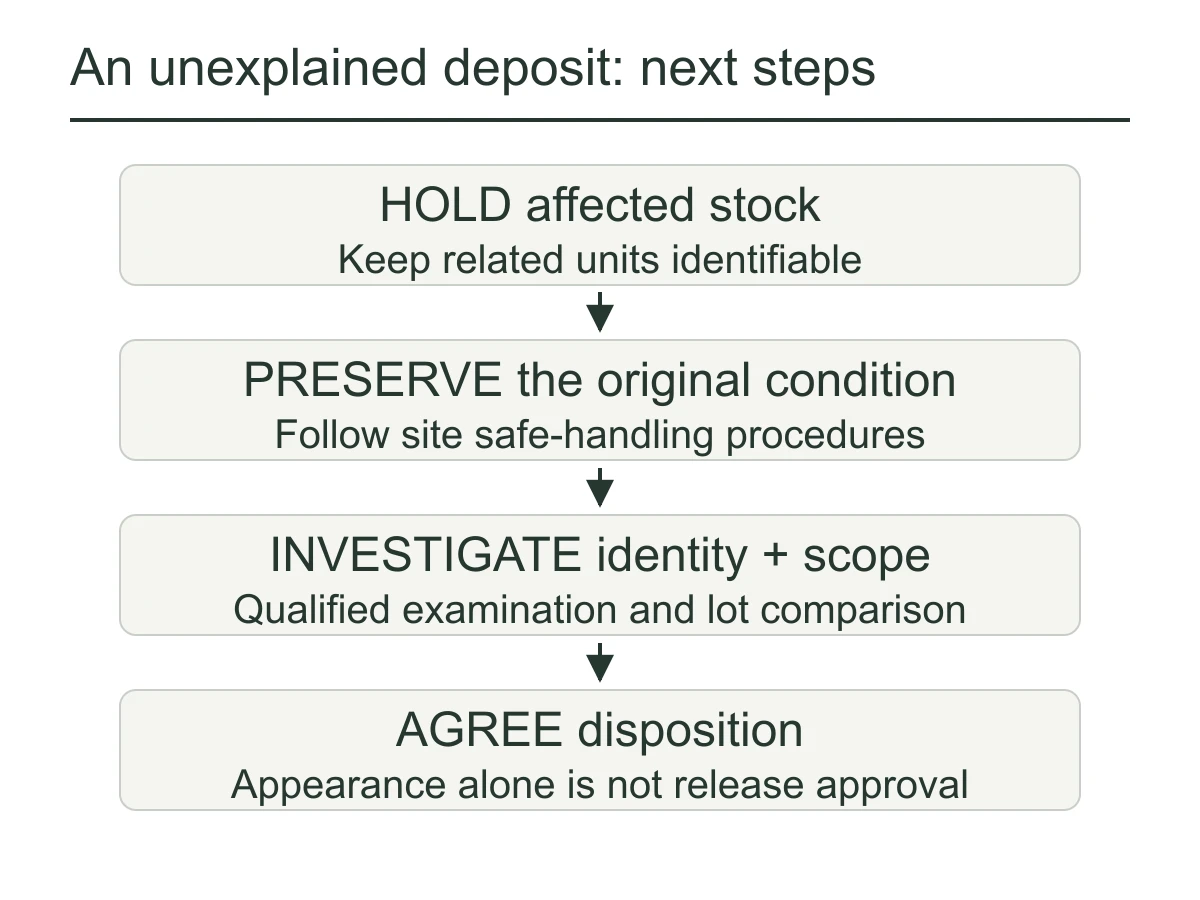
Separate the immediate hold decision from the eventual commercial claim. A hold prevents uncertain stock from entering picking or retail preparation while the facts are established. It need not prejudge the entire order, but its initial boundary should be broad enough to keep potentially related units identifiable.
- Stop routine preparation of affected stock. Do not clean, relabel or mix it with accepted belts. Tell the responsible quality and warehouse personnel what was observed.
- Follow the site’s safe-handling procedure. Where mold is suspected, have the responsible health-and-safety person determine access, handling and containment. Do not improvise drying or remediation on the receiving floor.
- Record the original state. Capture the carton identifier, visible packaging condition, style, color and material lot where known. Photograph the overall arrangement and the affected positions without disturbing the deposit.
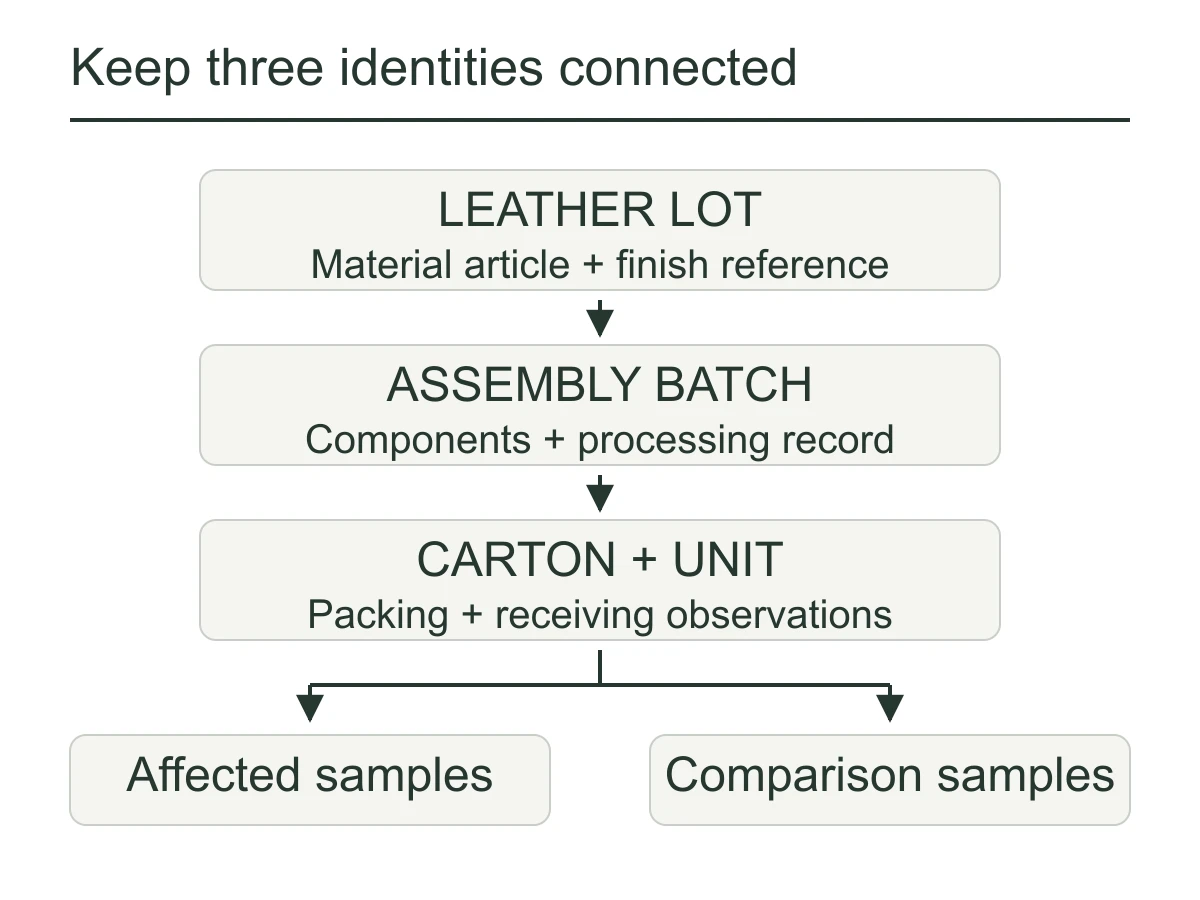
- Keep the links between objects and records. A close-up with no belt, lot or carton identity is difficult to investigate. Assign a sample reference and keep it linked to the wider photographs.
- Agree the next examination. Supplier quality staff and an appropriately qualified laboratory or specialist should determine which items are needed and how they should be transferred.
Do not mail suspect samples casually or invent a universal bagging instruction. Packaging for investigation must consider both exposure control and preservation of the condition being examined. Obtain the recipient’s handling and shipping instructions first. Record any change already made, including wiping, airing, heating or applying a product, because it can change what the examiner sees.
A short incident record is more useful than a large folder of unlabeled photos. Include when the issue was first noticed, which units were examined, how those units were selected and whether anything happened between opening and photography. Avoid writing “all belts moldy” when only one open carton has been observed.

Ask the supplier to compare three histories
The leather and finish history
Start with the actual leather article, not a broad sales term such as genuine leather or Crazy Horse. Ask which material lot went into the affected style and whether there were changes to finishing, conditioning or surface treatment. A wax-rich appearance described in our Crazy Horse leather guide does not make every later deposit an approved feature.
Compare the approved reference, retained production material and delivered units. If the retained material also develops a deposit, the material route deserves closer attention. If only assembled or packed belts are affected, examine the additional operations and conditions. These are investigation branches, not proof that the earlier operation was fault-free.
The assembly and packing history
List what contacts the leather: lining, adhesive, edge treatment, metal fittings, tissue, protective wrapping and retail presentation materials. A residue at a repeated contact position is a reason to examine that interface. Broadly replacing the leather may be an expensive and ineffective response if the source is a neighboring material.
Ask whether the sample and production belts used the same packing configuration. A showroom sample displayed openly is not equivalent to finished stock enclosed with protective materials. If the approved sample never underwent the planned packing sequence, that is a gap in the comparison—not evidence that the packing caused the problem.
The storage and transport history
Collect available records of packing dates, storage locations, shipment handovers and environmental observations. Describe what the records actually cover. A logger in one location does not necessarily represent every carton, and the absence of a logger is not evidence that conditions were stable.
The EPA identifies moisture control as central to mold prevention. For a belt investigation, the practical implication is to examine why a moisture exposure could have occurred, not just whether the finished surface can be made presentable. Building guidance is not a belt-specific storage specification; agree the relevant material and packaging conditions with the parties responsible.
Define the question before commissioning a test
“Please test the white marks” is too vague to produce a useful release decision. Different questions require different expertise. Identification asks what the deposit is. A distribution investigation asks which material or packing groups are affected. A corrective-action evaluation asks whether the proposed change addresses the cause without creating another defect.
- If identity is uncertain: ask a qualified specialist what examination can distinguish the plausible explanations and what untreated samples are required.
- If identity is established but scope is uncertain: agree how to compare related lots, cartons and unaffected-looking controls. Define the sampling basis before interpreting the result.
- If rework is proposed: assess the treated belt’s appearance, construction and recurrence risk under an agreed protocol, as well as the specialist’s relevant findings.
A result belongs to the examined samples and the stated method. It should not silently become “the whole order is safe” or “the entire factory has a mold problem.” Ask the report to identify the specimen, examination date, findings and limitations. Then connect it to the lot map and the intended disposition.
Do not set an arbitrary waiting period and call the absence of visible return a pass. The observation period and conditions need a reason: they should address the proposed mechanism and anticipated supply route. If that information is missing, the supplier should propose a justified validation plan rather than promise that the deposit will never return.
Release, rework or reject: use two separate decisions
The first decision concerns identification and handling; the second concerns conformity with the purchase agreement. Confirmed non-biological bloom can still fail the approved appearance requirement. A finish sold with an intentional waxed character needs an agreed reference showing what is acceptable; a supplier cannot redefine an unexpected residue as “natural” after delivery.
For a proposed rework, request a small, controlled evaluation before authorizing treatment of the stock. Record the method, treated sample identity and results against the agreed reference. Depending on the construction, review color, gloss, hand, edge condition, lining and hardware appearance. Cleaning that changes the finish may solve one visual problem while creating another.
If mold is confirmed or remains a credible unresolved concern, do not treat a cosmetic improvement as release approval. Qualified personnel need to determine the appropriate handling and disposition. Commercial discussions about replacement, rejection or costs should use that finding alongside the agreed product requirements and contract—not an improvised cleaning demonstration.
For any route, name the person authorized to release stock and state which units the decision covers. A laboratory identifies or measures within its scope; the buyer and supplier still need a documented disposition. Keep unaffected stock separate until its relationship to the issue has been assessed, rather than assuming an entire order must share one outcome.
A worked receiving example
Consider an illustrative shipment with black and brown belts made from different leather articles. Pale deposits appear on some black belts in two opened cartons; the brown belts examined so far look clear. There is no confirmed identification yet. The wrong response is either “black wax always blooms, wipe it” or “reject every style immediately.”
A better first record states exactly what is known: which cartons were opened, which black units showed deposits and which brown units were inspected. The team holds the affected stock and identifies potentially related black material and packing batches. It does not extrapolate a defect rate from those few observations or mark the brown order accepted merely because the first examples looked clear.
The supplier then compares retained black leather and production references, while the receiving team supplies the packing observations. A qualified examiner determines the next identification step. If the deposit is confirmed as fatty material, the buyer still evaluates whether the cause and proposed treatment support the required retail appearance. If biological growth is found, the handling and disposition route changes. Either way, the initial traceable record remains useful.
Prevent the next dispute at sample approval
For leather with a deliberate oily or waxed character, describe the acceptable surface rather than relying on the article name. Agree whether a visible deposit is part of the supplied appearance, whether preparation before display is intended, and who provides any approved care instruction. Do not leave a retailer to discover an unstated preparation requirement at receiving.
Where recurrence or packing interaction is a concern, include an agreed packed-sample evaluation in development. Retain references with their material and packing identities, and review changes when either route changes. This does not guarantee that every transport condition has been simulated; it makes the approved comparison more representative and makes later investigation less ambiguous.
Remaining questions
Does confirmed bloom mean poor leather?
Not by itself. Identify the deposit and assess the particular finish and purchase requirement. A non-biological explanation does not automatically mean the delivered appearance is acceptable or that recurrence is irrelevant.
Should receiving staff heat the mark to see whether it disappears?
No. Do not use heat or solvents as a receiving shortcut. They can change the surface and erase useful evidence. Let the qualified examiner specify any diagnostic procedure and keep untreated references.
Bring the material and packing context together
HongDing’s quality-control coordination connects material, construction and finished-belt checks. Share labeled photographs, the style or sample reference, and what was observed on opening. We can discuss which material and packing records need comparing and what specialist investigation may be needed before a disposition is agreed.