

When an invoice and a receiving measurement show different leather areas, first compare the same identified pieces, in the same units and a comparable condition. Then investigate the measurement method and the calculation. Do not deduct cutting waste from a hide’s measured area and call the remainder an area shortage: the amount purchased and the amount that can become acceptable belt straps are different quantities.
For a belt buyer, this distinction affects material costing, a supplier claim and the next production decision. A low strap output may expose a selection problem even when the area invoice is correct. Conversely, a plausible output does not prove that the billed area was measured correctly. This guide explains how to reconcile the input quantity before discussing cutting yield.
Separate three quantities before investigating a shortage
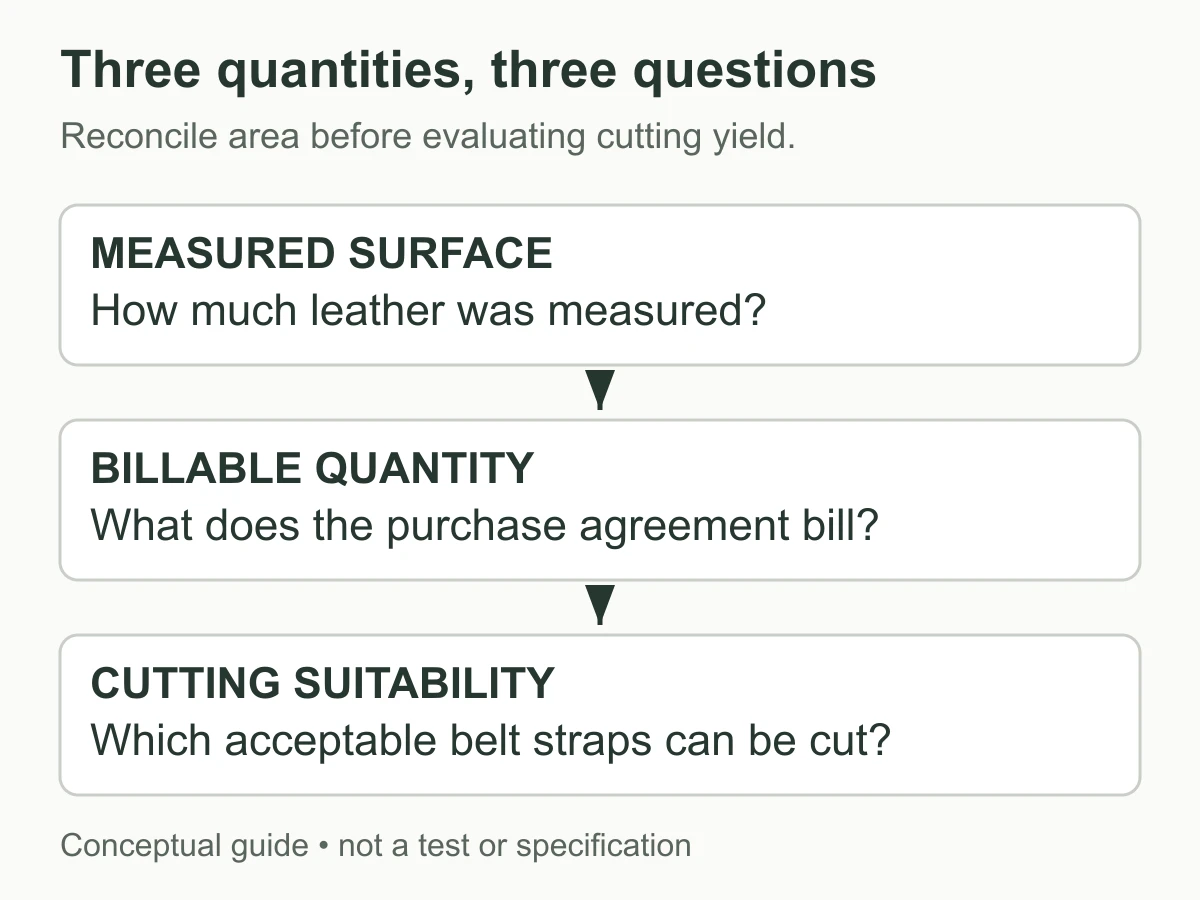
Measured leather area describes the surface quantity determined for the identified leather pieces by the stated method. Billable area is the quantity used under the purchase agreement, including any explicitly agreed commercial adjustment. Usable cutting area depends on the belt specification and the parts that can actually be placed on the material. These figures should be connected, but they should not silently replace one another.
Consider a hide with an irregular edge and a scar in the middle. Its contour affects surface measurement. The scar affects whether a particular belt strap can cross that location. The scar does not necessarily make that surface disappear from the area measurement. A buyer may negotiate quality deductions or a selection grade, but that commercial arrangement must be distinguishable from the measured quantity.
Long, straight belt strips also create a geometry problem. A relatively large piece can have too little uninterrupted length in the required direction for the intended size mix. Several smaller usable patches cannot necessarily be joined into one acceptable long strap. If the concern is output from an accepted input, use our belt cutting-yield guide; the reconciliation here comes before that calculation.
Match the pieces, not just the bundle total
Start with identity and arithmetic because neither requires an argument about the measuring equipment. Compare the purchase order, supplier piece list, packing list and receipt count. A bundle description such as “brown leather” is not enough when several thicknesses, finishes or shipments share that name. Match the leather article, color, lot, piece identifiers and the physical bundle that was actually received.
Retain the original supplier readings separately from the factory’s readings. A spreadsheet that overwrites the supplier’s value with a corrected value loses the very comparison needed to explain a difference. Add separate columns for the original unit, original reading, converted reading, receiving reading and reason for any adjustment. Keep canceled, missing and duplicate records visible until resolved.
Check whether the document represents whole hides, sides, cut panels or some combination. Counting twenty physical pieces does not establish agreement with an invoice for twenty hides. Equally, a supplier may use a commercial piece description that is valid for that order but unfamiliar to the receiving team. Resolve that naming issue before deciding whether the quantity or the price is wrong.
For a partial shipment, compare the received subset with its matching invoice lines. Do not compare the first pallet with the entire order or use a later credit note without showing which material it covers. Once physical identity and document scope agree, any remaining difference is much more useful to investigate.
Choose a measurement method appropriate to the leather
The public scope of ISO 11646:2014 concerns area measurement of dressed and other dry, flexible leathers. ISO 19076:2023 addresses electronic measurement of leather surfaces and leather parts; its stated scope includes specified dry and wet flexible materials. The two references should not be treated as interchangeable names for any method of measuring any hide.
These public descriptions help identify a relevant method, but they do not provide a receiving team with every operating instruction, machine check or acceptance rule. Have the measurement provider apply the appropriate complete method. A quotation that says only “ISO area” leaves the edition, material condition and actual procedure unresolved. Nor does naming a method establish the commercial tolerance between buyer and seller.
For a genuinely rectangular panel with straight edges, length multiplied by width describes its geometric area when both dimensions use compatible units. That does not make the same shortcut valid for an irregular hide. Multiplying the greatest length by the greatest width includes space outside the leather contour. Treat such a rectangle as a bounding box, not as proof of the hide’s area.
A photograph with a ruler can document identity and an obvious shape issue, but it is not automatically a defensible area measurement. Perspective, folds, hidden edges and the relationship between the ruler and the leather plane affect what the picture represents. If image-based measurement is proposed, the provider needs a defined acquisition and calculation method, not a casual phone photograph converted into a confident number.

Make a repeat measurement comparable
A useful remeasurement reproduces the agreed basis as closely as practicable. First identify the material’s state when each reading was taken: for example, supplier dispatch, receipt after transport or a later production stage. If the leather has been trimmed, cut or processed between readings, the resulting values no longer describe an unchanged object. Record those events instead of attributing the whole difference to the instrument.
Ask the measurement provider to identify the equipment, applicable method, setup checks and how the piece was presented. A folded edge or overlapping portion can hide material from a surface measurement; handling that pulls a flexible piece into a different shape can also change the comparison. The practical objective is a repeatable presentation under the chosen procedure, not whichever handling gives the largest or smallest reading.
Do not invent a universal relaxation time or moisture correction factor. If conditioning is required by the selected procedure or purchase agreement, record that requirement and whether both measurements followed it. Where the states differ, ask a qualified measurement provider whether and how a valid comparison can be made. A theoretical correction pasted into a spreadsheet may conceal more uncertainty than it resolves.
Repeated readings on a retained, identified piece can help distinguish an unstable measurement process from a consistent difference between systems. If one piece gives materially different readings during the same review, investigate handling and equipment before applying a blanket invoice deduction. If readings are repeatable but differ consistently from the supplier’s, compare methods, settings and material state before deciding whose figure should govern payment.
Convert units once, then check rounding
Area conversions use squared length factors. For the international foot, 1 square foot equals 0.09290304 square meter; the NIST conversion tables provide the area factor. A square meter equals 100 square decimeters. The factor 0.3048 converts feet to meters, not square feet to square meters.
Keep the original values and convert them in a separate calculation field. Use enough precision for the reconciliation, then apply the agreed invoice rounding at the correct stage. A piece list rounded before addition can produce a different displayed total from a total converted and rounded only at the end. That difference should be explained by the calculation, not dismissed as “normal leather variation.”
Also distinguish conversion precision from measurement precision. More decimal places after conversion do not make the original instrument more accurate. If a supplier reports a piece to one decimal place, converting it to six decimal places preserves arithmetic but does not justify claiming that the physical area was measured to that finer resolution.
A worked invoice reconciliation
The following numbers are an illustrative arithmetic exercise, not a HongDing order, measurement study or acceptance limit. Assume four identified pieces were invoiced in square feet and receiving recorded their areas in square meters. Assume identity, material state and the agreed method have already been reconciled so that comparing the numbers is meaningful.
On a small screen, scroll the table horizontally to view all columns.
| Piece | Invoice ft² | Converted m² | Receiving m² |
|---|---|---|---|
| A | 22.4 | 2.0810 | 2.07 |
| B | 21.8 | 2.0253 | 2.02 |
| C | 23.1 | 2.1461 | 2.14 |
| D | 20.7 | 1.9231 | 1.91 |
| Total | 88.0 | 8.1755 | 8.14 |
Using the unrounded conversion, 88.0 × 0.09290304 = 8.17546752 m². The receiving total is 0.03546752 m² lower, or approximately 0.434% below the converted invoice total. The denominator here is the invoice area. If a different denominator is used, label it; otherwise two people may report different percentages for the same absolute difference.
This arithmetic establishes a difference, not a verdict. Whether the difference triggers a repeat measurement, commercial adjustment or acceptance depends on the agreed measurement and purchasing terms. It is not evidence of a universal allowed shortage. Compare the piece-level pattern as well as the total: a wrong piece identifier or a large discrepancy on one item calls for a different investigation from small differences spread across the entire set.
Now suppose the receiving sheet accidentally lists piece B twice and omits piece D. The reported total becomes 8.25 m² instead of 8.14 m². The apparent shortage becomes an apparent surplus even though no leather changed. This is why matching the physical pieces and checking the spreadsheet comes before debating measuring-machine accuracy.
Use the discrepancy pattern to choose the next action
- The totals differ, but the original piece readings match. Check formulas, unit conversion, duplicated lines and the rounding stage. Request a corrected document if the underlying quantity is agreed.
- One or two pieces account for most of the gap. Check their identity, whether they were trimmed, and whether the measurement included the same physical object. Preserve those pieces for a joint comparison.
- The same pieces vary during repeat measurement. Investigate presentation and the measurement system before treating one reading as decisive.
- The area agrees, but long straps cannot be obtained. Move the discussion to shape, selection, defects, orientation and size mix. That is a cutting-suitability or yield question, not automatically an area-invoice error.
Where production must continue, agree how disputed and undisputed material will be identified and handled. Cutting all the questioned pieces may remove the best opportunity for a direct remeasurement. However, retaining material also has a scheduling cost. A useful joint plan names what will be retained, who will measure it, what documents will be compared and how the production consequence will be handled.
If neither party can establish a comparable basis, an independent measurement provider may be more useful than another exchange of totals. Define the question narrowly: which identified pieces, which method and state, and which difference needs resolution. The provider’s report then informs the commercial discussion rather than being asked to decide every quality and pricing issue in the order.
Write the next purchase specification so it can be reconciled
The next order should name the supplied form, area unit, measurement method and edition, relevant material condition, piece-level record format and rounding convention. Add a clear process for raising discrepancies, preserving material and selecting a joint remeasurement route. Any agreed tolerance or adjustment belongs in the purchasing terms; it should not be inferred from a website article.
Keep belt-making requirements alongside, but separate from, that area basis. Specify the intended strip dimensions, size mix and material-selection requirements so the supplier understands what the leather must support. Buying a larger surface quantity cannot repair a mismatch between the required long-strip geometry and the selection supplied.
HongDing’s material coordination, cutting and quality-review capabilities are relevant at this interface. We can discuss how the supplied leather relates to the proposed belt construction and which records would make a discrepancy easier to investigate. That is different from promising a particular yield or claiming that every shipment is measured on a named machine.
Two remaining purchasing questions
Can leather weight settle an area dispute?
Not by itself. Weight is not surface area, and the relationship depends on the particular material and its condition. A weight check may identify a shipping inconsistency, but it should not replace the agreed area measurement with an assumed weight-per-area factor.
Should a quality credit change the original measured area?
Keep the original measurement traceable. Record whether the settlement changes billable quantity, unit price or a separate credit, and identify the affected pieces. Otherwise a later costing review may mistake a commercial settlement for a new measurement.
Bring the two records into one discussion
Share the leather article, the supplier and receiving piece lists, their units and the belt dimensions you need to produce. HongDing can help separate the material-quantity question from the cutting and construction questions before the next sample or order decision.