Two leather pieces can have the same measured thickness and different mass per unit area. Apparent density adds a volume basis to that comparison, but it does not identify leather quality, predict strength or explain hand feel by itself. For belt development, compare identified materials under consistent conditions, keep the actual measurements, then evaluate the construction and performance that matter to the finished belt.
A heavier replacement strap is a useful observation, not a diagnosis. Before asking the supplier to change the leather, establish whether the difference belongs to the leather, another layer, the buckle or the size being compared. This article explains how mass, area and thickness help separate those questions. For buckle clearance, folded ends and overall profile, use our belt leather thickness guide.
Three quantities that answer different questions
Thickness describes the distance through the material at the measured location and under the stated measuring conditions. It is relevant to space: whether a strap fits a buckle opening, how bulky a fold becomes and whether an edge profile matches the design. It does not tell you the mass contained in a given area.
Mass per unit area describes how much a defined area of material weighs. In dimensional terms it is mass divided by area, often expressed in grams per square meter. It is useful when comparing the material contribution to weight while keeping the amount of surface being compared consistent. A large piece should not be called heavier material merely because it contains more area.
Apparent density relates mass to the volume calculated from the piece’s measured area and thickness. It concerns the material as measured, including its internal structure, rather than isolating the density of a pure chemical substance. Record the specimen identity and measurement basis with the value. A number detached from those details is difficult to compare and easy to overinterpret.
ISO 2420:2017 addresses determination of apparent density and mass per unit area of leather. Its public scope applies to leathers; it does not establish a universal preferred density for belts. Choosing a method and choosing a product acceptance requirement remain separate decisions.
Scroll horizontally on a narrow screen to compare all columns.
| Quantity | Useful question | What it cannot establish alone |
|---|---|---|
| Thickness | Does the identified material or assembly occupy the intended space? | Its mass, strength or durability. |
| Mass per area | How much mass corresponds to the same material area? | Whether the material is denser or simply thicker. |
| Apparent density | How does mass compare after accounting for measured volume? | A quality grade, composition or failure mechanism. |
| Finished-belt mass | How heavy is this complete configuration and size? | The properties of its leather component in isolation. |
A worked comparison with consistent units
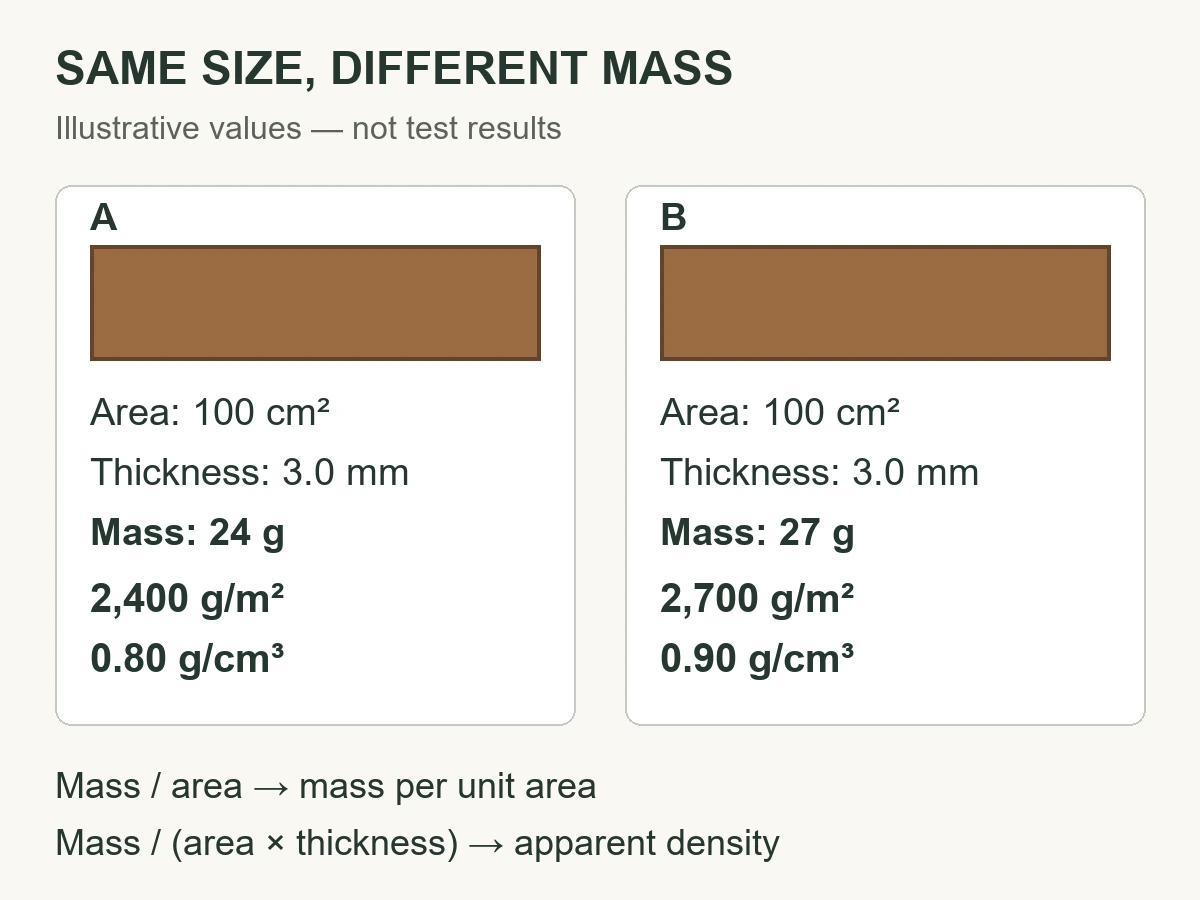
The following numbers are invented solely to demonstrate the arithmetic. They are not HongDing test results, recommended leather specifications or a prescribed laboratory specimen size. Imagine two flat material pieces, each with an area of 100 square centimeters and a measured thickness of 3.0 millimeters. Piece A has a mass of 24 grams; piece B has a mass of 27 grams.
Convert the units before comparing. An area of 100 square centimeters is 0.01 square meter. Dividing 24 grams by 0.01 square meter gives A a mass per unit area of 2,400 grams per square meter. For B, the same calculation gives 2,700 grams per square meter. Because their areas match, the mass difference is a material comparison rather than a piece-size difference.
For volume, convert 3.0 millimeters to 0.30 centimeter. Each piece then has a calculated volume of 100 × 0.30 = 30 cubic centimeters. Dividing mass by this volume gives an apparent density of 0.80 gram per cubic centimeter for A and 0.90 gram per cubic centimeter for B. Both quantities differ by 12.5 percent relative to A in this particular example because thickness is the same.
Now change one assumption: suppose B were 3.375 millimeters thick instead, with the same area and 27-gram mass. Its volume would be 33.75 cubic centimeters and its apparent density would also be 0.80 gram per cubic centimeter. B would still have higher mass per area, but that difference would be accounted for by thickness. This is why an area-weight result cannot stand in for a density result.
Keep the original numbers in the comparison record, rather than retaining only a calculated percentage. A rounded thickness can hide a meaningful difference in the denominator. A unit error can be much larger than the material difference being investigated. For example, using a millimeter value with an area in square centimeters without conversion makes the calculated volume ten times too large. A spreadsheet should show units beside every input and calculation.
Make the pieces comparable before interpreting a difference
Start with material identity. Record the supplier’s article reference, finish, color, batch and whether the specimen is unassembled leather or part of a bonded build. A finished face leather and an unfinished comparison piece are not interchangeable just because their nominal thicknesses match. Material added or removed during processing changes the object being measured.
Moisture is another reason to control the comparison. Water present in a specimen contributes to the measured mass; its condition can also affect dimensions and handling. A recently unpacked piece and a retained reference stored under different conditions may therefore be poor immediate comparators. ISO 2419:2024 covers conditioning dry leather for physical and mechanical testing in standard atmospheres. Ask the laboratory to apply the appropriate preparation rather than inventing an informal drying or soaking routine.
Do not try to “correct” a result by subtracting an assumed moisture percentage. Without a suitable determination and a defined reporting basis, that creates a new estimated number rather than a comparable measurement. If the intended question concerns the leather in a particular service condition, identify that question separately from the standard-condition comparison. The two may require different assessments.
Next, match sampling locations and material state. A small piece is evidence about that specimen; it is not automatically a description of every usable part of a hide or every hide in a delivery. Keep the sampling route and the relationship to the intended belt-cutting area visible. When a report summarizes several pieces, ask to retain their individual results as well as the summary so that an average does not conceal a mixed population.
Finally, control thickness measurement. A soft or uneven piece can respond differently to the measuring arrangement. If one supplier uses a different approach from another, the apparent-density calculation inherits that difference. ISO 2589:2016 addresses leather thickness measurement. Have the actual laboratory confirm the applicable procedure and reporting details; this article does not reproduce a complete test protocol.
What higher apparent density does—and does not—tell you
Once identity, conditioning and measurement are comparable, higher apparent density means more measured mass per calculated volume. That is the supported conclusion. It does not reveal which constituent or processing difference produced it. Added finishing material, a different material structure or a changed specimen condition would require their own investigation; a density number alone cannot select among those explanations.
Nor can density identify a leather grade or authenticate a material description. A claim about material composition needs evidence appropriate to composition. A claim about tensile behavior needs a relevant mechanical assessment. Turning density into a general quality score combines questions that should remain separate, and can reward a heavier material that does not meet the actual design brief.
Hand feel also needs direct comparison. The buyer may be noticing bending resistance, surface drag, compression or how the strap recovers after handling. Those observations are different from simply noticing mass. Compare identified samples using the same practical handling task and describe the change precisely: “harder to bend around the selected buckle bar” is more useful than “less premium.” Then choose a relevant assessment if the difference affects the product requirement.
For example, a heavier candidate may still be acceptable for a firm single-layer casual belt if its appearance, closure behavior and required performance are suitable. The same increase may be undesirable for a lightweight dress-belt brief. These are design choices with different priorities, not proof that one density is universally better. Compare the candidate in the intended width, construction and hardware before deciding what to revise.
Keep leather measurements separate from finished-belt weight
A complete belt includes more than its face material. Lining, adhesive, reinforcement, edge finishing, thread, keepers and hardware can all contribute mass. A change of buckle can therefore outweigh a small leather difference. Comparing two finished belts without matching size and component configuration leaves too many explanations open.
A useful first separation is to compare equivalent complete belts, then investigate the relevant components where suitable samples are available. Do not cut apart the only approved reference merely to create a number. Preserve it and arrange suitable comparison specimens. If destructive investigation is needed, agree the objects, purpose and retention of evidence before work begins.
Mass per unit area can help estimate a flat leather component’s contribution when its area and material basis are known. It does not automatically give finished-belt weight: cutting shape, local thinning, folded sections, added materials and hardware must still be accounted for. Use a finished sample to check the assembled outcome. An estimate is useful for exploring options; it should not quietly become the shipping specification.
Build a comparison record that supports a decision
Keep one row per identified specimen or comparison item. The useful record connects measurements to a question rather than collecting numbers without a purpose. For an unexplained replacement-material change, record:
- Identity and state: article, finish, batch, sampling location and whether other layers are present.
- Measurement basis: preparation, method, units, measured mass, area and thickness, plus the laboratory’s reporting information.
- Calculated results: mass per unit area and apparent density, with the original inputs retained.
- Product observations: relevant bending, appearance, buckle fit or other agreed checks on the intended construction.
- Decision: accept the candidate, investigate a specific mismatch or revise an identified component, with the reason and next comparison recorded.
Consider a hypothetical repeat order in which the incoming material meets the stated thickness range but feels heavier than the retained reference. First compare identified, appropriately prepared material specimens. If the difference remains, review the article and finish history with the supplier rather than immediately reducing thickness. Thinning might reduce mass while changing edge appearance or buckle-end behavior, leaving the actual material substitution question unanswered.
If the investigation supports a material revision, compare the revised candidate against the properties the original design needed to preserve. Recheck the relevant finished-belt behavior after the change. If material results are comparable but complete belts still differ, move the investigation to component configuration and size. This sequence prevents repeated leather adjustments when the main difference belongs to hardware or assembly.
For production, an approved reference and an agreed measurement plan are more useful than a density target copied from another product. Decide whether the quantity is an informative comparison, a development target or an acceptance characteristic, and establish any limits from the actual program. A result outside an agreed condition should trigger the defined review and disposition process; it should not be averaged away with unrelated material.
HongDing’s quality-control overview describes material and production checks. For a specific belt project, the practical role is to coordinate the material identity, sample comparison and relevant verification questions with the development team. That does not turn a general quality-control capability into a claim that every material has already passed an apparent-density test.
Bring the weight difference and the material reference together
Share the two material or belt references, what feels different and any available measurement record. HongDing can discuss which material, construction and verification questions should be resolved before a sample revision. A reference sample or clear photographs can start the discussion; unknown measurement details can remain open while the comparison is defined.