
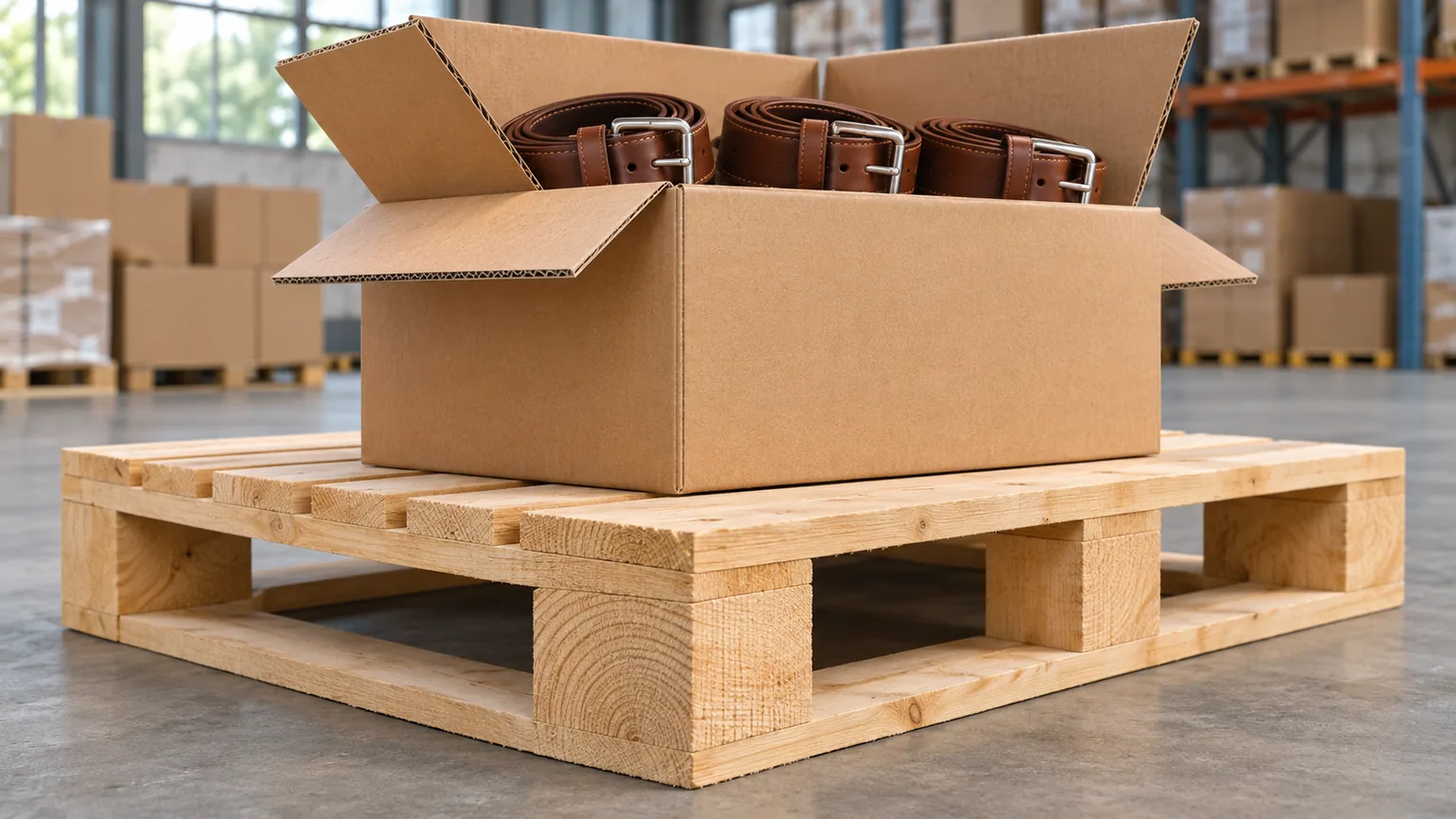
A belt shipment can have accurate carton labels and still be held because of the wood underneath it. For a shipment from China to the United States, check the construction of the pallet, the treatment mark on regulated wood packaging, and any loose wood used to brace the load. Make the final check where the last person adds or changes packaging, while the wood is still accessible.
Take a pallet described on the quotation as “plywood.” Turn it on its side before the belt cartons go on. A layered plywood deck may sit on sawn timber runners. Those runners change the purchase decision. You need the pallet supplier to account for the regulated wood in the assembled unit, or to supply an alternative built entirely from suitable processed material. A photo looking down on the deck misses the distinction.
Which parts of a belt shipment fall under ISPM 15?
ISPM 15 addresses the risk of plant pests traveling in raw wood used to support, protect or carry goods in international trade. The wood can carry that risk even if the cargo is a finished fashion accessory. Sawn boards can retain material in which insects live. The standard provides for debarking and approved treatment of regulated packaging. Some wood products undergo enough processing during manufacture to qualify for an exemption. The IPPC standard sets out the scope and exemptions.
Start at floor level and work up. Identify the runners or blocks, top boards, any container bracing, and any timber collars or lids. Ask the person who will actually build the load what they use to fill the gap behind the last row of cartons. A supplier can give you a perfectly accurate specification for the pallets leaving its factory and have no visibility of the additional wood a consolidator uses later.
What to ask when the packing specification names only the base
Swipe horizontally on a small screen for the buying decision.
| What the packer has | What determines the decision | What to request |
|---|---|---|
| Sawn timber skid | Raw wood supports the cartons. | A compliant unit for the route, with its mark visible in use. |
| Plywood-topped pallet | The blocks and runners may be solid wood. | An underside or end view and a component description. |
| Entirely processed wood base | Every wood component must meet the relevant exemption. | A construction specification covering the deck, base and feet. |
| Molded plastic pallet | Check separately for loose timber restraints or a wooden collar. | The final bracing method and receiving warehouse requirements. |
| Floor-loaded cartons | There may still be wood used for blocking. | The loading instructions given to the warehouse or forwarder. |
The standard includes exemptions for packaging made entirely from thin wood of 6 mm or less and for qualifying processed wood products such as plywood. “Entirely” matters. A thin sheet added to the top of a timber pallet does not convert the supporting structure into exempt packaging. Nor can you identify the construction from a brown surface alone. For a proposed processed base, ask for a view of a cut edge or a drawing that identifies each component. If a foot is described only as “wood,” resolve that detail before ordering a production quantity.
For a US-bound order, have the importer or broker check the origin and routing against USDA APHIS import guidance. The same page points to the Agricultural Commodity Import Requirements database. If the forwarder changes the routing or the place where cartons are consolidated, give the broker the revised itinerary. For another market, obtain that destination’s requirements rather than copying the US instruction onto every purchase order.
How to read the mark on the pallet you will ship
Look for the IPPC symbol with a country code, an identifier for the responsible authorized producer or treatment provider, and a treatment code. For example, HT identifies conventional heat treatment. The country and provider codes identify responsibility for the marked packaging. They do not establish where the belt was made. Record the complete mark as it appears, with a photo of its position on the unit. An isolated “HT” on a loose board gives the buyer too little information to identify the assembled pallet.
Under Annex 2, the mark must be durable, readable and visible when the packaging is used. On an integrated pallet with treated timber runners and a plywood deck, one mark identifies the assembled unit and may appear on the processed wood where it is visible. The standard prefers placement on at least two opposite sides. If the purchase order calls for accessible views on two sides, say so as a project requirement. A mark can be readable at the pallet supplier’s warehouse and hidden later by an opaque pallet skirt. Position the skirt or carton labels so the packer can secure the cartons and still leave the wood mark visible. Keep ordinary shipping labels off that area.
Match your photograph to what an inspector could see standing beside the load. Start with a wider view that shows the location of the mark in relation to the deck and carton stack. Follow with a closer view in focus, without glare from stretch film. On adjoining pallets with similar markings, keep the pallet identifier in the wider shot. A code that repeats across the batch can identify the provider, but it cannot tell your distribution center which assortment was on which pallet.
A treatment invoice is useful for tracing a problem back to the provider. A sample mark on a sales sheet is useful when discussing where it will be placed. Neither gives the packer a remedy for an unreadable mark on the pallet at the loading bay. Ask the authorized supplier to resolve it or change the pallet. Never have the belt factory trace a faint mark with a pen, print a replacement sticker or transfer a marked block to another base. The standard’s Annex 2 provides the official marking examples.
Can a previously used pallet carry the next belt order?
Age alone is a poor purchasing criterion. An intact unit that was properly treated and marked and has not been repaired, remanufactured or otherwise altered can be reused without routine retreatment under ISPM 15. The warehouse still needs to examine its present condition. A readable mark on a split runner does nothing to restore its ability to support cartons. Conversely, sound-looking wood does not establish treatment status. Have the packer check both questions while an unloaded base can still be exchanged.
Replacement wood changes the analysis. The standard distinguishes a repair involving up to approximately one third of components from remanufacture involving more than approximately one third. The detailed rules govern how approved providers handle replacement components, previous marks and retreatment. The buyer usually has neither the repair history nor the authority to resolve the classification at the dock. When the warehouse finds a newly fitted board, ask the pallet provider to identify the repair route and account for the material used. If that cannot be resolved before loading, use another suitable unit.
Several marks can occur on legitimately repaired material, so counting marks is a poor shortcut. Compare the unit with the supplier’s description and look for changes that the description cannot explain. A freshly cut piece nailed across a loose corner on the morning of shipment is a specific discrepancy. Photograph the piece and the joint, identify the affected unit, and ask when it was added. A decision about that unit does not require reopening product approval for every belt style on the order.
Check for signs of insects as well. An exit hole, loose dust near a hole or visible insects warrants a closer look by the appropriate provider or plant-health authority. Dust in a busy warehouse has many possible sources. A buyer need not diagnose the species from a phone photograph to withhold a questionable pallet from packing. Keep it identifiable and separate from ready-to-load bases pending instructions. APHIS publishes photographic examples of questionable wood packaging for comparison.
Write a packing instruction that survives the warehouse handoff
A useful instruction names the route, the agreed base, who may substitute it and what happens if the design changes. For example, a brand shipping boxed dress belts to a US distribution center might specify the agreed marked wood pallet, prohibit undocumented substitutions at consolidation, and require a fresh photo of any replacement before dispatch. Send the instruction to both the belt packer and the party booking the freight. A line on a factory purchase order will not reach a third-party warehouse unless somebody passes it on.
Resolve the warehouse constraints at the same time. A plastic alternative can remove one wood-packaging issue while introducing a receiving problem if its footprint, fork openings or rack rating do not suit the distribution center. Compare the supplier’s stated capacity in the intended handling condition with the expected gross load. Ask whether the cartons will sit on a rack, a flat floor or another pallet. A rating given for a stationary, evenly supported load cannot answer every one of those questions.
Belt construction also changes what happens during a pallet swap. Retail boxes containing heavy metal buckles concentrate weight, especially when many identical packs place the hardware at the same end. A carton corner hanging beyond the replacement deck loses support. A carton forced inward by a tightened strap can press hardware against a finished strap or distort a gift box. On a trial stack, open a lower carton after the proposed handling sequence and inspect the presentation pack, buckle protection and belt surface. Set the stack pattern from those observations and the carton specification.
Keep the pallet identity connected to the belt assortment
- Before stacking, assign a pallet reference. Record the base material, a wide view and any applicable mark. For a mixed construction, include the underside or end that shows how the deck is supported.
- After stacking, connect the reference to carton numbers or another unambiguous range. Record mixed-size cartons explicitly if splitting the pallet could separate part of a store assortment.
- At final load-out, have the last packer record additional blocking, any replacement base and the final carton allocation. Update the outbound pack record even when the total number of cartons stays the same.
Use the belt carton and barcode labeling guide to resolve carton-level identifiers. Keep the two identification systems independent. The receiving team can use the pallet reference to locate cartons, and the packer can use that reference to retrieve wood packaging photos. Putting a pallet supplier’s treatment code into the retail barcode field would break that link for the people scanning the cartons.
A last-minute change at consolidation
Consider a hypothetical first order divided between two retail destinations. The packer photographs two marked pallets and passes them to the forwarder. At the consolidation warehouse, one stack is too tall for the booked space. To reduce its height, the warehouse moves the top layer onto a spare base and proposes using a timber offcut to brace it. The original two pallet photographs and the original carton total can both be accurate. Neither describes the new third base or the loose block.
Before authorizing the change, ask the forwarder to show the third base and proposed restraint. A loose piece of regulated timber used as dunnage must itself retain a complete, legible mark after cutting. If the offcut has only part of a mark, reject that piece even if the parent board or adjacent pallet has a complete one. If a suitable verified pallet and suitable dunnage are available, match them to a new pallet reference, record the relocated carton numbers and check stability at the new height. If the warehouse proposes an accepted nonwood restraint, ask how it will hold the stack during the planned handling. Keeping the load stable still matters after the wood issue is resolved. The warehouse should confirm the revised arrangement with the party responsible for securing the cargo.
Now consider the cost of leaving the decision until the vehicle arrives. The pallet change may consume paid warehouse time, require new wrap or carton labels, or cause a booking to be missed. Compare those specific costs against having an acceptable spare base ready before consolidation. A frequent mixed-assortment program may justify the spare. A low-volume trial shipped as individual cartons may justify asking the forwarder to supply the final base. In each case, assign the final inspection to the party that can actually see the wood.

What if the problem is reported at the US port?
Ask the importer for the actual notice and the shipment identifiers before instructing the overseas packer. In the United States, an Emergency Action Notification can specify the issue and direct a response. APHIS advises importers to review the violation and coordinate corrective actions with the officials identified in the notice. Options depend on the finding and official direction. A private proposal to replace the pallet or dispose of the wood at a convenient warehouse is not authorization to move a held shipment.
Use the records to narrow the investigation. If the photograph shows the suspect block beside a pallet added at consolidation, contact the consolidator as well as the belt supplier. If the original pallet is implicated, retrieve the supplier and treatment information linked to that unit. Give the importer the original images, the last carton allocation and any change record with their dates. That makes it possible to investigate the correct packing point while the importer works on the immediate shipment.
Plan the first pack with the belt sample
When arranging a belt sample with HongDing, share the destination warehouse’s packing instructions, the proposed belt presentation and where palletization will take place. An estimated carton mix is enough to start discussing buckle protection, carton layout and which packaging details the final packer needs to document.