
DAP and DDP can both bring a belt shipment to an agreed destination. The central difference is import clearance: under DAP, the buyer handles that obligation and the related import charges; under DDP, the seller does. Choose between them by identifying who can actually manage the destination import process, then compare quotations for the same delivery point, product configuration and receiving service.
For a belt buyer, “delivery to our warehouse” is not a complete purchasing instruction. The warehouse may receive the cartons while another company acts as importer, a broker prepares the entry and a carrier arranges the appointment. Those roles need to fit together before the goods move. A convenient price does not solve a mismatch between the sales contract and the parties named in customs documents.
This comparison focuses on two destination-delivery options for commercial belt orders. For the different question of origin-side vessel delivery versus destination delivery, use our FOB versus DDP guide. The practical examples below are proposed purchasing workflows, not accounts of completed HongDing shipments.
Start with the same destination and different clearance roles
ICC Academy’s DAP and DDP explanation describes delivery under both rules as goods placed at the buyer’s disposal on the arriving vehicle, ready for unloading at the agreed place. Both work with different transport modes. DDP adds the seller’s import-clearance obligation; DAP leaves import clearance to the buyer. Neither term should be reduced to the informal phrase “door to door.”
A named place should be useful to the people arranging and receiving the shipment. “DAP United States” cannot tell a driver where to stop. Even a street address may be incomplete when the receiving operation uses a specific freight entrance or booked distribution-center dock. Put the agreed place and, where relevant, the point within it beside the rule and edition: DAP or DDP, the agreed destination, Incoterms® 2020.
Then describe receiving services separately. Is the destination a staffed distribution center, a small wholesale office or a third-party fulfillment warehouse? Does it accept palletized cartons, require an appointment or need a vehicle with unloading equipment? These details affect the workable transport service. They should be priced and agreed instead of discovered when the driver reaches the gate.
Compare the same order and destination. On a narrow screen, scroll the table horizontally.
| Question | DAP | DDP |
|---|---|---|
| Import formalities and import charges | Buyer’s obligation. | Seller’s obligation. |
| Agreed destination | Name the receiving place and relevant delivery point. | Name the same receiving place when comparing prices. |
| Operational question before selection | Can the buyer arrange clearance in time for the seller’s transport plan? | Can the seller’s proposed destination import arrangement lawfully work? |
| What the buyer should compare | Supplier price plus the buyer’s separately managed import scope. | Supplier price plus any clearly identified receiving or exceptional services outside that scope. |
The table separates the rule from our suggested purchasing questions. It does not assign every possible delay invoice. A late document, a customs examination and a receiver’s missed appointment are different events. Their consequences need to be considered against the applicable rule, the contract and what actually caused the delay.

When DAP can give a buyer useful control
DAP can be a sensible starting point when a buyer already has a suitable importing arrangement and wants its own team or broker to handle destination formalities. That can make document review and communication easier to integrate with existing purchasing records. It does not automatically make the order cheaper, and it does not work merely because a buyer has used a broker once before.
Consider a retailer importing several belt constructions for one launch. The customs work may require different product descriptions for leather, coated textile and woven products. Its broker needs the actual construction and origin information, not a single marketing description copied across the range. A buyer-led process is useful only if those details reach the broker early enough to resolve questions before arrival.
The important coordination point is that the buyer’s clearance work sits inside a transport plan arranged by the seller. Ask the parties to agree when draft documents will be available, who checks them and who tells the transport coordinator that the import requirements have been addressed. If every correction has to pass through an unnamed intermediary, keeping clearance on the buyer’s side may provide less practical control than expected.
- Choose an accountable import contact. Name the person who can resolve missing descriptions, importer details and document corrections.
- Match the broker to the route. Confirm that the appointed service can handle the intended destination and shipment arrangement.
- Make readiness visible. Use a shared status for document review, outstanding questions and expected receiving availability.
These are operating arrangements to agree, not extra obligations created by the letters DAP. Their value is preventing a shipment from arriving before the buyer’s import process is ready. A smaller buyer without that process may need professional importing support before DAP is a useful choice.
When DDP simplifies coordination—and what must be established first
DDP can suit a buyer that wants the seller to coordinate the import side as part of destination delivery. The convenience comes from having a workable arrangement behind the quote. Ask the seller to explain the destination process in concrete terms: the proposed importer, the customs representative, the documents each party needs and the party funding the import charges.
The ICC’s Incoterms® 2020 checklist cautions that the seller must be able to meet DDP’s import responsibilities. Foreign sellers can face destination-country restrictions or practical barriers. Resolve the route with qualified local support before selecting the term; adding DDP to an invoice does not create an import registration or make an ineligible party eligible.
A quote is not ready simply because the salesperson says that the forwarder will handle everything. The forwarder may organize transport without being the party legally responsible for the customs entry. The commercial team should be able to explain which entities are involved and how the arrangement relates to the purchase contract. Do not assume that a carrier’s delivery label establishes that answer.
For a U.S. example, CBP’s guidance for new importers states that an importer of record remains responsible for entry correctness and applicable duties, taxes and fees even when using a broker. Consequently, a belt buyer should not accept being named in an entry without understanding the role and authority involved. A seller-paid service and the buyer’s legal customs position are separate questions.
If the proposed arrangement cannot be explained or confirmed, pause that delivery quotation. Options may include a properly supported seller-led import route or a revised DAP arrangement in which the buyer knowingly takes on clearance. The right correction is to align the documents and responsibilities, not retain a convenient label while quietly shifting the work.
Separate unloading, risk and insurance from the headline price
Under the ICC’s actual DAP and DDP rules, the normal risk-transfer point is delivery at the agreed destination, on the arriving vehicle and ready for unloading. There are exceptions: under DAP, a buyer’s failure to fulfill import-clearance obligations can place the resulting risks and additional costs on that buyer before normal delivery, subject to the rules’ conditions, including clear identification of the goods to the contract. Review the cause and applicable provisions rather than assigning every customs delay to one party.
ICC Academy’s discussion of DDP explains that unloading risk rests with the buyer even when unloading costs are included in the seller’s carriage contract. This is why a supplier’s “unloading included” note needs a service explanation. Who provides the equipment, who performs the work and what has already been paid?
For belt cartons, a receiving problem can be mundane but consequential. A truck booked for a loading dock may reach a location without one. Cartons may need to be unloaded individually when the receiver expected pallets. A vehicle might arrive outside the warehouse appointment window. Record these receiving conditions in the quotation request so a transport provider can offer a suitable service.
Insurance deserves a separate question. DAP and DDP do not, by themselves, impose a seller obligation to arrange cargo insurance for the buyer. Where coverage is needed, agree its scope and the claims route rather than treating the word “delivered” as an insurance policy. Also distinguish transport damage from product defects: a torn carton and an incorrectly positioned buckle hole call for different supporting records and corrective actions.
Agree a practical receiving record. The receiver can record carton count, visible packaging condition, relevant shipment references and any exceptions at handover, while retaining photographs where useful. That record helps establish what was observed; it does not decide liability on its own or replace the contract’s notice requirements. Route an incident promptly to the appropriate transport or product contact.
Compare quotations by scope before comparing totals
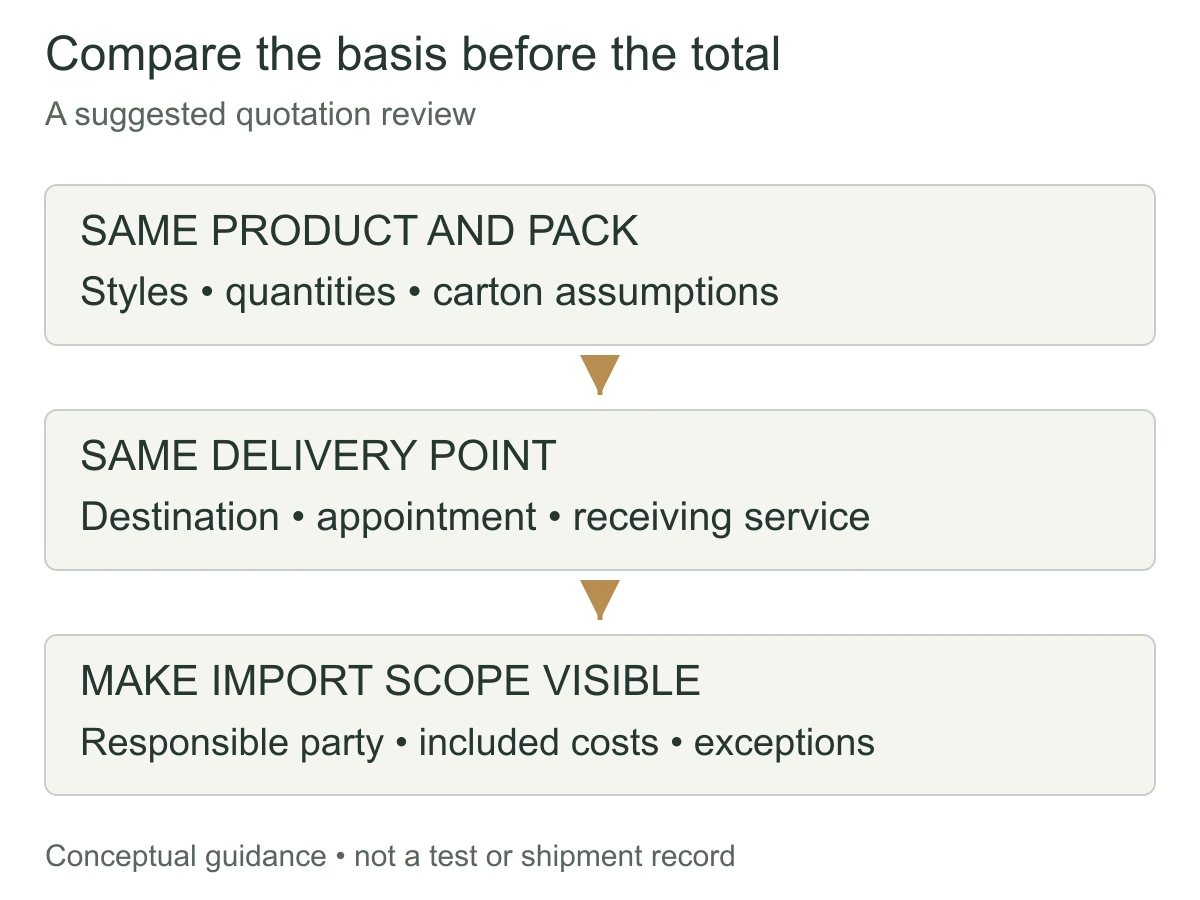
Use one product and shipment brief for both prices. A DAP quote for loose cartons and a DDP quote for palletized cartons are not a clean comparison of trade terms. Neither are quotations based on different quantities, destinations or collection dates. First hold the controllable inputs constant; then identify which costs and activities move between the parties.
Our recommended comparison sheet has four sections:
- Common order basis. Record belt styles, SKU quantities, approved construction, retail pack and shipment packing assumptions. Mark provisional dimensions and weights as provisional.
- Common transport endpoint. Use the same destination, receiving point, appointment conditions and agreed service level.
- Different import scope. Separate the buyer’s expected clearance and import charges under DAP from the seller’s stated scope under DDP. Resolve exclusions rather than assuming them away.
- Exceptions and timing. State quote validity, the treatment of changed inputs and how an unexpected event will be communicated and authorized.
For budgeting, keep a comparable purchase-cost view and a cash-payment view. A tax paid at import may be recoverable in a particular situation, but recovery depends on the relevant rules and entitled party. Have that treatment confirmed; do not deduct tax from a DDP comparison merely because another buyer recovered it on a different route. Record who receives the documents needed for the applicable treatment.
The belt classification workflow explains why the actual product construction matters to customs review. This article does not assign an HS code or a duty rate. A delivery term is not evidence of classification, origin or admissibility, and a lower transport total cannot compensate for incorrect product information.
Illustrative scenario: the same belts, two workable routes
Suppose a brand orders a new belt range for delivery to its U.S. fulfillment warehouse. The product selection is stable, but the retail hangtag and carton assortment are still being finalized. It asks for DAP and DDP alternatives. This is a hypothetical purchasing example, not a HongDing quote or shipment result.
The first useful action is to freeze a comparison basis, even if the final pack is not yet approved. Both quotations should use the same stated carton assumptions and identify the change that will trigger recalculation. Otherwise, the brand might attribute a packing-volume difference to the Incoterm and select the wrong option.
In the DAP route, the brand confirms its importer and broker arrangement, supplies the relevant company details through an appropriate channel and schedules document review. The seller’s transport coordinator needs a clear contact for unresolved clearance questions. The fulfillment warehouse separately confirms its appointment and unloading arrangements. The route is promising when those responsibilities have owners and the documents can be reviewed before arrival.
In the DDP route, the seller identifies how import clearance will be performed and how the proposed importer’s role is authorized. The brand checks whether that arrangement fits its business requirements, including access to the needed records. It compares the seller’s included scope with the DAP route’s separately managed costs, using the same packing and delivery point.
Now suppose the proposed DDP paperwork unexpectedly names the brand in a role the brand has not agreed to assume. The answer is not to sign quickly because the invoice says duties are included. The parties should resolve the legal and operational arrangement, revise the quotation if necessary and keep the shipment from proceeding on conflicting instructions. Conversely, if the DDP arrangement is clear and suitable, the brand may reasonably prefer its coordination model even without expecting the lowest headline price.
Carry the agreed term into the shipment handover
Once a route is selected, connect the commercial agreement to the released order. A later change in carton dimensions, SKU mix, destination or shipping window can affect the quotation assumptions. Keep the current packing information and delivery instruction together so the person booking transport does not rely on an obsolete sample-stage estimate.
HongDing can coordinate belt labels, retail packaging, protective materials, carton marks and delivery information within the agreed project scope. That supports a coherent handover between the product team and the parties arranging the shipment. It is not a promise that every destination or Incoterm is available on every order; the commercial route needs written confirmation.
Before release, reconcile the product descriptions and quantities across the approved order, packing information and shipping documents. When a discrepancy appears, identify the affected document and owner, resolve it and recheck the connected records. Releasing goods with a known description mismatch simply transfers an avoidable problem to the destination team.
Questions that remain after choosing the term
Does DDP mean the buyer has no work to do?
No. The buyer still needs to cooperate with the agreed process, provide accurate information where required and arrange receipt. A seller-managed import route does not excuse an unprepared receiving location or incorrect information supplied by the buyer.
Does the Incoterm decide ownership or payment timing?
No. Address title and payment separately in the sales contract. ICC’s explanation of what the rules do not cover distinguishes the rules’ allocation of delivery responsibilities from matters the sales contract must address separately.
Discuss the delivery basis alongside the belt program
Share the belt range, intended destination and receiving arrangement, plus the import responsibilities you already manage. If the packaging is still open, say so. HongDing can discuss the product and packing information needed for a project-specific delivery quotation and clarify which commercial arrangements remain to be confirmed.