

Belt production lead time is the elapsed time between an agreed production-start condition and an agreed completion point. It is not necessarily the time from your first inquiry to stock arriving at your warehouse. Build the schedule around confirmed materials, hardware, approvals, manufacturing, inspection and logistics, then identify which dependency actually controls delivery.
A purchase order can carry a required ship date while the strap color remains open, the buckle finish awaits approval and the barcode file is still being revised. In that situation, the date is a target, not a complete production plan. The buyer and manufacturer need the same definition of “ready to start” and “finished.”
For an OEM/ODM belt program, the useful question is not simply “How many days?” It is “What must happen before the next stage can begin, who owns that decision, and what happens if it changes?” This guide explains how to turn a delivery target into a manageable schedule without inventing a universal factory lead time.
What controls the date
- Separate development time, bulk production time and door-to-door replenishment time.
- Available sample components do not establish bulk material availability.
- Parallel work saves time only when the branches can genuinely proceed independently.
- Recover delays by changing the controlling dependency or the delivery plan, not by silently removing inspection or curing time.
Define the start and finish before comparing quotations
One supplier may quote from sample approval; another from receipt of the agreed payment and all materials; a third may include component procurement. Those numbers cannot be compared without the underlying conditions. Put the start trigger next to the duration, including the status of the specification, material approvals, hardware, commercial terms and production slot.
The completion point also matters. “Production complete” may mean assembled belts before final inspection and packing. “Ready for dispatch” should identify the release conditions. A vessel departure, a destination port arrival and stock available for sale are later events with different owners. Use explicit milestones instead of treating all of them as “delivery.”
| Clock | Useful boundary | Common omission |
|---|---|---|
| Development | Confirmed sample scope to approved production reference | Buyer review, revision rounds and sample transport |
| Bulk order | Agreed order-release conditions to inspected and packed goods | Component procurement, required conditioning or release checks |
| Replenishment | Order decision to saleable inventory at the required location | Booking, transport, clearance, receiving and allocation |
HongDing’s current sampling workflow makes timing dependent on confirmed inputs and project scope. For a new program, ask for a schedule showing both the assumptions and the resulting dates. A historical sample-duration reference is not a commitment for a newly tooled buckle, unusual finish or unresolved construction.
Find the dependency that controls production release
The critical path is the chain of dependent activities that determines the earliest possible completion. A delay on that chain moves the result unless another activity can recover the time. Work outside that chain may have some flexibility, but its spare time is not unlimited. The path can also change as actual progress becomes known.
Suppose, in a hypothetical planning exercise, approved leather takes 18 working days to become available and approved hardware takes 28. If both orders can start on the same date and assembly needs both, the component-readiness gate is 28 working days away, not 46. Expediting the leather by five days would not improve that gate. Expediting the hardware by five days could, provided nothing else then becomes the bottleneck.
Now change the assumption: the hardware cannot be ordered until a ten-day tooling review is finished. Its branch becomes 38 working days, even though the component supplier still quotes 28. The delay sits in the dependency before supply begins. A useful schedule exposes that distinction rather than repeatedly asking the assembly team to compensate.
Material preparation, packaging artwork and transport planning may run in parallel, but only where dependencies permit it. Cutting large quantities before size approval is not free time saving; it transfers unresolved design risk into work already made. If a buyer authorizes such advance work, identify the approved scope and the financial exposure explicitly.

Why material and hardware choices change the schedule
A stock-looking buckle may still need a new route
An existing buckle shape can require a new plating color, logo operation or component source. Each change can introduce a sample, approval or procurement step. Ask whether the quotation refers to an available finished buckle, an available unfinished component or a newly tooled part. “Stock hardware” is too vague if the required finish is not actually available in the needed quantity.
Changing buckle dimensions after the strap is approved can affect the fold, keeper, fastening datum and overall proportion. That is why hardware approval should include the assembled belt interface. HongDing can coordinate material and hardware development, but the final route and its timing must be confirmed for the actual design.
Leather approval is more than naming a color
A material article includes the relevant substrate, thickness, finish and agreed appearance range. A swatch approved for color may not establish the bending behavior of the finished layered strap. If that issue emerges only after bulk material arrives, the project may need additional development rather than a simple production adjustment.
For constructions requiring finishing, lamination or coated edges, review the process sequence. Drying or conditioning requirements depend on the actual material system and process; they are not arbitrary idle days to remove during expediting. A compressed schedule needs a technically supported route, not a promise that all waiting time can disappear.
Complexity also comes from the order mix
A large order in one approved construction is not operationally identical to the same total quantity spread across many colors, sizes, buckles and packaging combinations. Additional variants can add setups, component matching and inspection work. Ask which variants share a process and which require separate preparation. Do not infer a delivery advantage from total order quantity alone.
Late additions deserve the same scrutiny. Adding a new buckle color to an otherwise approved range can create a separate controlling branch. It may be more sensible to confirm a later release for that variant than to hold the whole order, provided the buyer’s assortment and logistics can support a split.
Use milestones that demonstrate readiness
A progress percentage can conceal the important shortage. “Ninety percent complete” is not reassuring if the missing ten percent is the only buckle needed for the full order. Ask for the next release condition and the quantities or variants affected.
- Specification released: the current size schedule, construction, material and hardware references agree with the approved sample.
- Critical inputs confirmed: the relevant components have a supported availability date, with shortages and provisional substitutions identified.
- Production started: the required input and process conditions are met for the stated lot, not merely for a sample demonstration.
- In-process issues resolved: any defects affecting continuation have an agreed disposition and recheck.
- Goods ready for release: the agreed inspection, labeling, packing and shipment-document conditions are complete.
These are planning questions, not a requirement for every buyer to receive a large audit binder. A concise status report can state the baseline date, current forecast, variance, cause and decision needed. Name one person on each side who can resolve an approval issue. An email copied to many people is not the same as a clear decision owner.

Build buffers around identifiable uncertainty
A buffer protects against uncertainty; it should not hide an unexplained delay inside every line. Separate a baseline task duration from the allowance for a known risk, such as a new hardware finish, an approval round or variable transport. Otherwise, buyer and supplier may each add invisible contingency and still disagree about the true latest decision date.
Use working days for the relevant factory or supplier operations and calendar dates for the launch. Map weekends, confirmed holidays and closures explicitly. Do not convert “six weeks” into a fixed number of factory working days without checking the operating calendar. A carrier cutoff can also make a one-day production miss produce a much larger departure delay.
Here is a hypothetical backward plan, stated entirely in calendar days for clarity. Assume stock must be saleable on November 30. Allow 7 days for receiving and allocation, 21 for the confirmed transport plan, and 4 for the agreed dispatch preparation. The goods-release target is therefore October 29. If the confirmed bulk route requires 56 calendar days before that release, the production-start target is September 3. Development and all release prerequisites must fit before that date.
These intervals are illustrative, not HongDing lead times or freight quotes. The practical value is the dependency: moving the launch date does not make the preceding tasks disappear. Replace each assumption with a confirmed project input, then check whether the resulting start date is still achievable.
Respond to delays with a specific tradeoff
When a date slips, first identify whether the cause is approval, supply, manufacturing, quality release or logistics. Then ask which action changes the controlling path. Expensive air freight cannot recover an unresolved material decision before production starts. Extra assembly capacity cannot make an unapproved buckle finish acceptable.
| Cause | Possible response | Tradeoff to confirm |
|---|---|---|
| Late critical hardware | Review an available approved alternative or separate the affected variant | Appearance, fit, evidence and commercial approval may need revision |
| Buyer approval waiting | Consolidate comments and resolve the actual open decision | A conditional approval must state exactly what remains provisional |
| One variant behind | Consider a useful partial release | The arriving size/color mix must support a viable launch |
| Transport delay after goods release | Review another confirmed route or limited expedited quantity | Additional cost, booking availability and receiving arrangements |
A split shipment should be defined by saleable assortment, not only by the easiest units to finish. Sending mostly slow sizes may create freight expense without relieving the stockout. Ask the merchandising team which variants are needed together, then calculate whether the first release actually supports the planned channel.
Record the revised plan and what has changed. If a new material or finish is accepted, update the controlled specification and applicable assessment rather than leaving the old sample as the only reference. If the design cannot be changed, a revised launch or delivery commitment may be the honest outcome.
Keep packing and receiving inside the schedule
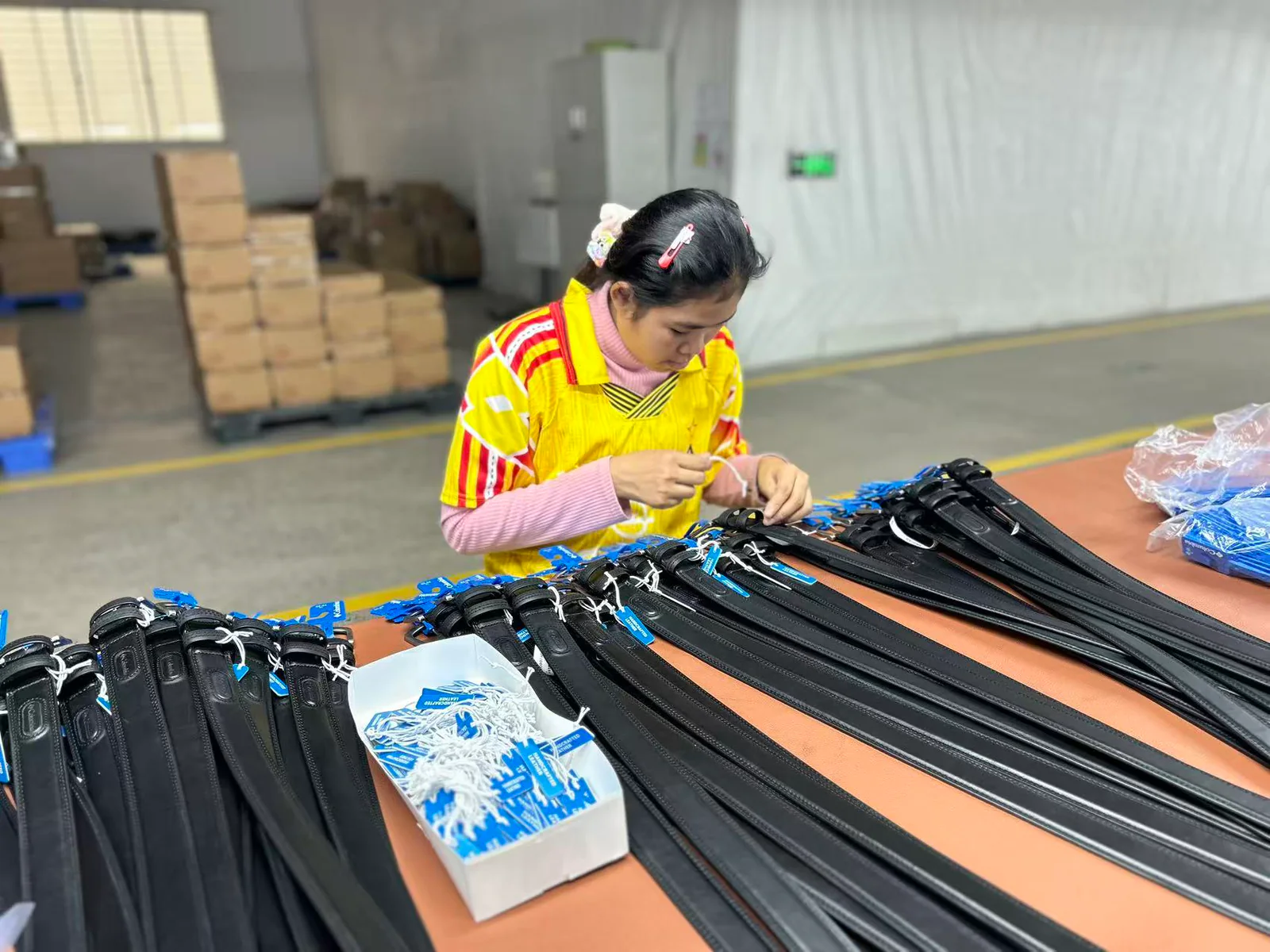
Labeling can stop a finished belt from becoming usable stock. Incorrect barcodes, missing retail data or an unsuitable carton breakdown can delay receiving even when the manufacturing work is complete. HongDing can coordinate labels, barcodes and retail packaging within the agreed project scope; the buyer must provide and approve the required data in time.
Confirm whether the destination receives individual SKUs, mixed cartons or store-ready packs. A late change to that structure may require repacking and document changes. Tie artwork approval to a real date, and verify a representative packing configuration before the full quantity is closed.
For repeat programs, compare actual milestone dates with the original assumptions. Was the variation in material supply, buyer review or destination receiving? The answer helps improve the next plan. A single overall average can hide a reliable manufacturing stage and an unreliable approval stage, leading to the wrong corrective action.
Lead-time questions to settle early
Does a repeat order always have a shorter lead time?
No. Reusing an approved construction can reduce development work, but component availability, capacity, order mix and required updates still matter. Confirm that the previous material and hardware references remain available before treating the reorder as unchanged.
Can we start without a finished technical pack?
Yes, a development discussion can start from references or a concept. Separate that early collaboration from bulk release: production timing should be confirmed against the decisions and inputs the agreed route actually requires.
What should a useful quotation say about timing?
It should identify the start trigger, completion point, assumed order scope, critical inputs and exclusions. Ask whether sample transport, buyer review, testing, packing and freight are included or handled as separate schedule lines.
Bring the required arrival date into development
Share your belt reference, quantity by variant, intended destination and required stock-available date with HongDing. We can review the material, hardware and sample decisions that affect the route, then discuss an order-specific schedule and its assumptions.