A leather swatch can look exactly right under a showroom light and still be wrong for a belt collection. The difficulty usually appears later: the second color looks flatter, the buckle fold changes the surface, or a customer expects every strap to match the product photograph. Choosing aniline, semi-aniline or pigmented leather is therefore a decision about acceptable appearance and wear—not a simple ladder from premium to cheap.
Choose aniline when visible natural character and developing patina are part of the product promise. Consider semi-aniline when you want some natural grain character with more controlled coverage. Start with a pigmented finish when consistent surface color is the stronger requirement. None of these names, by itself, establishes belt strength, resistance to color transfer or service life. Those depend on the actual leather, finish formulation and assembled construction.
What the three finish names actually describe
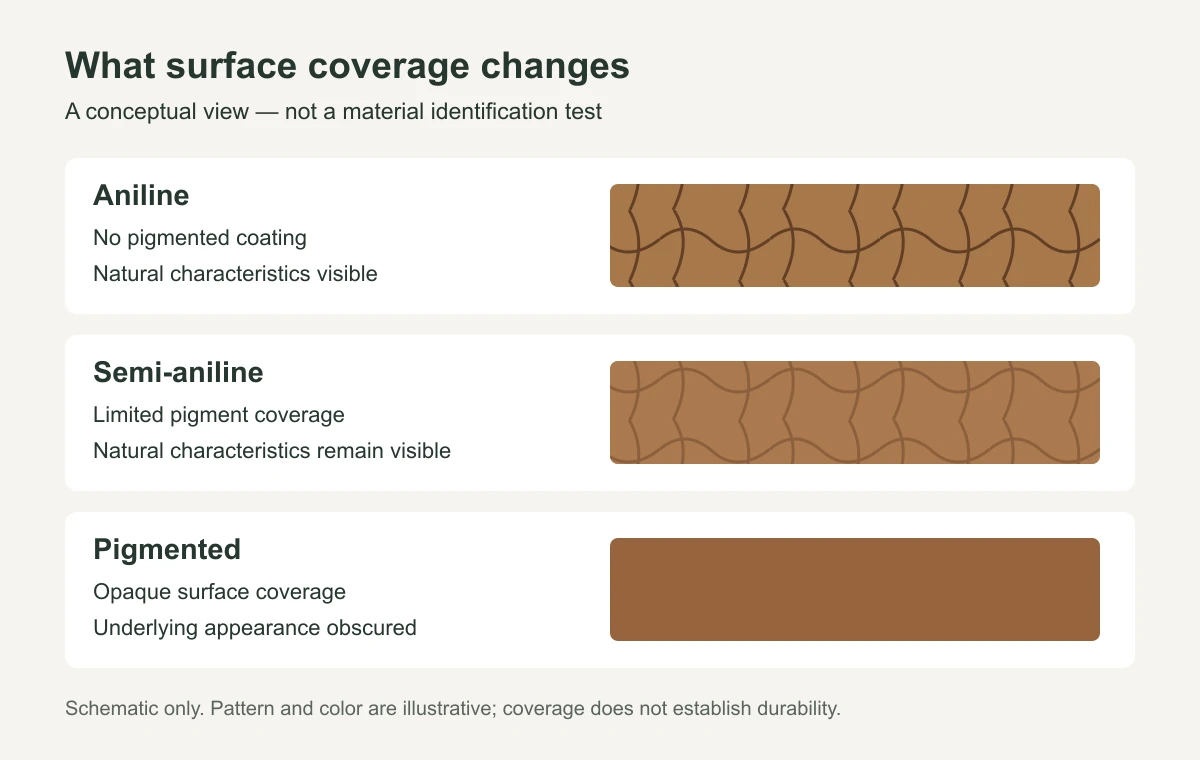
Aniline leather does not have a pigmented surface coating; a transparent finish can still be present. Semi-aniline uses limited pigment while leaving the hide’s natural characteristics visible. A pigmented finish provides opaque coverage. These distinctions concern how the surface is finished, as explained by the Leather Research Laboratory’s finish definitions. Calling aniline “completely unfinished” is therefore misleading, and calling semi-aniline “the same leather with half the coating” is not a useful specification.
Also separate these terms from full grain, corrected grain and split leather. Grain descriptions concern the leather substrate and its surface treatment; tanning describes another part of material production. A buyer needs more than one field to identify the material. The Leather Naturally terminology guide is a useful starting point for keeping these categories distinct.
For a belt, our development question is not merely “Which finish is best?” It is “Which finish on which substrate, at what finished thickness, gives the intended appearance after cutting, folding and wear?” A highly attractive surface cannot compensate for a strap that stretches beyond the agreed fit or for a lining that transfers color to clothing.
| Finish | What you are choosing | Main development tradeoff | Sample question |
|---|---|---|---|
| Aniline | Natural surface character remains visible | Character versus a narrow cosmetic matching standard | Does the accepted range still look like one collection? |
| Semi-aniline | Limited pigment with natural characteristics still visible | Coverage versus the depth and variation you want to retain | Is the approved balance repeatable across colors and hides? |
| Pigmented | Opaque surface color coverage | Controlled appearance versus the desired natural-looking surface | Does the finish remain acceptable through folds and contact points? |
Why a belt needs a different comparison from a flat swatch
A belt is repeatedly bent, drawn through hardware and handled along narrow edges. Its face, underside, cut edge and buckle fold experience different conditions. A flat panel reveals color and feel, but it does not show how the finish behaves at the tight fold around a buckle bar. Nor does it show whether a keeper rubs the surface every time the wearer adjusts the belt.
Build the comparison around the intended construction. If one sample is a thick single-layer strap and another is a thinner face leather laminated to a lining, you are changing more than the finish. Differences in bending resistance or shape retention cannot reasonably be attributed to “aniline versus pigmented.” Record the layer stack and finished thickness before interpreting the result.

The buckle fold concentrates the design problem
At a fold, the outside face stretches while the inside is compressed. A change in color can be an intended visual response or an unacceptable mark; a crack or loss of finish is a different issue. Evaluate the sample around the actual hardware geometry and intended fold construction. Bending every candidate around an arbitrary sharp corner may create damage unrelated to the product’s use.
If a fold fails, investigate the interaction between leather temper, local thickness, preparation, finish flexibility and buckle geometry. Merely changing the category name on the material order may leave the underlying problem untouched. Conversely, thinning the fold without checking attachment strength can solve appearance at the expense of another function.
The underside is not protected by the face specification
Dark face color and a light lining are separate development choices. A good face finish does not establish the underside’s rubbing behavior. For reversible belts, both faces are working surfaces, so both need evaluation with their intended clothing contact and hardware movement. The material supplier’s face-leather approval should not become an automatic approval of the whole belt.
Natural character versus controlled color: make the tradeoff explicit
Aniline’s visible character is valuable when the collection is meant to show leather as a naturally variable material. It becomes commercially difficult when the same collection is photographed as perfectly uniform. The purchasing specification, photography and customer expectations need to agree. Otherwise, the factory may be asked to preserve natural variation while simultaneously rejecting every visible difference.
Use a shade-and-character range rather than a single “golden” square. Include representative lighter and darker appearances and the sorts of visible grain variation the brand is prepared to accept. Define the face area separately from less visible areas. This is not permission to accept damage: natural appearance variation and defects that weaken the strap should be discussed separately.

Semi-aniline is worth sampling when the brand wants to moderate surface variation without removing its natural appearance. Do not buy it as an automatic compromise that solves every problem. A small change in coverage, color or gloss can substantially change how natural a narrow strap looks. Ask to compare the actual proposed finishes, not three unrelated showroom materials carrying convenient labels.
Pigmented leather is a logical starting point for a collection with a tight visual color requirement, but opaque coverage is not proof of color consistency. Application uniformity, gloss, texture and the underlying material still affect the finished impression. Two black straps can have the same nominal color and look different because one is glossier or more heavily textured.
Judge matching under agreed viewing conditions with physical references available to both teams. Screen photographs are useful for discussing placement or obvious changes, but camera exposure and lighting can conceal small differences. When the target is a coordinated bag-and-belt set, approve the relationship between the products; identical color codes on different substrates do not guarantee an identical visual result.
Wear resistance is several questions, not one “durability” score
Separate surface marking, color transfer, finish adhesion and flexing behavior. A surface might resist visible scuffing yet transfer color under wet rubbing. Another might show a cosmetic crease without losing structural function. If all outcomes are compressed into “durable,” the supplier and buyer can accept different things while believing they agree.
For rubbing, specify whether the concern is a change on the belt, staining of an adjacent material, or both. SATRA TM167 addresses surface color transfer during dry or wet rubbing. That scope is useful when discussing clothing staining, but it does not supply a universal pass grade for every belt collection. Agree the method, conditions and acceptance level with the testing laboratory and buyer.
For a coated surface that lifts or cracks, a different investigation is needed. SATRA lists separate leather methods covering flexing and finish adhesion. A laboratory can advise which method fits the material and complaint. Do not claim that a passing rub result proves the finish cannot peel, or that a hand bend replaces a controlled flex test.
Water spotting and care expectations deserve their own discussion. A protective surface can change how a leather responds to contact, but “pigmented” does not mean waterproof. Nor should a brand promise that marks on aniline will always disappear as desirable patina. Use the intended care instructions on development samples and judge the resulting appearance before approving customer-facing language.
Leather Naturally notes that care products can darken aniline leather and recommends a hidden-area patch test in its leather care guide. For a commercial belt program, this means the care recommendation belongs in product development, not as generic wording added after packaging is printed.
How to run a useful finish comparison
First isolate the variable. Where the leather supplier can offer it, compare related finish options on comparable substrates and thicknesses. If identical substrates are unavailable, document the differences and call the exercise a comparison of complete material options. That is still useful; it simply answers a different question from a controlled finish-only comparison.
Next make representative belt samples. Keep width, buckle, keeper, tip, edge treatment and construction constant where practical. Include the buckle-end fold, adjustment area and a usable length of strap. A tiny swatch may hide the shade variation visible over a full belt and cannot reveal whether the assembled strap feeds smoothly through the keeper.
Then separate the observations. Record initial color and feel; appearance after assembly; response at hardware contact points; and results from the agreed laboratory checks. Retain an unexposed control so the team is not relying on memory. Record sample identity, leather lot and finish reference so a later supplier change does not silently turn into a different comparison.
| Record | Why it changes the decision | Useful output |
|---|---|---|
| Substrate and finish reference | Prevents a finish label from hiding a material change | Traceable supplier material description |
| Appearance range | Defines character and color variation the brand accepts | Physical boundary samples |
| Assembled construction | Shows the actual folds and contact surfaces | Approved belt sample with component references |
| Separate performance outcomes | Distinguishes cosmetic change, staining and physical damage | Agreed test plan and recorded results |
| Care and retail wording | Aligns customer expectations with the selected surface | Material-specific care text |
Two collection scenarios—and why the answer changes
Illustrative scenario: a casual collection built around visible leather character. The brand wants warm brown shades, a relatively substantial strap and a surface that changes with use. An aniline candidate is worth developing if the acceptable variation range supports that promise. The decision is not finished until the brand has seen representative straps, evaluated clothing contact and accepted how the buckle fold and care treatment alter the appearance.
If the buying team later demands near-identical light brown faces across every size and replenishment order, that is a change in the product brief. The team should revisit semi-aniline or pigmented options and judge the aesthetic change openly. Asking the cutting department to select around an unrealistically narrow appearance range may increase material loss without resolving the mismatch in expectations.
Illustrative scenario: a dress belt coordinated with a repeated black accessory range. Controlled color and a clean surface are the priorities. A pigmented candidate may be the better starting point. Compare its gloss, edge appearance and fold behavior in the intended laminated or single-layer construction. If the surface looks too uniform for the collection, trial a semi-aniline alternative, but do not accept a visual improvement while ignoring inconsistent matching.
These examples are development choices, not claims about completed HongDing orders. They show why price or a finish name should not decide the material before the brand has defined what the customer is supposed to notice.
Carry the approved finish into production
Approval needs to survive the move from a selected development sample to production leather. Identify the finish reference and accepted range in the material specification, then check incoming material against those references before cutting the whole lot. A change in supplier, finish formulation or relevant surface treatment should trigger review of the affected appearance and performance requirements.
Assembly can introduce its own marks. Check contact with guides, presser feet, stacking surfaces and packaging rather than assuming every visible change originated at the leather supplier. A repeatable mark near a stitch line suggests a different investigation from a shade difference across a hide. Distinguishing where the change first appears is more useful than rejecting the entire finish category.

Finally retain the approved assembled reference as well as the leather swatches. The swatch defines the material; the belt defines the result after manufacturing. For the broader development sequence, see our belt manufacturing process guide.
Questions buyers ask about leather finishes
Is aniline always the highest-quality option?
No. It describes a finish category, not a complete quality grade. It can suit a character-led product very well and be a poor match for a tightly uniform retail brief. Judge the substrate, construction and agreed performance alongside the appearance.
Can I identify the finish from a photograph?
Not reliably. Lighting, texture and surface treatments can produce similar appearances. Ask for the material description and a physical sample; use qualified material identification when the distinction needs verification.
Should every color use the same finish?
Only if the results meet the collection brief. Evaluate the actual colors and their acceptable variation. If finishes differ, record that deliberately so a later reorder is not assumed to use one identical specification.