An adaptive belt closure should remove a specific difficulty in dressing: finding the ends, holding them steady, aligning them, applying force or releasing the fastening. Choose it by observing those tasks on a complete belt. A buckle that closes with one hand may still require two hands to adjust or remove, and a magnetic closure is not automatically suitable for every wearer.
For a brand developing easy-fastening belts, “limited dexterity” is a starting concern, not a mechanical specification. People differ in pinch strength, reach, coordination, sensation and preferred handling. The useful development question is concrete: which action prevents this intended wearer from using this belt, with this garment, in the intended situation?
This guide focuses on everyday clothing belts. It does not address restraint, lifting or protective equipment. Its purpose is to help product teams select sample changes and evaluate them with intended users, without presenting an accessory as a medical treatment.
Start with the action
- Separate initial fitting from daily closing, adjustment and removal.
- Check what stabilizes the buckle when the other hand is unavailable.
- Measure operating effort separately from retention and attachment strength.
- Approve the assembled belt through relevant user trials and product testing.
Turn the user need into an observable task
“One-handed fastening while seated, after the belt has already been threaded through the trousers” describes a different product from “independent dressing, including threading an unfastened belt through every loop.” Both might be advertised as easy fastening, yet the second has a much broader task. State the starting condition and the point at which the user should finish without assistance.
Describe available actions rather than assigning a buckle to a diagnosis. Can the person pull a broad tab but not pinch two small wings simultaneously? Can they bring two ends together but not hold one steady? Does the task become difficult when the release is hidden beneath a shirt? These observations lead to different revisions.
The U.S. Access Board’s operable-parts guidance highlights the barriers created by tight grasping, pinching, wrist twisting and simultaneous actions. It concerns built-environment controls, not clothing-belt certification. Those action categories are useful prompts for a belt brief; its regulatory force limits should not be copied into a belt specification.
Include the garment, wearing position and whether assistance is acceptable for initial sizing. A belt adjusted once by a helper and then opened independently may satisfy one brief. It fails a brief that requires the wearer to change the fit throughout the day. Make that distinction before selecting hardware.
Separate closing, adjustment and removal
Walk through the whole sequence with a representative garment. Threading involves finding the loops and directing a flexible tail. Closing involves locating, orienting and engaging the fastening. Adjustment changes the circumference. Removal may require both releasing the buckle and withdrawing the tail through a keeper. Success at one stage does not establish success at the next.
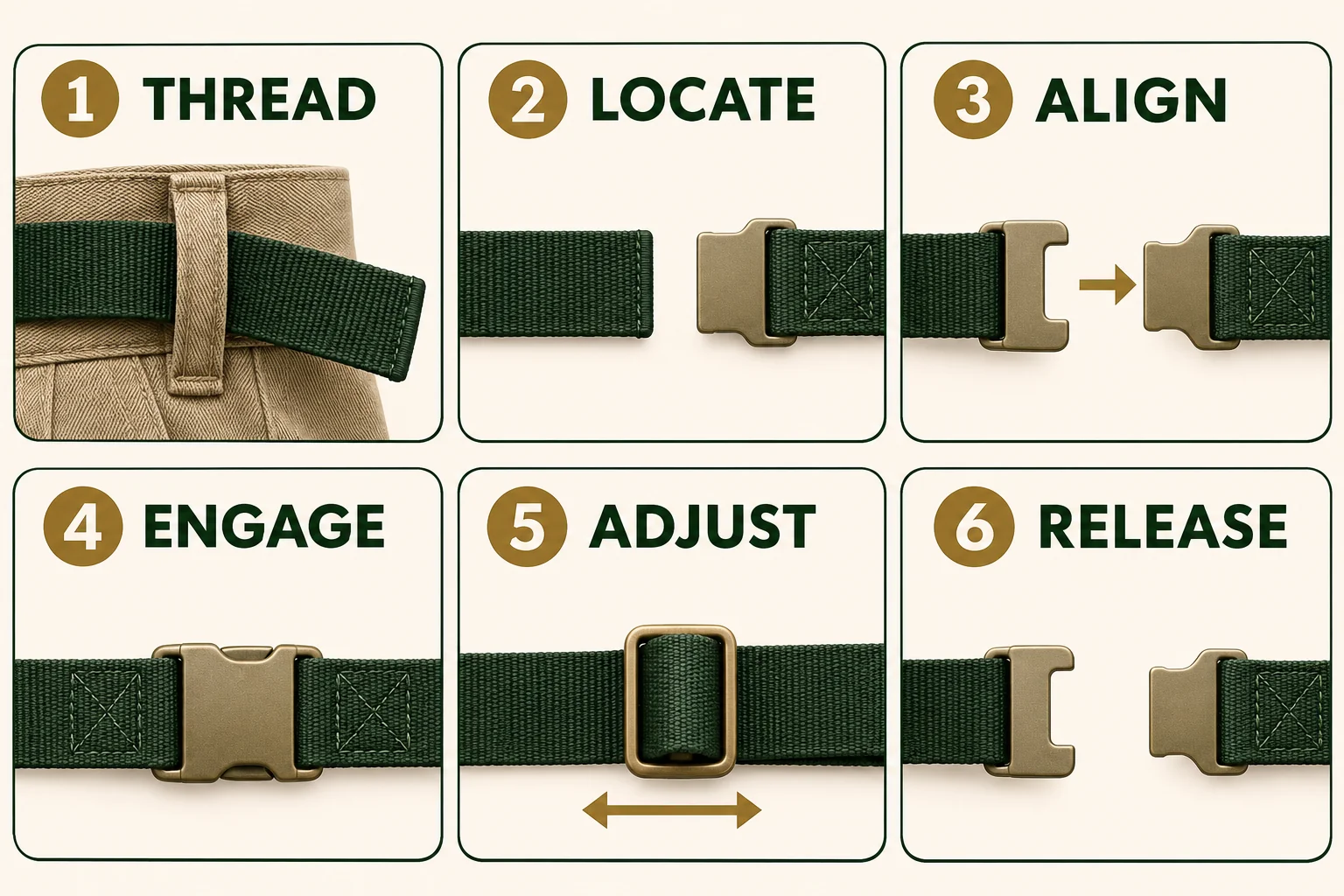
A useful architecture can separate a daily opening point from an infrequently used length adjuster. This may reduce repeated threading, but the adjuster must retain its setting and avoid pressing into the wearer. If it creeps, the user is forced back into the difficult task that the design was meant to avoid.
Also examine the unsecured ends. A very flexible strap may feel comfortable yet fall away before the wearer can bring the closure together. A locally firmer attachment can help present the buckle, but added stiffness may make seated contact uncomfortable. Evaluate the local attachment first instead of stiffening the entire strap.
Handedness remains relevant, especially when opening requires a lateral movement. Our left-handed buckle guide covers permitted orientation and artwork direction. Here, the additional question is whether the wearer can stabilize and operate the assembly through the required motion.
Compare closures by the work they ask the hand to do
A closure family is a candidate, not a usability result. Parts within the same family differ in release geometry, grip area, spring behavior and attachment. Use the following comparison to decide which samples deserve investigation, then evaluate the exact part on the intended belt.
Closure choices and the task to investigate
On smaller screens, swipe horizontally to see all columns.
| Closure route | Potential advantage | Task that can remain difficult |
|---|---|---|
| Prong buckle | Familiar operation and visible fastening position | Holding tension while bending the strap and finding a hole |
| Side-release buckle | Separate opening point from length setting | Simultaneous squeezing while pulling the halves apart |
| Hook-and-loop overlap | Broad adjustment area and possible large pull tab | Starting the peel and supporting the opposing strap |
| Ratchet-style assembly | Incremental adjustment without finding a punched hole | Feeding the tail and locating a small release control |
| Magnetic-mechanical buckle | Magnetic attraction can assist alignment | Performing the specified release motion and managing device-related restrictions |
For a prong buckle, changing the frame alone may achieve little if the strap is difficult to bend or the keeper resists withdrawal. For a side-release design, large wings are not enough if both must be pressed at once by a hand that cannot span them. For hook-and-loop, a visible tab can make the opening edge easier to find, but the user still needs a workable peel direction.
Magnetic and mechanical functions should be distinguished. FIDLOCK describes its SNAP buckle family as combining magnetic attraction with a snap fastening, with lateral sliding used for opening. That provides a specific example of assisted engagement with a different release action. It does not establish that every magnetic buckle operates the same way or that this family suits every adaptive belt.
Ask the component maker for the exact part’s permitted application, assembly instructions and operating direction. Do not modify a proprietary latch or add a lever to it without the maker’s engineering input. An apparently helpful extension can change how the release is loaded or accidentally triggered.
Separate hand effort from holding performance
Operating force is the input needed to perform an action; retention is the fastening’s resistance to unintended separation in a specified condition. A high retention figure does not tell you how difficult the release is to operate. Conversely, a low-effort release does not establish attachment strength or resistance to accidental opening.
Direction and travel matter alongside peak force. A short stiff movement and a longer lighter movement can be difficult for different users. A thumb may reach a control but run out of comfortable travel before the mechanism releases. If the control must remain depressed while the strap is pulled, record that combined action rather than measuring the button alone.
Where a lever is designed into a mechanism, a longer effective lever arm can reduce the input force needed for a given turning moment. It also increases the space swept by the control and may create a snagging point. This is an engineering tradeoff to evaluate on the intended geometry, not a reason to extend an existing release indiscriminately.
For instrumented comparisons, define the actuation point, direction, speed, belt tension and fixture restraint. A rigidly clamped buckle can appear easy to open because the fixture supplies all the stabilization. Record that limitation and follow it with an assembled wearing trial. Agree numerical acceptance limits from the project requirements and suitable testing; there is no single release-force number that makes all belts accessible.
Find out what replaces the second hand
One hand often performs an unrecognized job: preventing the buckle from moving while the other hand operates it. When that support disappears, a release can travel with the user’s hand instead of moving relative to its housing. The difficulty may be the support arrangement rather than an excessively stiff latch.
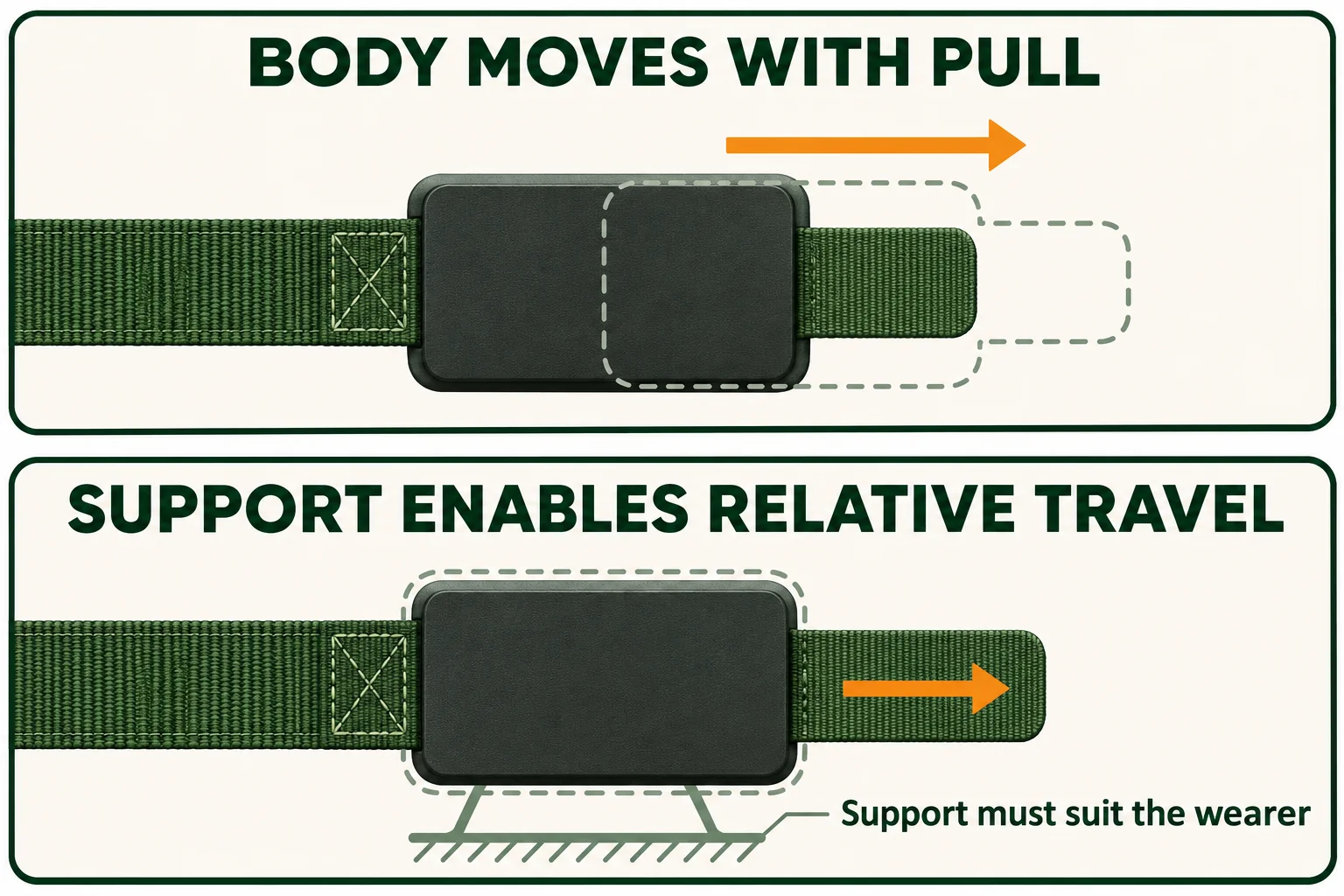
Compare how the attachment presents the buckle and resists rotation. Options might include changing the local strap fold, the location of the opening point or the grip surface. Each affects the complete assembly. A garment loop should not be treated as an unlimited anchor, and the wearer should not need uncomfortable pressure against the body to make the release work.
Consider a hypothetical sample whose broad release tab is easy to grasp but whose buckle rotates when pulled. Making the tab larger may increase movement without solving the problem. Compare the original with a sample that changes only the local support arrangement. Observe whether the intended release movement becomes achievable, then recheck seated comfort, adjustment and unwanted opening. This describes a development comparison, not a reported customer test.
Keep the working surface recognizable by touch and sight where practical. Contrast can help locate a control, while a distinct shape may help distinguish it from decorative hardware. Neither substitutes for a release motion the user can actually complete.
Make closure status clear without making release accidental
A fastening should communicate whether it has fully engaged. An audible click can be useful, but sound alone may be missed. Evaluate visual alignment, tactile feedback and the manufacturer’s specified engagement check together. A design that appears closed while only partly engaged deserves explicit investigation.
A larger tab can improve access while increasing the chance of catching on clothing or nearby objects. Recessing a control can reduce exposure while making it harder to find. Review both intentional opening and plausible incidental contact in the intended wearing situation. The objective is controlled operation, not simply the lowest possible opening effort.
Magnetic options introduce another selection question. The American Heart Association warns that magnets can interfere with pacemakers and implantable defibrillators. Do not assume that a waist position makes a magnetic belt suitable for every implanted-device user. Follow the relevant device and fastener guidance and obtain appropriate advice for the intended use. A nonmagnetic closure may be the appropriate development route; magnetic attraction should never be the default accessibility promise.
Test the task with intended users
A designer’s successful demonstration is insufficient. Before user trials, have prototype risks assessed and agree an appropriate supervised process, consent arrangements and stop conditions. Recruit for the operating capabilities and use situations in the brief rather than assuming people with the same diagnosis have the same needs.
- Set a comparable starting condition. Use the intended garment and belt setting. State whether the belt is already threaded and whether initial assistance is part of the design.
- Observe an attempt before coaching. Record where the participant looks, what they grasp and where the sequence stops. Distinguish an unclear instruction from an unreachable or unworkable control.
- Record assistance and recovery. Note dropped ends, partial engagement, repeated attempts, unintended opening and any discomfort. A fast completion achieved with unplanned help is not independent success.
- Compare the revision fairly. Keep unchanged features consistent and allow for learning or fatigue. Ask what felt easier, harder or uncertain; do not infer comfort solely from elapsed time.
- Repeat relevant everyday tasks. Include opening again after wear, adjustment if required and removal through the keeper. Stop when discomfort or an unsafe condition appears.
Use findings to revise the brief as well as the sample. Some participants may prefer different operation routes, making two configurations more useful than a claim of universal suitability. Record who the final design is intended to serve and which tasks remain assisted.
Usability trials and product validation answer different questions. Trials reveal operating barriers; separate checks address component security, attachment strength, wear, corrosion or other relevant performance. Define those methods and acceptance criteria for the actual materials, hardware and market. Passing a handling trial does not establish durability or regulatory compliance.
Preserve the working action in production
Once a sample works, freeze the details that created that result: hardware part and orientation, strap width and thickness, attachment fold, release clearance, grip-tab construction and keeper position. A visually similar substituted buckle may have a different release direction or effort. A thicker seam allowance can obstruct travel even when the same component is used.
At incoming and first-assembly checks, compare component identity and the critical interfaces with the approved specification. During production, monitor the operations that could change them, such as stitching across a tab or closing an attachment fold too tightly. Finished samples should demonstrate the agreed sequence as well as acceptable appearance.
If a deviation affects operation, identify the affected production and hold the relevant goods for review. Correct the cause, repeat the agreed checks and obtain the appropriate release decision. These are recommended project controls, not a claim that a particular order has already passed them. Keep intended-user evidence connected to the approved configuration and reconsider it when a functional substitution is proposed.
Bring the difficult action into the development brief
Send HongDing a reference image or sample, the intended garment and a description of the action you want to improve. Include what must remain unchanged in appearance or fit. Our design and development service can start from concepts and references and coordinate material, hardware and sample decisions. Specialized user evaluation, testing and any product claims need an agreed project scope; a complete tech pack is not required to begin the discussion.