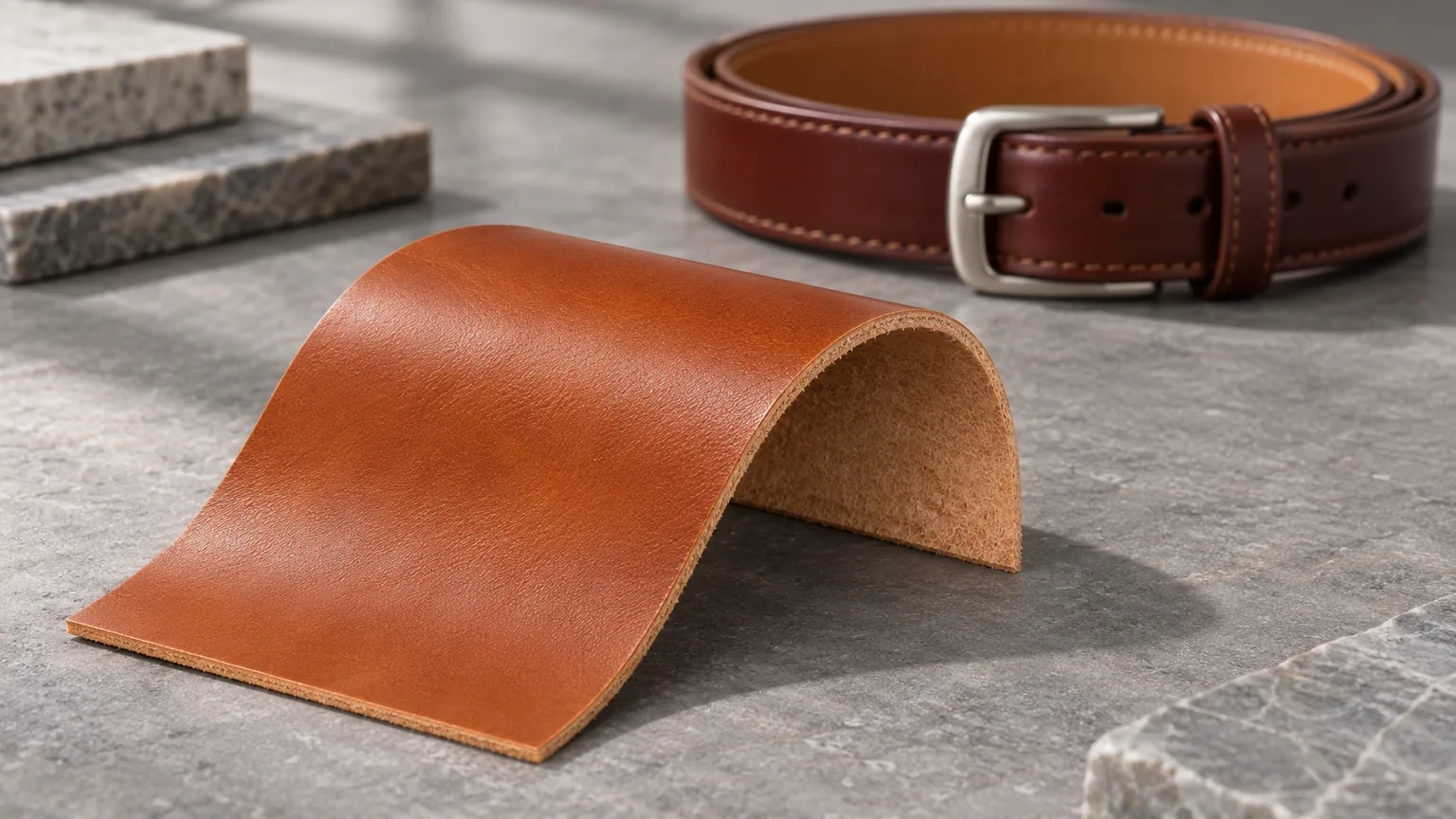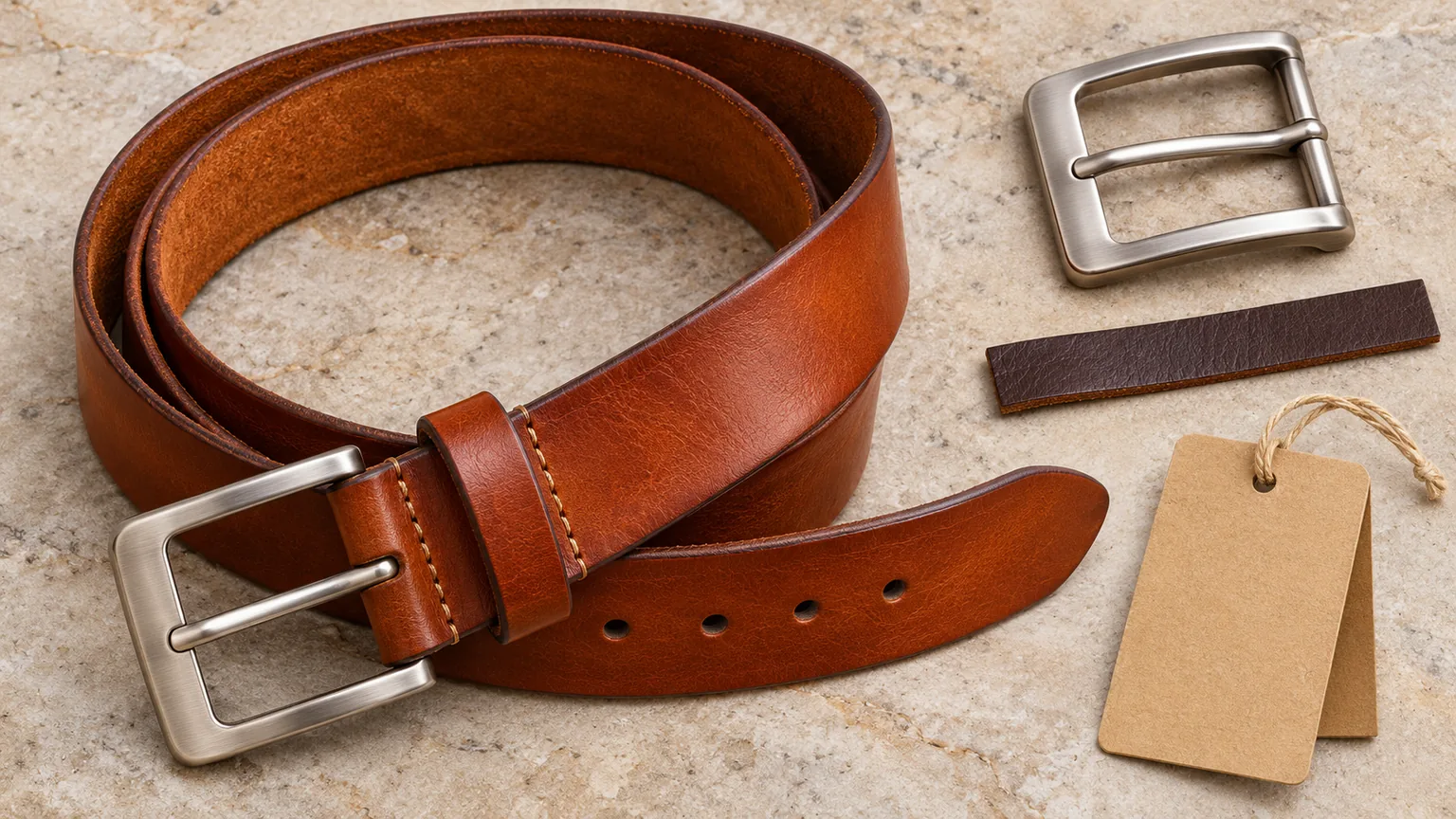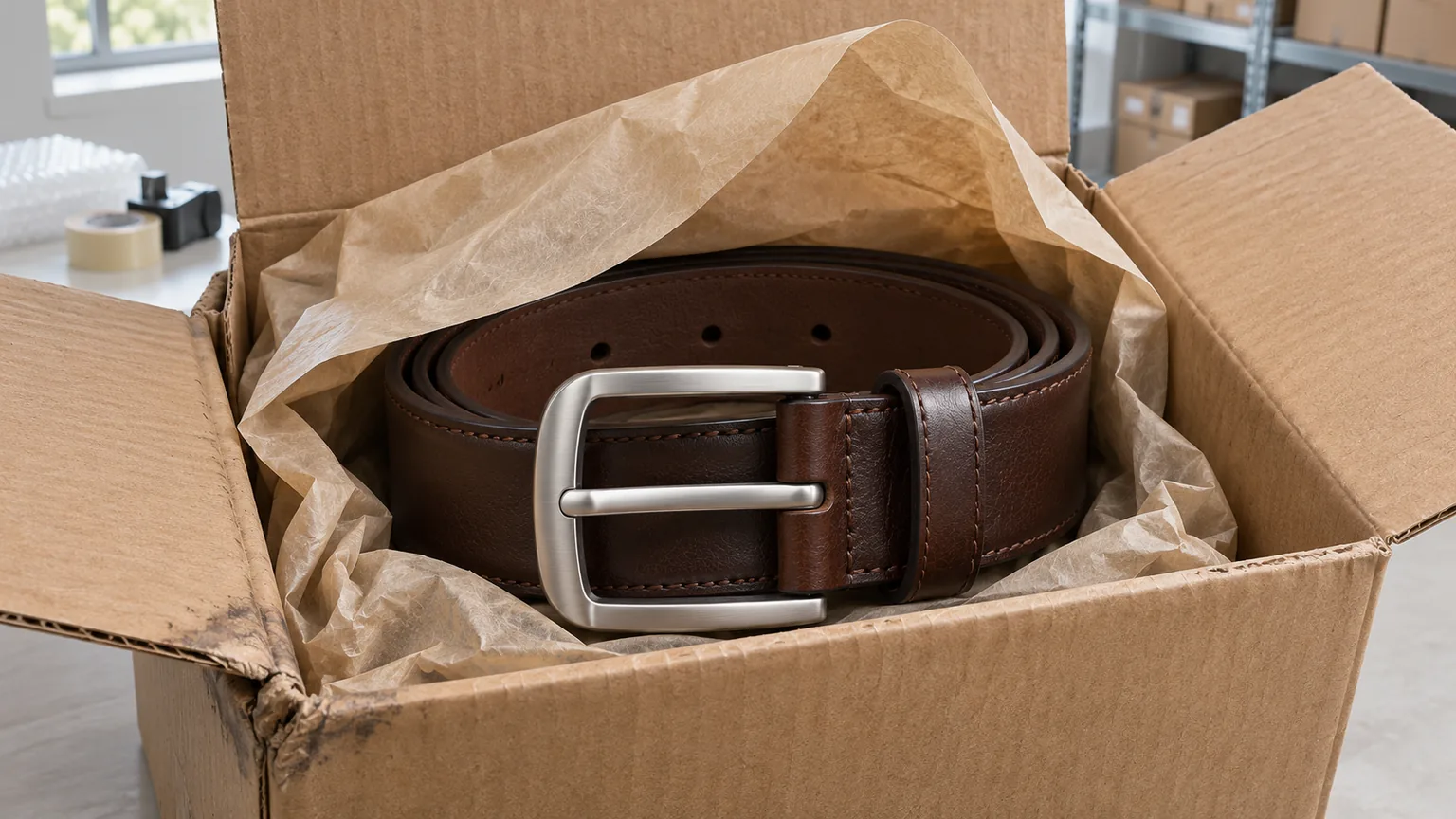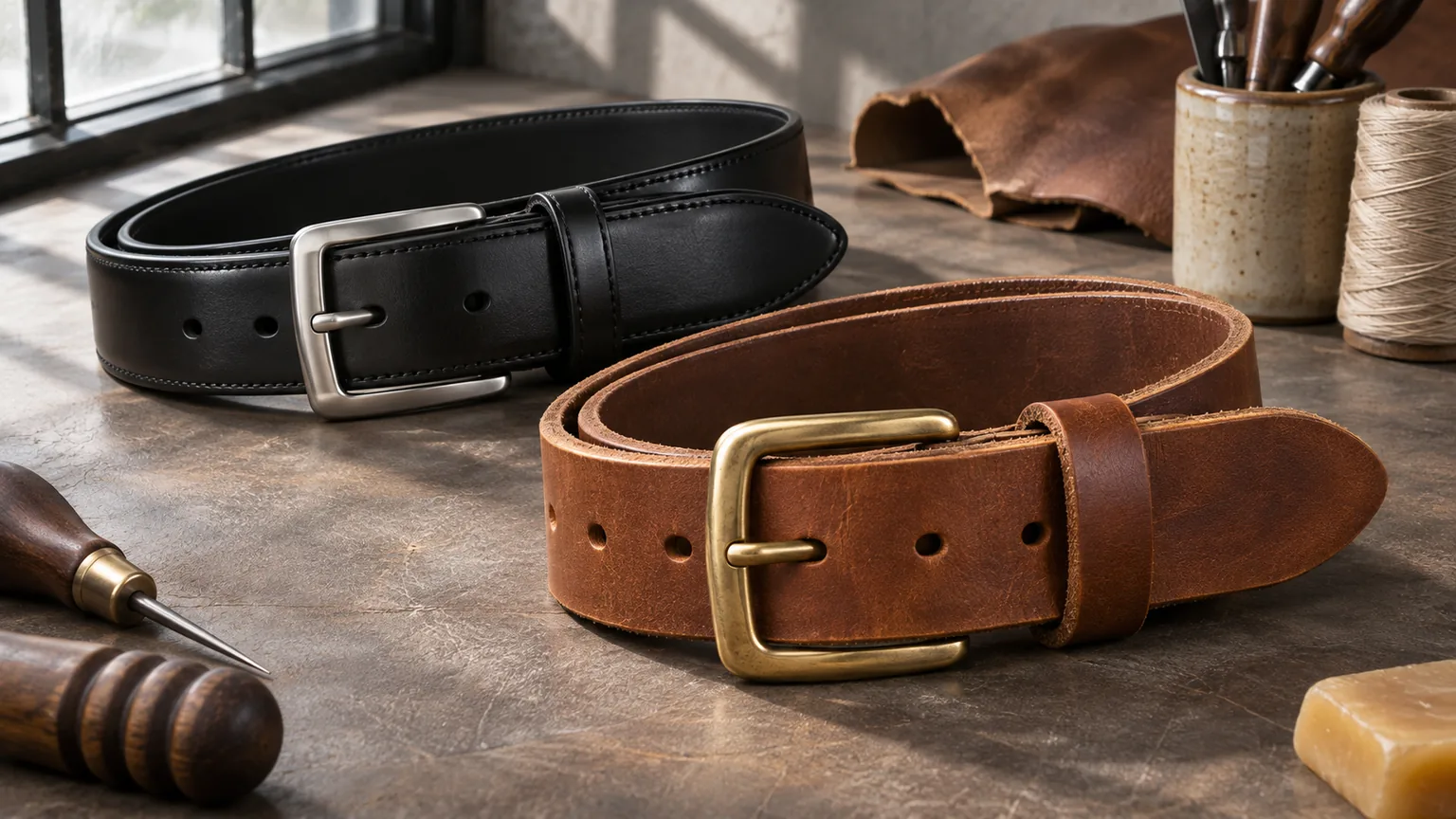
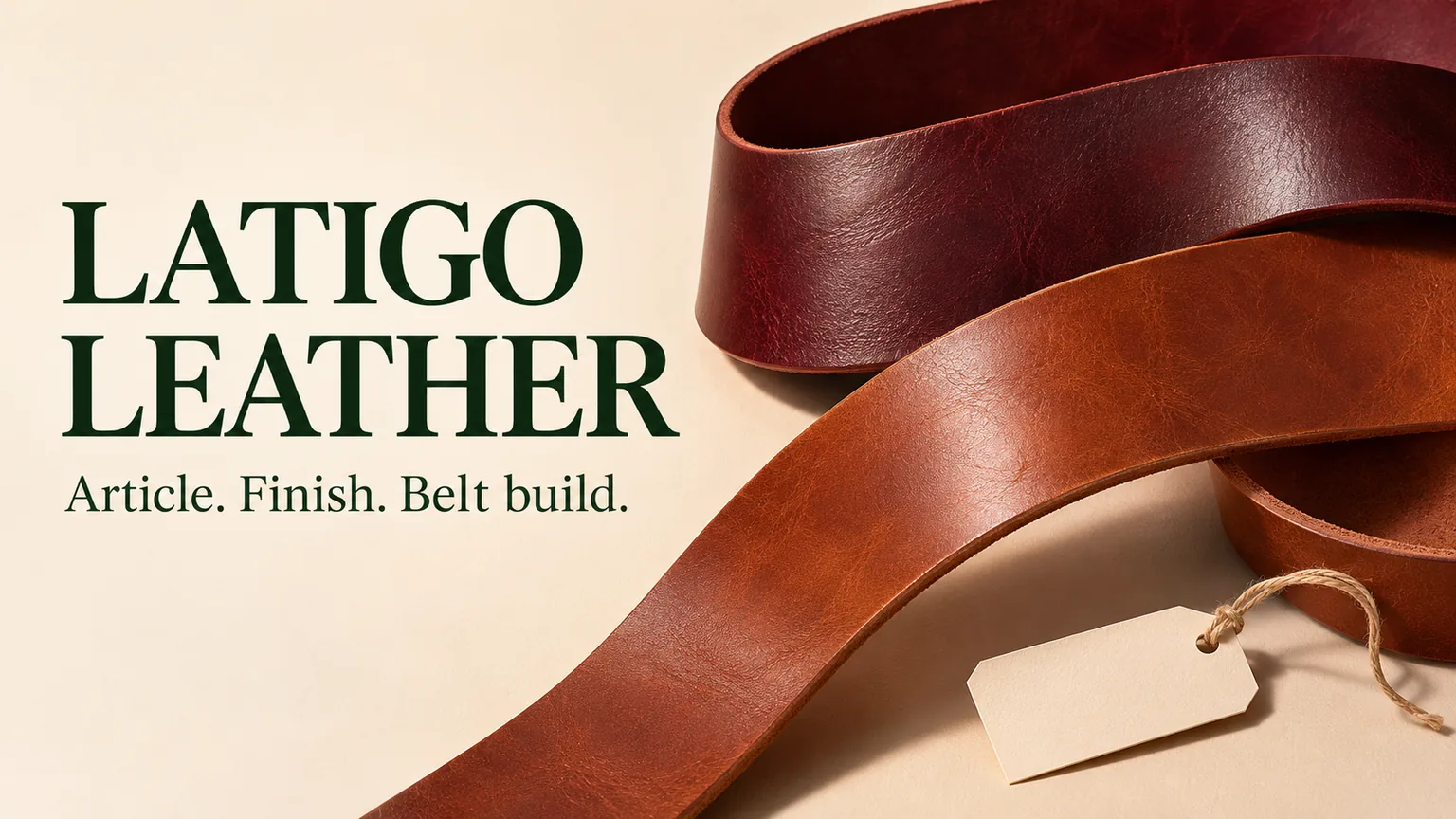
For latigo leather belts, specify the supplier’s exact leather article before approving the name on a purchase order. “Latigo” does not give a product team a complete tanning recipe, firmness, surface treatment or finished-belt performance specification. Two quotations carrying that name can describe materially different starting points. The useful decision is whether a particular article fits your belt design—and what must be rechecked when someone proposes another.
This guide concerns ordinary apparel belts. It focuses on identifying and comparing commercial latigo articles, including alternatives for repeat orders. Appearance development is covered separately in our pull-up leather guide; a rich-looking surface alone cannot identify the leather or establish equivalence.
Why the same name can lead to different samples
A supplier’s commercial article is a particular product reference, usually tied to a code or named range. That reference matters because tanning, conditioning, finishing and available temper can vary within a broad market description. Treat “latigo” as the beginning of the material conversation. Do not automatically translate it into “double tanned,” “vegetable tanned,” “full grain” or a strength rating on a product page.
Two current manufacturer descriptions demonstrate the distinction. Wickett & Craig describes its Oiled Latigo & Show Harness as hot dipped with oils, waxes and tallows, available in firmer and softer tempers, with possible leaching associated with high oil concentration. Its H Latigo combines a Traditional Harness crust with an English Bridle finish. Those descriptions identify separate products; they are not definitions for every tannery’s latigo.
The practical consequence is significant. A quotation for “latigo, brown” might be aligned with your color reference while leaving the hand, reverse treatment and finishing route unresolved. Matching the swatch’s shade does not close those gaps. Ask the supplier to connect the offered sample to the precise article being quoted, including any custom splitting or finishing that changes its delivered condition.
The named tannery examples illustrate terminology. They do not identify HongDing’s current stock, promise availability or establish a commercial relationship with those manufacturers. The proposed source and article must be confirmed for the actual belt project.
Build a material identity that survives purchasing
A useful material card joins four kinds of information: who supplies the article, what the article is, which version you sampled, and what the belt team intends to do with it. Keeping these together prevents an attractive reference swatch from becoming detached from the order that follows.
Start with the manufacturer or accountable supplier, article name and code, color code, and sample identifier. Record the supplier’s description of hide type, grain treatment and tanning route separately. If that information has not been provided, mark it unresolved rather than inferring it from the name. A sample can still be discussed for appearance while its material description remains open.
Then identify the delivered configuration: thickness and measurement basis, temper or physical hand reference, face finish, reverse treatment, and any requested splitting or additional finishing. “Same article” is incomplete if one sample was softened or refinished and the repeat order is supplied without that step. A color extension also deserves its own identified sample; the approved brown piece cannot stand in for every color.
Finally, attach the proposed belt construction. State whether the leather forms an unlined strap, a face over a lining, or another defined build. Keep the supplier’s material facts distinct from your own design targets. “Oil-conditioned article” describes an input; “clean contact with a pale garment” describes an outcome that needs separate evidence.
Compare quotations by what is included
Before comparing price, check whether each offer includes the same material preparation. A cheaper unsplit article and a prepared strap material are not directly comparable inputs. The additional work may affect the route, usable output and sample timing. Conversely, paying for preparation that the belt construction does not need adds cost without resolving a design problem.
Ask which supplied form the price covers and who owns the remaining operations. A side, back, cut strap and completed belt are different purchasing units. Where a long uninterrupted visible strap matters, obtain a cutting and selection proposal for that style rather than assuming that the lowest area price produces the lowest accepted-belt cost.
Fields that can change the meaning of a latigo quotation
On a narrow screen, scroll the comparison table horizontally.
| Field | Compare explicitly | Why it changes the decision |
|---|---|---|
| Article identity | Supplier, article code and agreed version | A shared family name does not authorize substitution. |
| Preparation | Splitting, softening, reverse treatment and further finishing | Additional processing can change the supplied hand and manufacturing route. |
| Supplied form | Hide section, cut strap or finished belt; selection basis | Unit price and usable output refer to different things. |
| Approval coverage | Colors, construction, contact materials and identified samples | Evidence for one configuration may leave another unresolved. |
A supplier may reasonably propose a different article when the preferred one is unavailable. Ask for the proposed difference in writing, together with the sample and revised quotation. “Equivalent latigo” should mean a candidate for review, not permission to replace the original material invisibly.
Separate the surface you want from contact behavior
Oiled latigo leather can be a useful search term for a rich, conditioned design direction, but the phrase does not specify how much material can transfer to a neighboring surface. The manufacturer example above explicitly mentions possible leaching for one product. That is a reason to assess the relevant contact conditions, not evidence that every latigo article stains.
Make two decisions separately. First, determine whether the face has the desired shade, gloss and response to handling. Second, determine whether the completed belt is compatible with its lining, clothing-contact surfaces and packaging. A pleasing change of appearance when bent and an unwanted mark on a pale recipient are different observations.
For a light-garment program, agree the relevant color-transfer evaluation with the supplier or test provider. For a gift pack, use the actual contacting insert or tissue in development. Do not let a dark recipient conceal the question, and do not diagnose a visible mark as oil solely because the article is called oiled latigo. The leather oil-migration guide explains how contact marking and adhesive compatibility require separate investigations.
This distinction also prevents an expensive overcorrection. If the only unresolved issue is one packaging contact, changing the entire leather article may sacrifice the approved hand and appearance unnecessarily. If the actual belt assembly is affected, a packaging change cannot establish that the construction is satisfactory. Locate the unresolved interface before deciding which input to change.

Use the same belt build to compare the material
Temper is a hand description, not a complete prediction of the assembled strap. Bending a small piece in the hand does not reproduce the length, width, layers or local folds of a belt. A thicker candidate may feel more resistant to bending because of the geometry as well as the leather itself. If those variables change together, the comparison reveals a product preference but does not isolate its cause.
For the first material comparison, use the intended width, finished thickness direction, hardware and construction for both candidates where feasible. Record unavoidable differences. Then evaluate the face, reverse, edges and complete adjustment sequence. If one candidate can only achieve the target after extra preparation, that preparation belongs in its cost and production route.
An unlined design exposes the leather’s reverse and cut edges. A lined design introduces another layer and a joining method, which can change the total thickness and hand. Adding a lining to improve the underside therefore creates a new build to approve; it does not merely complete the same material test. Where bonding is used, assess the selected materials and process together rather than assuming that a leather family name guarantees compatibility.
Separate local and overall observations. A bulky attachment with an otherwise satisfactory strap may justify reviewing the buckle-fold construction. An unsatisfactory feel along the whole belt points back toward article, thickness or overall build. The bridle and harness comparison develops these construction checks further. Here, their purpose is to determine what a proposed latigo substitute must reproduce.
Worked example: a substitute with the same name
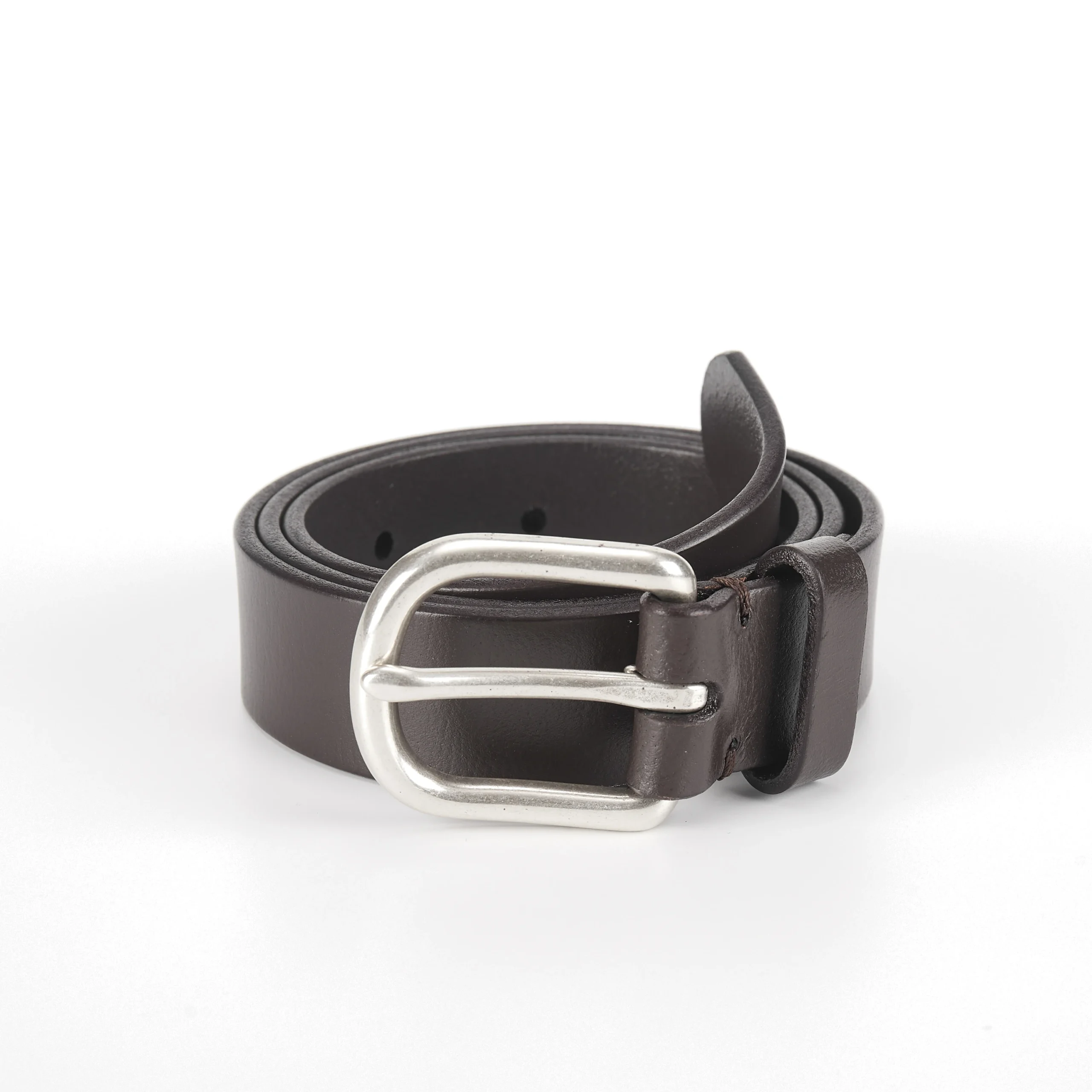
Consider an illustrative development case, not a reported HongDing order. A brand has approved an unlined brown casual belt using Article A. Its supplier proposes Article B, also described as latigo, for the next order. The initial photograph looks close in color, and B is available sooner. That is enough to request a sample, not enough to approve replacement.
On the two material cards, the team finds that A includes a specified reverse finish and a particular delivered thickness, while B’s offer leaves both unspecified. The first action is to clarify B’s delivered configuration. Otherwise, a sample improvement made by the workshop might never reach the purchase order, and production could receive a different version from the one the brand reviewed.
The team then compares belts made to the same intended build. Suppose B achieves the preferred face appearance, but its reverse does not meet the brand’s unlined finish target. There are three practical routes: retain A, ask whether B can be supplied with an acceptable reverse treatment, or develop B with a lining. Each route preserves and changes different parts of the approved product.
Retaining A protects the existing material decision but leaves the availability problem to resolve. A revised reverse treatment may preserve the unlined design, subject to review of its feel and contact behavior. A lining may produce the desired underside but changes the bill of materials, joining route, edge and assembled thickness. It must be quoted and sampled as a revised construction.
The brand chooses which tradeoff fits its collection and timing. If B with revised treatment is preferred, its new configuration receives its own reference, and the finished sample is checked against the original appearance and functional targets. The approval says exactly which version of B is accepted. It does not say that any future leather sold as latigo is equivalent.
Carry the decision from sample to repeat order
Keep the selected material card with the approved belt and appearance range. Retain evidence of the actual article and version supplied for sampling, not only the retailer-facing material name. If the agreed hand is communicated by a physical reference, identify that reference so a later team can distinguish it from an earlier rejected sample.
At receiving, compare the delivered identity and relevant condition with the approved record before treating the material as interchangeable stock. If the article, finish or declared preparation differs, hold the affected input for clarification. A matching brown shade does not resolve a missing article identity.
During first-piece review, check the completed configuration, especially any preparation introduced to make the selected article work. If a new reverse treatment or local thickness change was part of approval, verify that it appears in the production instructions and finished sample. This is where a material decision becomes a repeatable manufacturing decision.
Record departures against the affected lot and decide whether they require a focused comparison or a complete sample revision. After correction, recheck the characteristics that mattered to the selection before release. These are recommended control points, not a claim that a particular HongDing order has already passed them or a substitute for project-specific performance testing.
Start with the material direction you have
A buyer does not need a complete tech pack to begin. A reference belt, material swatch, photograph or desired surface direction can establish what the collection is trying to achieve. The next useful inputs are intended construction, approximate width, preferred hand, wearer or garment context, and any material wording the product must support.
HongDing supports material and hardware coordination, sample development and production handoff. Our leather belt materials guide helps place the proposed article within the broader material choice. Specific tannery availability, article documentation and finished-belt requirements remain part of the project discussion.
Turn a latigo reference into a defined belt sample
Share your reference with HongDing, including any supplier article details you already have. Tell us which appearance and hand you want to preserve, and which decisions are still open. We can use that starting point to discuss the material and construction together.