By Kevin · Technical review by HongDing Sourcing and Quality Team · Published September 12, 2026 · Reviewed September 14, 2026 · Publisher profile · Review scope
A long supplier list is easy to assemble. A defensible one is harder. Search results for private label belt manufacturers worldwide routinely place factories beside retail brands, tanneries, directories, and sourcing businesses, even though those entities give a buyer very different control over product development and production.
This guide narrows the field to 15 companies whose own websites describe leather-belt production plus private-label, OEM, contract-manufacturing, or equivalent brand service. It does not claim that one supplier will outperform another. Instead, it gives sourcing teams a cleaner starting set, exact plain-text source URLs, and a practical way to turn public claims into comparable evidence.
What You Will Find Here
How This Official Shortlist Was Built
An official-source research list means that inclusion is based on what each company publicly describes on its own website. To qualify, a company needed an accessible official site, a page showing leather belts, a B2B customization or manufacturing route, a contact or location signal, and enough information to label its business model without inventing missing details. Official pages were checked on September 11, 2026.
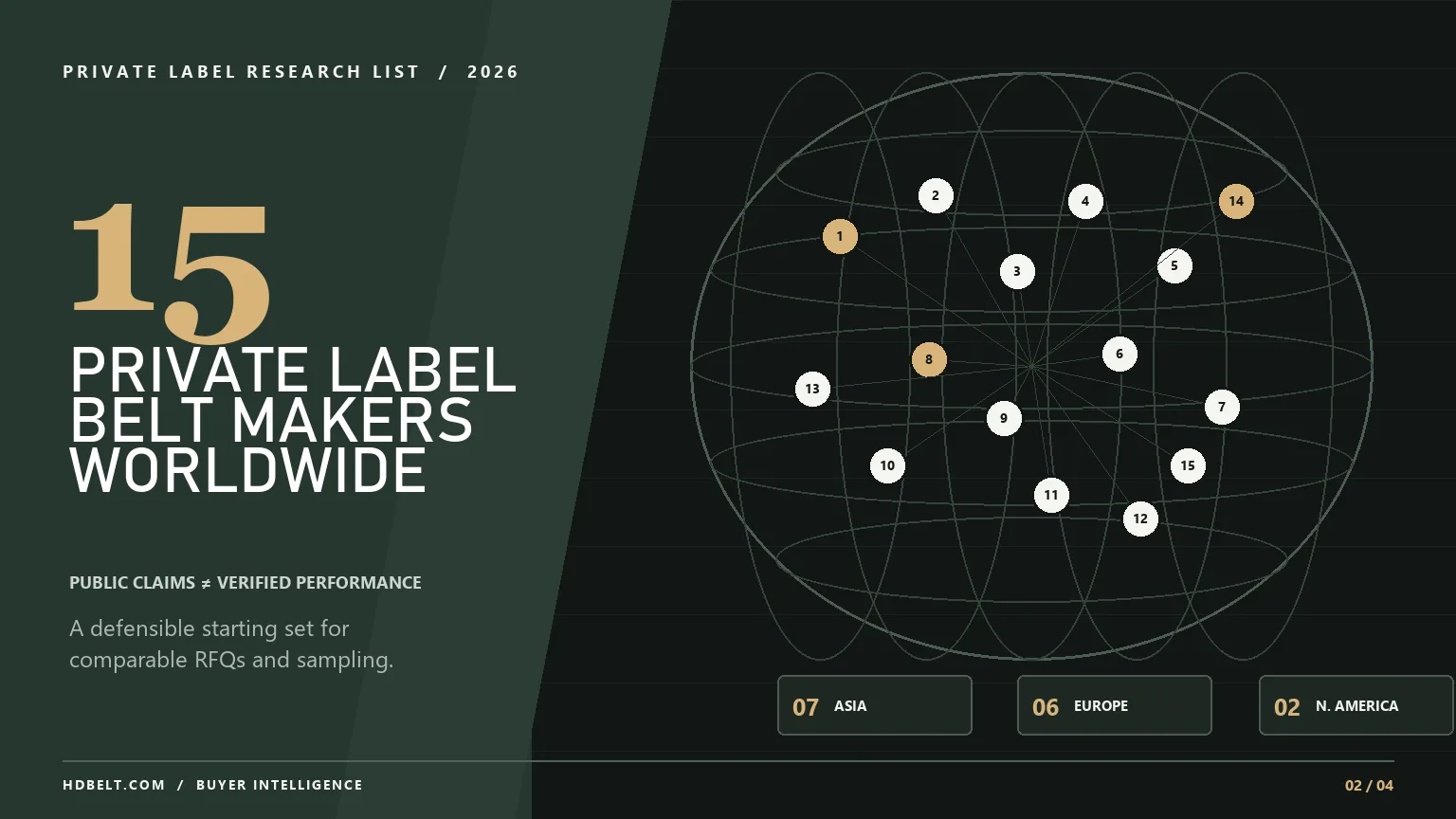
Geographic scope: “worldwide” describes a cross-region starting set, not a complete directory of every manufacturing country. This edition covers seven Asia-linked profiles, six Europe-linked profiles and two North American profiles found through the documented official-source screen. Africa, Latin America, Oceania and companies without sufficient accessible first-party evidence are not represented; absence is not a negative judgment.
That evidence is useful, but it has a limit. A supplier page can show that a service is publicly offered. It cannot independently prove workmanship, on-time delivery, usable capacity, test performance, financial stability, factory ownership, or certificate validity. Those points remain open until the buyer reviews current documents, samples, facility evidence, and order-specific terms.
Entries are grouped by region and alphabetized inside each group. The order is not a score. We also distinguish a direct manufacturing claim from a brand-plus-factory structure or a hybrid manufacturing and sourcing model. A related brand was not counted separately where public signals left its relationship with HDBelt unresolved, and directories, retail-only brands, tanneries, and supplier networks were excluded.
Compare The Fifteen Public Supplier Profiles
The matrix below summarizes public positioning, not verified performance. “Manufacturer” means the official site presents the company that way; it is not a third-party factory audit. The final column is deliberately a question because the missing fact often matters more than the marketing claim.
| Company | Public base or structure | Public belt signal | Model label | First buyer check |
|---|---|---|---|---|
| Adnan Lederwaren | Netherlands-facing | Custom private-label belts | Supplier/manufacturer claim | Actual production site |
| Arnold Wills | UK plus global sourcing | Private-label belts | Hybrid | Order-specific source |
| Avish Global | India | Brand and wholesale belts | Manufacturer claim | Current factory evidence |
| FAP Italia | Italy | Private-label leather belts | Manufacturer claim | Scope-specific terms |
| Great British Accessories | United Kingdom | Belts for brands | Manufacturer claim | Current material scope |
| HongDing | China and Cambodia context | Leather-belt programs | Manufacturer claim | Order production site |
| L’Accessorio | Italy | In-house private-label belts | Manufacturer claim | Current process map |
| Lider Kemer | Turkey | OEM and wholesale belts | Manufacturer claim | Evidence behind compliance claims |
| Magna Leather | United States | Private-label belt options | Manufacturer claim | Current leather and style scope |
| NYC Belts | United States | Custom fabric and leather belts | Custom manufacturer claim | Current private-label scope |
| OHM New York | US brand, India factory claim | OEM and private label | Brand-plus-factory claim | Factory ownership evidence |
| STAN INDIA | India | Custom bulk belts | Manufacturer claim | Sample-to-bulk controls |
| Szoneier Leather | China | Custom OEM/ODM belts | Manufacturer claim | Current facility and terms |
| True Trident Leather | India | Private-label leather belts | Manufacturer claim | Evidence for material claims |
| YSK Leather Goods | China | Belt OEM and private label | Manufacturer claim | Current capacity allocation |
All profile descriptions below are paraphrases of company-reported information on the listed official domains. Inclusion does not indicate HDBelt approval, equivalence, or a business relationship.
Exact official pages reviewed
These addresses are shown as plain text, without promotional outbound links, and the same rule applies to the publisher profile: https://hdbelt.com/leather-belts/; https://hdbelt.com/private-label/; https://www.avishglobal.com/leather-belt-manufacturers; https://www.ohmnewyork.com/pages/leather-belt-manufacturer; https://www.ohmnewyork.com/pages/private-labels; https://stanindia.com/leather-belts-manufacturer/; https://szoneierleather.com/custom-leather-belts/; https://www.truetridentleather.com/leather-belts/; https://www.truetridentleather.com/private-label-manufacturing/; https://yskleathergoods.com/belt-manufacturer/; https://yskleathergoods.com/private-label-leather-goods/; https://www.adnanlederwaren.nl/product-category/belts/; https://www.arnoldwills.co.uk/private-label.aspx; https://www.fapitalia.it/; https://greatbritishaccessories.uk/; https://www.laccessoriobelts.com/en/; https://www.laccessoriobelts.com/en/services/; https://www.liderkemer.com/en/; https://www.alligatorbeltsbymagna.com/; and https://nycbelts.com/. Checked September 11, 2026.
Asia Private Label Belt Suppliers
Asia offers a broad supplier pool, but the public business structures are not interchangeable. Ask whether the entity quoting your program owns the proposed production site, manages another factory, or combines manufacturing with external sourcing.
Avish Global
Public-source status: Included because its official page connects leather belts with brand, wholesale, and private-label programs.
Avish Global’s official leather-belt page (official source: avishglobal.com) presents the company as an Indian manufacturer serving brands, wholesalers, and private-label businesses. The page gives buyers a relevant public signal for custom belt programs, but its broader statements about standards, flexibility, and export readiness remain supplier assertions.
Why evaluate: The public offer is framed around B2B belt development rather than consumer personalization.
Confirm directly: Legal factory entity, production address, leather construction, current sample process, and capacity allocated to your order.
HongDing
Public-source status: Included with publisher disclosure because official HDBelt pages describe leather-belt and private-label program routes.
HongDing’s leather-belt page describes program development for brands, retailers, and wholesale buyers. Its private-label page separates ready styles, customized styles, full custom development, and contract-manufacturing routes. HDBelt publishes this shortlist, so these statements are first-party and commercially interested.
Why evaluate: The public pages separate development routes and discuss materials, construction, hardware, branding, and approvals.
Confirm directly: Which facility will make the order, what is subcontracted, and which specification and inspection records become part of approval.
OHM New York
Public-source status: Included with a structure label because official pages connect private-label belts to an India factory claim.
OHM New York’s belt-manufacturer page (official source: ohmnewyork.com) and private-label page (official source: ohmnewyork.com) describe OEM belt service and a dedicated manufacturing facility in India. That structure may suit buyers who want a North American-facing relationship with an Asian production claim, but the site itself is not independent evidence of factory ownership.
Why evaluate: The public offer connects brand service with an identified production-country claim.
Confirm directly: Contracting entity, factory ownership, facility address, quality responsibility, and whether any part of the order moves to another site.
STAN INDIA
Public-source status: Included because its official belt page describes bulk customization, private labeling, sampling, and logo work.
STAN INDIA’s official belt page (official source: stanindia.com) describes custom bulk leather-belt production, private labeling, sampling, and logo application. Those are useful signals for a brand project. Promotional language about quality, scale, or customer outcomes should not enter a supplier comparison without order-specific evidence.
Why evaluate: Sampling and brand application are visible parts of the public service description.
Confirm directly: Sample approval stages, bulk-tolerance rules, buckle sourcing, edge-finishing process, production location, and inspection access.
Szoneier Leather
Public-source status: Included because its official page describes custom leather belts plus private-label, OEM, and ODM service.
Szoneier Leather’s custom leather-belt page (official source: szoneierleather.com) describes private-label styles plus OEM and ODM service. It publicly covers customization across a brand program, making it relevant to an initial sourcing screen. Numerical, certificate, performance, and client claims need their own evidence and are not relied on here.
Why evaluate: The page is directly aligned with custom belt work for brands rather than retail-only sales.
Confirm directly: Actual factory entity, current product engineering ownership, leather traceability, sample gates, and order-specific commercial terms.
True Trident Leather
Public-source status: Included because official pages connect leather-belt production with private-label manufacturing.
True Trident Leather’s belt page (official source: truetridentleather.com) and private-label page (official source: truetridentleather.com) describe custom leather-belt manufacturing for brand programs. This establishes a public B2B route. It does not independently validate environmental, durability, export, or workmanship language that may appear elsewhere on the site.
Why evaluate: Leather belts and private-label manufacturing are connected on official company pages.
Confirm directly: Leather source documentation, facility identity, process ownership, buckle and plating controls, sample criteria, and bulk inspection records.
YSK Leather Goods
Public-source status: Included because official pages show both belt-specific OEM and broader private-label services.
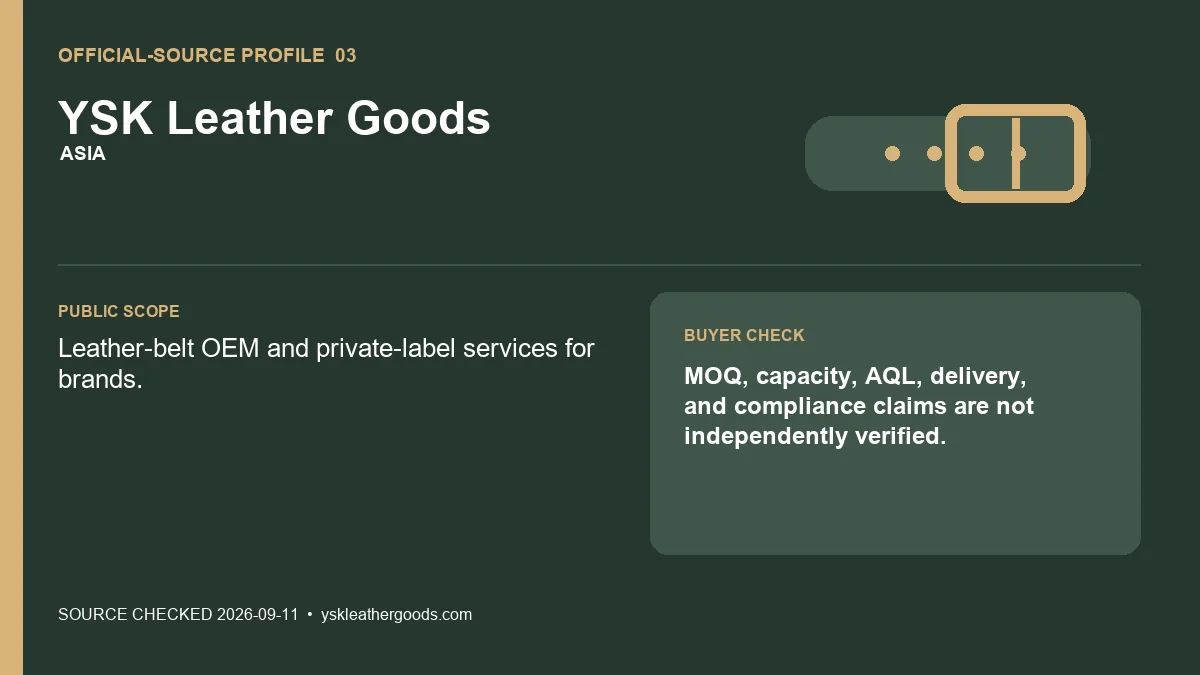
YSK Leather Goods’ belt-manufacturer page (official source: yskleathergoods.com) identifies leather-belt OEM service, while its private-label page (official source: yskleathergoods.com) describes brand-facing development. The combination meets this shortlist’s public-scope test, but capacity, AQL, facility, delivery, pricing, and compliance statements were not independently verified.
Why evaluate: The official site exposes both belt-specific and wider private-label service paths.
Confirm directly: Belt-line location, current capacity allocation, inspection standard, approved-material controls, tooling ownership, and quote validity.
Europe Private Label Belt Suppliers
European-facing suppliers can represent local production, a local commercial office, a hybrid sourcing model, or some combination. Do not treat a country-domain website or office address as proof that every operation happens in that country.
Adnan Lederwaren
Public-source status: Included with a location caveat because its official page describes custom belts for several business-buyer channels.
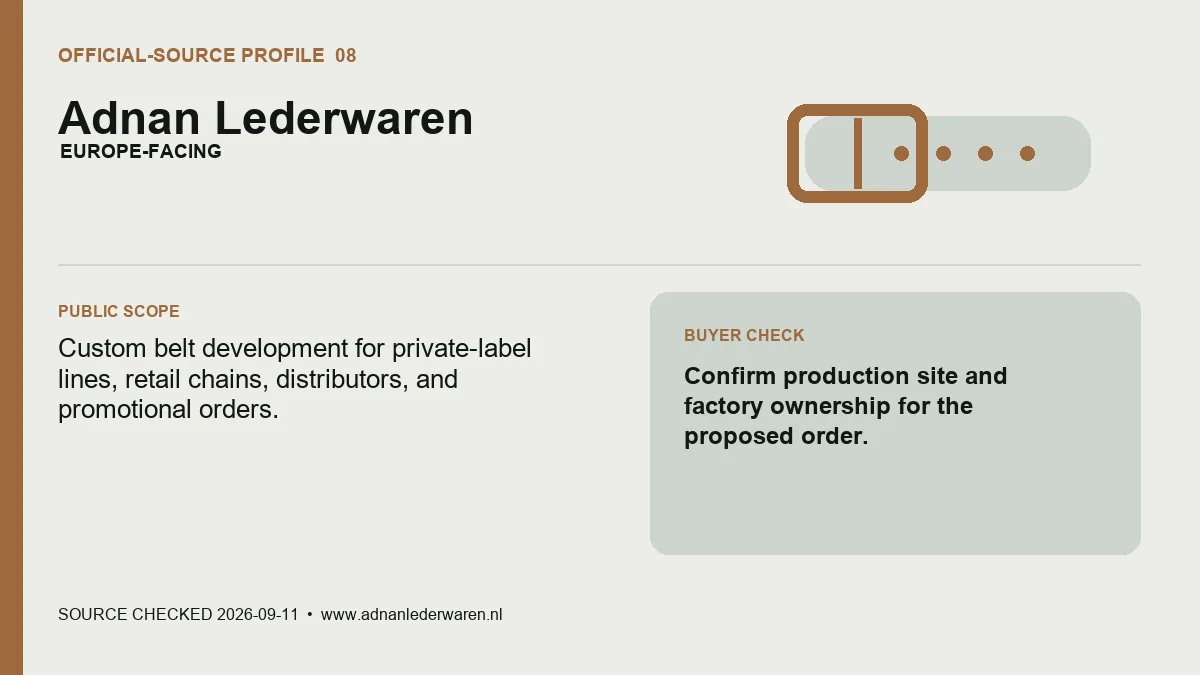
Adnan Lederwaren’s official belt page (official source: adnanlederwaren.nl) describes custom belt development for private-label lines, retail chains, distributors, and promotional orders. That is a relevant B2B signal. The page does not give this research enough independent evidence to assume that all production occurs in the Netherlands.
Why evaluate: The service description names several business-buyer channels and custom development.
Confirm directly: Production country, factory ownership, subcontractors, leather origin, responsible quality entity, and where samples and bulk goods are inspected.
Arnold Wills And Company
Public-source status: Included as a hybrid because the official page separates UK manufacture from global sourcing.
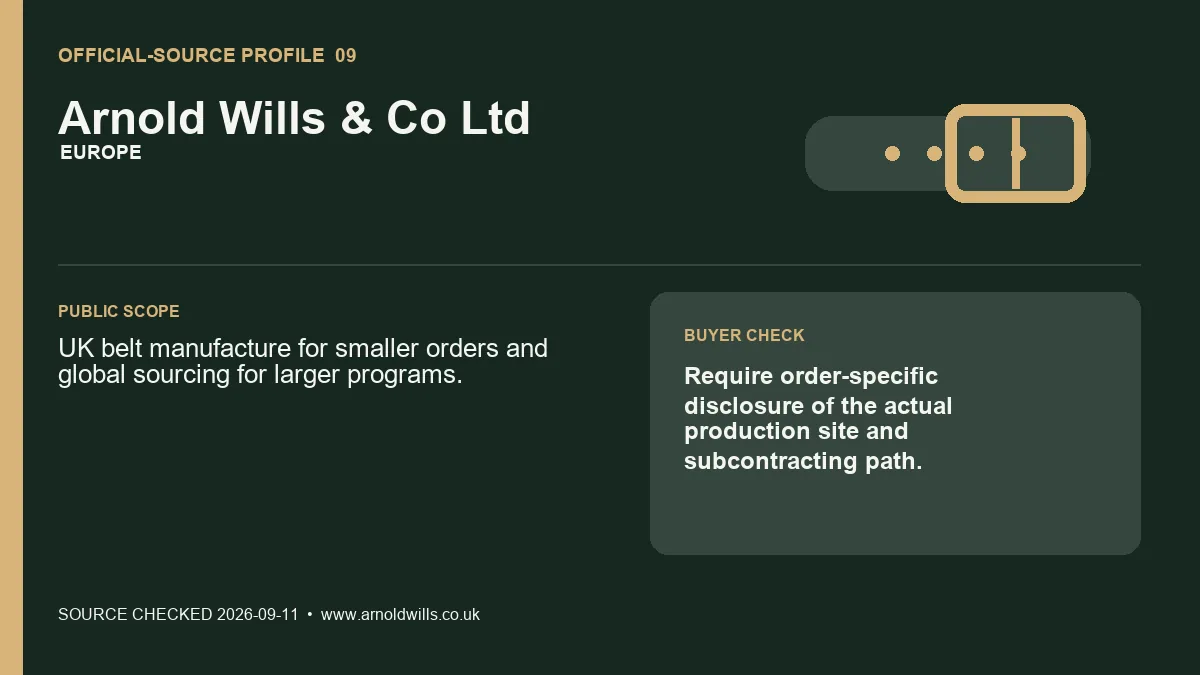
Arnold Wills’ private-label page (official source: arnoldwills.co.uk) makes an important distinction: it describes UK manufacture of belts and braces for smaller orders and global sourcing for larger programs. That hybrid model can be commercially useful, but a buyer must not assume the same facility, labor path, or country of origin across order sizes.
Why evaluate: The website is unusually explicit about local manufacturing and global sourcing as separate routes.
Confirm directly: Which route applies to the quote, the legal manufacturer, country of origin, subcontracting controls, and approval required before a source changes.
FAP Italia
Public-source status: Included because its official site describes private-label belt production and in-company work.
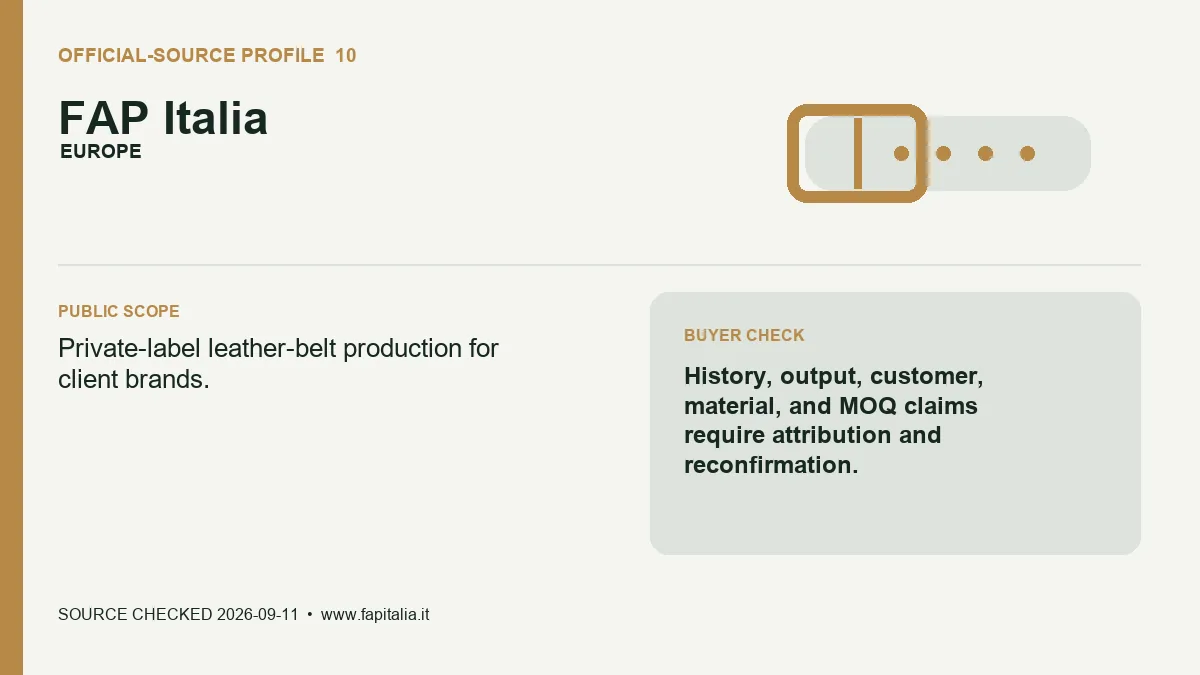
FAP Italia’s official site (official source: fapitalia.it) presents private-label leather-belt production for client brands and describes work performed within the company. That makes it relevant for buyers screening Italian production. Public statements about history, output, customers, materials, and minimums remain company-reported and should be refreshed in the actual quotation.
Why evaluate: Private-label belt production and an in-company manufacturing claim are explicit.
Confirm directly: Exact site, process steps performed in-house, material source, current minimum by style, sample charges, and production scheduling basis.
Great British Accessories
Public-source status: Included because its official site presents leather-belt manufacture for brands and retailers.
Great British Accessories’ official site (official source: greatbritishaccessories.uk) describes leather-belt manufacture for brands, retailers, and businesses, with language covering small runs and repeat orders. That may interest brands testing a focused range. Experience, lead-time, material, and quality statements still require current, product-specific support.
Why evaluate: The public offer is directed at business buyers and explicitly mentions smaller and repeat programs.
Confirm directly: Current minimum, available constructions, production address, buckle supply, logo methods, sample timing, and repeat-order tolerances.
L’Accessorio Di Morri Sergio
Public-source status: Included because official pages describe in-house private-label belts and custom work from client designs.
L’Accessorio’s official site (official source: laccessoriobelts.com) describes in-house leather-belt production for its collection and private labels. Its services page (official source: laccessoriobelts.com) adds custom production from client designs and logo application. Unnamed collaborations or broad material claims are not treated as independent evidence here.
Why evaluate: The public pages connect private-label work, client designs, branding, and in-house production.
Confirm directly: Which operations are internal, tooling and artwork ownership, leather and lining specifications, sample approval, and bulk-quality records.
Lider Kemer
Public-source status: Included because its official site describes an Istanbul factory serving private-label, OEM, and wholesale programs.
Lider Kemer’s official site (official source: liderkemer.com) describes an Istanbul belt factory offering genuine and synthetic leather belts for private-label, OEM, and wholesale orders. This is a strong category signal, not proof of each promotional claim. Compliance, QC, returns, export reach, volume, logistics, and minimums require current evidence.
Why evaluate: The public service covers multiple belt materials and B2B production routes.
Confirm directly: Material definitions, factory identity, current certificate evidence, test method and acceptance limits, order minimum, and change-control process.
North American Custom Belt Suppliers
For buyers prioritizing a U.S. commercial or production route, public location language still needs verification. Confirm the actual production site, imported inputs, subcontracted processes, and origin basis for the exact style.
Magna Leather Corporation
Public-source status: Included because its official site describes U.S. private-label belt manufacturing and multiple style options.
Magna Leather Corporation’s official site (official source: alligatorbeltsbymagna.com) describes U.S. private-label belt manufacturing across dress, casual, western, custom-color, buckle, and design options. That breadth gives buyers several categories to discuss. Claims involving notable clients, inventory, experience, quality, or price were not independently verified for this shortlist.
Why evaluate: The public offer is belt-specific and includes private-label customization across several style families.
Confirm directly: Current production address, leather species and origin, applicable restrictions, buckle sourcing, minimum by construction, and sample-to-bulk controls.
NYC Belts And Universal Elliot
Public-source status: Included because the official site presents custom fabric and leather belt manufacturing for brands.
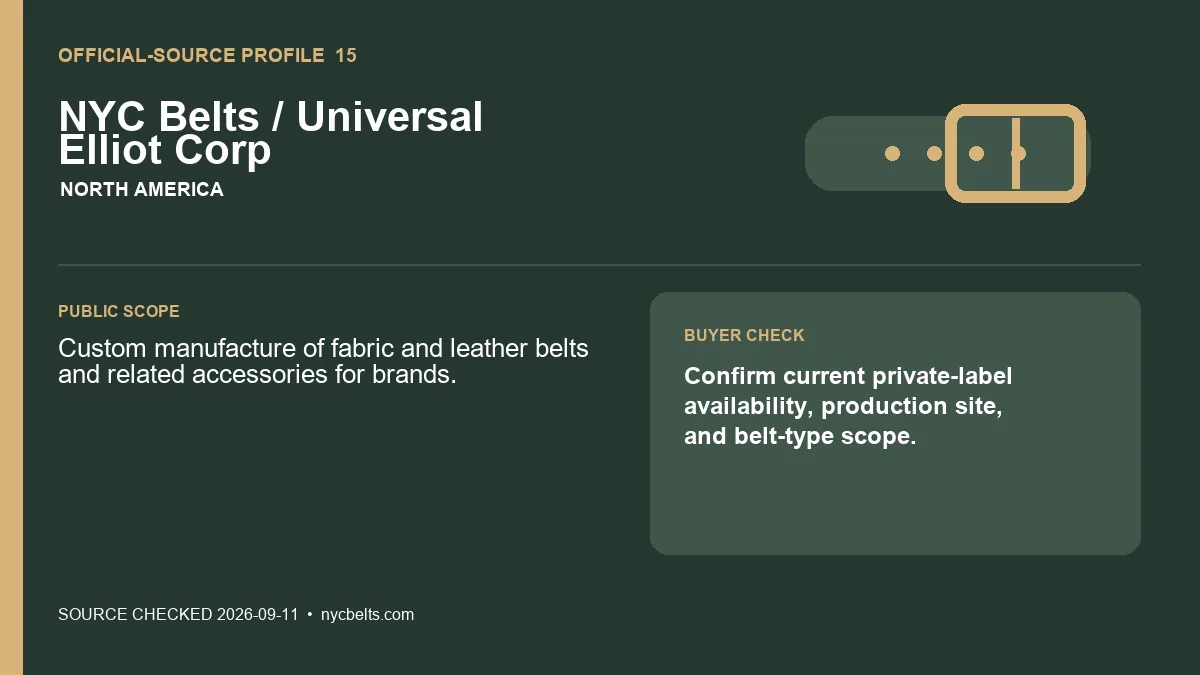
The NYC Belts official site (official source: nycbelts.com) identifies Universal Elliot Corp as a custom manufacturer specializing in fabric and leather belts and related accessories for brands. The page provides a relevant custom-manufacturing signal. It does not, by itself, establish current private-label availability for every belt type or prove that all processes share one location.
Why evaluate: The business publicly centers on custom belts and brand programs rather than consumer-only sales.
Confirm directly: Current belt constructions, production site, private-label terms, imported components, subcontracted steps, tooling ownership, and inspection documentation.
Verify The Factory Behind The Website
A direct factory and a sourcing company differ in who owns production assets and who controls the operating process. Both models can serve a brand. The risk comes from approving one while believing it is the other.
ISO 19011:2026 gives guidance on audit principles, audit-program management, conducting management-system audits, and auditor competence. It does not certify a supplier or prove product capability. Use it to structure the audit, then keep order-specific factory, process, sample, and quality evidence in scope.
Start with identity. Ask for the legal name on the quotation, bank account, sales contract, factory license, and shipment documents. Compare those names with the website and email domain. If they differ, request a written relationship map rather than accepting a verbal explanation.
Next, map the proposed order. Record the facility address for cutting, stitching, edge work, buckle assembly, logo application, packing, and final inspection. Ask which steps are subcontracted and whether the supplier needs written approval before moving work. A polished video call proves that a facility exists; it does not prove that your order will run there.
Then verify evidence at claim level. A certificate logo should lead to an issuer, scope, certificate number, named legal entity, site, and validity period. A test report should match the material, color, buckle finish, method, and acceptance limit in your brief. For leather-chain claims, review the limits of the cited scheme rather than extending a tannery status to the finished belt without support.
Finally, connect the sample to bulk release. Approve a dated specification, signed sample, approved component board, packing standard, and measurable inspection criteria. If you use AQL sampling, define the lot, inspection level, defect classes, and acceptance numbers before production; the belt AQL guide provides a starting framework.
Move From Shortlist To Comparable Quotes
Do not ask every public lead for a price at once. First remove companies whose production model, geography, materials, or order scale does not match the program. Keep only the number your team can investigate with the same evidence standard before detailed sampling.
Send the remaining companies three controlled files. The product brief defines belt construction, dimensions, leather or alternative material, color, edge finish, holes, keeper, buckle, logo, labels, packing, and reference images. The evidence request lists the legal entity, facility, process map, material documents, test reports, and inspection records you need. The commercial response sheet forces every quote into the same currency, incoterm, quantity tier, tooling line, sample fee, production assumption, packing basis, and validity period.
| RFQ file | What it controls | Failure it prevents |
|---|---|---|
| Product brief | Construction and appearance | Quotes for different belts |
| Evidence request | Identity and process proof | Unverified factory assumptions |
| Commercial response | Price and delivery basis | Hidden scope exclusions |
Compare exceptions, not just totals. One quote may omit buckle tooling, testing, barcodes, cartons, or delivery to the same point. Another may price split leather against a full-grain reference. Once the commercial basis is normalized, release a pre-production sample against the same written brief and record every approved change before bulk production.
Common Private Label Manufacturer Questions
How do I find a private label belt manufacturer?
Begin with an official page showing belt production and a brand-facing OEM or private-label route. Then verify the legal entity, proposed production site, subcontracting, material scope, sample process, and order-specific commercial terms. A directory entry or retail product page is only a discovery lead.
Is a direct factory always preferable to a sourcing company?
No. A direct factory can offer tighter process ownership, while a sourcing company may coordinate specialized suppliers or broader categories. The important requirement is transparency: know who contracts, who manufactures, which site handles each process, and who is responsible when scope changes.
Do belt manufacturers have a standard MOQ?
No universal MOQ applies across suppliers or even across styles at one supplier. Construction, leather yield, buckle tooling, color minimums, logo method, packing, and material availability can change the workable quantity. Request a current MOQ for the exact specification and ask what cost or process creates it.
What should a private label belt sample prove?
A sample should confirm the written construction, dimensions, material, color, edge finish, hole spacing, buckle and plating, logo, labels, and packing approach. It should also expose unclear tolerances and test needs. A visually attractive sample is not enough if it cannot be tied to the bulk specification.
How many suppliers should receive the final RFQ?
Use only as many suppliers as your team can qualify consistently, then narrow before detailed sampling. The correct number depends on program risk, geography, order scale, and available sourcing resources; this guide does not set a universal count.
Build A Shortlist You Can Defend
The value of a manufacturer shortlist is not the number of names. It is the quality of the next decision. First, narrow these public leads by the production model, geography, materials, and program scale you actually need. Second, verify the contracting entity and factory path for the proposed order, including every subcontracted process. Third, issue the same three-file RFQ package to each remaining supplier so construction, evidence, and commercial assumptions stay comparable. Finally, approve a controlled sample and inspection plan before scale.
HDBelt is one disclosed commercial option in this field, not the judge of it. If our public program routes align with your brief, you can send HDBelt your belt specification for an order-specific review. Whichever companies you contact, keep the same evidence standard. That is how an official-source list becomes a supplier decision your product, finance, and quality teams can defend.