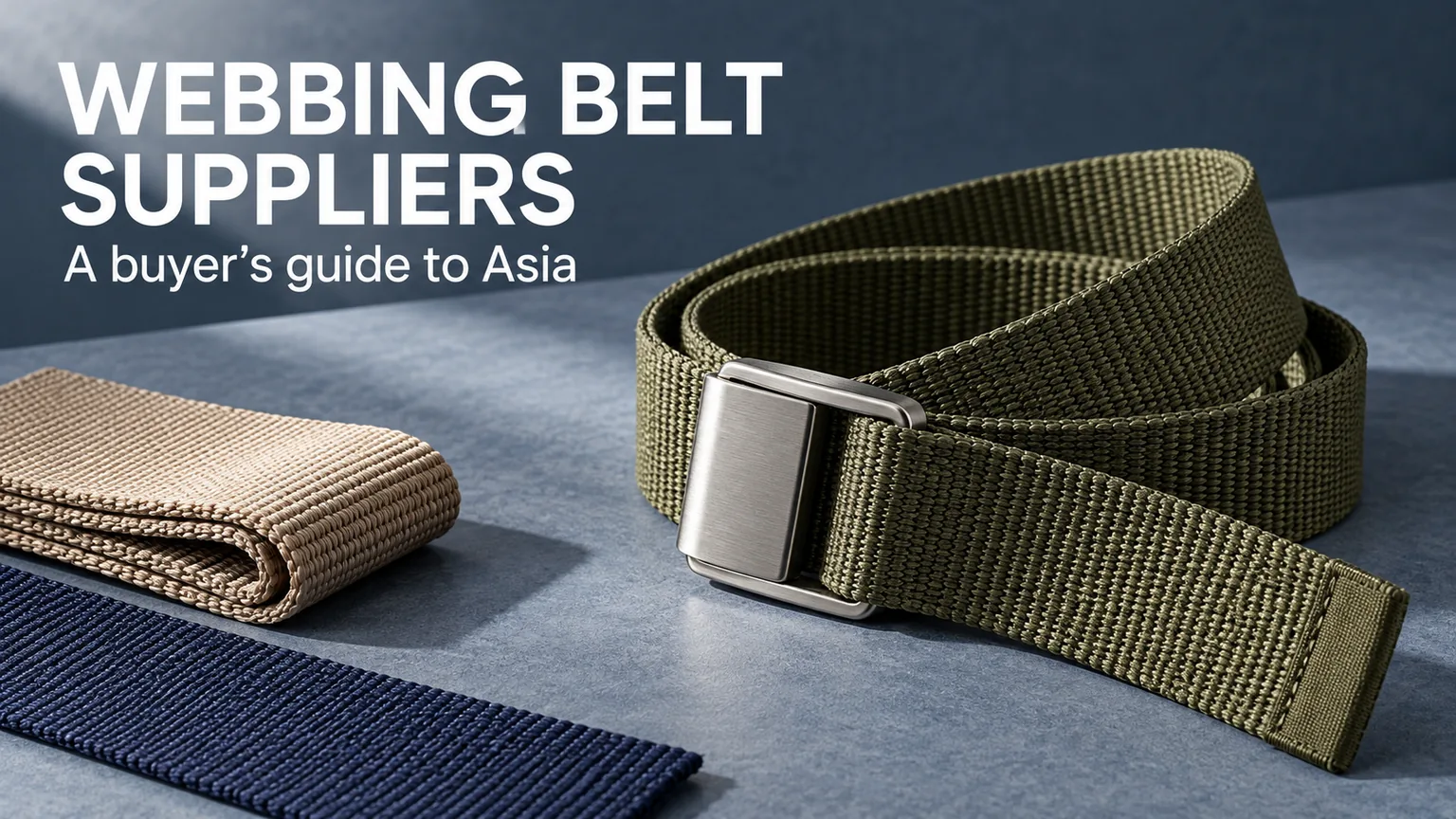
For finished fashion webbing belts in Asia, investigate Baijin Weaving, J.D. Belt Factory, Isson Webbing and HongDing as four distinct supplier options. Their published offers cover finished accessories or belt development, rather than only rolls of webbing. The essential buying decision is who takes responsibility for the complete strap, closure, end finish, sizing and packing—and where your actual order will be produced.
This is a non-ranked shortlist based on official company pages reviewed on October 10, 2026. HongDing publishes the guide and is included as an interested manufacturer, not an independent recommendation. The scope is apparel and fashion belts, not lifting slings, restraint systems, fall-protection equipment or industrial transmission belts.
The shortlist includes China-based and Taiwan-based businesses, with Cambodia operations described where supported. We have not established an eligible Vietnam-based finished-fashion-belt producer from sufficiently clear official evidence for this shortlist. That is a limit of this research, not a claim that Vietnam lacks such factories. We do not add a webbing mill or an unverified directory listing simply to fill a country heading.
Four Asian webbing belt supplier options
These are service-route comparisons, not audited capability scores. A public product page can establish that a company offers a relevant product; it cannot establish current capacity, a confirmed factory allocation or the performance of your future shipment.
| Supplier | Published relevant offer | Clarify for your project |
|---|---|---|
| Baijin Weaving | China-based webbing production and finished accessory assembly | Responsibility across weaving, components and belt finishing |
| J.D. Belt Factory | Custom finished webbing belts; China/Cambodia operations described | Which entity and production site will handle the order |
| Isson Webbing | Taiwan-based OEM/ODM with canvas, elastic and branded webbing belts | Weave, closure, branding and proposed production site |
| HongDing | Belt development and manufacturing with Dongguan coordination and Cambodia production routes | Feasibility, component sourcing and selected production route |
Baijin Weaving: connect upstream webbing to the finished accessory
Baijin’s official site describes a China-based arrangement in which its Qiannan division produces woven and elastic materials while Baijin develops and assembles finished accessories. Belts are listed among those finished products. This is relevant when the textile itself—its weave, pattern or elastic behavior—is an important part of the development task.
Do not stop the conversation at the roll specification. Ask how the selected webbing becomes the actual belt, including hardware sourcing, cut ends, attachments and final inspection. Integrated material and assembly capability can simplify coordination, but the proposal still needs to identify the final product owner and the accepted assembly. A good roll sample does not demonstrate buckle operation.
J.D. Belt Factory: a finished-belt catalog and custom route
J.D.’s webbing-belt category includes printed, elastic and leather-trimmed finished styles and describes OEM, ODM and private-label development from a technical pack, design or sample. The site identifies operations in China and Cambodia. That supports a relevant supplier inquiry, not an assumption that every listed style is made at both locations.
Use the catalog to identify the construction closest to your own requirement, then state what must change. A printed web belt and a wide elastic fashion belt may sit in one category while requiring different closures and sample checks. Ask for the proposed production entity and location with the quotation instead of inferring them from a broad company description.
Isson Webbing: connect textile choices with the closure and branding
Isson Webbing’s belt page presents finished canvas, elastic and branded webbing belts, including D-ring, pin and slide-buckle options. The company identifies itself as a Taoyuan, Taiwan manufacturer offering OEM and ODM services. Its published range makes it relevant to a fashion-belt brief where woven pattern, stretch or closure type is a central design choice.
Use that range to discuss a specific assembly, not a generic claim that one weave works with every buckle. For a branded stripe, ask how the repeat lands near the closure and tip across different lengths. For elastic, review the pattern both relaxed and extended: stretching can alter the spacing and proportions that make a logo recognizable. Confirm the production site proposed for your order rather than assuming the company address settles every manufacturing step.
HongDing: coordinate the belt as a complete development project
HongDing supports canvas and webbing belt development, including discussion of materials, hardware, sample revisions and retail requirements. Dongguan handles development and coordination, with Cambodia production routes reviewed for the actual project. Our manufacturing overview connects approved inputs, making, inspection and packing; it does not reserve capacity for an unspecified order.
Our business roots date to 2004, with the current company identity formed in 2010. For a brand, the useful application of that experience is resolving the interaction between strap, closure and finishing before production. You can start with a reference image or concept; the first discussion can identify which details are already fixed and which need sample development.
Decide whether you are buying a material or a finished belt
A webbing roll is an input. A finished belt is an assembled product with an adjustment method, a wearing length and ends that can survive ordinary handling. Confusing those purchase scopes leaves important work unassigned. The buyer may discover late that cutting, sewing, buckles, branding or retail packing were never included.

If you already have an assembly partner, buying webbing separately may give you control over the textile specification. It also means someone must manage the interface: the material width and thickness accepted by the buckle, the attachment design and the cut-end treatment. Those responsibilities do not disappear because the mill and assembler are both capable businesses.
If you need a complete product, state that directly. Ask for a belt sample with the intended closure and finish, not merely a swatch. Compare the quotation against a finished-product description: textile, trim, hardware, joining, end treatment, branding, size identification and packaging. A lower material price cannot be compared with a complete-belt price.
Match the webbing and the closure as one system
A belt strap must look right, pass through its intended openings and remain adjusted in use. Those requirements interact. A thicker or firmer webbing may create the hand you want while becoming difficult to thread. A softer webbing may thread easily but behave differently in a friction-based closure. Material selection is therefore incomplete until the assembled belt has been reviewed.
Width and thickness need to be checked at the tightest point
Nominal strap width and the outside size of a buckle are not matching dimensions. What matters for passage is the usable opening along the actual threading path. A folded end, sewn reinforcement or fitted tip can be bulkier than the single webbing layer. Review that finished area, not just an unfinished strip passed through a loose buckle.
If threading becomes difficult only at the tail, inspect the end finish before changing the whole strap. If resistance continues along the entire length, compare the webbing dimensions and hand with the buckle opening. A change to the buckle may be preferable to changing the textile identity—but it can also change the visual proportion and cost. Sample the intended solution as an assembly.
Separate threading ease from holding behavior
A friction-based buckle uses contact with the strap to retain the adjustment. Its behavior depends on the particular hardware geometry, threading route and textile, not simply whether the fabric is called nylon or cotton. A strap that slides smoothly during threading is not automatically proven to hold securely when worn.
First confirm the intended threading method with the supplier. Then evaluate the assembled sample under agreed use conditions, recording whether it shifts and where. If slipping appears, do not immediately assume the fiber is wrong. Compare the webbing surface, thickness, buckle revision and threading to the approved combination. Any performance test needs a defined method and acceptance conditions; this guide does not supply a universal load threshold.
A prong buckle with a reinforced end presents a different task. Here the fastening holes, reinforcement and attachment need to support the intended adjustment range. A pleasing decorative tab does not establish that the hole area or joint has been validated. Evaluate that construction with its own appropriate checks rather than borrowing a result from a friction-buckle model.
Choose the end treatment around the actual textile
A cut end can be folded and sewn, covered with trim or finished using another process appropriate to the material. Do not specify heat sealing simply because “webbing is synthetic.” The actual fiber or blend, surface, construction and desired appearance need to support the proposed process. A treatment that controls unraveling may still leave an uncomfortable or visually heavy edge.
Look at the end from both sides, pass it through the actual buckle and garment loops, and handle it as the wearer would. If the edge catches, identify whether the obstruction comes from a hard finish, a projecting thread, excessive thickness or the shape of the tip. Changing only the end may preserve the rest of a successful strap.

Write a brief that resolves the important variables
Begin with wearing use. A casual trouser belt, a fashion waist belt and a uniform accessory may share a textile category but have different appearance, adjustment and packing needs. Identify the intended garment and customer before asking suppliers to choose webbing based solely on price.
- Textile direction: describe the color, surface, hand and whether stretch is intended. Request the actual material identity rather than guessing it from a photograph.
- Closure and adjustment: provide a reference or describe how the wearer should fasten and adjust the belt.
- Finished dimensions: distinguish overall length from usable wearing range and identify the measurement points.
- Branding: explain whether the identity comes from a woven pattern, printed artwork, trim, label or hardware.
- Range structure: identify shared construction and the colors, sizes and quantities that remain to be decided.
For a patterned strap, think about what changes across sizes. If the belt is cut from a repeating design, the visible motif at the tip or closure can differ. Decide whether that variation is acceptable or whether placement needs to be controlled. Controlled placement can affect how the material is cut and used, so it belongs in the quote discussion.
For stretch constructions, keep the measurement condition explicit. A relaxed length and a length measured under tension are different values. The amount of stretch, recovery and adjustment required should be discussed with the manufacturer and evaluated on the proposed assembly. Do not infer them from an “elastic belt” product title.
Work through a focused sample revision
Consider an illustrative casual belt that threads comfortably through the buckle but catches at the garment loops. The correct first response is not necessarily a narrower strap. Examine whether the single webbing passes freely and whether the obstruction occurs at the reinforced tip. If the body is suitable but the tip is bulky, a localized end revision may retain the desired width and visual weight.
Keep the successful features fixed in the sample feedback: approved textile appearance, body width and buckle operation. Identify the precise problem and ask for an alternative end construction. When the revision arrives, recheck threading, adjustment and the appearance of the tip together. This avoids solving garment-loop passage while accidentally weakening another part of the design.
A photograph can show the location of the difficulty, but the physical sample is often needed to judge stiffness and passage. Share both when possible. The objective is to narrow the next development decision, not to send the supplier a long list of unexplained complaints.
Qualify bulk production beyond the approved sample
For webbing belts, consistency starts with the inputs. A similar-looking replacement roll may differ in hand, thickness or surface behavior. A buckle that appears identical may have a different usable opening or finish. Keep the approved textile and hardware identities connected to the finished sample.
- Incoming material: compare the bulk webbing and hardware with the approved references and identify their lots. Hold unexplained substitutions or material differences before cutting and assembly.
- First finished pieces: check the actual threading route, adjustment, end passage, attachment and agreed dimensions. Confirm that the instructions produce the approved belt.
- During production: monitor the relevant operations, such as cut length, sewn attachment position, end finish or pattern placement. Trace a discrepancy to the affected input lot or production interval.
- Final assortment: match finished belts to labels, barcodes and carton quantities. Similar colors or neighboring sizes can be confused even when the workmanship is satisfactory.
- Deviation and release: isolate affected goods, determine the cause, agree correction or another disposition, then repeat the relevant checks before authorized shipment release.
This is a recommended qualification method, not an assertion that all four suppliers use the same procedure. Agree inspection sampling, functional tests and acceptance conditions for your product. Textile strength data alone does not establish the behavior of a complete belt with its particular buckle and attachments.
Compare countries through the proposed production route
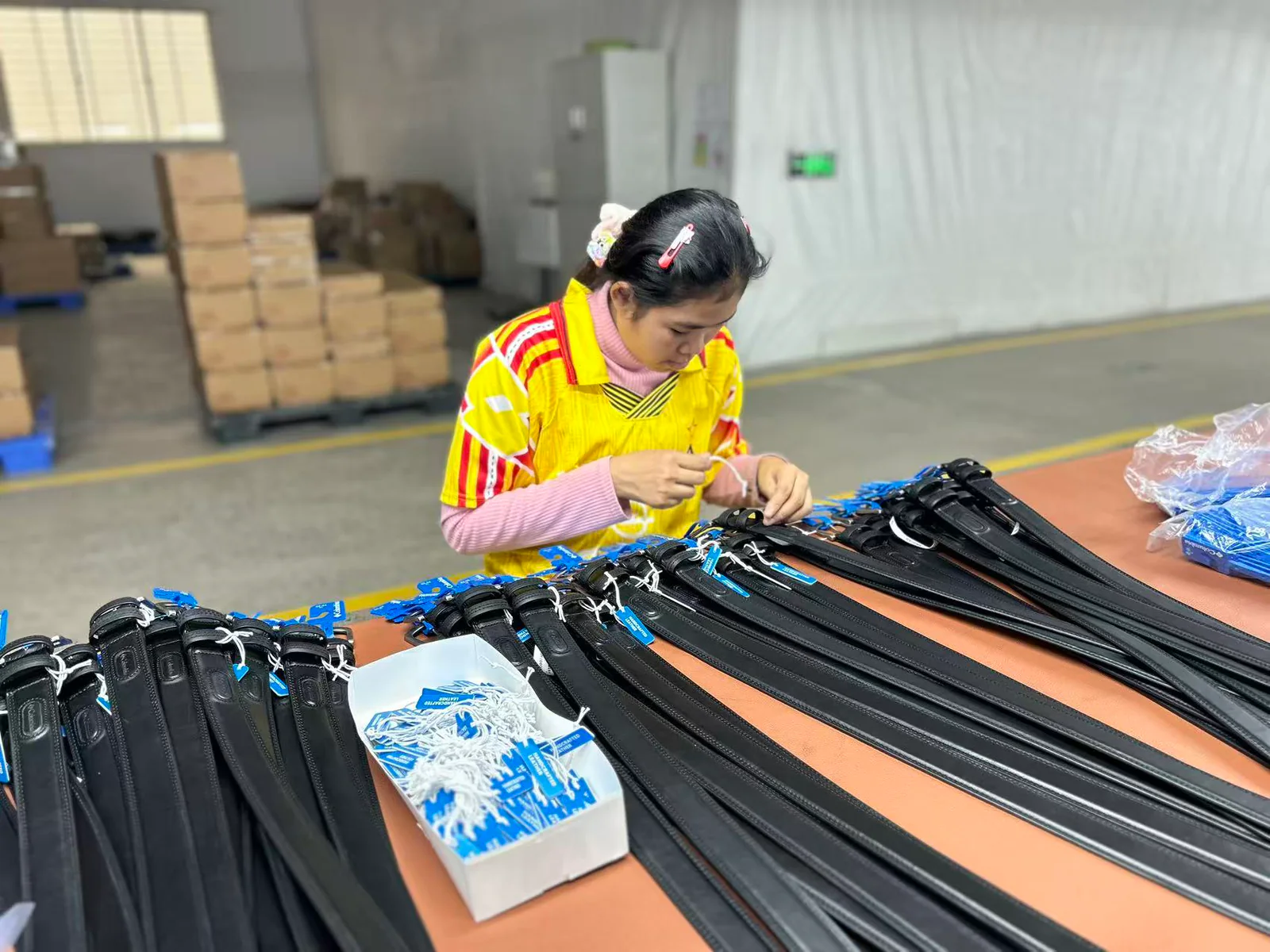
China, Taiwan, Cambodia and Vietnam should not be treated as interchangeable quality grades or automatic cost rankings. For the actual offer, identify the contracting business, development location, production site and component supply route. A sales office in one country and assembly in another can be a workable arrangement when responsibilities are clear.
If a supplier proposes moving a style between sites, treat the move as a production change. Establish how approved samples, instructions, components and inspection requirements transfer. Check the first pieces from the proposed site rather than assuming that a sample from another workshop proves the new route. The relevant question is continuity of the product, not just continuity of the company name.
Do not build the sourcing decision around assumed duty savings. Classification, origin and destination treatment need order-specific specialist review. Similarly, an apparent labor-cost difference can be outweighed by component movement, development, order fragmentation or replenishment needs. Compare actual scoped offers rather than publishing a country-wide price rule.
Make quotations comparable
Ask suppliers to separate development and tooling from repeat production, and to identify what is included in the complete belt. Compare the same material, closure, end finish, decoration, assortment, packing and delivery basis. Where an alternative is proposed, show it as an alternative—not as a silent substitution inside a lower price.
Review minimums at the level where the constraint occurs. A textile color, a woven motif and custom hardware may have different purchasing implications. A total belt quantity does not explain how those requirements interact across the assortment. Ask which components are shared and which decisions create separate commitments before spreading a small order across many variants.
Questions before the first order
Can a webbing mill also supply finished belts?
Some can; others supply only the textile. Confirm the actual offer through relevant finished products and an assembly proposal. Do not infer it from the word “belt” in a material catalog.
Does a strong strap make a safety belt?
No. This guide concerns apparel belts. A material property does not qualify a finished product for restraint, climbing, lifting or fall protection; those applications require their own engineering and applicable verification.
Start with the belt you want to develop
Send HongDing a reference image, the intended garment or use, and the features you want to retain. We can discuss the textile, closure, end finish and sampling questions as one project. If material identity or dimensions are still open, say so; a complete technical pack is not required to begin the development conversation.