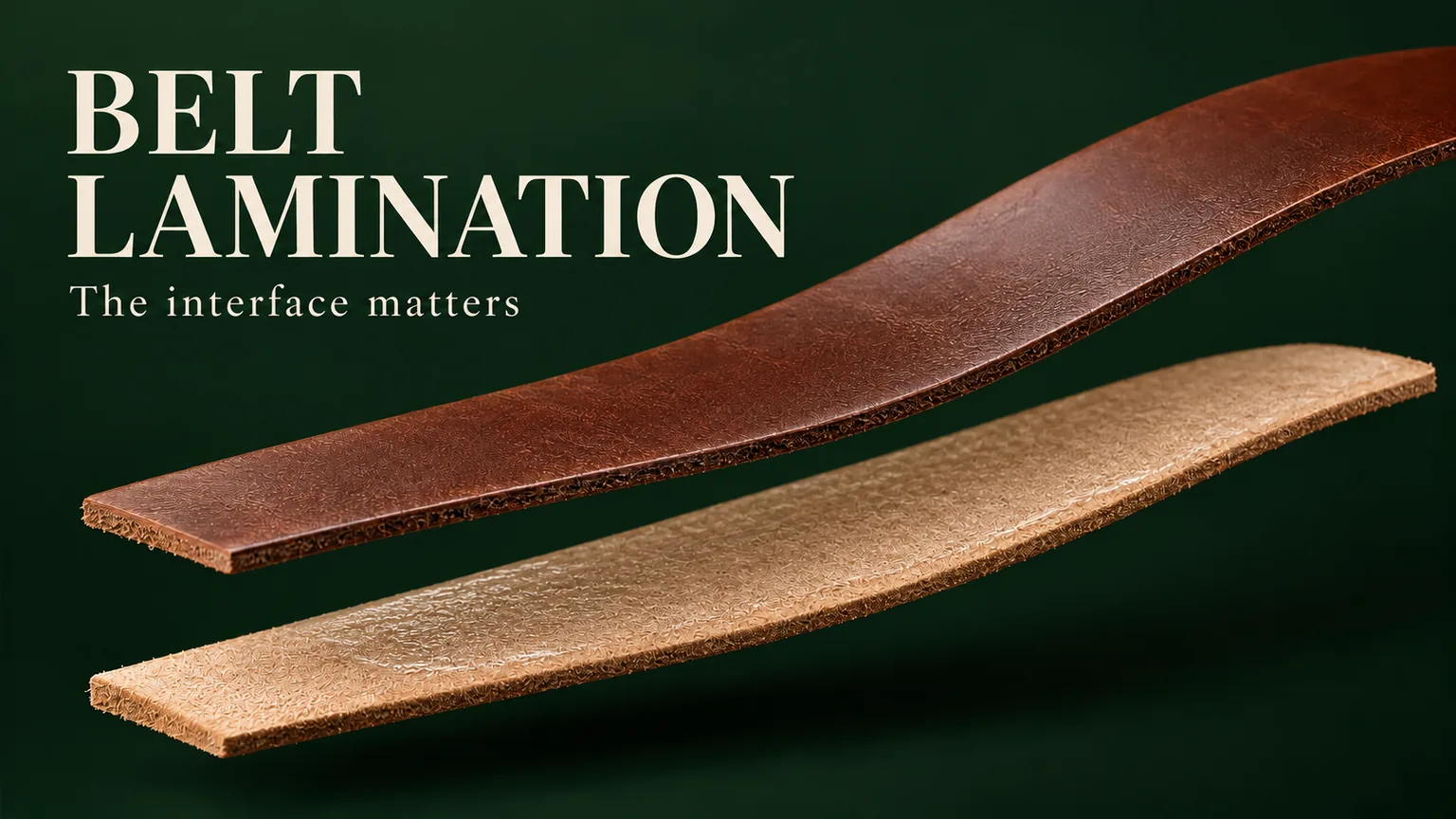
A laminated belt can leave the press looking flat and still separate at the tip, wrinkle near the buckle or feel unnecessarily stiff. Choosing the adhesive by the words “water-based” or “solvent-based” alone will not prevent these problems. Those words describe the liquid carrier, not the whole bonding system.
For belt lamination, choose a specific adhesive together with the actual face leather, lining, reinforcement and production method. Water-based systems are worth evaluating where the substrates and drying process support them. Solvent-based systems remain possible where a suitable product and controlled process meet the construction requirements. Neither category is automatically stronger, safer in every application or more suitable for every leather.
Carrier, adhesive chemistry and bond function are different choices
A water-based adhesive carries its bonding components in water; a solvent-based adhesive uses an organic solvent system. In a waterborne dispersion, the polymer and other ingredients remain as the water leaves. Bostik’s description of water-based technology explains this basic distinction. It does not mean all waterborne products have the same flexibility, heat response or application sequence.
The polymer and formulation help determine the eventual bond. The process determines whether that formulation can perform on the intended surfaces. Some systems also have a separate crosslinking or activation requirement. Dry to the touch, ready to join, safe to handle and ready for final bond evaluation are therefore not interchangeable milestones.
One useful illustration is Renia’s Aquilim technical brochure. Within a single water-based range it describes polychloroprene and polyurethane products, as well as non-permanent positioning adhesives. It also distinguishes dry-contact application from a restricted wet, one-sided method for absorbent materials. These examples demonstrate why “use water-based glue” is not a manufacturing instruction. The brochure is older technical literature; confirm the current product data sheet before specifying a product or process setting.
Decide what the glue must do. Holding layers in registration until stitching is not the same task as maintaining a permanent laminated bond throughout the belt. If the design depends on a permanent bond, a repositionable assembly aid should not be treated as an equivalent merely because both products are used on leather.
| Decision | Water-based candidate | Solvent-based candidate | What to establish |
|---|---|---|---|
| Liquid carrier | Water must leave through the intended process | Solvent must leave through the intended process | Substrate permeability and controlled drying route |
| Bond formation | Depends on polymer and formulation | Depends on polymer and formulation | Permanent versus positioning role; activation or crosslinking needs |
| Assembly | Product-specific wet or dry-contact method | Product-specific application and assembly window | Correct sequence, coat application and pressure contact |
| Production fit | Validate with actual drying conditions and throughput | Validate with actual drying conditions and controls | Repeatable output, not a single successful sample |
| Safety and claims | Assess the exact product and application | Assess the exact product and application | Current SDS, site controls and substantiated wording |
Which route should you trial first?
Prioritize a suitable water-based candidate when reducing organic-solvent use is a defined process objective and the line can support its drying and joining requirements. Start with material compatibility and a realistic drying trial. If the bonding faces are absorbent and the selected product explicitly permits the intended method, development may be relatively straightforward. If they are compact, coated or oily, do not assume the same route will work without additional preparation or process development.
Retain an already validated solvent-based route while a replacement remains unproven. For an existing construction that meets its agreed requirements, an unresolved waterborne drying bottleneck or interface failure is a reason to continue controlled development—not to change live production on the strength of a carrier preference. Retaining the process does not remove its current safety or operating obligations.
For a new layer stack, shortlist products from either category with the adhesive supplier. There is no validated incumbent to defend. Compare compatible systems through the actual belt construction and intended line. If neither produces a stable result, revisit the backing treatment, reinforcement or construction instead of repeatedly switching adhesive labels.
Start with the surfaces being bonded
“Leather to leather” is too broad a description for a laminated belt. The bonding side may be open and fibrous, compacted, finished, oily, waxy or attached to a reinforcement. A lining can have a very different absorption behavior from the face leather. List each interface rather than treating the belt as two identical pieces of hide.
For an absorbent surface, adhesive can enter the fiber structure. That may help contact, but excessive absorption can leave too little effective material at the interface. Adding more adhesive without understanding absorption can also change drying time and stiffness. Evaluate application coverage and the resulting bond, not simply whether the surface looked wet during coating.
On an oily or waxy surface, the issue may be poor wetting or a weak boundary layer. The adhesive can appear to stick initially while the surface underneath remains unsuitable. Use preparation recommended for the selected material and adhesive; do not prescribe an unverified solvent wipe for every leather. Preparation itself can alter color, feel or finish and needs to remain compatible with the product.
For a compact or coated layer, ask where the carrier can escape. Closing two poorly permeable surfaces while the adhesive is still in the wrong state can trap liquid. A dry-contact process and a wet-lamination process cannot be swapped casually because the same operator can physically press the layers together. Follow the product-specific route and verify it with the complete construction.
Include reinforcements in this discussion. If a belt contains a textile, board or synthetic layer, that layer introduces another surface and another potential failure location. A bond that holds to leather does not automatically establish compatibility with a coated reinforcement. Record the actual supplier material reference so a cheaper replacement is not introduced under the generic name “lining.”
Drying and assembly: the clock is not the specification
A fixed waiting time can be a useful process control only after it has been validated for the product, coating method and conditions. Coat weight, airflow, substrate absorption and ambient conditions can all change the state reached in that time. An operator following yesterday’s clock may not be producing yesterday’s bond if the applied layer or drying environment has changed.
For a dry-contact system, the relevant question is whether the surfaces have reached the product’s specified joining condition and remain within its assembly window. Joining too early and joining too late are different deviations. Do not repair either by pressing harder without checking the adhesive instructions and the state of the coating.
Solvent-based products are not one universal fast-drying alternative. Renia’s cement range chart lists differing drying windows and material applications. That older chart supports the need to identify the product; it should not be copied into a belt factory’s operating recipe. Current supplier guidance and a validated trial must establish the working settings.
Plan how the line will cope with interruptions. If coated straps wait longer than expected, the operator needs a defined decision: continue within the approved window, use an explicitly permitted reactivation route, or segregate the affected pieces. An improvised extra coat can change thickness and solvent or water loading while concealing the original deviation.
The factory also needs enough space and handling discipline for drying and staging. If the line can coat faster than it can dry and join, work accumulates at the bonding station. Compare throughput at stable conditions, including rejects and rework, rather than comparing only the seconds needed to brush adhesive onto one sample.
Pressure makes contact; it does not correct incompatible materials
The purpose of pressing is to establish the intended contact across the bonded area. Local steps, uneven thickness or poorly supported edges can leave areas that receive different contact from the center. A belt with a reinforcement ending near the tip may therefore behave differently from a uniform test strip, even when the adhesive is unchanged.
Use a representative construction to assess those transitions. Check the tip, buckle fold and boundaries of inserted layers, not only the middle of a long flat strap. Increasing pressure without reviewing the leather and finish can introduce marking or compression. Pressure, dwell and any activation conditions belong to the validated material-process combination, not to a universal belt recipe.

Stitching changes the construction but does not make lamination quality irrelevant. It can secure the perimeter while poorly bonded layers still move, wrinkle or lift between stitch lines. If the design intentionally uses adhesive only as a positioning aid, document that role. If it requires permanent lamination, assess that function separately from the appearance of the seam.

Read a failed sample before selecting another adhesive
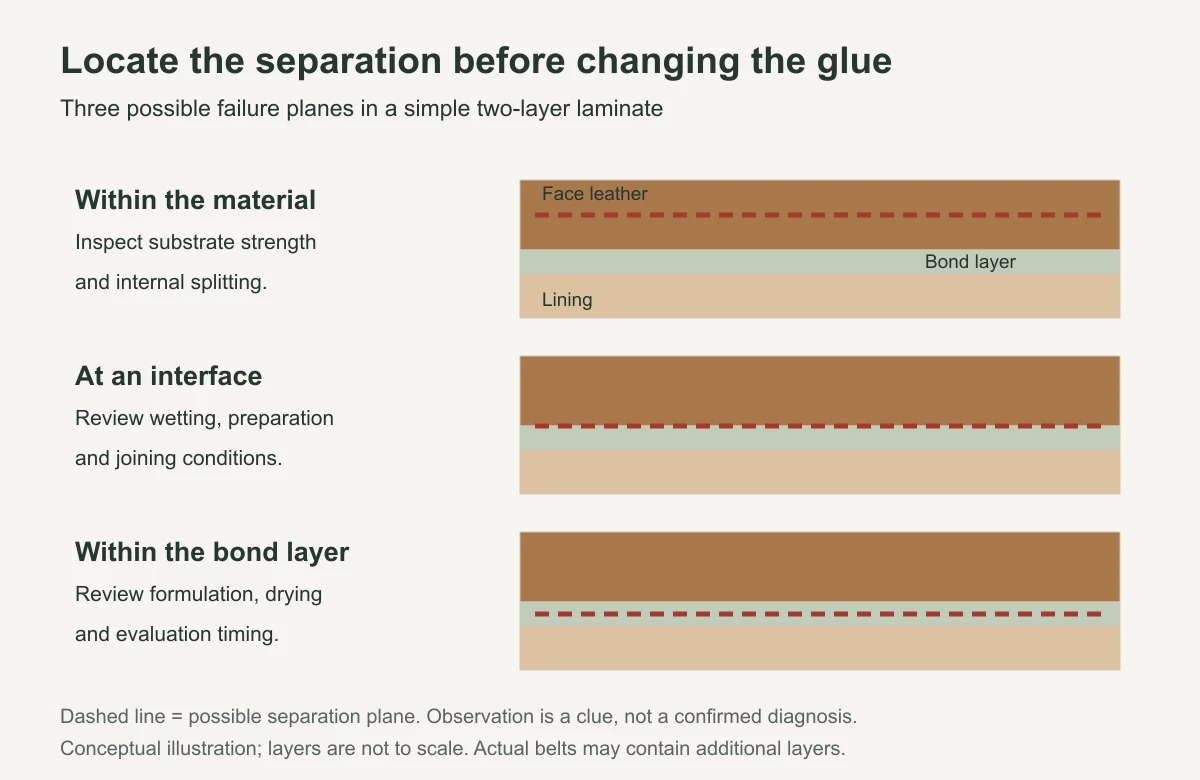
When layers separate, inspect both surfaces. A clean-looking release from one side suggests a different investigation from torn leather fibers or adhesive remaining on both sides. These observations are diagnostic clues, not proof of a single cause. Retain the failed sample, its material references and process record before trying a new formulation.
Renia’s material-identification discussion makes an important general point: a substrate can fail even where an adhesive holds. For belt development, that means “stronger glue” is not always the answer. If the leather or reinforcement splits internally, changing only the adhesive may leave the weak layer in place.
| Observation | Possible issue to investigate | Useful next comparison |
|---|---|---|
| Clean release at one interface | Surface compatibility, contamination, preparation or assembly state | Controlled preparation trial on the same material lot |
| Adhesive visible on both faces | Bond-layer condition, formulation, drying or evaluation timing | Same stack at the supplier-specified evaluation stage |
| Fibers or reinforcement tear | Strength within the material rather than only adhesion | Material section and alternative substrate review |
| Tip lifts but center remains bonded | Coverage, local contact, layer termination or repeated bending | Representative finished-tip samples |
| Wrinkling after bending | Layer movement, differential response or construction stiffness | Assembled flex comparison with an unexposed control |
A manual peel can help locate separation, but it should not become an undocumented acceptance test. Peel angle, specimen width, speed and conditioning affect the result. Where bond strength needs a measured specification, agree an appropriate method and acceptance criteria with the buyer and laboratory. Record the failure location alongside the measured result; the number alone may hide a material failure.
A fair water-based versus solvent-based trial
Use a small, controlled comparison before changing production. Keep the face leather, lining, reinforcement and finished geometry the same. Give each adhesive its own correct application and drying conditions rather than forcing both through the incumbent process. Otherwise, the exercise tests whether the new product tolerates the old recipe, not whether it is suitable for the belt.
Record material lot, adhesive reference, preparation, application method, assembly timing, pressing route and the stage at which evaluation occurs. Use the current technical data sheet to choose process settings with the supplier. Avoid changing surface preparation, coating amount and cure time simultaneously when investigating a defect; you would lose the ability to explain an improvement.
Evaluate both the flat bond and the assembled belt. Include appearance, feel, edge condition and representative bending around the intended hardware. For the selected end use, agree whether additional heat, humidity, aging or chemical-exposure evaluation is relevant. These are not interchangeable tests, and no generic “all-weather” conclusion should be drawn from an ordinary room-condition sample.
Finally, repeat the promising route under representative production conditions. A carefully hand-coated development piece does not prove that the intended line can apply the same layer consistently. Assess usable output, drying-space demand, handling, cleaning, rework and material compatibility together. Adhesive purchase price per container is only one part of the process cost.
Illustrative choice: a lined dress belt moving to a new bonding system
Consider a brand developing a leather-faced belt with a lining and a stitched perimeter. The team wants to evaluate a water-based alternative to its proposed solvent-based process. This is a hypothetical development example, not a claim about a completed order or measured HongDing trial.
The first samples bond well in the center but lift at the tip. Instead of concluding that water-based adhesive is weak, the team checks coverage, drying state and contact at the tip’s layer transition. It then makes matched samples with the corrected process while preserving the same leather and geometry. If the problem persists, the adhesive supplier reviews compatibility and the required bond role.
Suppose both candidates then meet the agreed sample requirements. The choice can move to production fit: whether drying is stable, whether operators can maintain the application window, how much work accumulates between stations and what controls each product requires. If one route cannot remain consistent at the planned throughput, the team may change the line arrangement or select the other route. Passing a sample is necessary evidence, not the entire commercial decision.
The same reasoning prevents a misleading sustainability claim. A process change may reduce reliance on a particular solvent, but the finished belt should not be advertised as non-toxic, emission-free or environmentally superior without evidence supporting that exact statement.
What belongs in the production handoff
The handoff should name the approved layer stack and adhesive, its intended function, the current technical-data reference and the validated application sequence. Include how operators recognize an out-of-window condition and where suspect pieces are held. Substitutions to leather backing treatments, reinforcement or adhesive require review because they can change the interface without changing the belt’s outward design.
Safety requirements must come from the current safety data sheet and the site’s qualified assessment. Water-based is not a blanket exemption from handling or exposure controls; additives, application method and cleaning products still matter. Solvent-based materials likewise require the controls specified for the actual formulation and operation. This article is a product-development comparison, not a chemical-handling procedure.
Common adhesive selection questions
Is solvent-based glue always stronger?
No. Strength depends on the specific formulation, substrates, process and test conditions. Compare suitable products on the same construction using agreed evaluation methods. A carrier label cannot replace that comparison.
Can a factory switch without changing the line?
Possibly, but it should not be assumed. Drying, staging, preparation, application and cleaning may need adjustment. Validate the new route at representative throughput before treating it as a drop-in replacement.
Does perimeter stitching remove the need for bond testing?
Not if the design relies on permanent lamination. The stitch line can remain intact while layers move elsewhere. Define whether the adhesive is a positioning aid or a permanent functional bond, then evaluate that role.