Retail belt assortment planning means deciding which customer needs the collection will cover, then assigning styles, sizes, colors, prices, and quantities to those needs. Build the range around distinct buying reasons, not a target number of designs. A smaller collection with the right size depth and replenishment route can serve customers better than a large range whose most useful combinations are unavailable.
For a retailer developing private-label belts, merchandising and product development cannot be separate spreadsheets. Changing a buckle finish, leather article, width, or packaging format can create another purchasing constraint even when the shop sees only one extra color. This guide connects the retail assortment to the product and manufacturing decisions behind it, without assuming a universal size curve, margin target, or minimum order.
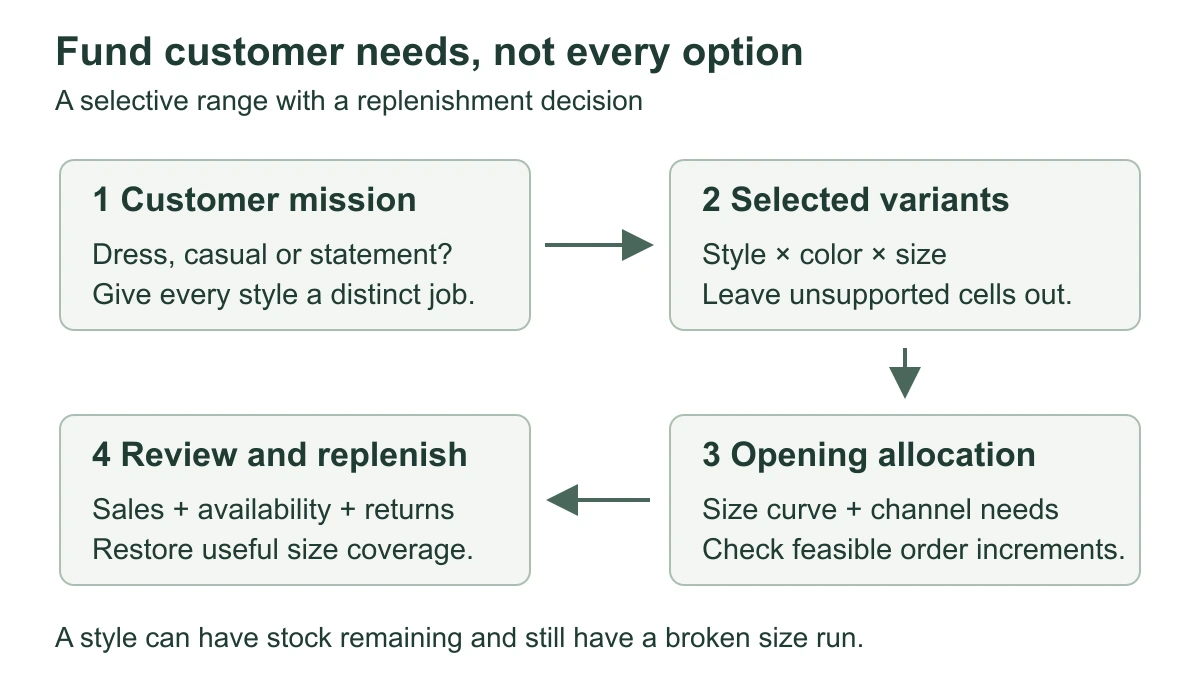
Define the customer mission before selecting samples
Start with the clothing and occasions the belt must work with. A tailored-trouser customer, a jeans customer, and a customer looking for a decorative waist belt may all choose black, but they are not necessarily buying substitutes. Width, stiffness, buckle scale, finish, and wearing position can create distinct needs that a color-only assortment sheet misses.
Describe each proposed style in one operational sentence: “a restrained dress belt for narrow trouser loops,” for example, or “a casual strap with a more substantial buckle for denim.” Then identify what makes it different from the nearest style in the range. If that difference is difficult to explain without reading a material specification, test whether customers can perceive it on the fixture or product page.
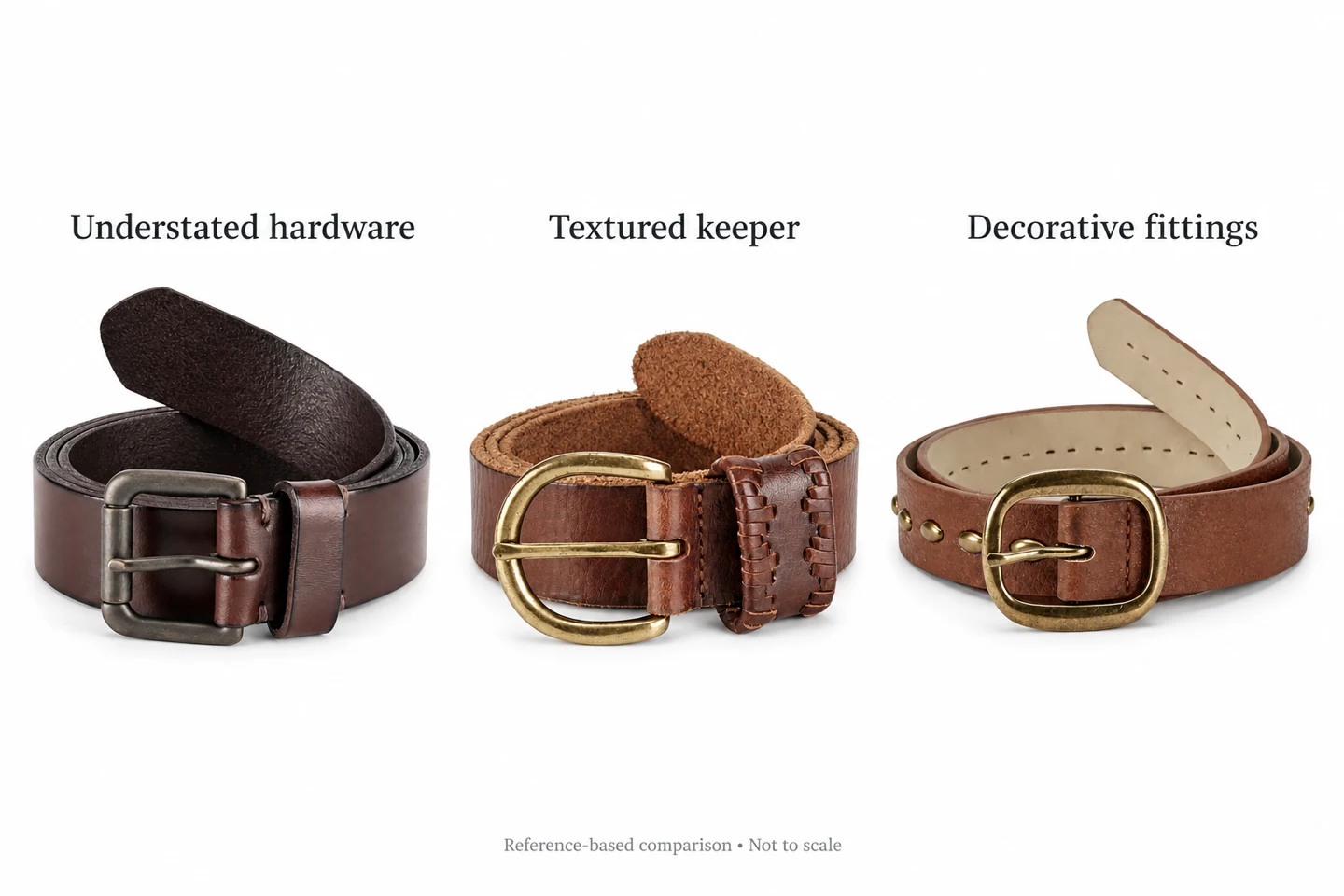
Assign a commercial role before adding variants. A core style is intended to be available repeatedly; a seasonal expression supports a particular collection; an experimental style tests a specific demand hypothesis. These roles can coexist, but they should not receive identical replenishment assumptions. A seasonal color does not become a core item merely because its initial order was large.
| Role | What the belt must do | Planning priority |
|---|---|---|
| Core wardrobe | Answer a recurring outfit and fit need. | Available sizes, repeatable components, and replenishment. |
| Collection support | Coordinate with a known apparel story. | Matching launch timing, color, and price relationship. |
| Statement option | Offer a visibly different styling reason. | Selective breadth and a clear exposure plan. |
| Trial | Test an explicit customer or design hypothesis. | A bounded buy and a decision date for expansion or exit. |
Do not assign permanent percentages to these roles without evidence. A uniform-oriented retailer and a trend-led boutique have different reasons to hold stock. Use the role labels to explain the order, then allocate money and units according to your own customer history, selling calendar, and willingness to carry unsold inventory.
Count the sellable combinations before approving the collection
A style is a design family; a SKU is the specific unit you track and sell. If every combination is offered, styles × colors × sizes × separately sold hardware options gives the number of variants. Packaging can create further distinctions when it represents a different sellable item, such as a gift set rather than the same belt with a shipping label.
For illustration, four styles in three colors and five sizes produce 60 SKUs. Adding two selectable buckle finishes to every combination produces 120. With an unchanged 1,200-unit opening order, equal allocation would fall from 20 units per SKU to 10. The calculation does not recommend equal allocation; it exposes how an apparently small design choice can dilute availability.
Build a sparse matrix instead of filling every possible cell. A brown leather color may make sense in a casual family but not in a collection developed around a specific dress code. A statement buckle may justify one coordinated strap color rather than all of them. Leave an option out when there is no clear customer reason to fund it, and record that decision so it is not accidentally restored during ordering.
Distinguish customer-facing variety from production variety. Two belts that look different may share a strap construction and hardware platform; two similar black belts may use different leather articles, edge systems, or attachment methods. The first pair may be easier to coordinate, but shared components still need confirmation. Appearance alone cannot establish that orders can be combined for purchasing or production.
Ask the supplier to map constraints at the right level:
- Finished belt: which combinations can be ordered and replenished separately?
- Material article and color: which options require distinct sourcing or finishing lots?
- Hardware: which molds, finishes, and attachments are shared or unique?
- Branding and packaging: which artwork, labels, and pack formats change by SKU or market?
This is more useful than asking only for “the MOQ.” A supplier’s total-order response may hide a smaller but important constraint at the color, buckle, or packaging level. Confirm those dependencies before promising the full assortment to stores. HongDing can coordinate material, hardware, sample, and packaging questions for a proposed wholesale or retail belt program; the workable mix is reviewed for the actual product configuration.

Build the size curve from comparable demand
A size curve allocates demand across sizes. Start by making sure the size labels mean the same thing. A numerical label, an S–XL label, and an overall strap length are not interchangeable. Document the actual fastening measurement, adjustment range, and intended wearing position for each product family before borrowing a curve from another belt.
A jeans belt and a high-waist fashion belt may serve the same customers at different body positions. An elastic construction can also behave differently from a nonstretch strap. Treat these as comparability questions, not automatic reasons to invent a new curve. Our size guide explains the measurement distinctions that should underlie the retail labels.
Use sales history with availability attached. If a size sold 30 units before stocking out while another sold 40 over the full season, the raw totals do not prove that the second size has higher demand. Record the in-stock selling days, stockout dates, returns, promotions, and channel exposure. A size hidden online or never sent to a store had a different opportunity to sell.
For a simple illustration, 30 sales over 15 in-stock days imply two observed sales per available day; 40 over 40 days imply one. Those rates help reveal the stockout distortion, but they are not automatically forecasts. A launch event, promotion, or change in traffic can make the first period atypical. Compare like periods and use the calculation to investigate, not to double the next order mechanically.
When there is no belt sales history
Use the closest defensible starting point: a related belt with the same fit convention, customer measurements from a relevant apparel program, or a deliberately limited trial. Label the assumption and set a review date. Do not convert trouser-label distribution directly into finished-belt quantities without checking the measurement relationship and how the belt is worn.
Preserve access to the intended size range while testing. Concentrating nearly all units in assumed middle sizes can make the apparent demand distribution self-fulfilling. Conversely, equal units in every size may tie up stock where demand is lower. Choose a starting curve that reflects the available evidence, then review it with actual availability and returns rather than treating it as an industry default.
Analyze fit returns separately from preference returns. “Too small” can reflect a misleading size guide, a measurement inconsistency, a garment-use mismatch, or a genuinely insufficient size range. Reordering more large sizes solves only the last possibility. Compare returned units with the approved measurement and ask whether the product page described the same fastening convention.
Separate store and online allocation where the evidence differs
A chain-wide curve can conceal local variation. Group stores by a relevant observed pattern rather than creating a unique ratio for every location immediately. Online demand may need its own comparison because the available selection, customer reach, and return behavior differ. Keep the groups understandable enough that buying, allocation, and replenishment teams can explain why units moved.
For prepacked store deliveries, test the proposed ratio against the size curve and fixture capacity. A standard pack can simplify receiving but repeatedly overfill slow sizes. Where the operating model permits, compare fixed opening packs with size-specific replenishment. The best pack is not simply the one with the neatest carton arithmetic.
Build price architecture around visible and useful differences
A price ladder should give customers a reason to trade up or choose differently. Material identity alone may not communicate that reason. A more refined buckle, cleaner edge execution, softer hand, reversible functionality, or a distinctive construction can matter, but each must be real, understandable, and appropriate to the customer mission.
Avoid making every higher price correspond to “better leather.” That phrase hides construction and can misrepresent the lower tier. Describe the actual difference: a specified leather article versus another material, an unlined strap versus a lined build, or a simple buckle versus a developed hardware design. The premium option should not rely on unsupported durability or sustainability claims.
Compare samples side by side at the proposed prices. Ask whether a customer can recognize the difference in the few seconds available at a fixture or in the first product images online. If not, decide whether to improve the explanation, change the product, or remove the price step. More price points can create confusion rather than broader choice.
Use a consistent cost boundary when comparing alternatives. Ex-factory price is not the same as landed cost; duties, freight, packaging, and other costs may belong in the buyer’s model. Tax and accounting treatment depend on the business and market, so the following arithmetic is a planning illustration, not a margin recommendation.
That comparison shows why a lower purchase price is not the only assortment lever. A belt with weak differentiation may require deeper markdowns; an overextended color range can leave residual stock despite attractive initial margins. Evaluate the price architecture and quantity architecture together. Do not use the best-case full-price margin to justify every uncertain variant.
Allocate the opening buy at the level you will replenish
Translate the assortment into units only after defining the style roles, variant matrix, size assumptions, and production constraints. Reserve capacity to respond where the business model allows. Buying the entire season’s speculative demand at launch may simplify one purchase order but removes flexibility if the initial mix is wrong.
The following example illustrates a selective range, not a recommended order quantity or supplier minimum. Suppose a retailer approves three families with different jobs and budgets 600 units:
| Family | Offered variants | Opening units |
|---|---|---|
| Core dress | 2 colors × 5 sizes = 10 SKUs | 300, weighted to its own size curve |
| Core casual | 2 colors × 5 sizes = 10 SKUs | 240, using a separate fit history |
| Seasonal statement | 1 color × 3 sizes = 3 SKUs | 60, with an explicit trial decision |
This produces 23 SKUs, but 600 ÷ 23 is not the purchasing rule. Allocate the family total by color demand and then by a defensible size curve, checking whether color and size interact materially. A single curve applied everywhere is a simplification to validate, not a fact. Round to feasible order increments only after seeing how much the rounding distorts the intended mix.
Check the result against the display plan. A store fixture may need enough units to present a credible range, but display minimums should be distinguished from expected sales. Online, a wider assortment does not require identical physical presentation quantities, yet fulfillment still needs a sellable size-color combination. Channel-specific allocations should add back to the same approved order total.
Make identification part of the assortment, not a packing afterthought
Assign each sellable combination a stable internal SKU and a clear description. Keep material and hardware revisions traceable without casually changing the customer-facing identity. If the item changes materially, review whether it remains the same trade item under the applicable identification rules.
Where GS1 identification is used, distinct size and color variations need their own GTINs; a GTIN is not the same as the retailer’s internal SKU. GS1’s variant guidance explains this one-to-one distinction. Reconcile the product, hangtag, barcode data, purchase-order line, and pack instructions before production packing starts.
A barcode that scans successfully can still identify the wrong size. Include a physical-to-data check: measure or confirm the belt, read the printed label, scan the code, and compare the returned item description. This is especially important where neighboring sizes look almost identical. Correct identity protects both replenishment data and the customer’s buying experience.
Replenish winners without hiding broken size runs
Monitor the sellable variant, not just the style total. A style with 80 units left may effectively be unavailable to most buyers if its required sizes are gone. Report missing core sizes alongside total stock. Before placing a new production order, check whether transfers between locations can restore useful availability without creating the same shortage elsewhere.
Choose and document your sell-through definition. For example, Shopify’s product analytics uses units sold divided by units sold plus units still in inventory. Other planning reports can use different receipt and period conventions. Comparing percentages without matching the denominator, returns treatment, and date range can make the wrong style look strongest.
A practical reorder calculation starts with expected demand during the replenishment period, adds a chosen buffer, then subtracts usable stock and relevant confirmed incoming units. Separate damaged, held, or already committed units from stock available to sell. The buffer and forecast should reflect uncertainty; neither should be copied as a fixed percentage across all styles.
Use the actual replenishment path when estimating timing. A shared buckle already available for a core family creates a different situation from a seasonal finish requiring new sourcing and approval. Ask what must be reconfirmed for the repeat order: material article, color reference, component availability, packaging artwork, and production slot. An earlier shipment date does not guarantee the next one.
Set a decision rule for the seasonal trial before the review meeting. Expansion might require sustained sales while in stock, acceptable fit returns, and a repeatable component route. Exit might follow weak demand despite adequate availability and exposure. Avoid calling an item a failure when it was unavailable, or a winner when one heavily promoted week explains most of its sales.
Keep development changes visible to the buying team
A late material or buckle substitution can invalidate the assortment logic. If the premium belt loses the detail that justified its price, retaining the same retail ladder does not preserve its value proposition. Compare the revised sample with the intended role and price, not only with the supplier’s cost target.
HongDing’s design and development support connects concepts, material and hardware coordination, samples, and production handoff. In an assortment project, that means reviewing which design differences deserve separate development and which can share a controlled platform. It does not mean every color or small trial quantity is automatically feasible; those decisions depend on the actual configuration and current sourcing route.
Bring the range, not just a total quantity
Send the customer or apparel direction, the styles you are considering, and any known size or color mix. Reference images and an early concept are enough to begin; quantities and open choices can be refined. Discuss your belt assortment with HongDing to connect the retail range to sample priorities, component choices, and a workable purchasing brief.