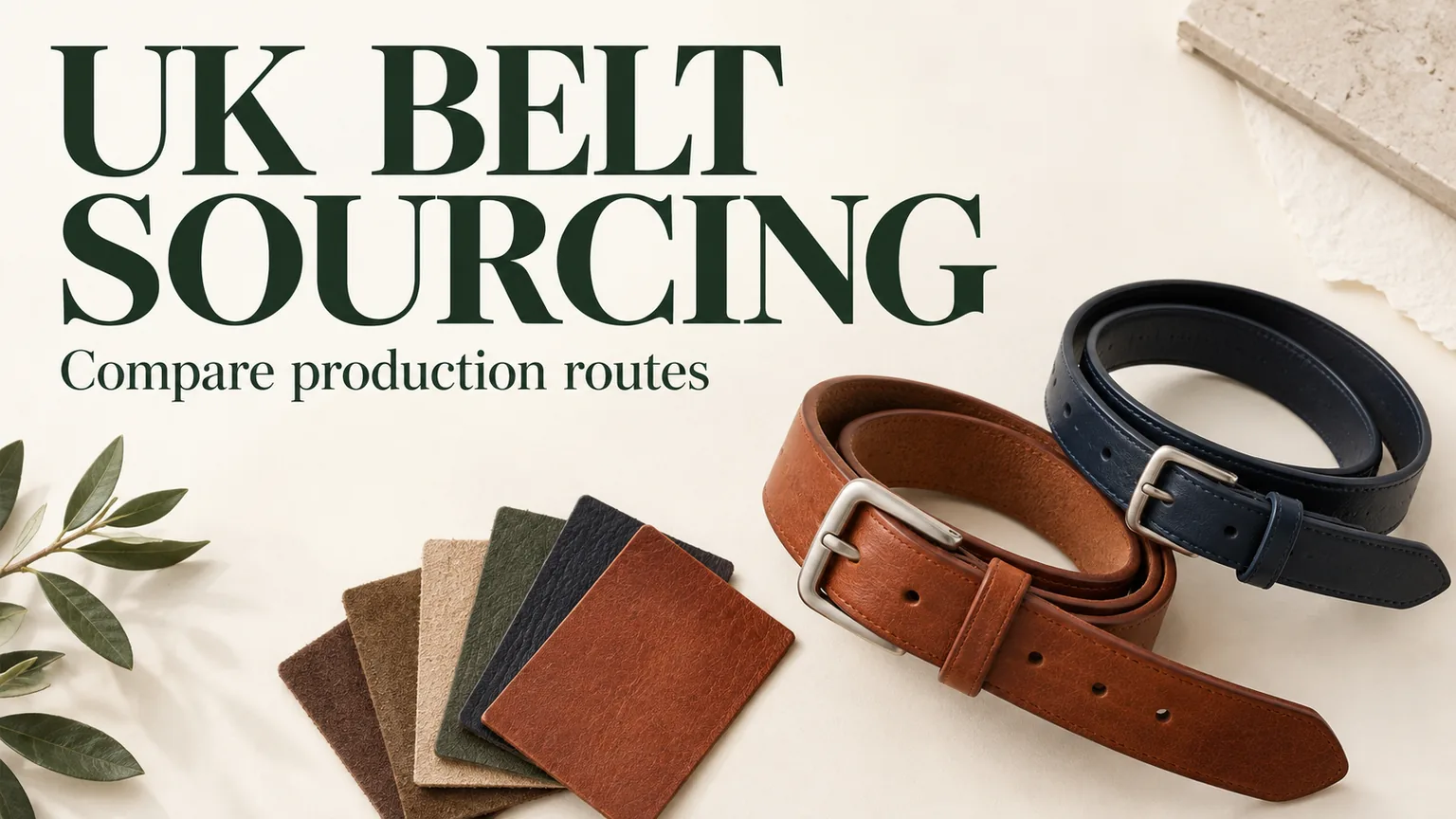
UK leather belt sourcing is not one uniform service. Arnold Wills offers a UK manufacturing route alongside global sourcing; Great British Accessories presents a specialist private-label workshop route; Mowbray Leather Goods develops private-label belts alongside bags and small leather goods; and Contrado provides a configurable printed-leather belt. Choose the route that matches what you need to change, then confirm where your specific order will be made.
The four options below were researched through their official websites on October 10, 2026. They are not a quality ranking or four equivalent factory models. This guide concerns finished fashion belts for brands and retailers, excluding industrial belting, leather merchants and buckle-only suppliers. HongDing is a belt manufacturer publishing a commercial buyer guide, not an independent testing organization or a UK factory.
Start with the manufacturing decision
- A UK business address does not establish UK manufacture for every order.
- Printed customization, a new private-label construction and buying a branded collection solve different needs.
- A nearby sample maker can simplify discussion, but material availability and the actual production route still govern delivery.
- Approve the belt, its size system and its retail identification together before scaling the range.
Four UK belt production routes worth investigating
The table summarizes what the sources support. “Best starting conversation” is our practical interpretation, not an endorsement of performance. Ask for a proposal for your own belt rather than treating a website service description as an accepted order.
| Business | Published production model | Best starting conversation |
|---|---|---|
| Arnold Wills | UK manufacture plus global sourcing | Which route and site will make this range? |
| Great British Accessories | Specialist UK private-label belt making | How will the concept become a repeatable style? |
| Mowbray Leather Goods | Private-label belts and other leather goods made in Melton Mowbray | How will a belt-specific construction coordinate with the wider collection? |
| Contrado | London-made printed leather product format | Does the available format fit the artwork and intended wearer? |
Arnold Wills: specify UK manufacture rather than assuming it
Arnold Wills’ private-label page describes belt and accessory manufacture in its Midlands factory, while also explaining that larger or particular projects may use its global supply chain. This is a useful distinction: a buyer can discuss domestic production without mistaking the whole business for a UK-only operation.
If UK manufacture is a fixed requirement, put that in the opening brief and ask the quotation to identify the proposed route. If it is a preference, request the tradeoff between the available routes for the same design. Compare development responsibility, component availability and replenishment—not merely the office location. The British Belt Company says it is part of Arnold Wills, so it should not be counted as an additional independent factory to inflate a shortlist.
Great British Accessories: a specialist own-brand discussion
Great British Accessories describes a small UK artisan team making leather belts for brands, retailers and businesses. Its published services include developing new ranges, refining designs, repeat orders and retail-ready finishing such as packing and barcoding. Those capabilities make it relevant to a brand that wants to discuss the belt as a complete product.
Start with the intended customer and the features that must remain recognizable. Ask the team to separate what can use existing materials or hardware from what requires dedicated sourcing. A small first collection can still become complicated if every color uses a different leather, buckle and edge process. Simplifying genuinely shared elements may improve continuity without making every style look the same.
Mowbray Leather Goods: develop the belt within a coordinated leather range
Mowbray Leather Goods describes private-label development and manufacture of belts, bags and small leather goods at its Melton Mowbray factory. It accepts early sketches or references as well as technical packs, with sampling and production requirements assessed for the project. This is relevant when a brand is considering belts alongside other leather accessories.
A shared leather color can connect a collection, but identical material specifications need not suit every product. A bag panel may need drape while a belt must hold its shape around the buckle and adjustment holes. Ask for a belt-specific sample using the proposed thickness, backing and edge process rather than approving the belt from a bag swatch. If coordinated colors matter, compare finished products together under consistent lighting: coatings, bending and surface orientation can change their appearance. Confirm whether the materials are shared or merely matched, and what that means for later replenishment.
Contrado: printed customization within a defined product format
Contrado’s leather-belt page describes printing and making the product in London, with selectable leather surfaces, buckle finishes and edge colors. It also presents business purchasing options. This is materially different from asking a factory to engineer any construction shown in a sketch: the published offer starts with a defined customizable product.
It may be a useful route when original artwork is the main differentiator. Review the printable area, repeat direction, keeper artwork and available sizing before investing in a design. If your concept needs a different closure, substantial construction change or unusual width, establish whether that falls outside the standard offer. Do not assume that “custom” always means unrestricted engineering.
What “UK supplier” should mean in your brief
Separate three questions: who handles the relationship, where the belt is made, and where its materials originate. A UK team may coordinate overseas production. A UK-made belt may use imported leather or hardware. A belt made elsewhere may use British leather. These are different supply arrangements and should not be compressed into one vague heritage claim.
For example, Elliot Rhodes’ own description distinguishes UK design from belt manufacture in Italy and Spain. That is why a familiar British retail name alone is not sufficient evidence for a UK manufacturing shortlist. It is not a criticism of that arrangement; it is simply a different answer to the sourcing question.
Decide which requirement matters commercially. If local manufacture is essential to your brand proposition, treat it as a fixed condition when seeking proposals. If your main need is accessible development support or domestic stock handling, say that instead. Otherwise, you may reject a useful supplier for the wrong reason or approve an offer that does not support your intended product description.
Keep origin and labeling decisions tied to actual production information and destination requirements. This article does not determine legal origin. For a claim you intend to print on the belt or packaging, obtain the relevant documentation and appropriate specialist advice before releasing artwork.
Build a range that a maker can understand
A collection brief should explain why the belt exists. Is it a quiet formal accessory, a substantial casual strap, a printed fashion item or a coordinated uniform line? That purpose helps the manufacturer propose materials and constructions. “Premium black leather belt” leaves nearly every decision open.

- Wearer and garment: explain where the belt sits and what loops or waistband it must work with.
- Appearance: show the proportions, surface character, edge and buckle effect you want, distinguishing inspiration from a design to be developed.
- Range structure: identify shared features and true variants across colors and sizes.
- Open choices: invite alternatives where you need material or construction guidance rather than pretending every specification is settled.
For an early concept, a reference image and garment description are enough to start a productive discussion. For a production quotation, more details will need to become fixed. Those are different stages. Asking for clarification is part of development; requiring a complete engineering package before discussing a concept can exclude the very work the buyer needs help with.
Do not make a heritage belt unnecessarily stiff
A substantial strap can suit a casual or country-inspired collection, but greater thickness is not automatically a better product. The belt still has to pass through the garment loops, curve comfortably and work with its closure. Compare the complete construction rather than choosing thickness as a proxy for quality.
If a sample is comfortable along most of its length but bulky at the buckle, review the folded assembly and attachment. If it resists bending everywhere, the material and overall construction deserve attention. Those observations lead to different revisions. Reducing the whole strap may solve the first problem while losing the substantial hand that made the concept appealing.
Also evaluate the reverse surface against the intended garment. A soft knit dress and robust denim create different contact conditions. Ask the supplier to demonstrate the proposed belt on a representative garment or fit form, then record the observations. Do not turn one satisfactory fitting into a universal wear or color-transfer claim.
Printed leather needs an artwork review and a product review
A digital preview is good for composition but cannot fully communicate how a printed surface looks when curved, touched and fastened. Review a physical sample for color appearance, pattern placement and the way the design continues—or deliberately stops—at the keeper and tip. The artwork should still make sense where the belt disappears behind garment loops.
For a repeating motif, confirm how different sizes are cut or laid out. A longer size can expose a different part of the repeat. If the visual story depends on one centered element, an all-over repeat may not satisfy the brief. Resolve that before approving the artwork, not after receiving a mixed-size shipment.

Get the size system right before multiplying SKUs
A belt’s labeled size, total length and usable wearing range are not interchangeable. Suppliers may describe products using different conventions. Before comparing samples, agree the measuring start point, the fastening point used as the reference, the adjustment range and the tail allowance. An otherwise well-made belt can become an expensive retail problem if its label means something different from the buyer’s size chart.
Work from the wearer’s garment position, not just the number on a trouser label. A waist belt worn over a dress and a belt worn lower through trouser loops are different applications. The same person can need different wearing lengths for those uses. Keep the intended position clear in the brief and consumer-facing size information.
Consider this illustrative range: one style, three colors and five sizes creates fifteen sellable variants. It does not necessarily create fifteen manufacturing processes, but each variant needs correct identity and quantity. A maker may share one buckle across the range while cutting different lengths and applying separate size labels. Mixing those labels at packing can undo an otherwise successful production run.
Check the shortest and longest intended versions as well as the central sample when the range presents fit risk. Look at whether the hole pattern, tail appearance and decorative placement remain appropriate. Keep the size chart and physical references aligned after revisions; changing the fastening geometry without updating the chart leaves two competing definitions of the product.
Use a small production run to learn the right things
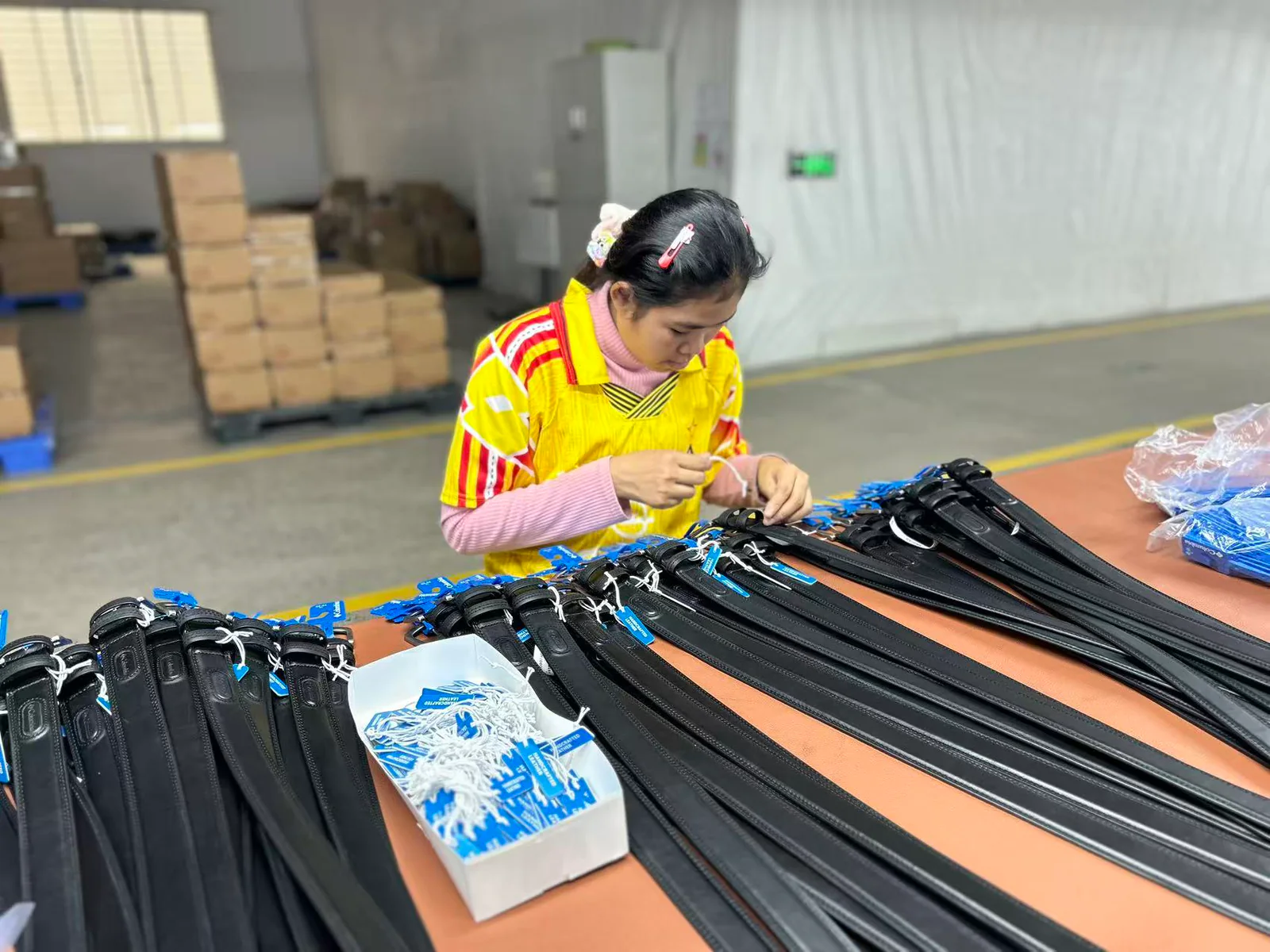
A first run should test repeatability, not simply create enough stock for launch photographs. Agree which characteristics must match the approved sample and which natural variations are acceptable. A good inspection plan is specific enough to guide action but does not pretend that every leather surface will look mechanically identical.
- At incoming review, connect leather and hardware lots to the approved identities. If a new material differs in color, hand or finish, resolve it before cutting the whole order.
- At the first assembled pieces, compare the agreed measuring points, closure operation, edge appearance and keeper fit. This catches assembly interpretation before it repeats.
- During making, review the operations most likely to change the intended result. For one style that may be edge build-up; for another it may be stitching alignment or print placement.
- At packing, reconcile the belt, size label, barcode and carton assortment. The physical product and its retail identity must agree.
- If a discrepancy appears, identify and hold the affected lot or production interval, agree its treatment, and recheck before an authorized release.
Choose inspection sampling and any performance tests with the supplier and the responsible technical team. A workshop visit or a few good pieces can help establish confidence, but neither proves a whole shipment meets an unstated standard. The purpose of the first run is to expose the decisions that need control before reorders become routine.
Understand the tradeoff between low initial commitment and repeat supply
An existing model can reduce the number of development decisions and may let a brand test demand sooner. Its limitation is that the construction and component choices may not be exclusive. A dedicated design offers more control but adds dependencies such as a particular leather article, custom buckle or tooling. Decide which of those differences customers will actually notice.
Ask how the first order and the reorder will differ. The first quotation may include one-time development costs; a later order may need fresh material purchasing even though tooling already exists. A small initial quantity does not prove that replenishment will be available immediately. Confirm what is held in stock, what is reserved for you and what must be ordered again.
Compare quotations with a short inclusions schedule: construction, hardware, branding, packaging, sample work, inspection and delivery basis. Leave uncertain commercial details open for clarification rather than filling them with assumptions. If one offer includes retail-ready barcoding and another supplies untagged belts, unit prices alone will mislead the buying team.
Domestic production can be valuable when close collaboration or UK manufacture is important, but it does not remove every dependency. Leather, hardware, finishing and approval schedules still matter. Build the delivery plan from the proposed route and confirmed inputs. A general statement about proximity is not a production reservation.
Where HongDing fits in a wider sourcing comparison
If your requirement is specifically UK-made belts, the production route must satisfy that requirement; HongDing should not be presented as a domestic substitute. If your brief is open to an international route, our manufacturing capabilities can be reviewed against the same construction, sample and retail requirements. Dongguan development and coordination connect with project-specific production arrangements, including Cambodia—not a claimed UK factory.
Our business origins date to 2004, with the present company identity formed in 2010. The practical value of that background should appear in how material, hardware, sampling and production questions are resolved, rather than in unverified ranking language. For any route, the result you approve and the controls behind the order matter more than a broad experience claim.
Two final sourcing questions
Can a retail sample prove private-label capability?
It can show the workmanship of that product. It does not establish that the business accepts your branding, offers your construction or can supply your quantity. Confirm the relevant trade service and develop a sample where the requested product differs.
Should I send a complete tech pack to every shortlisted maker?
Send the information you have and identify unresolved choices. A concept conversation can start with images and intended use. Before production, those choices must become agreed specifications and references; the initial inquiry does not need to pretend they are already settled.
Compare a real product brief
If an international development route is an option, share the intended wearer, a reference image and the features your range must retain. HongDing can discuss the material, closure and size decisions that need resolving before a sample is commissioned. Read about our development support or start with the open questions.