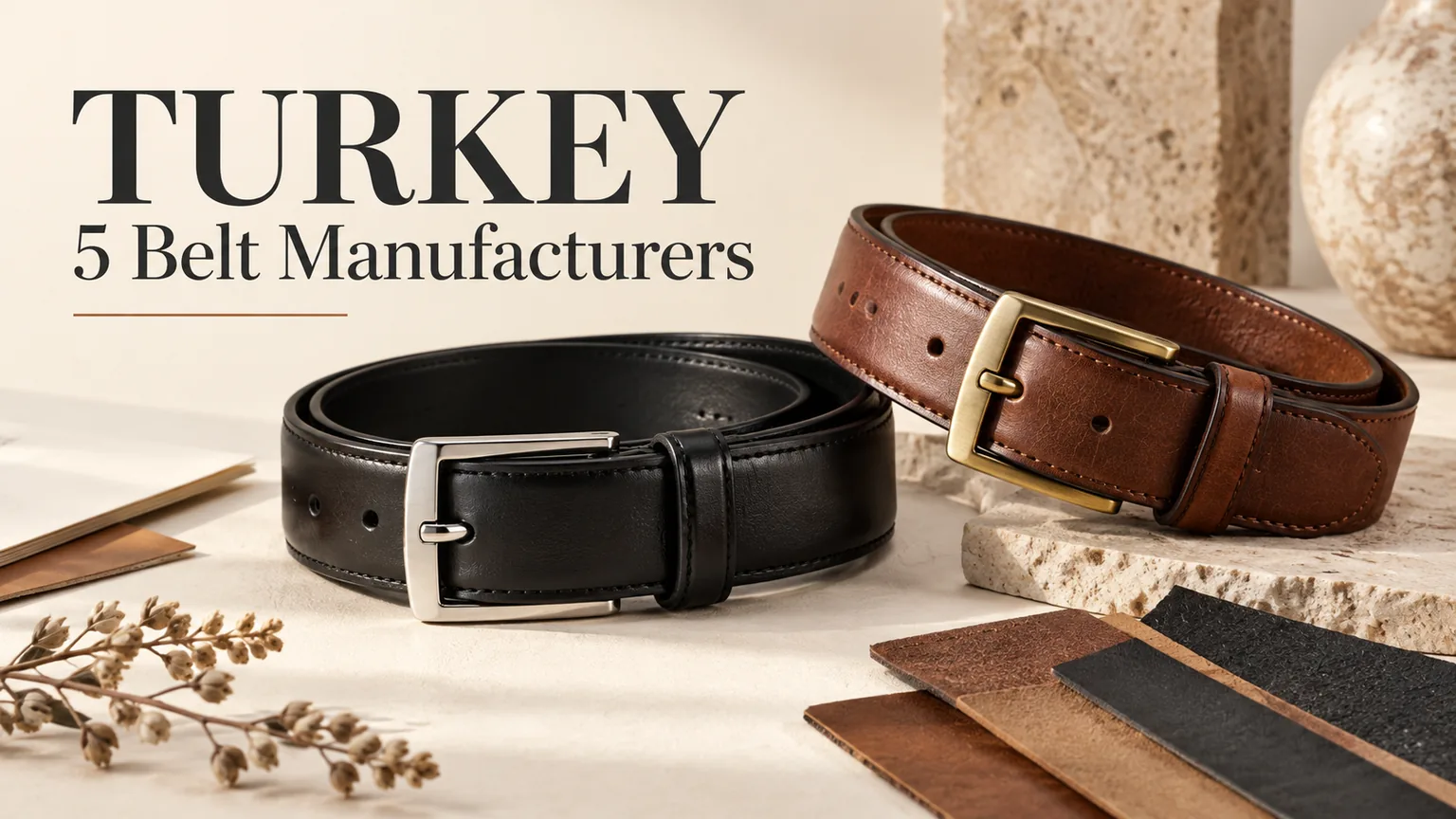
A Turkish leather belt supplier may be a belt-focused factory, a multi-category leather goods maker or a wholesale business with its own production. All three can be relevant to a brand, but they do not solve the same development problem. Before comparing quotations, establish who will make the finished belt, where that work happens and whether the supplier supports your particular construction.
This shortlist covers five leather belt manufacturers in Turkey: Lider Kemer, Ümya Kemer, Lederist, Nedus Leather and leFather. They are included because their official materials describe finished-belt production in Turkey and a business-facing supply route. The practical choice depends on your belt design, development needs and repeat-order requirements—not the order in which the companies appear below.
How we selected these five companies
“Top 5” means an editorial shortlist, not a verified ranking by output, price or quality. We reviewed official company and product pages on October 14, 2026. The inclusion checks were finished leather belts, a stated Turkish manufacturing base, an identifiable business and a route relevant to wholesale or brand production. We excluded raw-leather suppliers, industrial belt businesses and retail-only listings.
Public websites are self-descriptions. We have not independently audited these factories, tested their samples or compared their quotations. Exact production addresses, subcontracted operations, current order terms and product-specific compliance still require direct confirmation. No numerical capacity, delivery or minimum-order claim is used here as a comparative fact.
HongDing publishes this guide as a belt manufacturer with a separate development and production offer. HongDing is not a Turkish manufacturer and is not counted among the five. Our practical buying guidance below is manufacturer-side interpretation, clearly separate from what each listed company states about itself.
| Manufacturer | Turkish production description | Published business route | Question for your sample request |
|---|---|---|---|
| Lider Kemer | Belt factory in Merter, Istanbul | Wholesale and private label | Which leather, hardware and construction changes fit the proposed program? |
| Ümya Kemer | Istanbul leather and synthetic belt production | Design, manufacture, packaging and export | Which operations and components are controlled at the quoted facility? |
| Lederist | Istanbul leather goods manufacturing; belts listed | OEM and private label | Can the belt be developed alongside the intended accessory range? |
| Nedus Leather | Istanbul OEM leather goods production; belts listed | OEM and CMT | Who supplies and approves leather, reinforcement and hardware? |
| leFather | Gerede/Bolu production; Istanbul sales office | Wholesale and custom leather products | Which belt format and customization route match the order? |
1. Lider Kemer: a belt-focused wholesale and private-label route
Lider Kemer’s official site describes genuine and synthetic leather belt manufacturing at its Merter, Istanbul factory, together with wholesale and private-label services. Its published offer includes men’s and women’s belts, logo customization, buckles and packaging. This makes it a relevant starting point for a buyer looking specifically for a finished-belt supplier rather than a general leather goods catalog.
Our suggested first discussion is how far the proposed design departs from the supplier’s established constructions. Changing a logo on an existing strap is a different development task from introducing a new buckle attachment or a different layered build. Ask for a sample that represents the proposed construction, not merely a visually similar catalog belt.
The site displays different street-address details in different locations. Treat Merter/Istanbul as the stated manufacturing area, but confirm the current production and visit address directly before planning an audit. We have not verified the site’s broader capacity, delivery or compliance claims.
2. Ümya Kemer: belt production with design-to-packaging services
Ümya Kemer’s official website identifies leather and synthetic belt manufacturing in Istanbul and describes design, material selection, production, packaging and delivery. It also presents bags, wallets and multiple belt styles. The useful distinction is its explicit belt-production offer, rather than an inference that any leather accessories business can make your belt.
For a fashion-led belt collection, start by discussing the construction behind the styling. A decorative buckle, narrow strap or unusual tip can require different attachment, finishing and assembly decisions. Ask which operations are performed at the proposed site and which components arrive from outside suppliers. A coordinated service does not mean every material and buckle is made in-house.
A productive sample brief would identify the visual reference, intended wearer, width direction and customization that matters most. Then compare the supplier’s proposed construction with that reference. Do not infer current minimums or delivery dates from the breadth of the website.
3. Lederist: an OEM route for coordinated leather accessories
Lederist describes itself as an Istanbul leather goods manufacturer offering OEM and private-label production, explicitly including belts alongside bags, wallets and small leather goods. Its published positioning makes it relevant when a brand wants to discuss a coordinated accessories range through one development relationship.
The buyer-side opportunity is shared development of color, texture and hardware appearance. The risk is assuming that a successful bag sample proves the belt construction. Belts place different demands on long narrow straps, repeated buckle bending, adjustment holes and clothing contact. Ask for belt-specific samples and confirm which team and production route will handle them.
The website’s broad manufacturing description is not a substitute for the exact belt-line address or a list of subcontracted processes. Those details remain part of qualification. Coordinating the range can be useful, but accept each product against its own functional requirements.
4. Nedus Leather: OEM and CMT with explicit material-sourcing choices
Nedus Leather presents Istanbul OEM and CMT production for handbags, small leather goods and belts. Its belt section lists different leather constructions, edge-finishing options and hardware sourcing. The company also describes the use of its own sourcing network, approved suppliers or client-supplied components.
That makes responsibility allocation a useful early discussion. Under an OEM arrangement, ask who selects and validates each material. Under CMT—cut, make and trim—the buyer’s input responsibilities need to be stated explicitly rather than assumed from the acronym. If you supply a buckle, establish who checks its fit with the strap and who handles an unsuitable incoming component.
Nedus describes related tanning and retail businesses. They are not counted as additional belt manufacturers in this list. Nor do the website’s tannery-related claims establish certification or chemical compliance for a particular finished belt; request current, relevant evidence for the proposed materials and order.
5. leFather: Bolu production with an Istanbul commercial office
leFather’s official site describes in-house production of leather belts, wallets and accessories and a wholesale business in Gerede. Its company page locates production in Bolu province and distinguishes that from the Istanbul sales office. This is an important distinction for a buyer arranging production visits or assessing the actual manufacturing route.
The company also describes ratchet leather belts and custom wholesale production. For that format, the relevant sample question is how the strap, track and buckle function together—not simply whether the face leather looks right. Confirm what can be changed and what depends on an existing mechanism.
For conventional leather belts, establish the selected leather, edge treatment and attachment construction in the same way. Wholesale availability and custom development are different commitments; ask which route the quotation covers. We do not treat the website’s general quality or environmental language as independent verification.
Choose by product architecture before requesting a price
Start with the belt’s construction because it determines which capabilities matter. A single-layer casual strap, a lined dress belt and a reversible belt may all appear under “leather belts” in a catalog, yet they create different material and assembly problems. A useful shortlist should narrow those problems, not just collect five email addresses.
Single-layer leather belts
The strap itself supplies much of the feel and structure. Compare thickness consistency, temper, the underside, cut edges and behavior around the buckle fold. A heavy-looking sample is not automatically a better belt: extra thickness can make the keeper difficult to use or create an awkward buckle-end build. Request a sample through the intended hardware rather than evaluating only a strip of leather.
Lined or laminated leather belts
Ask for the layer stack. The face leather, lining, adhesive and any reinforcement jointly affect stiffness, shape and edge appearance. A quotation using the word “leather” can conceal materially different constructions. If one sample bends easily and another feels rigid, identify which layers changed before deciding that one manufacturer is better.
Look closely at tips and buckle-end transitions, where local thickness and layer termination can differ from the center. A neat stitched perimeter does not prove that the layers are well bonded between the stitches. Evaluate the assembled construction after the agreed conditioning and handling, using an appropriate laboratory method if quantified bond performance is required.

Reversible and ratchet designs
These add a hardware-system decision to the leather decision. For reversible belts, evaluate both faces and the movement required to reverse the buckle. For ratchet belts, evaluate the specific track-and-buckle combination through adjustment and release. A maker’s general belt capability does not establish compatibility with every mechanism you may source independently.
If your team has not selected a mechanism, make that an open development question. Sending a reference image is useful, but the supplier needs to distinguish visual intent from a component that is already fixed. Otherwise, both sides may spend time refining a strap around hardware that later changes.
Turn five suppliers into a comparable sample round
Do not ask each supplier for its “best leather belt” and then rank the answers. You will receive different solutions to different briefs. Send the same decision-focused request: intended use, reference image or sample, construction direction, approximate size assortment and the choices that remain open. A complete tech pack is helpful when available, but it is not necessary to begin an informed discussion.
Separate non-negotiable requirements from areas where you want manufacturing advice. If the buckle silhouette is fixed but the attachment method is open, say so. If the collection needs a particular visual hand but not a particular tannery, allow suppliers to propose materials and explain the tradeoff. This lets you compare judgment as well as execution.
| Buyer input | What the supplier should explain | What to compare |
|---|---|---|
| Reference and use | Proposed construction and any departure from the reference | Whether the proposal answers the same product brief |
| Material direction | Face, lining, reinforcement and finish references | Feel, appearance and construction—not a generic leather label |
| Hardware and adjustment | Component source, fit and attachment route | Function with the actual strap |
| Size assortment | Measurement datum and size-grading approach | Wearable fit across the proposed range |
| Repeat-order needs | Material continuity and change-notification process | How the approved sample will be reproduced |
Compare quotations only after these construction differences are visible. A lower unit price may represent a different lining, buckle, edge treatment or packaging scope. Ask suppliers to identify alternatives rather than silently substituting them. A useful quotation tells you what product you are buying and which assumptions remain open.
What to inspect when the samples arrive
Begin with fit and geometry. Use an agreed measurement reference; total strap length and functional wearing length are not interchangeable. Run the strap through its keeper and buckle, check the tail presentation at representative adjustment positions and review whether the size grading preserves the intended proportions. A belt can meet an overall length while fitting differently because the buckle or attachment changed.

Then evaluate the surfaces that contact the wearer’s clothing. The face, lining and exposed edges may use different treatments. Agree relevant color-transfer and wear checks rather than treating the face-leather description as approval of the entire belt. Dark lining against light clothing deserves an explicit discussion even when the face looks excellent.
Inspect the edge in the places where it changes direction: the tip, holes and buckle end. Compare smoothness, coverage and appearance after representative bending. If an edge opens or cracks, ask whether the issue comes from the material, layer alignment, preparation or finishing process. A single damaged sample identifies a question; it does not by itself establish the root cause or the performance of every future order.
Keep separate records for cosmetic observations, functional issues and agreed test results. Label samples and retain an approved reference. If a supplier revises a sample, state what changed and recheck the affected functions. Accepting a new buckle because its color is better should not bypass another fit check.
Confirm the production route—not only the company address
A sales office, sampling room and bulk-production site can be different places. Ask for the site that will cut, assemble and finish your belts, together with any outsourced operations relevant to the order. This is especially important when a supplier offers several product categories or sourcing routes. A Turkish contact address is not sufficient evidence that every component or operation is Turkish.
Distinguish finished-belt manufacturing location from leather and buckle origin. Imported hardware does not tell you where the belt was assembled, and a local leather source does not prove local finished-goods production. If country-of-origin wording is commercially or legally important, obtain the actual production facts and have the applicable determination reviewed by a qualified trade adviser. Do not derive origin labeling from a supplier’s homepage.
For quality planning, ask how the approved sample becomes a production reference. In an illustrative first order, the factory compares incoming leather with the retained material and appearance references, checks the buckle against its approved component and keeps lot identities available. The first assembled pieces are then compared with the approved belt for functional length, hole placement, buckle attachment, keeper clearance and edge appearance before the run proceeds.
If a keeper becomes too tight after a material change, hold the affected work and identify which material lot and pieces are involved. Compare thickness, fold construction and component dimensions before deciding on correction; do not simply enlarge every keeper. Recheck the corrected assembly against the approved fit and the other affected functions, then document the disposition and release of conforming pieces. Keep the revised reference only if the buyer has accepted the product change. This is a proposed control sequence, not a claim about any listed factory’s actual procedure. It makes repeat-order capability a concrete discussion about change control rather than a promise of consistency.

Illustrative shortlist decisions for two buyers
A brand launching a core dress-belt range might first contact the belt-focused suppliers with one comparable construction brief. Its main questions are whether the proposed materials, buckle fit, edge finish and size assortment can be developed consistently. It should not choose solely on who offers the broadest accessory catalog or quotes first.
A brand coordinating bags, wallets and belts might include the multi-category OEM routes early. Shared material development could simplify the visual relationship across products, but the belt still needs its own functional sample review. If the bag leather is too soft for the intended strap, a different substrate or construction may be needed while preserving the visual family.
These are hypothetical sourcing approaches, not reported results from the listed companies. In both cases, the next step is a focused sample discussion followed by comparison of actual proposals. The shortlist helps decide whom to approach; it does not replace product qualification.
Questions about sourcing leather belts in Turkey
Are all five companies verified factories?
They meet this article’s official-source inclusion criteria, but we have not conducted independent factory audits. Confirm the exact site, legal contracting entity and order-specific production route before committing.
Can I start without a complete tech pack?
Yes. A reference image or sample, intended use and clear explanation of the unresolved choices can start development. The supplier should help turn those inputs into a specific sample proposal rather than guess silently.
Which supplier has the lowest MOQ or fastest delivery?
This research does not establish a reliable comparison. Request current terms for the same construction, material availability, assortment and packaging. General website claims are not comparable order commitments.
Is HongDing included in the Turkish list?
No. HongDing is a separate option for buyers considering development and production outside Turkey. It is not presented as a local Turkish factory or an impartial ranking authority.