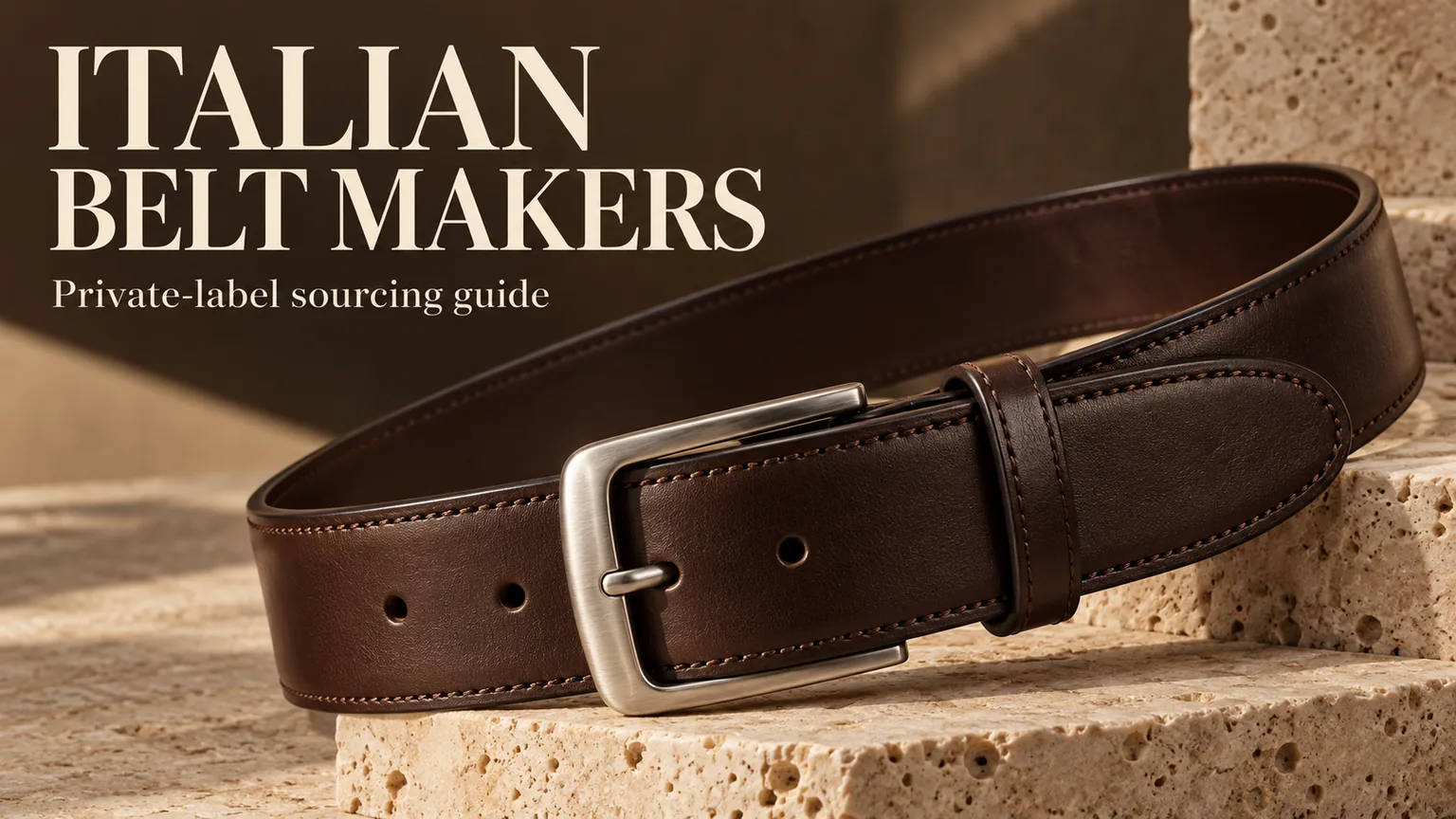
For an Italian-made private-label belt collection, FAP Italia, Laino Industry, Niagara & Co. and L’Accessorio offer four different starting points. Compare their published development routes against your actual product: a refined dress belt, a decorative women’s style, a retail range or a specialized size offer. Then judge the assembled sample and the production proposal together. An Italian address or an attractive leather swatch cannot answer those questions on its own.
This shortlist covers finished fashion belts, not machinery belts, buckle suppliers or leather merchants. We reviewed the linked company pages on October 10, 2026. The names are not ranked, and inclusion is not an independent factory audit. HongDing publishes this guide as a belt development and manufacturing business; we are not presenting ourselves as an Italian manufacturer.
Four Italian leather belt manufacturers to investigate
Use the table to choose who deserves a development conversation. The “starting point” column is our interpretation of the published service, not a claim that one company outperforms the others. Current availability, commercial terms and acceptance of your design need a direct proposal.
| Company | Published route | Useful starting point |
|---|---|---|
| FAP Italia | Stock, white-label and fully customized belts | Decide how much development the range needs |
| Laino Industry | Private-label women’s fashion belts | Decorative or material-led women’s designs |
| Niagara & Co. | Private-label belts and packaging for trade buyers | A coordinated retail or wholesale assortment |
| L’Accessorio | Own collections and private-label leather belts | Material, finish and extended-size discussions |
FAP Italia: separate stock customization from a new construction
FAP Italia’s official site separates ready-stock, white-label and private-label services and describes in-house belt production in Italy. This distinction is useful for a brand deciding whether its differentiation comes from a logo or from the product itself. An existing model with branding is a different development task from a new strap construction and dedicated hardware.
If an eligible stock style already has the right width, hand and buckle proportion, begin by evaluating that physical model. If your concept requires a different lining, edge profile or buckle system, request the custom route explicitly. Do not carry a stock-program minimum or dispatch estimate across to a new design. Ask the proposal to distinguish stock availability from components that must be purchased or produced.
Laino Industry: a women’s fashion-belt development conversation
Laino’s private-label page describes women’s belt production in leather, laminated materials, textiles and jewelry-style constructions. Its company site describes accessories designed and produced in Italy. That makes the company a relevant lead when the belt is an expressive part of the garment rather than simply a trouser accessory.
Bring the intended outfit and wearing position into the conversation. A statement closure may look successful on a flat sample but sit awkwardly against a soft dress. For a decorative design, make the first review about proportion, weight distribution, reverse-side contact and adjustment. Establish which decorative elements are essential before reducing cost; removing one element can change the entire visual balance.
Niagara & Co.: connect the belt to the retail assortment
Niagara & Co. describes Italian production of belts and leather accessories for men, women and children, with private-label work and customized packaging. Its stated customer groups include chain stores, wholesalers and department stores. These are company descriptions, not evidence of a particular buyer’s production slot or performance.
The useful discussion is how a collection will be organized: which styles share a buckle, which colors share a construction, and how sizes and packaging identify each item. A retailer should present the intended range architecture, not merely a total unit count. That lets the manufacturer separate genuinely shared components from variants that require separate purchasing, preparation or finishing.
L’Accessorio: material variety and extended-size development
L’Accessorio di Morri Sergio describes handcrafted Italian belt production for its collections and private labels, with in-house processing and men’s, women’s and extended-size offerings. Its published material range includes calfskin, suede and nubuck. Treat those categories as an invitation to review actual articles and constructions, not as interchangeable quality grades.
An extended-size request should identify the wearing circumference and adjustment range rather than simply asking for “the longest belt.” The extra length affects material selection, usable cutting area, grading and how much tail remains after fastening. Establish whether the proposed long version preserves the same appearance and construction as the core sizes before committing to one size-inclusive collection.
Specify what makes a leather belt feel refined
“Luxury quality” does not give a pattern maker or production team an actionable target. Translate it into a small set of visible and tactile priorities. For a dress belt, those may be a quiet buckle profile, a controlled edge, a smooth lining and a strap that curves without looking limp. For a casual belt, grain character, edge treatment and a more substantial hand may matter more.

Separate the surface leather from the complete strap
A leather name describes only part of the product. A lined belt may combine a face leather, backing and other internal components; an unlined strap presents a different edge and reverse surface. Ask for a construction description alongside the swatch. Two belts using a similar face leather can have very different bending behavior because the remaining layers and assembly differ.
For a clean formal appearance, a lined construction can give the designer more control over the reverse surface and overall profile. It also creates interfaces that must remain stable during bending and wear. A substantial single-layer strap avoids those particular interfaces but exposes more of the material’s own character. Neither route is automatically the more durable or more premium choice.
Compare the complete belt around the garment, not just a short offcut held in the hand. If the desired softness makes the long strap look slack, discuss the overall construction. If only the buckle fold is bulky while the rest feels right, investigate that local assembly first. Thinning the entire strap to solve one bulky joint may sacrifice the hand you originally approved.
Make the edge a design decision, not an afterthought
An edge can be visually discreet, contrasted or deliberately rustic. On a layered belt, its preparation and finish also influence how clearly the layers are seen. A painted edge and an exposed finished edge therefore need different appearance references. A photograph of the face alone does not communicate the required result.
During sample review, look along the edge in reflected light and around the tip and buckle fold. Uneven build-up may be most visible at a curve; an apparently neat straight section does not establish that the complete edge is equally controlled. Gently flex the sample as it would be worn and inspect again. This is an appearance and development check, not a substitute for an agreed durability test.
If the team proposes a different edge process, ask to see it on the actual material combination. A change may improve smoothness while changing the visual thickness or sheen. Record what matters to the collection so the next revision does not “improve” the belt away from the intended design.
Review the buckle, fold and keeper as an assembly
The keeper is the small loop that retains the belt tail. Its usable opening matters more than its outside dimension. A buckle can accept the strap while the keeper still resists the tail, especially where a tip is thicker or more heavily finished. Conversely, an excessively loose keeper can leave the tail poorly controlled.
Fasten the belt, pass the tail through the keeper and adjust it across the intended range. If resistance occurs at the buckle, examine the strap and buckle interface. If the buckle works but the keeper does not, isolate the keeper and tail relationship. This separates two problems that are often bundled into the vague comment “the belt is too thick.”

Compare suppliers using the same development question
A sample from a supplier’s existing range demonstrates that model, not your future belt. Use catalog samples to assess relevant workmanship, then commission a development sample when your construction or hardware differs. Otherwise, you may select a maker for a product it has shown successfully without testing the feature that makes your own design difficult.
Prepare a compact brief with three parts:
- Keep fixed: the wearing position, target garment, visual proportion and any essential material or hardware feature.
- Explore: choices where the manufacturer can propose alternatives, such as lining, edge treatment or a comparable buckle.
- Evaluate: the decisions the sample must resolve, including feel, adjustment, appearance and branding placement.
You can begin with reference images and a description of the product direction. An image can communicate shape and mood, but it cannot establish leather thickness, reverse construction or the exact dimensions of a hidden closure. Mark those points as open rather than letting each supplier silently interpret them differently.
A practical comparison example
Imagine a brand developing a slim brown belt for tailored trousers. One sample feels supple and has a small buckle; another has a firmer strap and a heavier closure. Calling the first “better leather” would skip the real comparison. The difference may lie in the layers, buckle mass, fold preparation or several choices together.
For this illustrative project, first confirm that both samples use the requested wearing length and width. Review them through the same garment loops, then compare the strap on its own and the finished assembly. If the second strap looks right but the closure pulls the front downward, request a hardware revision while retaining the approved strap construction. That gives the next sample a focused purpose.
Use separate notes for visual preference and functional difficulty. “Prefer a quieter finish” is a design instruction; “tail cannot pass through the keeper after fastening” describes an observable problem. Both are useful, but they require different responses. A manufacturer should not have to infer an engineering change from an aesthetic comment.
Test whether the approved result can be repeated
A successful sample is the beginning of supplier qualification. Before placing a substantial order, connect the approved reference to the materials and process that will produce the shipment. This is especially important when a sample was made from a readily available hide or buckle but bulk supply will come from another lot.
- Lock the reference and its limits. Retain the approved sample version, material identities, color reference, measurement method and agreed appearance range. Natural variation needs a usable boundary, not an instruction to make every piece identical.
- Review incoming components. Compare the proposed bulk leather and hardware with those references. A mismatch should be investigated before it is distributed through an entire cutting run.
- Check the first assembled pieces. Confirm wearing length, hole positions, buckle orientation, keeper fit and the edge around curves. A correct cut strap does not prove the finished assembly is correct.
- Observe the relevant production stages. Look for drift in the features that matter to the style: edge build-up, stitching position, finish variation or hardware handling. Record which material lot or production interval is affected.
- Resolve deviations before release. Hold the affected goods, agree rework or another documented disposition, then recheck the changed feature and any connected function. The authorized buyer or quality contact should know what is being released.
These are recommended control points, not a claim that every listed supplier uses one identical system. The inspection quantity, test methods and acceptance conditions should be agreed for the product and order. Do not mistake a close-up photograph, an attractive sample or a generic quality certificate for evidence that the shipment has met those conditions.
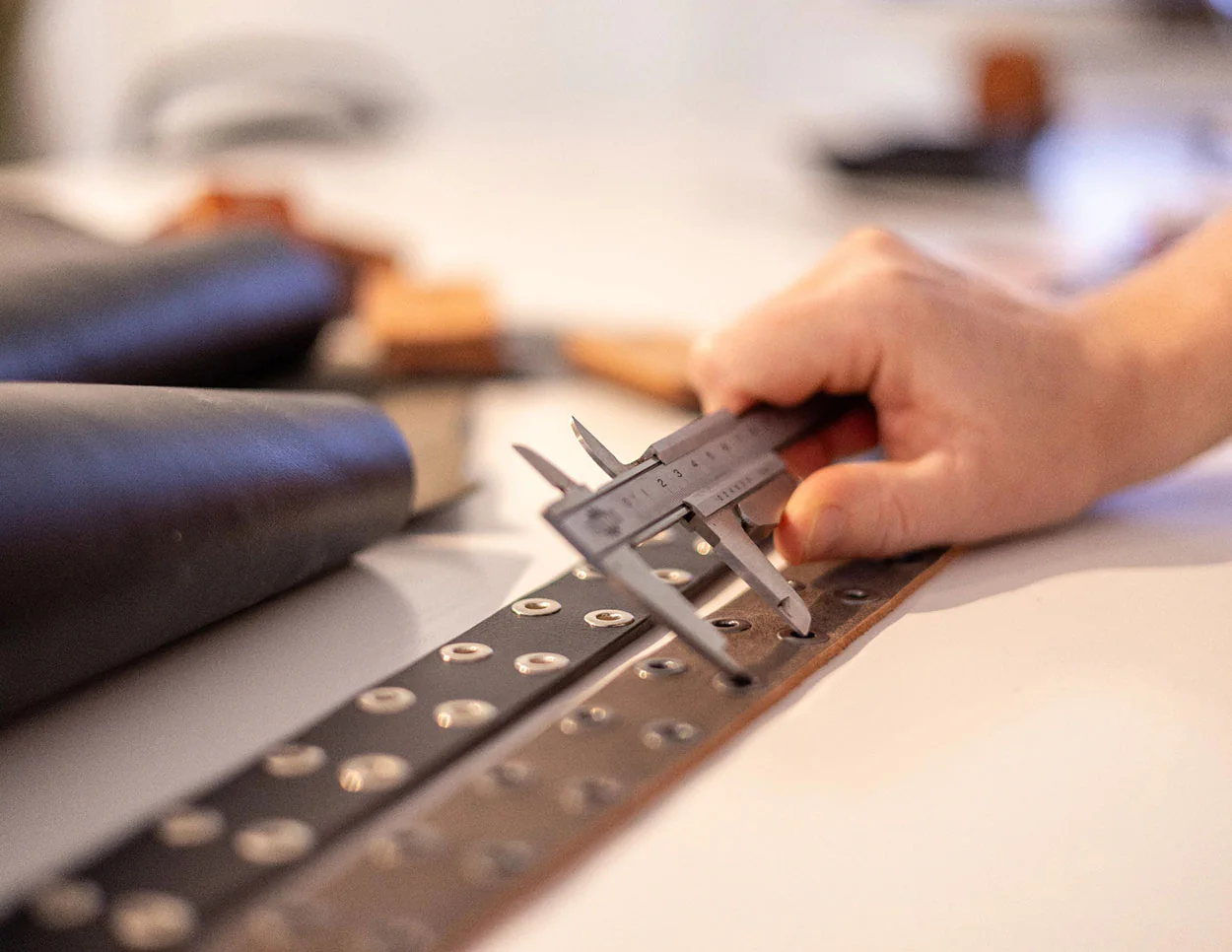
For a repeat order, retain the approved references but reconfirm component availability. A substitute leather article with a similar color may behave differently at the fold or edge. Treat a material or hardware substitution as a controlled change, then review the affected assembly. The old sample remains useful, but it cannot approve a new input by itself.
Compare the complete offer, not just the belt price
Separate development cost from production cost. A quotation may include an existing buckle and standard branding while another includes new hardware development, a dedicated stamp and custom packaging. Those are different offers. Ask each supplier to identify the included configuration before using unit price as a deciding factor.
Break the commercial comparison into product, assortment and delivery. Product covers the complete construction and finishing. Assortment covers sizes, colors and the quantities attached to each variation. Delivery covers packaging, inspection scope and the agreed delivery basis. This organization reveals whether a lower figure comes from a genuine efficiency or simply from something omitted.
Consider where customization adds value. A distinctive buckle can become the collection’s recognizable feature, but it may introduce tooling and replenishment dependencies. A standard buckle with carefully controlled leather and edge treatment may suit an understated collection better. The right choice depends on the design objective and repeat-order plan, not on the largest number of custom elements.
Country positioning should also be precise. Leather sourced from Italy and a belt manufactured in Italy are different statements. If Italian manufacture is essential to your range, have the supplier explain the actual production route and document the claim appropriate to the product and destination. This guide does not determine legal origin or replace specialist advice.
When an alternative production route deserves comparison
If Italian manufacture is a fixed part of the product proposition, retain it in the brief. If the priority is a specific appearance, construction or coordinated retail program, comparing a non-Italian route can be commercially useful—but compare the same product requirements. Do not describe it as equivalent Italian manufacture or assume that geography determines the outcome.
HongDing’s business roots go back to 2004, with the current company identity formed in 2010. Our role is to help brands connect material and hardware choices, sample revisions and manufacturing requirements. The relevant question is what a proposed route can deliver for your belt, not an unsupported claim to be the biggest or best supplier.
Questions buyers often leave until too late
Does private label mean an exclusive design?
Not automatically. Adding your mark to an existing model differs from commissioning exclusive construction or hardware. Establish the rights and permitted reuse of your artwork, tooling and design with the supplier before paying for development.
Should every size be sampled?
The appropriate sample coverage depends on the range. At minimum, decide how the shortest and longest versions, adjustment range and any changed construction will be evaluated. Do not assume a single middle size resolves every fit question.
Turn the desired look into a development brief
If you are also considering HongDing’s production route, send a reference image and tell us how the belt will be worn. Identify what must stay fixed and what you want to explore. Our design and development support can help organize the material, buckle and construction decisions before sampling. A complete technical pack is not required for that first discussion.