
By Kevin · Reviewed by HongDing Product Development and Quality Team · Published 2026-09-11 · Updated 2026-09-11
Braided and woven belts are not the same construction. A braid interlaces three or more elements along diagonal paths, while a woven structure crosses yarn systems commonly called warp and weft. That distinction matters, but it does not tell a buyer which belt will fit, stretch, hold color or repeat well in bulk.
The product name is only the first line of the specification. A braided leather body, an elastic braid and a flat woven webbing can behave very differently even when a catalog groups them together. Buyers need the actual material article, structure, dimensions, end assembly, buckle interface and approval method.
In short: choose braided or woven only after the structure has been translated into a finished-belt decision. The better route is the one that meets the intended use and can be repeated against a controlled file and approved sample.
How Interlacing Defines Belt Construction
The cleanest comparison begins below the surface. Technical braid guidance describes braiding as the interlacing of at least three yarns or strands at angles. A braid may be flat or tubular, and the elements change direction as they cross one another.
Weaving uses a different path. Industrial weaving guidance explains that at least two yarn systems interlace, commonly with warp running lengthwise and weft crossing it. A finished belt may use a narrow woven tape, webbing, decorative woven panel or a reinforced multilayer construction.
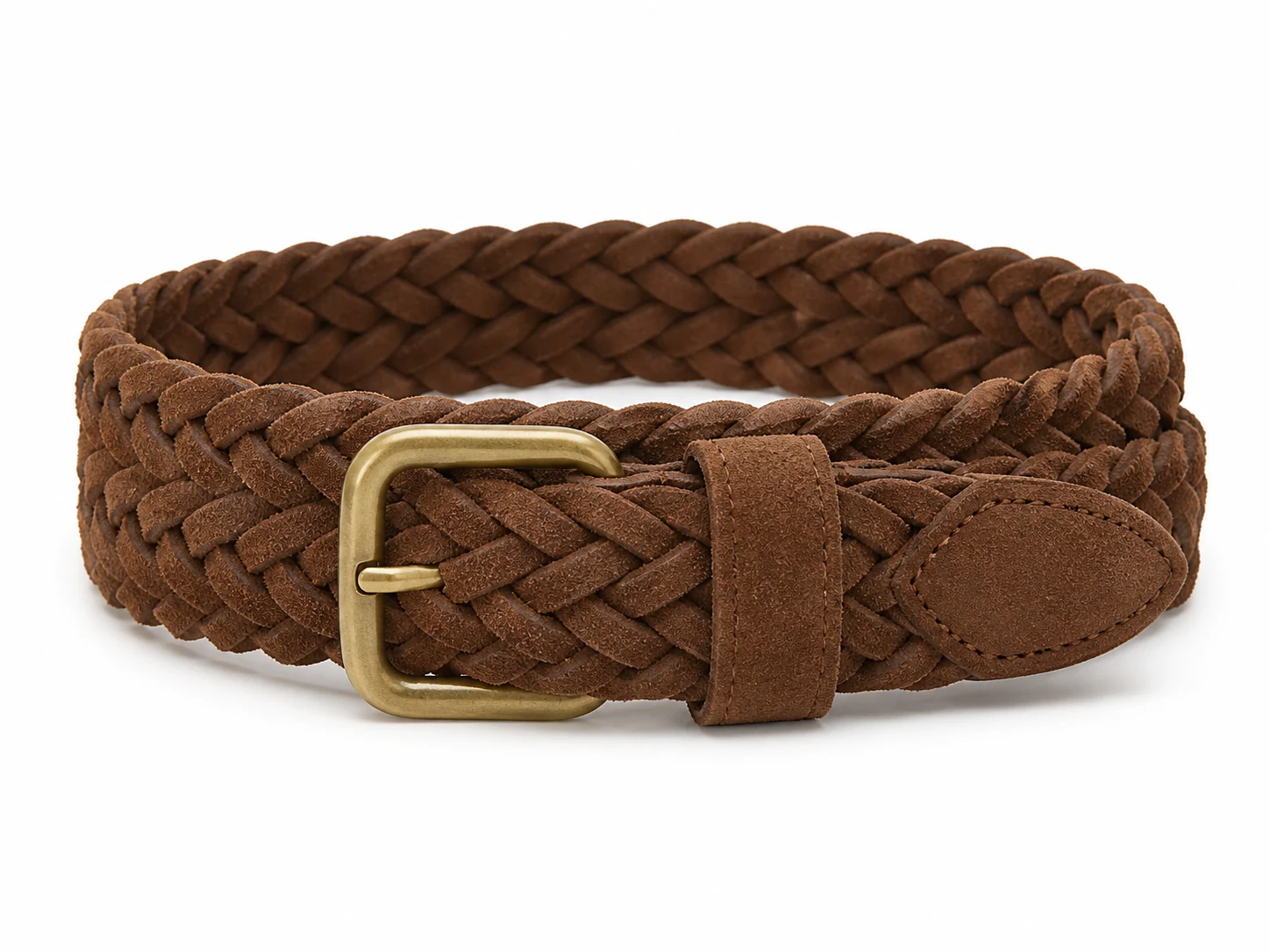
Catalog language often blurs this distinction. Sellers may call a plaited leather belt “woven,” and they may call an elastic woven body “braided.” Do not argue over a label. Ask the supplier to identify the actual strand, strip or yarn path and show both faces, edges and cut ends.
| Decision | Braided Body | Woven Body | Buyer Check |
|---|---|---|---|
| Element path | Elements cross on angled paths | Warp and weft interlace | Construction image or supplier article |
| Edge | May be integral or shaped | May use selvage or treatment | Edge stability after handling |
| Adjustment | May accept a prong between elements | Depends on openings or hardware | Test intended buckle and load |
| Stretch | Depends on elements and geometry | Depends on yarns and weave | Record relaxed and working condition |
| End finish | Requires controlled strand capture | Requires controlled cut-edge security | Inspect joint and transition |
Separate Belt Structure From Material
A construction name does not identify the raw material. Braided bodies may use leather strips, textile yarns, elastic elements, coated materials or mixed routes. Woven bodies may use natural or synthetic fibers, elastic yarns, decorative tapes or layered webbing. Each choice changes the hand, edge, color behavior and production controls.
This is where weak briefs fail. “Brown braided belt” leaves the supplier to choose the element article, width, finish, color reference, density and backing logic. “Navy woven belt” still leaves fiber identity, yarn size, pattern repeat, stretch direction and edge construction open. Two suppliers can quote products that look similar on screen and behave differently in hand.
Write material and construction on separate lines. The material line identifies the supplier article, composition declaration route, finish and color reference. The construction line identifies the braid or weave, density or pattern, width method, thickness condition and any stretch expectation. That separation also makes substitutions visible.
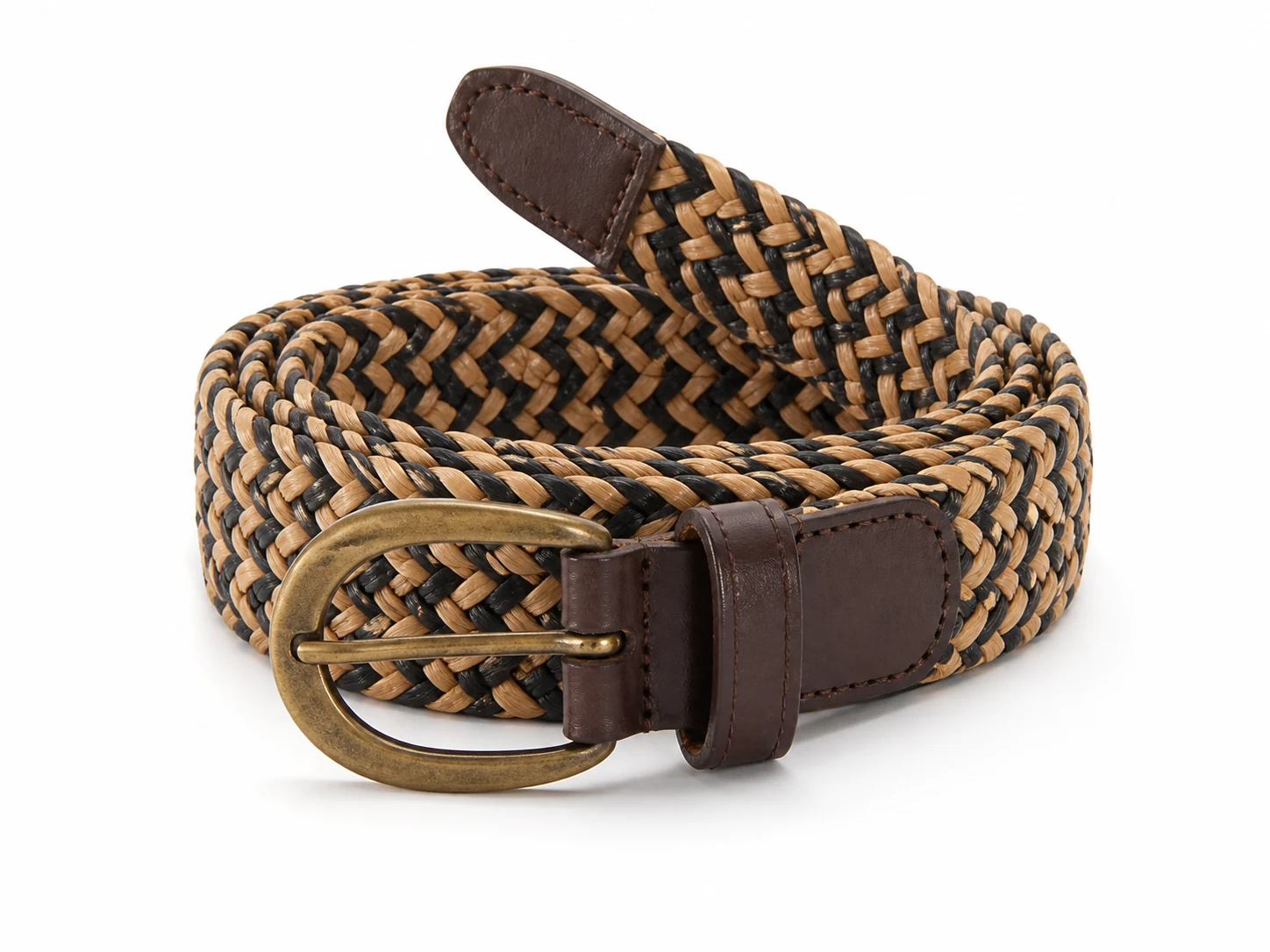
Do not approve a public material claim from appearance. The two-tone woven example below can show pattern and proportion, but a photograph cannot prove the fiber, recycled content or declared material. Those facts belong in order-linked records.
Compare Belt Adjustment And Fit
Many buyers associate braided belts with hole-free adjustment. That can be true when a prong passes cleanly between stable elements, but it is not automatic. The opening must accept the prong without forcing, splitting or dragging the body, and the structure must stay stable after repeated fastening.
Woven belts can also provide flexible adjustment. Some bodies accept a prong through designed openings; others use a clamp, frame, D-ring or automatic mechanism. A dense woven webbing may need defined holes or a different closure. The correct question is not “Does it have holes?” It is “How does this buckle engage this approved body?”
Fit needs a measurement rule. Record the finished-length datum, buckle allowance, working position, tail length and size interval. Stretchable constructions also need relaxed and working conditions defined. If a supplier measures one sample under tension and another at rest, the size table has no common baseline.
The HongDing elastic and stretch belt program treats body article, recovery, tabs and buckle as one product file. Use that route when stretch is a controlled requirement, not when “braided” is being used as a shortcut for comfort.
Control Ends And Buckle Interfaces
The middle of a belt body attracts attention, but failures often begin where flexible material meets rigid hardware. A braided end must capture the working elements without local pullout or uncontrolled bulk. A woven cut edge needs a finishing route that prevents fraying, distortion or a thick transition under the tab.
Specify the tab material, fold, reinforcement, stitch or fixing route, keeper and tip. Then connect those decisions to the buckle frame, bar, prong, roller or mechanism. Frame clearance must suit the finished body, not a nominal width. A prong must align with the actual opening or hole system. A roller should move without cutting or bunching the edge.
Inspect both sides of the connection. A clean face can hide a crowded fold, exposed cut ends, hard rivet backs or a stitch path that misses working elements. Pack protection matters too. Metal contact can mark a soft braided or woven surface before the product reaches the shelf.
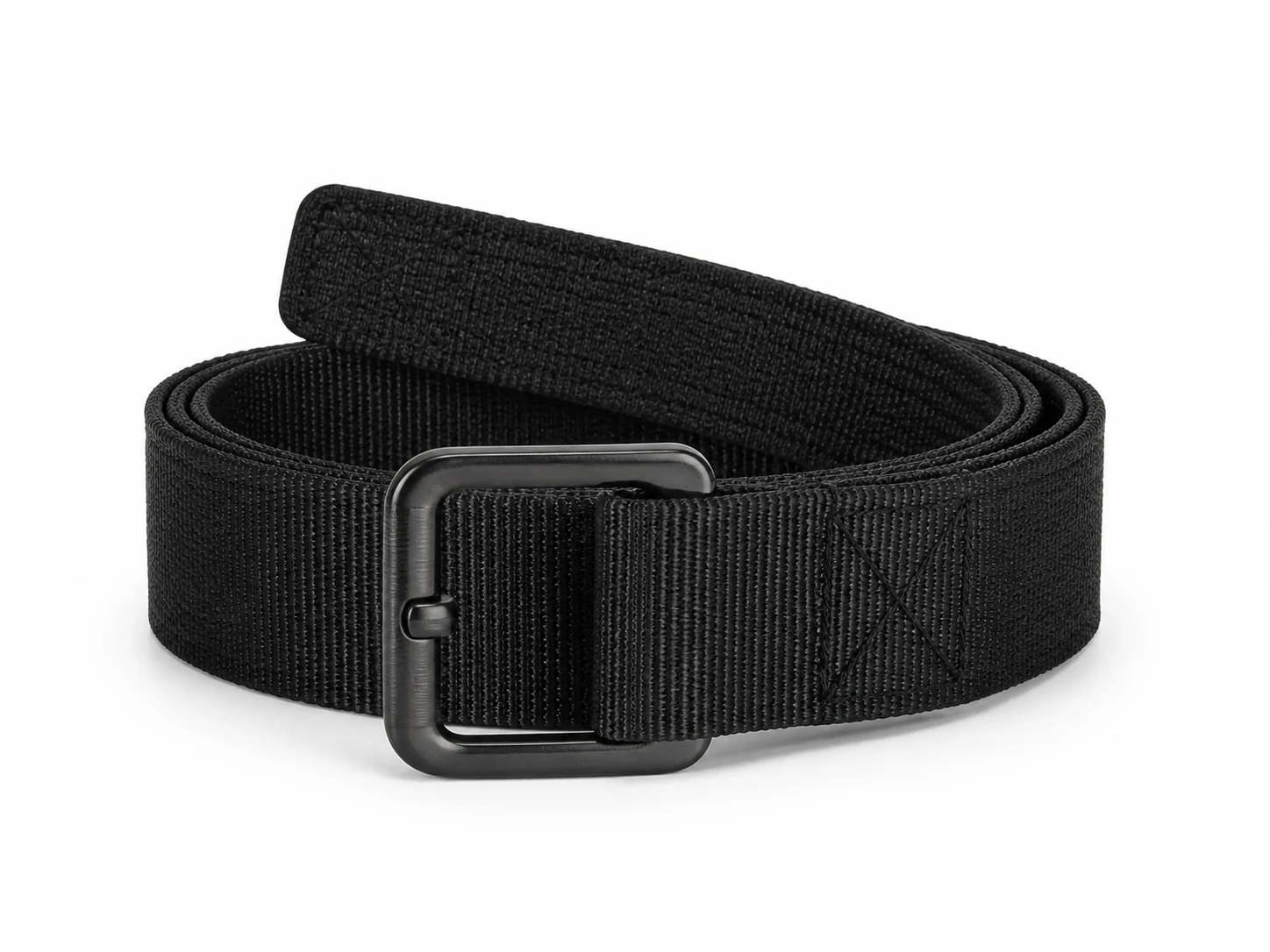
The HongDing woven and braided belt program defines the body, tabs, buckle attachment and stretch behavior for each project. The program boundary is the finished belt. It is not a promise that one joint design fits every construction.
Match Construction To Retail Use
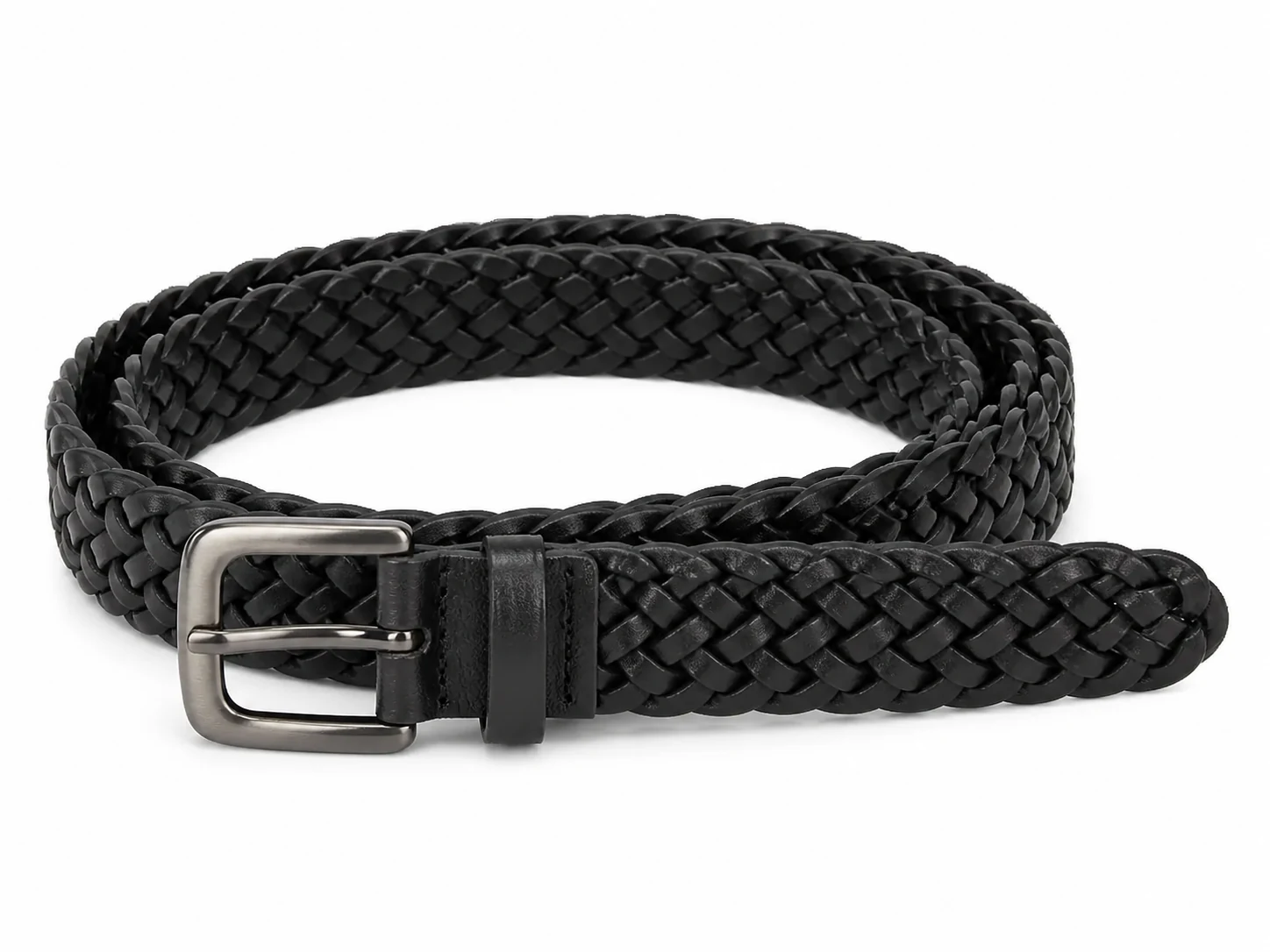
There is no universal winner, so make the decision against the program. Choose a braided route when diagonal structure, visual texture or flexible prong placement is central to the design and the approved body supports it. Choose a woven route when a controlled webbing face, repeatable stripe or pattern, defined edge and hardware-led adjustment better fit the range.
That is a preference, not a rule. A poor braid is not rescued by texture, and a poor weave is not rescued by straight edges. Buyers should compare color continuity, body stability, fit range, surface contact, joint construction, pack presentation and reorder controls for the actual SKU.
Choose Braided for Structure-Led Texture
Use it when the crossing elements are a visible design feature and the belt is approved with its intended buckle, ends and fit method.
Choose Woven for Webbing-Led Control
Use it when the program needs a defined woven face, edge, repeat or hardware interface that can be held by article and sample.
| Program Need | Likely Starting Route | Do Not Assume | Approval Evidence |
|---|---|---|---|
| Textured casual range | Braided body | Every opening accepts the prong | Complete-belt fastening review |
| Striped color program | Woven body | Screen color predicts bulk | Physical color and repeat sample |
| Stretch golf program | Elastic braid or weave | Fiber name proves recovery | Working-fit and recovery method |
| Uniform or work range | Controlled woven webbing | Heavy appearance proves strength | Named material and assembly checks |
| Leather-led fashion line | Braided leather strips | Texture proves leather identity | Material record and golden sample |
For assortment planning, connect the construction decision to the wholesale belt program route. Confirm whether the offer covers current allocation, a repeat style or a newly developed product. Those supply states need different approvals and timing.
Test The Complete Finished Belt
Testing should answer a named buyer risk. A rubbing method can address color transfer; an abrasion method can address surface wear under defined conditions. Maximum-force or elongation methods can describe a textile specimen. None of those results alone proves how the finished belt fits, fastens or holds at its end joints.
ISO 105-X12:2016 provides a method for assessing textile colorfastness to dry or wet rubbing. The standard supplies the method, not a universal belt pass grade. The buyer and supplier still need to identify the specimen, colorway, condition, report edition and project acceptance rule.
ISO 13934-1:2013 specifies a strip method for maximum force and elongation, mainly for woven textiles, including stretch fabrics. Applicability must be confirmed for the selected body. A material result cannot be silently extended to tabs, rivets, stitching or the complete assembly.
Add finished-product checks around the method. Operate the buckle through the intended adjustment range. Observe local deformation, slippage, strand or yarn movement, edge change, prong engagement, tab security and recovery where required. Record the sample identity and the condition before and after the check.
The HongDing belt quality-control process links checks to the approved product file. It does not replace the buyer’s responsibility to define destination-market requirements or approve project-specific methods and limits.
Build A Quote Ready Specification
A useful RFQ prevents suppliers from quoting different interpretations. Give every invited supplier the same reference package and mark each field as fixed, open or supplier-proposed. If a proposal changes the construction, keep it on a separate line instead of treating it as an equivalent substitute.
Start with product identity: intended market, wearer, use, channel, size range, colorways, quantities and packaging. Add the body article and construction, then the dimensions, adjustment method, buckle, tabs, keeper, branding and evidence requirements. Name the version on every drawing, specification and physical sample.
| RFQ Block | Required Input | Supplier Response | Approval Record |
|---|---|---|---|
| Body | Article, material, braid or weave | Proposed route and open fields | Approved article and reference |
| Dimensions | Width, thickness condition, length datum | Method and achievable control | Size schedule and sample measurements |
| Adjustment | Buckle, holes, openings or mechanism | Compatibility and exclusions | Working complete-belt sample |
| Ends | Tabs, keeper, tip and fixing | Construction and inspection access | Approved front and back views |
| Evidence | Risks, methods and report scope | Included checks and responsibility | Current reports and inspection file |
| Pack | Labels, protection and carton plan | Included work and exclusions | Approved packed presentation |
Ask suppliers to expose assumptions. “Same as sample” is incomplete if the sample’s material, size condition or internal construction is unknown. “Standard test” is incomplete if the method and acceptance rule are missing. “Custom color” is incomplete without a physical or controlled reference and a way to judge production lots.
Do not force one route into the other route’s template. A leather-strip braid may need controls for strip edges and joining. A woven elastic body may need relaxed and working dimensions plus recovery. A rigid webbing may need edge and buckle-clearance controls. One RFQ can compare them, but it must preserve their differences.
Approve Production Samples Before Bulk
A loose braid, woven tape or color swatch can close one decision. It cannot approve the product. Bulk release needs a production-intent belt at a representative size, with the intended buckle, end construction, keeper, branding, labels and pack elements that fall within the approval scope.
Review appearance and operation against the current file. Measure the stated datums, use the adjustment path, inspect both end joints, check buckle clearance and record any surface or structural change. If the sample contains a temporary buckle, substitute color or provisional tab, mark that status on the approval record. Silence turns provisional parts into accidental standards.
The HongDing belt sampling workflow separates feasibility, provisional components and production-intent approval. It also keeps tooling, revisions and responsibility visible. A golden sample is useful only when it remains linked to the same product revision and written specification.
Repeat orders need the same discipline. Revalidate any changed material article, yarn or strip, color, density, stretch element, buckle, tab, adhesive, stitch, label or pack. A product can look familiar and still contain a changed interface. The release decision belongs to the current inputs, not the age of the style.
Braided And Woven Belt FAQ
Are braided and woven belts the same?
No. A braided belt interlaces elements along angled paths, while a woven belt crosses warp and weft. Suppliers may use loose catalog labels, so buyers should confirm the actual construction.
Are braided belts always elastic?
No. Braided belts may use leather strips, rigid textile elements, elastic yarns or mixed constructions. Stretch and recovery must be specified and checked separately.
Can woven belts adjust anywhere?
Sometimes. Adjustment depends on the woven openings, body stability and buckle geometry. Test the intended buckle on the production-intent body before approving the claim.
Which construction is stronger?
Neither construction is universally stronger. Material, element size, density, joints, buckle interface and test method determine the relevant result for a project.
What sample should a buyer approve?
Approve a complete, production-intent belt with the correct body, tabs, buckle, keeper, size logic, branding and relevant packaging, all linked to the current specification.
Which tests belong in the specification?
Choose methods that answer the actual risk, such as rubbing, abrasion, force, elongation, recovery or joint security. Define specimens and acceptance limits for the project.
Why We Wrote This Guide
HongDing develops custom belt programs for brands, retailers, wholesalers and sourcing teams. Braided and woven requests often arrive as visual directions, yet a product name cannot hold the full buying decision. Material article, structure, fit, ends, buckle, samples and evidence still require control. This comparison belongs to our belt styles buyer guidance, while the product page remains the place to review development options.
This guide gives those details a practical order. It does not declare one construction superior or publish universal thresholds. HongDing confirms the route, testing scope, MOQ, timing and acceptance file for each reviewed project because materials, hardware, colors, sizes and packaging change the answer.
If you are comparing braided and woven options, send the intended use, reference, construction direction, quantities and target market. The next useful step is a controlled brief that lets product, sourcing and quality teams approve the same finished belt.