A work belt is not specified by calling it “heavy-duty” or choosing the thickest strap in a catalog. For a retail or uniform program, define what the belt will carry, where it will rub, how it closes, and how it must fit the wearer and the garments. Then select the strap construction, buckle attachment, keeper and finish as one assembly. A belt intended only to hold trousers needs a different brief from one that must interface with a nominated pouch; neither should acquire a safety or load-rating claim without a defined use and appropriate evidence.
Key takeaways
- Translate “durable” into the actual contact, bending and fastening conditions the belt will face.
- Check the assembled buckle end, holes and keeper, not only the appearance or thickness of a flat strap.
- A material abrasion result can inform selection but does not certify the finished belt or predict every wear environment.
- Approve a reference belt and an agreed comparison method before a multi-size, multi-color replenishment program.
The use case determines which “heavy-duty” decisions matter
Consider three products that could all be sold as work belts. A uniform belt supports regular adjustment and a consistent appearance through repeat wear. A casual utility belt may sit against denim and carry a removable accessory. A tool-compatible belt may need to pass through a specified pouch loop or retain an accessory in a specified position. The third case introduces a mechanical interface that the first two do not have. Describing all three as “thick leather belts” conceals the decisions that actually differ.
Start the brief with the wearer, clothing, contact surfaces, intended accessory and adjustment pattern. Is the belt threaded through narrow trouser loops? Is a pouch added after fastening? Does the buyer care more about a soft hand or a structured silhouette? Will the wearer repeatedly buckle at the same hole, or must the size run accommodate layered clothing? These are product questions, not a request for a universal belt rating. If the product is being marketed as protective equipment, a fall-restraint device or a safety component, this apparel-belt guide is not a substitute for that product’s applicable standard and engineering validation.
HongDing’s work-belt range presents leather, reinforced webbing, roller-buckle and other workwear directions. It establishes that the company develops complete belt products, not that every illustrated style carries a certified load capacity. For a new private-label brief, a reference image and description of use are enough to start a construction discussion; numbers and acceptance methods can be resolved during development.
| Use condition | Design question | Sample observation |
|---|---|---|
| Repeated daily adjustment | How are holes, prong, fold and buckle attachment built? | Watch hole shape, buckle movement and fold condition after the agreed trial. |
| Friction against garments or accessories | Which surfaces and edges contact the garment or pouch? | Compare wear and color transfer at those contact points. |
| Accessory interface | What is the accessory opening and how does it sit on the belt? | Test the actual nominated accessory with the assembled belt. |
| Retail size run | What measured point defines size and where do holes fall? | Check fastening positions across representative sizes, not one sample only. |
Choose the strap construction before choosing thickness
A single-layer leather strap, a lined-and-reinforced leather belt and a folded or stitched webbing belt can deliver very different behavior even when their finished widths look alike. A thicker single layer may feel substantial yet be difficult to fold neatly around a compact buckle. A multi-layer strap can preserve an intended silhouette while moving reinforcement to the area that needs it. Webbing may offer a different flexibility and edge behavior, but the weave, ends and closure still require their own specification. Material names alone do not establish finished-belt strength or service life.
For leather, ask how the face, possible lining, reinforcement and edge treatment are assembled. A belt that feels firm on a straight section may become bulky where the strap doubles back around a buckle. Local skiving changes that fold without necessarily changing the entire body; the skiving and splitting guide explains why local and overall thickness changes solve different problems. If the main body already has the desired hand and fit, thinning the whole belt to fix a single fold is a poor first move.
For webbing, identify the fiber and weave or construction actually offered, then examine the cut end, any reinforcement at the buckle and holes, and the way the edge contacts the wearer. A woven strap that feels secure in hand can still fail the product brief if the chosen buckle slips or the cut end frays under the intended use. Conversely, an extremely stiff end treatment may make a belt awkward to thread. A prototype should be judged as a system.
Width and thickness are interfaces rather than prestige numbers. The finished strap must pass through the intended garment loop, buckle opening and keeper with an acceptable feel. The tip may be narrow enough to thread yet the decorated or reinforced body may not. If a tool pouch is involved, its actual slot and the belt’s finished cross-section should be checked together. A drawing should identify the measurement station and the assembled condition; a single “belt thickness” value may not describe the folded end or a stitched edge.
Specify the buckle and its attachment as part of the belt
Frame shape, prong geometry, roller action, finish and attachment method alter how a work belt wears and adjusts. A broad buckle can look suitable on a wide strap yet place the prong poorly against the hole row. A roller may change the strap’s path and the wear pattern at the buckle. A double-prong design needs both rows of holes to align with the buckle in the assembled belt. A plate or decorative buckle introduces different clearances and attachment details. The correct choice follows the actual use and desired silhouette, not a generic “industrial” look.
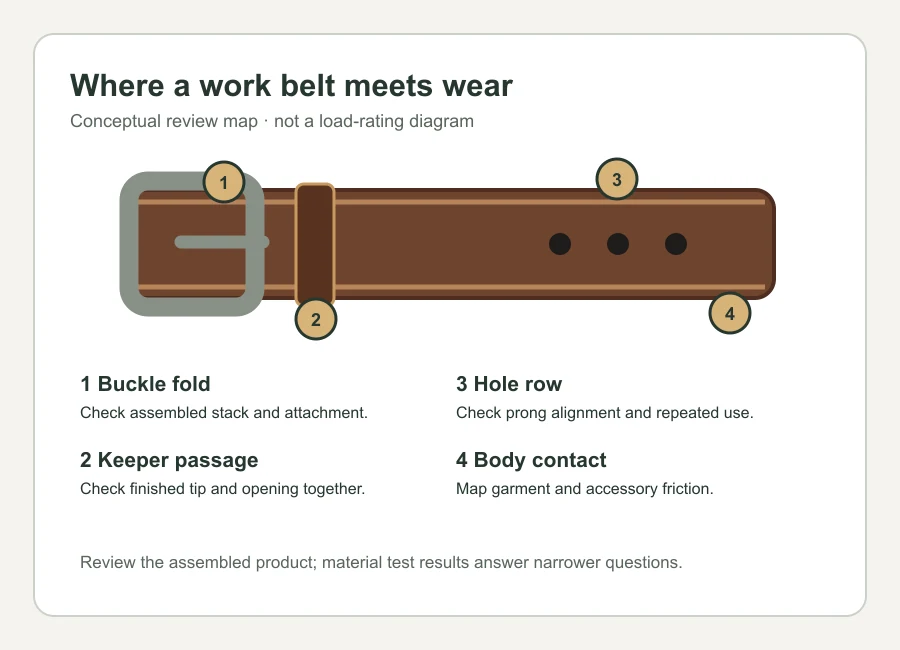
Ask for a buckle drawing or approved sample that shows the bar, pin or prong, internal clearance and strap route. Then make a finished first article and check fastening at more than the center hole. The fold, stitching or other retention method should be visible in a rear or section view. If a keeper is used, check that it holds the loose end without making removal difficult. These features interact: changing strap thickness can alter the buckle’s movement, fold profile and keeper passage, even when the face view remains almost identical.
Surface finish deserves a separate line in the bill of materials. “Antique silver” is an appearance cue, not a definition of base metal, coating route or acceptance criteria. If corrosion, nickel release or finish durability matters to a market claim, agree the applicable method and requirement for the actual hardware. The site’s buckle-plating test guide explains why a named test and an accepted result are different from merely choosing a finish color. HongDing’s documented capability includes coordinating buckle development and assessing the buckle with the full belt; it is not an independent general-purpose buckle foundry.
Map abrasion and finish changes to contact points
“Abrasion resistance” can refer to several things: the face leather losing finish, an edge becoming rough, a webbing yarn fuzzing, a metal finish marking, or color transferring to clothing. Those are different failure modes. Start with a contact map: where does the belt rub a trouser loop, buckle, keeper, pouch or garment? Where does it repeatedly bend? If the article is lined, which side touches clothing? This map helps decide whether a material comparison, a construction change or a finish check is relevant.
Laboratory methods can answer narrower questions. ASTM D7255 addresses leather abrasion on a rotary platform and explicitly notes that a laboratory abrasion result is only one factor in actual wear performance. ASTM D6182 evaluates a finished leather surface during repeated flexing for effects such as cracking or discoloration. Neither result by itself qualifies the whole belt, its buckle attachment or its behavior against a particular garment. If a retailer requires these methods, agree sample preparation, report version and pass criteria instead of quoting an unsupported “heavy-duty” threshold.
For a visible wear trial, compare a new reference and a used sample under the same defined conditions. Record where the change occurred: at the buckle fold, hole, edge, center back or accessory contact. Then distinguish an expected patina from a functional problem such as a distorted hole, peeling edge or loose attachment. On a deliberately waxed or pull-up leather, color movement may be part of the intended look; on a uniform program requiring a stable dark surface, the same visible change might be unacceptable. The buyer needs an approved appearance window, not a vague promise that every belt will age the same way.
Use the first sample to test the questions the artwork cannot answer
An illustrative brief might say: private-label utility belt for regular uniform wear; dark matte appearance; no specified tool load; must pass through the nominated trouser loop; roller buckle proposed; wearer adjusts it daily. This is a teaching example, not an actual HongDing order. The artwork can settle silhouette and color direction. It cannot prove that the assembled tip threads smoothly, the roller and holes behave as expected, or the edge remains acceptable after contact with the garment.
The first physical sample should therefore answer a short set of questions in order. Does it fit the garment loop and the size system? Can the wearer thread, fasten and release it without an awkward fold? Does the keeper control the free end? Where does rubbing occur in the specified trial? If an accessory will be used, does the real accessory move or retain as intended? Record the sample revision and the actual observations, not simply “approved.” A changed buckle may require a second assembled sample even if the leather color is already approved.
If the sample’s hole area distorts but the main strap is satisfactory, compare hole geometry, prong alignment and local construction before replacing all the leather. If the fold feels bulky, inspect the folded stack and attachment before reducing body thickness. If the tip catches only in the keeper, inspect the tip’s finished edge and the assembled keeper opening. These are diagnostic starting points, not a claim that one cause has already been proved. A change should be checked against features that were previously accepted, because improving one interface can degrade another.
For retail approval, document the size datum, measurement points, appearance reference, hardware identity, packaging and any required tests in one current revision. The belt tech-pack guide shows how to keep open and approved decisions distinct. A replenishment order then has a defined reference instead of relying on the memory of the person who reviewed the first sample.
Turn an approved belt into a repeatable retail program
A retailer may approve one sample but order several sizes and colors. The first sample is evidence for its own configuration, not automatic approval of every variation. A longer size can change hole placement or the look of a decorated section; a new color can behave differently at the edge or against a light garment; a substituted buckle finish can change appearance or test requirements. Identify which differences are controlled by a common master and which need a separate sample or artwork sign-off.
At incoming review, compare material and hardware identities with the current approved references. At the first assembled piece, check the relevant size datum, buckle operation, hole line and keeper fit. During production, look at the surfaces and joins most likely to drift for this construction. At packing, confirm the correct size/SKU, label and carton mix. If a deviation appears, identify the affected pieces or time period, hold them from release, agree a disposition and recheck the correction. This is a useful control sequence; it does not claim a fixed inspection schedule or that a specific order has passed it.
HongDing’s documented work spans development, material/hardware coordination, sampling, manufacturing and checks on dimensions, hardware, labeling and packing. The project’s exact construction, tests, inspection frequency and acceptance limits still need agreement. That division is important: a capable manufacturing partner can help convert a use brief into a sample and repeatable specification, but no supplier should substitute its own generic definition of “heavy-duty” for the retailer’s actual product requirements.
Questions buyers still ask
Does a thicker leather strap automatically make a stronger work belt?
No. The belt’s construction, buckle attachment, holes and actual load path also matter. Thickness alone may create a bulky fold or poor hardware fit. Define the intended use and test the assembled design.
Can a material abrasion report replace a finished-belt wear trial?
No. It can compare a specific material under a stated method, but it does not evaluate the whole closure, edge, garment contact or accessory interface. Use it alongside checks relevant to the finished product.
What can a brand send before it has full specifications?
A reference image, target wearer, intended use, desired appearance and any garment or accessory the belt must fit are a useful start. Open material, buckle and test decisions can be resolved during development.
Develop the belt around its actual use
Share the intended wearer, reference style and any garment loop or accessory interface that matters. HongDing can discuss a feasible strap-and-hardware direction and what the first sample needs to prove. A complete tech pack is useful later, but it is not required to begin that conversation.
Technical scope: ASTM D7255 leather abrasion method and ASTM D6182 finish-flex method describe distinct laboratory questions; neither is presented here as a HongDing test result or universal finished-belt rating.