By Kevin · Technical review by HongDing Sourcing and Quality Team · Published September 12, 2026 · Reviewed September 14, 2026 · Publisher profile · Review scope
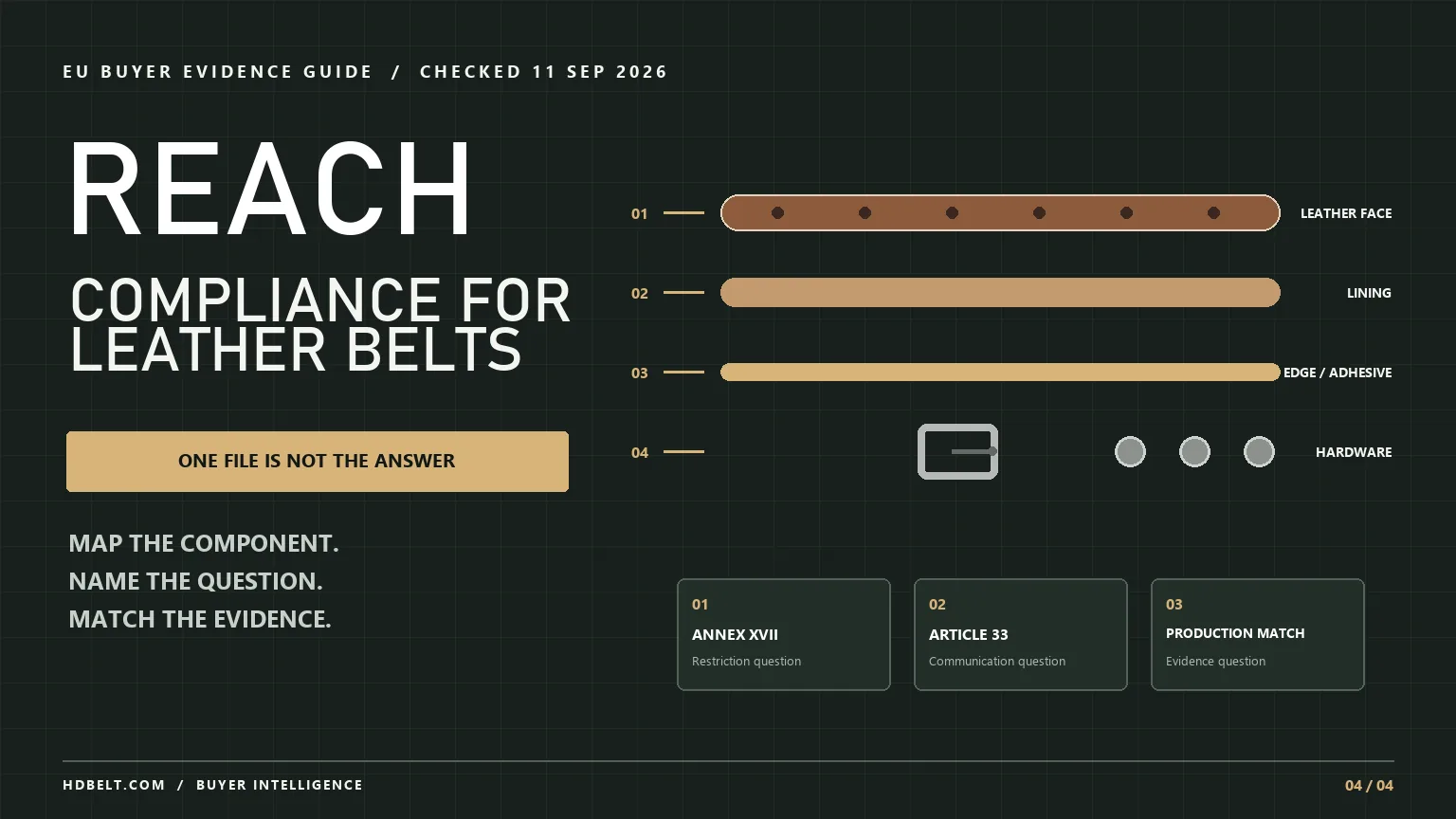
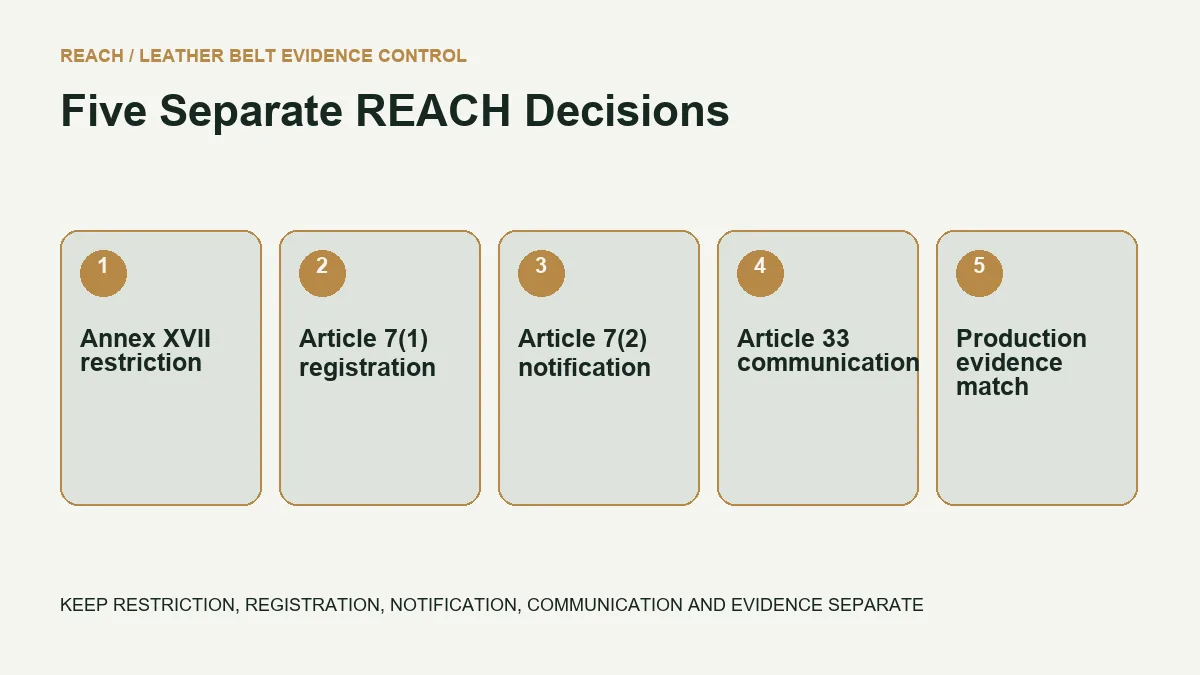
REACH compliance for leather belts cannot be established by collecting one file with “certificate” in its title. The responsible EU or EEA operator must separate five decisions: Annex XVII restrictions, Article 7(1) registration, Article 7(2) notification, Article 33 communication and whether the evidence matches the belt that will ship.
Key Takeaways
- Use dated law. This guide was checked on 11 September 2026 against the REACH consolidated text dated 22 June 2026 and ECHA’s live Candidate List.
- Keep the legal tracks separate. Annex XVII restrictions, Article 7 registration or notification and Article 33 communication have different triggers and duty holders.
- Map the components first. A leather strap, lining, buckle, prong, rivet, coating and adhesive may create different questions.
- Test to close a named gap. ECHA treats reliable supply-chain information as the primary route and analysis as a supporting option, not a universal panel.
- Audit the report, not the logo. Match method, limit, specimen, component, color, finish, date and production record before relying on a result.
That distinction matters because a clean chromium VI result for one leather swatch says nothing about nickel release from a buckle. A broad SVHC declaration also does not answer whether a restricted use under Annex XVII meets its conditions. Files are evidence only when each has a defined job.
What This Guide Covers
Start With Five Separate Decisions
A supplier may answer “REACH compliant” as though REACH were one test. It is not. For finished belts, the responsible operator’s working file should separate restriction, registration, notification, communication and evidence-to-production decisions.
| Question | Trigger | Buyer Output | Common Error |
|---|---|---|---|
| Annex XVII restriction | Entry-specific material, use or contact | Applicable-entry evidence map | Calling one SVHC screen sufficient |
| Article 7(1) registration | Substance intended to be released under normal or reasonably foreseeable use and total quantity above 1 tonne per producer or importer per year | Producer or importer registration analysis, subject to Article 7(6) | Assuming a belt can never intentionally release a substance |
| Article 7(2) notification | Candidate List substance above 0.1% w/w and over 1 tonne per producer or importer per year, subject to exemptions | Producer or importer notification analysis | Confusing it with Article 33 |
| Article 33 communication | Candidate List substance above 0.1% w/w; no tonnage trigger | EU or EEA article-supplier communication | Diluting a component across the belt |
| Production evidence match | BOM, supplier, finish or lot identity | Dated approval record | Reusing an unrelated report |
As checked on 11 September 2026, ECHA’s Article 33 guidance says an EU or EEA supplier of articles must communicate sufficient safe-use information when a Candidate List substance exceeds 0.1% by weight in an article. At minimum, the substance name must be communicated. A consumer request must receive a free answer within 45 days. This communication duty has no one-tonne trigger.
Article 7 asks different questions. Article 7(1) requires registration where a substance is intended to be released from articles under normal or reasonably foreseeable conditions and the total quantity in those articles exceeds one tonne per producer or importer per year. Article 7(2) can require a producer or importer to notify ECHA when a Candidate List substance is above 0.1% w/w in the articles and totals more than one tonne per producer or importer per year. Under Article 7(3), the notification duty in paragraph 2 does not apply where the producer or importer can exclude human or environmental exposure during normal or reasonably foreseeable conditions of use, including disposal; in that case, the recipient must receive appropriate instructions. Article 7(6) states that paragraphs 1–5 do not apply to substances already registered for that use. The Article 7(2) notification deadline is generally six months after Candidate List inclusion. Record each condition and exemption separately rather than treating an Article 33 declaration as the answer.
A non-EU manufacturer such as HongDing can provide component, supplier and production evidence. That commercial evidence role does not transfer the EU legal duty: the importer, producer or other EU or EEA article supplier must determine which REACH obligations apply to its facts.
 Watch ECHA: Communicating about substances in articles — opens on YouTube
Those facts do not create an Annex XVII pass. The REACH consolidated text dated 22 June 2026, checked 11 September 2026, contains restriction entries with their own conditions. Read the relevant entry, then ask for evidence that answers that entry.
Map Every Component in the Belt
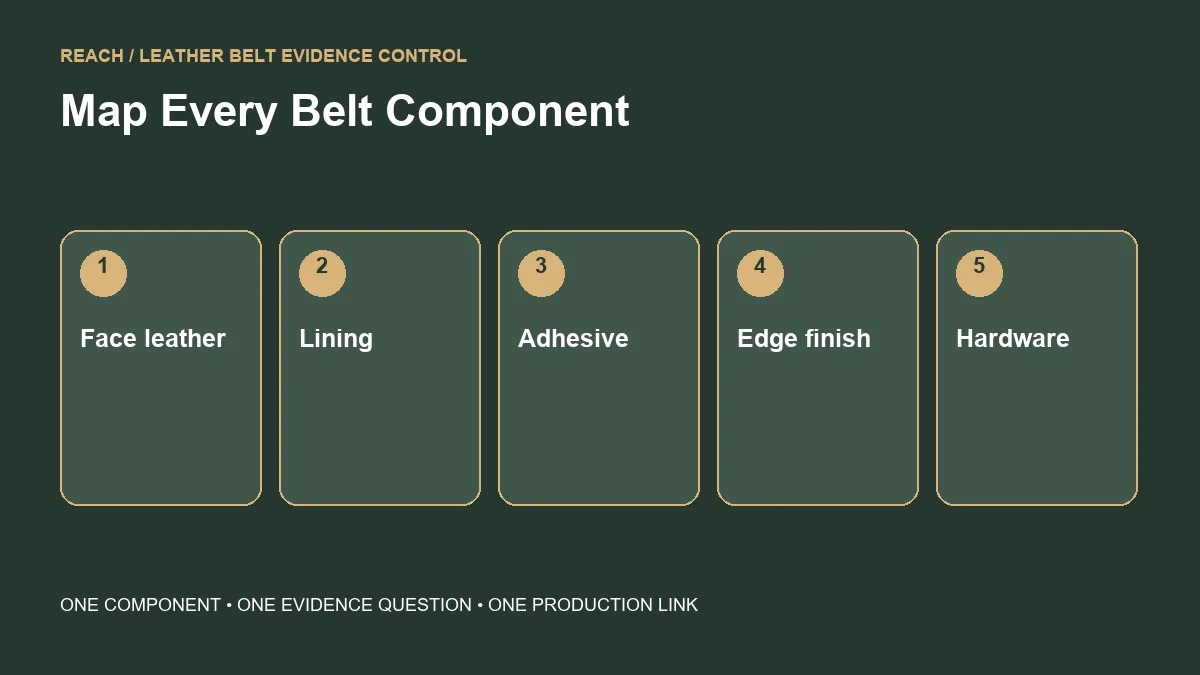
Start with the bill of materials, not a finished-product photograph. A belt may contain a leather face, lining, reinforcement, adhesive, edge paint, coating, thread, buckle frame, prong, bar, screws, rivets, eyelets, keeper and logo hardware. Each supplier route can carry different information.
The component map matters most for Candidate List substances. ECHA’s Guidance in a Nutshell, reviewed 11 September 2026, says Article 33 communication applies to each component article in a complex object when that article exceeds 0.1% w/w. Do not divide a concentrated substance in a small component by the weight of the whole belt.
Separate articles from applied mixtures
A buckle and rivet can remain component articles when assembled into a belt. Coatings, adhesives and edge compounds require a different record because they may begin as mixtures and become incorporated into the article. The classification and threshold analysis belongs to the responsible operator, supported by the current ECHA guidance.
Record the material supplier, article or recipe reference, color, finish and production site for each row. A vendor name alone is weak. When the buckle plating changes from one color to another, the evidence question may change even if the buckle drawing does not.
Screen the Relevant Annex Restrictions
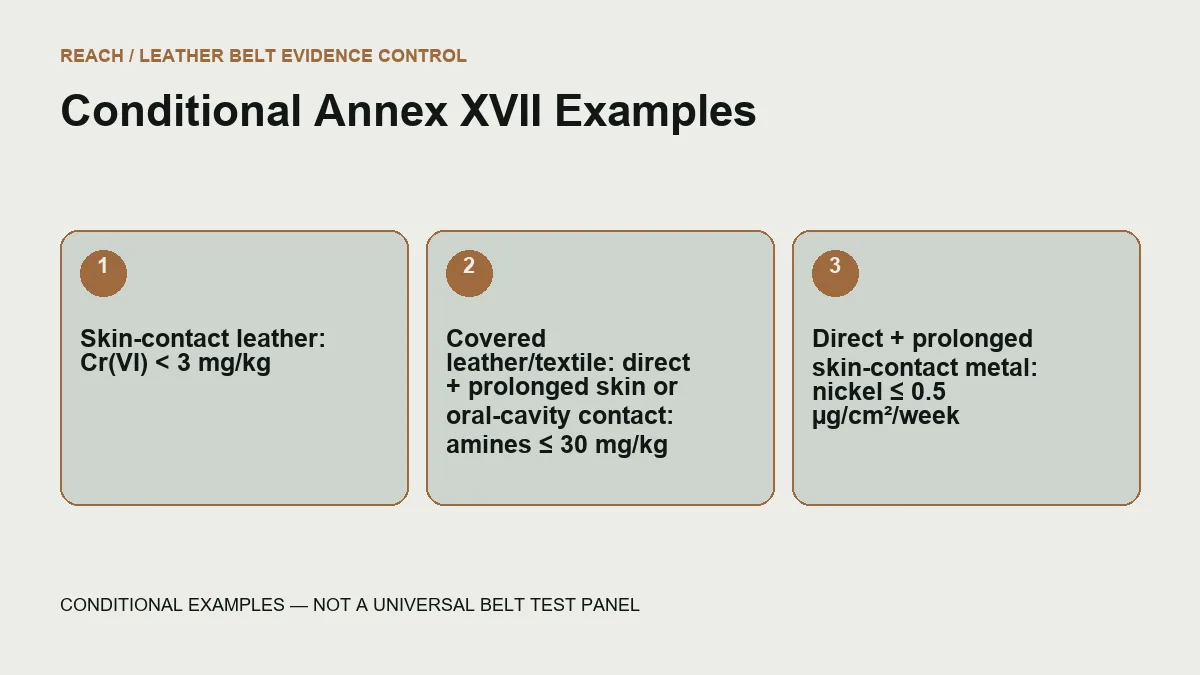
The table below gives three belt-relevant examples, not a complete REACH checklist. Each condition was checked on 11 September 2026 against the consolidated text dated 22 June 2026 and ECHA’s restriction pages. The current legal entry controls.
| Entry | Conditional Scope | Regulatory Value | Buyer Check |
|---|---|---|---|
| 47 Chromium VI | Leather article or part contacting skin | Below 3 mg/kg dry leather | Exact leather, color and finish |
| 43 Azo dyes | Covered dyed leather or textile intended for direct and prolonged skin or oral-cavity contact | Not above 30 mg/kg | Material, listed amine and contact condition |
| 27 Nickel | Relevant metal part with prolonged contact | At most 0.5 µg/cm²/week | Contact surface and coating route |
Chromium VI in leather
As checked on 11 September 2026, Annex XVII Entry 47 states that leather articles and leather parts coming into contact with skin shall not be placed on the market when chromium VI is present at 3 mg/kg or more of total dry leather weight. The evidence should identify the tested leather, color, finish and specimen source. A report for a different hide article is not a substitute.
Azo dyes in leather and textiles
Entry 43, checked on 11 September 2026, addresses specified azo dyes that can release listed aromatic amines above 30 mg/kg in textile or leather articles meeting its direct and prolonged skin or oral-contact condition. “Dyed leather” is not the full legal test. Confirm the current entry, material, contact route, amine scope and method used.
Nickel release from relevant hardware
Entry 27, checked on 11 September 2026, limits nickel release to 0.5 micrograms per square centimetre per week for relevant parts intended for direct and prolonged skin contact. Where an in-scope part has a non-nickel coating, the coating must keep release at or below that level for at least two years of normal use. A belt buckle does not enter the scope merely because it contains metal. Document which surfaces contact skin, the intended contact duration and how coating wear affects the evidence route.
The ECHA nickel contact paper supports interpretation, while the current legal entry remains controlling. HDBelt’s chain-belt specification page applies the same caution to chain links, clasps and decorative metal parts.
Use Declarations and Tests Correctly
A declaration and a laboratory report answer different questions. The declaration names the responsible entity and states what it knows about a defined product or component. A report records what a laboratory measured in named specimens under a stated method.
ECHA’s substances-in-articles guidance, reviewed 11 September 2026, calls supply-chain communication the most important and efficient route for gathering composition information. It also says chemical analysis can obtain or confirm information when needed, yet may be ambiguous or costly. That supports a risk-led approach, not a universal full-panel test.
| Evidence Situation | Declaration Role | Testing Role | Buyer Decision |
|---|---|---|---|
| Known, controlled composition | Carry dated supplier knowledge | Confirm selected risks | Approve with scope check |
| Missing composition data | Identify unresolved gap | Target relevant analytes | Hold until resolved |
| Changed supplier or finish | Issue revised statement | Reassess affected tests | Reopen approval |
| Old unrelated report | Cannot repair mismatch | Use current representative sample | Reject as sole evidence |
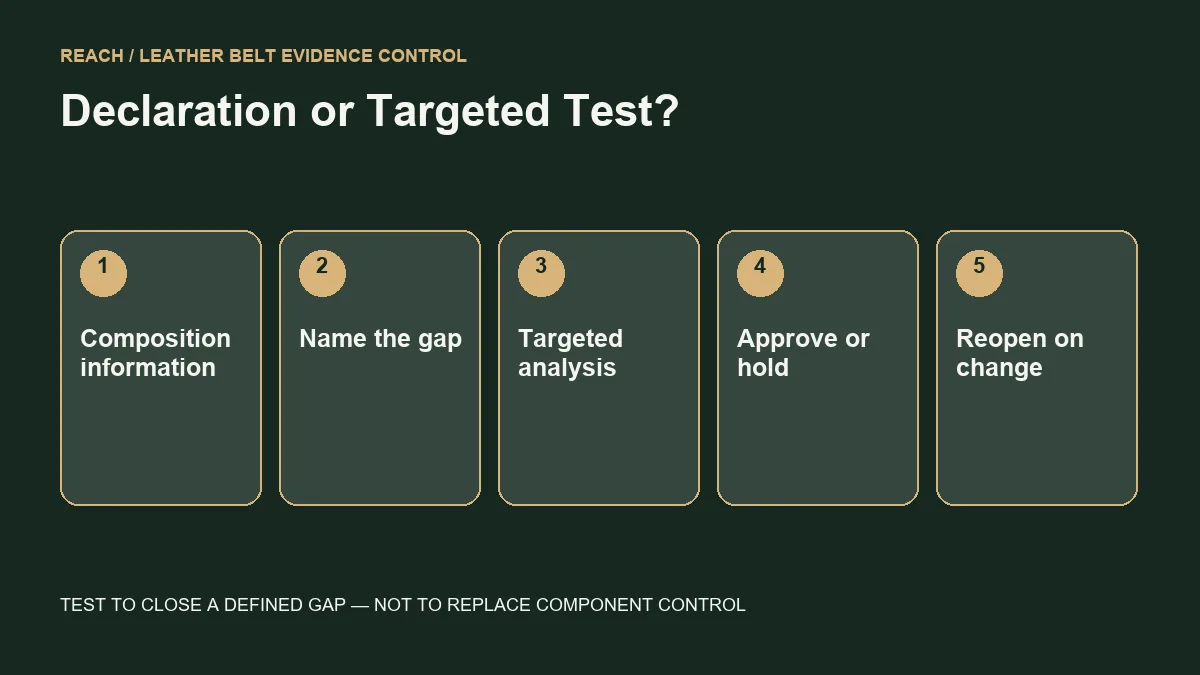
Do not accept a file because its heading says “REACH Certificate.” Review the underlying declaration, test report and legal scope. One document may support one part of the decision, but its title does not prove every component, restriction or communication duty.
Audit Every Laboratory Report Before Approval
A good report should let another reviewer reconstruct the decision. Start with the laboratory identity, report number and issue date. Then find the client, sample description, photographs or sample code, receipt date, test dates, method, analyte, unit, result and stated limit.
ECHA’s full guidance, reviewed 11 September 2026, says reviewers should check whether the reported concentration is actually below the relevant limit. It also warns that raw materials and processing can change between batches. The report must represent the product currently supplied.
Run the identity test
Can the report’s sample code be traced to the approved belt BOM? “Brown leather” cannot distinguish face leather from lining, one color recipe from another, or one finishing route from the next. Ask for the supplier article, color and component position.
Run the method test
Check that the method answers the legal condition. Total nickel content is not nickel release. A general metals screen does not replace the entry-specific measurement, and an SVHC screen does not automatically answer chromium VI or restricted azo-dye conditions.
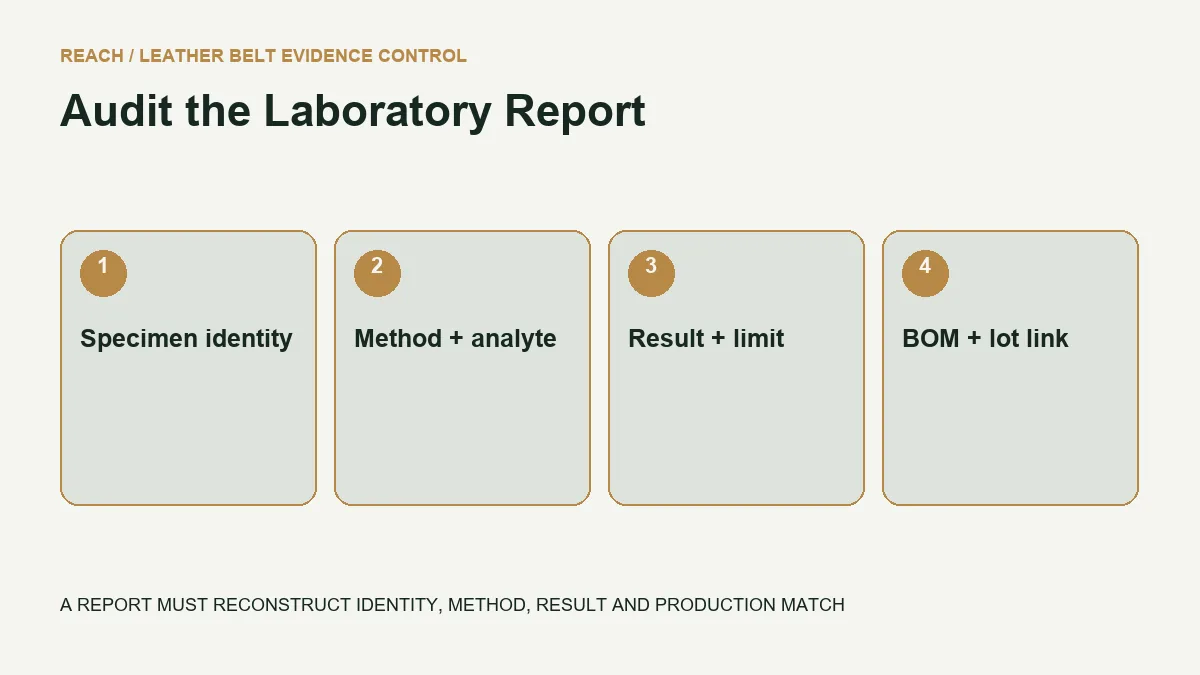
Run the production test
Link the report to the supplier, site, material lot or defined production window used for the order. Record any difference between the test specimen and the golden sample. HDBelt’s leather belt quality inspection guide explains why final inspection, supplier declarations and laboratory tests cannot be collapsed into one checkbox.
Turn the Requirement Into an RFQ
Send HongDing the destination market, belt BOM, intended skin-contact conditions and required evidence. We can review the development file, identify open component questions and coordinate supplier documents or project-specific testing within the confirmed scope.
Build the Buyer Evidence Worksheet
The worksheet below is the control point buyers can reuse. Keep one row per component or evidence question. Do not hide six materials behind one row called “finished belt.”
| Component | Regulatory Question | Evidence Held | Production Link | Reopen Trigger |
|---|---|---|---|---|
| Face leather | Entries 47, 43; current SVHCs | Declaration plus targeted report | Article, color, finish, lot | Leather or recipe change |
| Lining | Material, contact, current SVHCs | Supplier composition record | Lining code and supplier | Backing or supplier change |
| Buckle frame | Entry 27 contact applicability | Substrate and plating evidence | Drawing and finish code | Plating or contact change |
| Prong and rivets | Separate metal and contact scope | Component declaration or report | Hardware BOM revision | Component source change |
| Edge coating | Current restriction and SVHC screen | Recipe-level supplier information | Color recipe and site | Formula or color change |
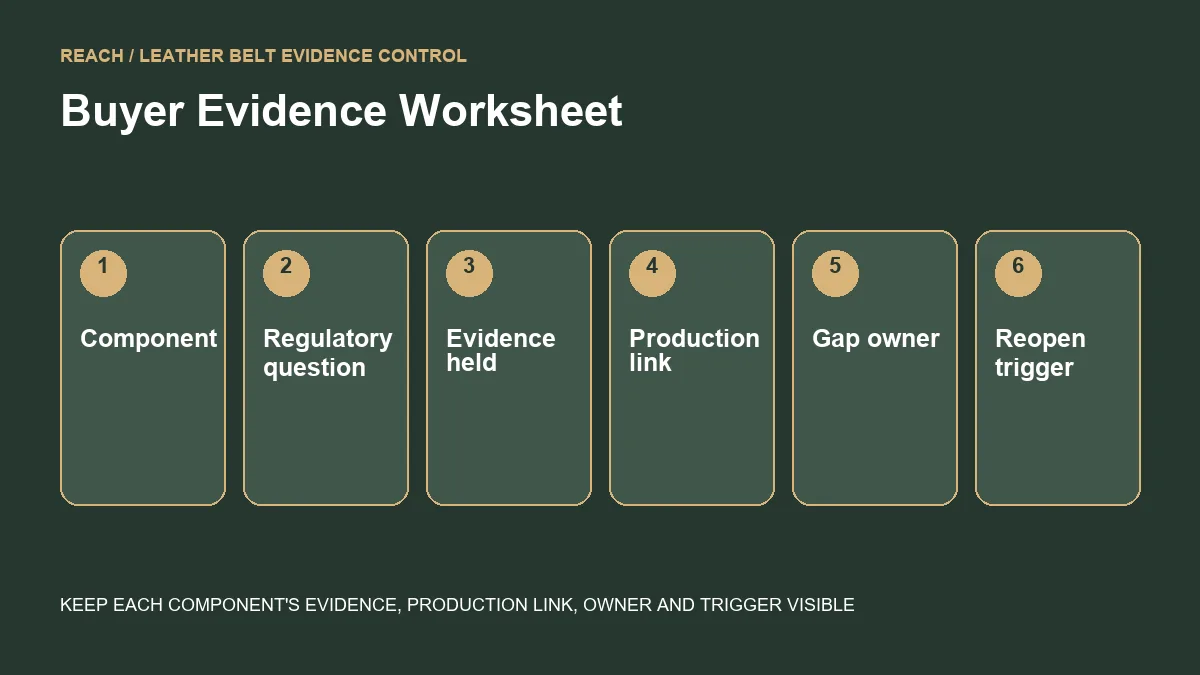
Add the target market, review date, official source version, responsible reviewer and unresolved-gap owner above the table. The sample rows are a control template, not a finding that every listed entry applies to every belt.
One column deserves special attention: production link. An evidence file is only useful when it identifies the approved material or hardware actually released to the factory. Tie that column to the BOM revision, component drawing, material article, color, finish and supplier route.
The “reopen trigger” prevents stale approvals. If a plated buckle becomes painted, a lining supplier changes, or an edge color uses a new formula, the responsible reviewer can see which evidence questions return. This is more reliable than assigning every document an invented expiry date.
Freeze Evidence Before Bulk Production
Evidence planning belongs before bulk release. A production-intent sample should represent the approved materials and components, while the controlled BOM names what cannot be inferred from appearance. Keep both with the declarations, reports and dated regulatory review.
At HongDing, the practical route is to connect the evidence file with the same controlled product records used for sampling and quality review. Those records can include the BOM, component references, golden sample, approved color and finish standards, supplier documents, named test requirements and written changes. The exact set remains project-specific.
Define release ownership
The EU importer or other responsible economic operator makes its own legal determination. The brand or buyer defines destination requirements and any customer restricted-substance list. Material and hardware suppliers provide upstream information; the laboratory reports measurements; HongDing coordinates the agreed manufacturing evidence.
That ownership map prevents a dangerous handoff. A factory should not guess the buyer’s legal scope, and a buyer should not assume a factory-wide statement covers every product. Put unresolved questions on hold with an owner and due date before cutting, plating or packing.
Reopen the File After Changes
A REACH review is dated because the inputs move. As checked on 11 September 2026, the ECHA Candidate List is a live list and obligations can begin when a substance is added. Record the exact list review date in every declaration and buyer worksheet.
Product changes matter too. Reopen the affected rows when the material article, leather finish, dye or coating recipe, adhesive, buckle substrate, plating, supplier, production site or intended use changes. A new color can be a chemical evidence change, not only an appearance change.
Use triggers instead of blanket expiry dates
No universal report validity period was found in the official sources reviewed for this guide. A calendar review is useful, but change-triggered review is stronger. Reassess when the law, Candidate List, component, supplier or production link changes.
A reorder with no visible design change can still reopen the file if the component source or recipe changed. Compare the new order against the approved BOM and retained evidence before release. HDBelt’s sampling workflow shows where the golden sample and written changes fit.
REACH Evidence Questions Buyers Ask
Does a REACH certificate prove a leather belt is compliant?
No single file proves every REACH duty. Check the legal version, components, substances, restriction entries, declaration scope, test specimens and link to the supplied production.
Must every component receive a full SVHC laboratory screen?
No universal test panel applies. ECHA prioritizes reliable supply-chain information; use targeted analysis when composition information is missing, doubtful or needs confirmation.
Does Entry 27 apply to every belt buckle?
Not automatically. Entry 27 concerns relevant metal parts intended for direct and prolonged skin contact, so document the buckle surfaces and actual contact scenario first.
What must an EU or EEA article supplier communicate for an SVHC?
Above 0.1% w/w in an article, the regulated supplier provides enough information for safe use and at least the substance name. Consumer requests receive a free answer within 45 days.
Can a previous belt report be reused?
Only after confirming the component, supplier, material, color, finish, method, legal version and production route still match. Any material change can reopen the evidence decision.
Conclusion
A defensible belt evidence file is not the thickest folder. It is the file that shows which dated legal question applies to each component, what evidence answers it, and how that evidence connects to the production belt.
- Check the current Annex XVII entry and Candidate List before each legal decision.
- Keep Article 7 registration or notification and Article 33 communication separate from restriction compliance.
- Use declarations for reliable supply-chain information and tests for defined gaps.
- Reopen affected evidence when the law, BOM, supplier, material, finish or use changes.
Begin the next RFQ with the Belt REACH Evidence Worksheet, not a request for a generic certificate. If you need a factory-side component and evidence review, send HongDing the intended EU market, belt BOM and open compliance questions; the review begins from those named inputs.
Official Sources Reviewed
- EUR-Lex consolidated REACH text dated 22 June 2026, checked 11 September 2026.
- ECHA Candidate List, checked 11 September 2026.
- ECHA communication in the supply chain, checked 11 September 2026.
- ECHA Guidance in a Nutshell on substances in articles, Version 3.0, checked 11 September 2026.
- ECHA Guidance on requirements for substances in articles, Version 4.0, checked 11 September 2026.
- ECHA Entry 27 nickel restriction page, checked 11 September 2026.
- ECHA Entry 43 azo restriction page, checked 11 September 2026.
- ECHA Entry 47 chromium VI restriction page, checked 11 September 2026.
This buyer guide explains an evidence workflow and is not legal advice. The importer or other responsible EU economic operator should confirm current applicability for the exact product, market and supply chain.