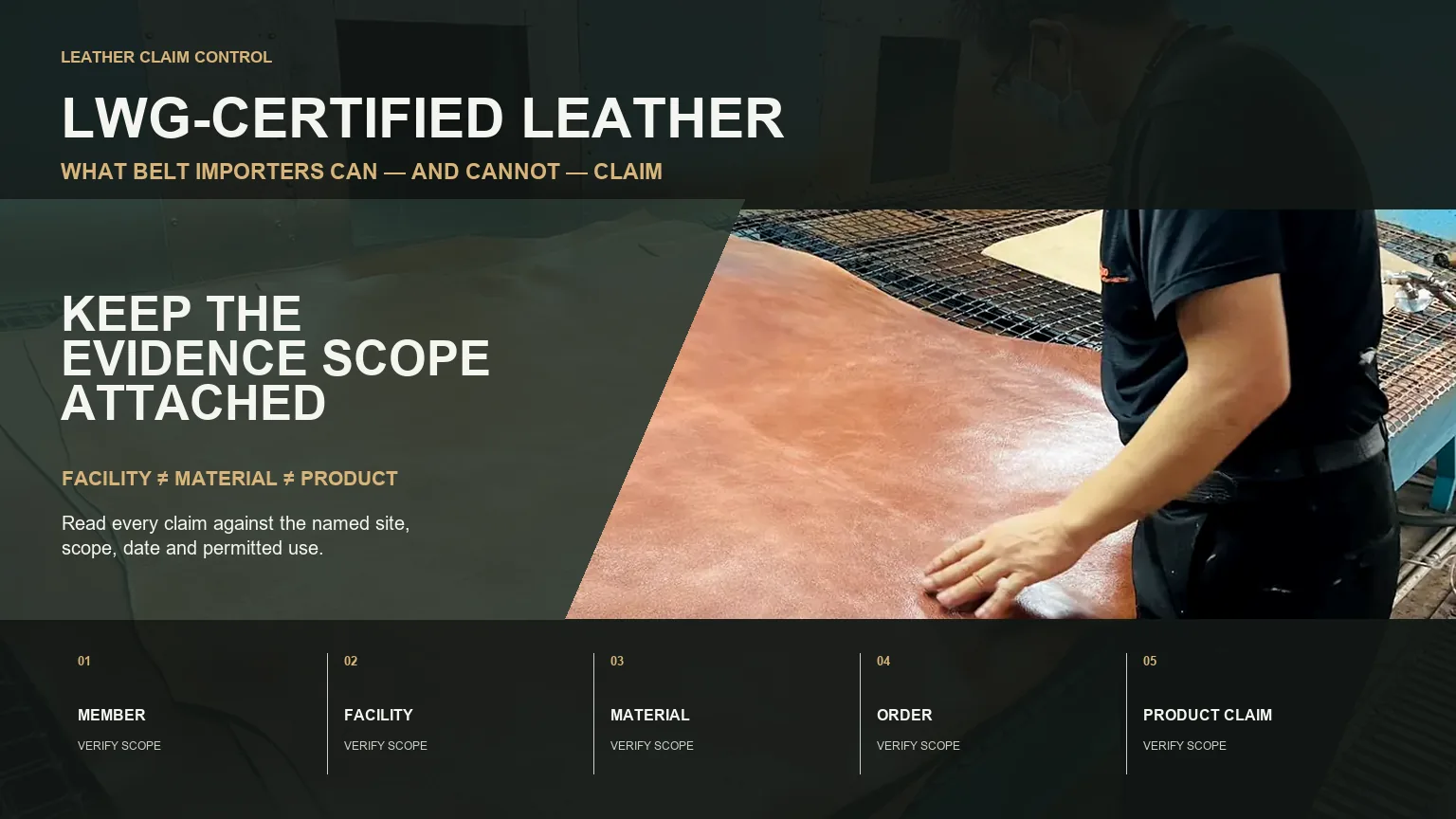
LWG-certified leather is facility evidence, not a certificate for a finished belt. Current Leather Working Group guidance says certification applies to the facility where leather was made. A belt importer must still connect that facility to the correct leather article, commercial transaction, production route, bill of materials and exact public claim.
Key Takeaways
- Check the site, not the group name. A genuine facility mark carries a unique reference number, or URN, and an expiry date.
- Match the correct supply-chain role. LWG currently uses four standards for leather manufacturers, traders, commissioning manufacturers and subcontractors.
- Keep the claim inside its scope. A facility record does not automatically certify a leather article, purchase order, brand or finished belt.
- Treat traceability as a separate result. LWG recognizes four traceability types, but the buyer still needs order-level article and transaction records.
- Retain separate product gates. LWG states that certification does not guarantee the absence of restricted-substance failures in a final product.
In short: start with the sentence you want to publish, then work backward to the facility, article and order records that support it. Starting with a logo encourages the evidence to travel farther than its real scope.
LWG Leather Is Facility Evidence
The phrase sounds like a material grade. It is not. The current LWG claims guidance places certification on the facility where the leather was made, while an individual belt remains a separate product with its own construction and evidence.
This distinction changes the RFQ. Ask the supplier to identify the legal facility, the activity covered by its standard and the article offered for your belt. A certificate attached to an email can start the review, but it cannot finish it. The buyer must show that the proposed article passed through the named site and entered the specific order.
The same rule protects material descriptions. Full-grain, vegetable-tanned or chrome-free wording answers a different question from facility certification. Use the leather belt material framework to define the article, surface, tannage, finish and complete construction before approving any environmental sentence.
Match Four Standards to Supply Roles
The LWG certification overview lists four standards. They address different actors, so the first review question is not only “Is the certificate valid?” It is “Does this standard match the work claimed for our leather?”
| Standard | Supply-chain role | Belt buyer must confirm |
|---|---|---|
| Leather Manufacturer | Processes hides or leather | Audited processing state covers the quoted article |
| Trader | Trades material with warehouse scope | Line of sight reaches the relevant upstream facility |
| Commissioning Manufacturer | Commissions external processing | Commissioned route matches the actual order path |
| Subcontractor | Performs a defined processing activity | Claimed activity sits inside the audited scope |
The same overview explains the current public scoring shorthand: 85% for Gold, 75% for Silver, 65% for Bronze and 50% for Audited. For a leather manufacturer, the reported level follows the lowest scored category rather than an average that hides a weak section. These thresholds describe the audited facility’s result; they are not a leather grade or a finished-belt quality score.
| Audited role | Public award label | Buyer interpretation |
|---|---|---|
| Leather Manufacturer | Gold, Silver, Bronze or Audited | Facility result; the lowest category controls the reported medal level |
| Commissioning Manufacturer | Medal rating when achieved, otherwise Audited | Site and commissioned chain remain inside the applicable audit scope |
| Trader | Approved | Do not convert an Approved trader status into a tannery medal |
| Subcontractor | Audited | Defined processing activity only; no product medal transfers downstream |
A trader record cannot silently replace the certificate for the manufacturer that performed the claimed leather process. The same limit applies inside a corporate group. Ownership, shared branding or a common sales office does not move one site’s scope to another address.
Verify the Site and Activity Scope
Use the official certified-supplier directory, then compare it with the mark and commercial documents. Record the legal facility name, address, site type, URN, expiry and relevant activity. If one field does not match, pause the claim review.
LWG states that certification remains valid for 24 months for leather manufacturers, commissioning manufacturers and subcontractors. The stated period for part-processed material traders is 12 months. Those periods make the displayed expiry a buying control, not a decorative detail.
The dated 26 March 2026 Certified Supplier Logo Guidance goes further. It limits the certification mark to the certified site and audited activities. It also requires relevant sales documentation to distinguish certified and non-certified material at line-item level.
Reject the sister-site shortcut
A certificate for Facility A does not cover Facility B because both use the same group logo. Ask which address processed the quoted article and which entity appears on the invoice. A screenshot without the URN, expiry or scope is a lead for verification, not approval evidence.

Separate Membership and Product Claims
LWG membership and facility certification communicate different facts. In its September 2025 membership-guidance announcement, LWG introduced a member logo distinct from facility certification marks. Membership can describe an organization’s participation and commitment; it does not certify each product or all leather purchases.
| Claim scope | Primary evidence | Does not prove |
|---|---|---|
| Brand membership | Current member record and member guidance | Every leather source or finished belt |
| Certified facility | Site mark, URN, expiry and scope | Another site or unrelated activity |
| Leather article | Article code and supplier documentation | The complete belt construction |
| Purchase order | Invoice, lot and material transaction link | Unrelated styles or future orders |
| Product wording | Current guidance and authorized final copy | Claims outside that wording and market |
Product-logo eligibility adds another gate. LWG’s published product-claims framework states that a product must contain leather as a prominent material and that 100% of the leather must come from LWG-certified leather manufacturers before the LWG logo and a product-level text claim may be used. The same framework also identifies membership, sourcing declaration and artwork or text approval requirements. Because LWG can update its framework, verify the current guidance and authorization at the moment the claim is released.
The practical rule is strict: evidence may support the scope shown in its row, then the buyer must build the next link. Never let a facility badge jump directly to a finished-product claim. Current LWG guidance and the relevant business authorization should control the final sentence and any logo use.
Read Traceability without Assuming Order Proof
LWG’s traceability guidance recognizes four types: physical, documented, group and regional. Its current score expresses the percentage of material traceable to a specific slaughterhouse, a group of slaughterhouses or a region of collection, depending on the route.
That score belongs to the facility assessment. LWG states that traceability is currently scored but is not a critical section directly affecting the overall medal rating. Buyers should avoid two shortcuts: reading the medal as a traceability guarantee, or reading a facility traceability score as proof for one purchase order.
Connect the score to the order
For a belt program, record the supplier article, commercial document, lot or transaction reference and the SKU that uses it. If the source or article changes, repeat the link. A high-level facility result cannot identify which leather entered a particular brown belt unless the order records make that connection.
Keep Each Compliance Gate Separate
A useful facility audit still has limits. LWG says its certification does not guarantee that a final product will avoid restricted-substance failures. It also says the audit is not a legal-compliance assessment and does not grant a legal operating permit.
Belt performance sits outside those conclusions. A facility record cannot approve leather grade, edge adhesion, buckle function, workmanship, labeling or the packed SKU. Those checks belong in the specification, sample, test plan and belt quality-control process.
| Gate | Decision | Typical record |
|---|---|---|
| LWG facility | Is the named site and activity current? | Directory entry and certification mark |
| Order traceability | Did this article enter this PO? | Article, lot, invoice and BOM link |
| Chemical compliance | Does the tested specimen meet requirements? | Scoped declaration or laboratory report |
| Product quality | Does the belt match approved requirements? | Golden sample and inspection record |
| Public claim | Is the exact wording authorized and supported? | Approved copy and evidence reference |
Build the Belt Order Evidence Chain
The buyer’s file should read like a chain, not a folder of unrelated PDFs. Start with the certified site and audited role. Link that record to the leather article and transaction, then connect the article to the finishing route, BOM, purchase order and finished SKU.
- Facility: record the legal site, URN, expiry and activity scope.
- Article: freeze the supplier or project code, tannage, surface, color and finish.
- Transaction: retain the invoice, lot or shipment reference that identifies the material.
- Conversion: connect the article to cutting, finishing and belt-production records.
- Product: link the BOM, golden sample, tests, inspection and final SKU.
- Claim: store the approved sentence, channel, market, owner and approval date.
HongDing’s sustainability and compliance review follows this project-specific logic. Pro Pelli may appear in the route only as the leather-finishing facility supported by the project file. Do not describe it as a tannery or infer any current certification status from its role.
Reopen the chain after a supplier, site, article, finish, lot, BOM, market or sales claim changes. The old evidence may still be genuine, but it may no longer support the revised product. Repeat orders deserve this check because certificate validity and sourcing routes can change between POs.

Control Wording across Every Sales Touchpoint
Write the proposed sentence before approving artwork. Record who owns the claim, where it will appear and which market will see it. The evidence reviewer can then mark the wording approve, revise, pause or reject.
Use one controlled source of truth
Keep the authorized copy and evidence reference together. The catalog, hangtag, packaging and e-commerce listing should not paraphrase the claim independently. A small wording change can enlarge the scope from one material route to an entire product range.
Do not invent a universal “safe” sentence from this guide. LWG updates its systems and claims guidance. Use the current official material, confirm any required authorization and keep the approved wording with the product file. If the evidence supports only a facility statement, revise the product copy instead of stretching the certificate.
Use This Belt RFQ Checklist
Place these fields in the RFQ or evidence schedule. Missing evidence means the buyer cannot yet decide. Failed evidence means the supplied record conflicts with the proposed route or claim. Those are different outcomes and should not share one red box.
- Exact proposed LWG-related sentence, market, channel and claim owner
- Legal facility name, address, site type, URN and certificate expiry
- Applicable standard, audited processing activity and material scope
- Leather supplier, article code, tannage, surface, color and finish
- Invoice, lot, shipment or other transaction link for the proposed PO
- Finishing route, production site, BOM, sample revision and finished SKU
- Separate chemical, legal-market, workmanship and performance evidence
- Approved public wording, logo file, authorization record and recheck trigger
A supplier claim is not evidence until the buyer can tie it to a site, date, scope and current document. For LWG leather, add two more links: the material transaction and the finished belt that will carry the wording.

Frequently Asked Questions
What does LWG-certified leather mean?
It is market shorthand for leather linked to a facility certified under an LWG standard. Certification applies to the named site and audited activity, not automatically to the article or belt.
Can a finished belt be called LWG-certified?
Do not approve that phrase from a facility certificate alone. Check current LWG product-claim guidance and authorization, then connect the leather article and transaction to the finished belt.
Does LWG certification guarantee traceability?
No. LWG reports traceability separately within the facility assessment. The buyer still needs article, lot or transaction records that connect the proposed leather to the specific purchase order.
Does LWG replace finished-product chemical testing?
No. LWG states that certification does not guarantee the absence of restricted-substance failures in a final product. Testing must match the specimen, requirements and target market.
How often should buyers recheck a facility record?
Check before approval and after any site, supplier, article, lot, process or repeat-order change. Always compare the displayed expiry with the planned production and claim dates.
Why We Wrote This
HongDing supports B2B belt programs across development, material and hardware coordination, sampling, manufacturing, quality control and packaging. Those stages generate different records, and buyers need to know which record answers which claim.
The practical next step is simple: send the exact belt construction, article, route, target market and proposed wording. We can help organize the evidence questions for that project without presenting a facility record as proof of the entire product.