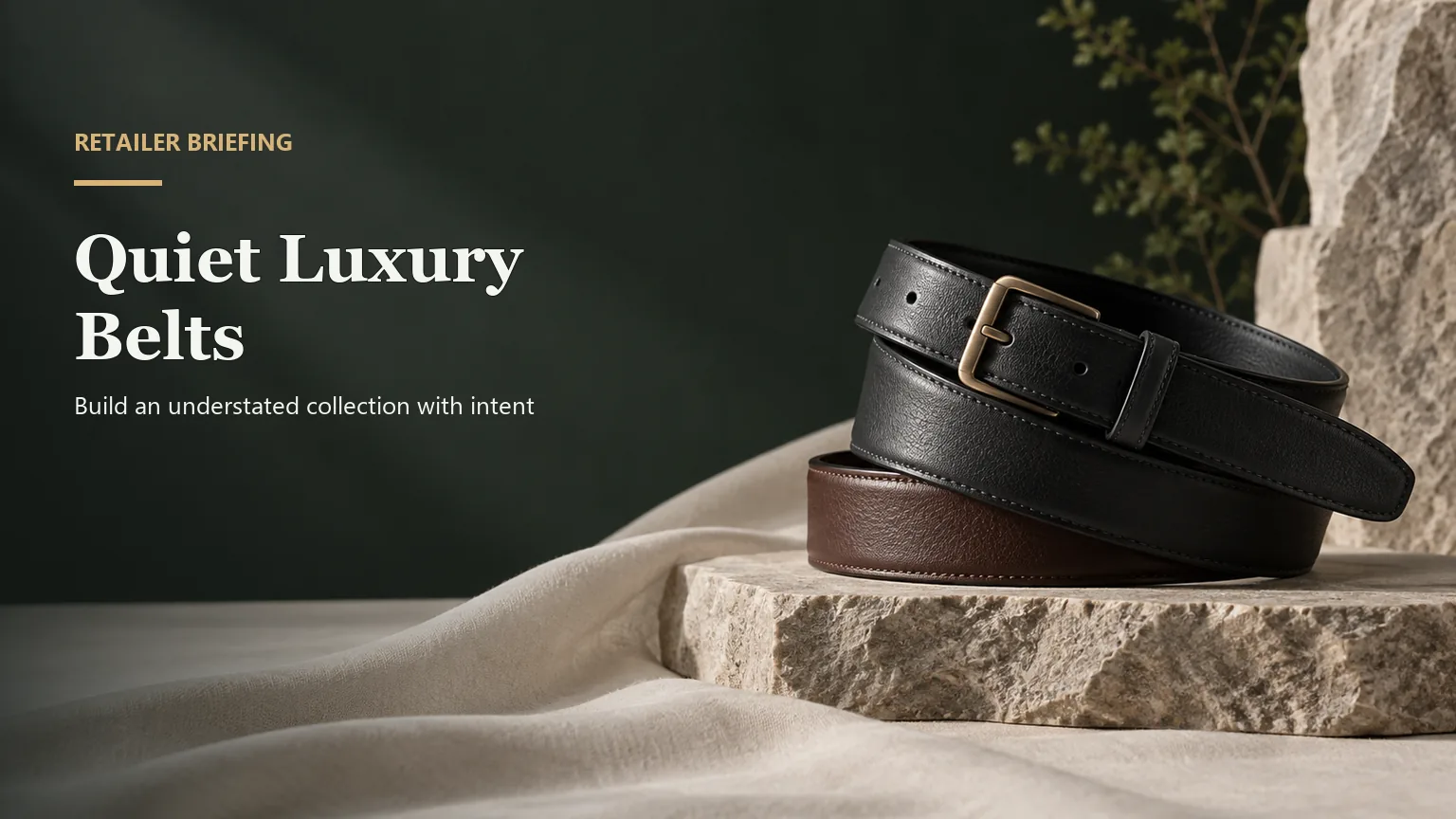
Quiet luxury belts succeed when proportion, material surface and workmanship support the same design intention. For a retailer, the useful brief defines what stays consistent across the collection, how the belt fits its intended clothing, and which details must survive sampling and production. A small logo alone does not create that result.
A restrained belt leaves little decoration to distract from an awkward buckle, a bulky fold or an uneven edge. Those details connect design directly to manufacturing. HongDing’s belt manufacturing roots date to 2004, with its current company identity formed in 2010. Our recommendation is to develop the strap, hardware and finish together, then approve the complete construction against the intended wardrobe.
Key takeaways
- Define the wearer, garment and range role before choosing a material or buckle finish.
- Approve buckle clearance and fold thickness on the actual strap construction, not separate component samples.
- Separate the desired surface appearance from material identity and performance evidence.
- Keep recognisable design details consistent across a capsule while assigning each style a distinct purpose.
- Record an approved master and acceptable variation so production can reproduce the sample intention.
Set the Direction Before Choosing Components
Quiet luxury describes an aesthetic, not a leather grade, certification or guaranteed price position. It usually favours restrained branding and carefully considered details. A minimalist belt can still be poorly proportioned, uncomfortable or difficult to reproduce. Treat the term as an opening conversation and convert it into product choices.
Begin with the garment. A belt for tailored trousers must work with the available loops and waistband. A waist belt worn over a dress has a different placement and visual role. A denim style may need a different balance of strap body and hardware scale. The same slim oval buckle should not be assumed suitable for all three.
Then define the selling context. An online customer first sees silhouette and colour, while an in-store customer can inspect the edge and handle the strap. Both routes need a coherent product, but they expose different weaknesses during selection. Assemble the intended apparel, product photography direction and target price position before approving an isolated sample.
Avoid treating the trend as permanent demand evidence. British Vogue’s June 2024 report on returning logo belts illustrates how different styling directions can coexist. Use current buyer and channel knowledge to decide the collection’s role; that historical article does not establish today’s sales forecast.
Resolve Proportion on the Assembled Belt
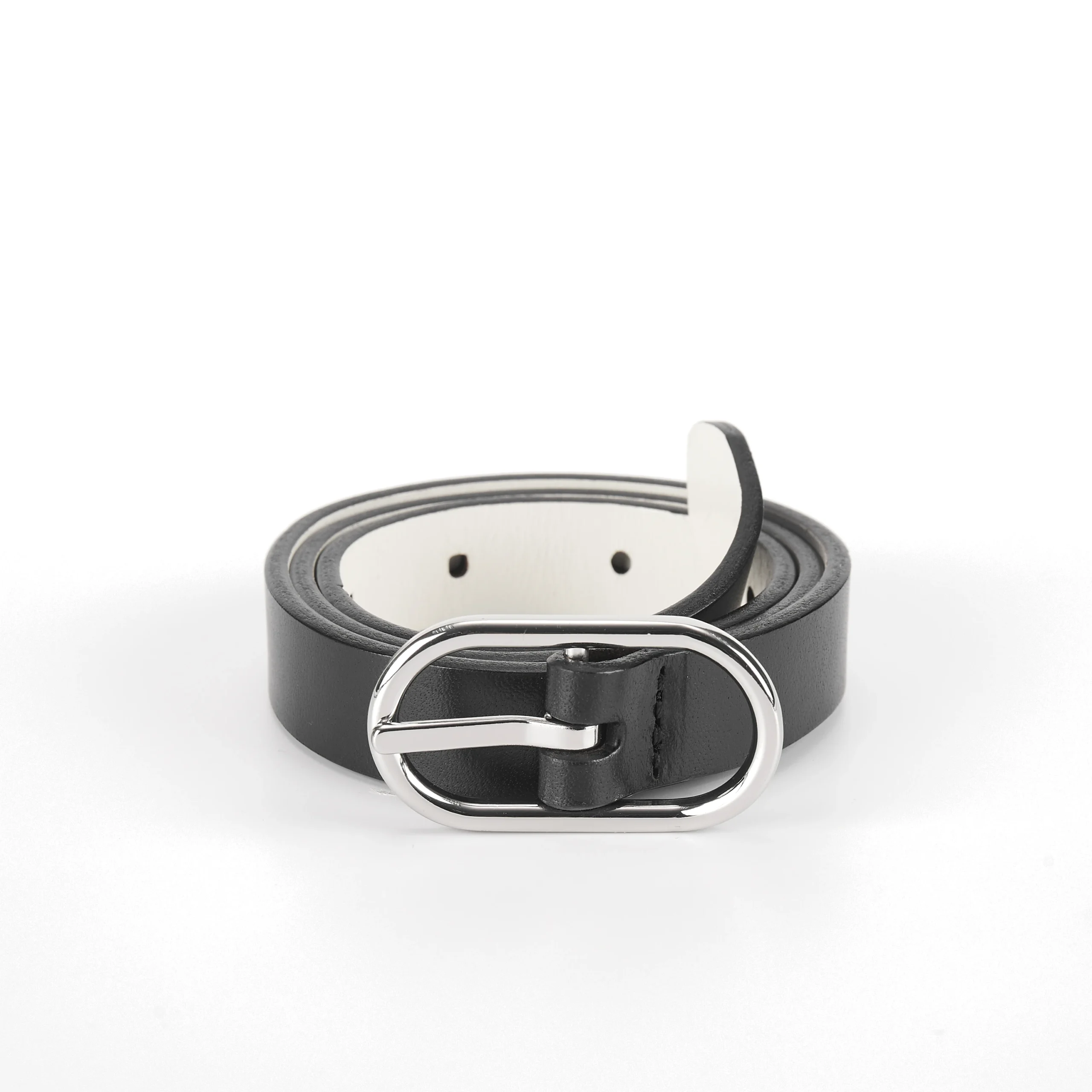
Start with strap width, buckle opening and the thickness passing through that opening. Width establishes the relationship with the garment; clearance determines whether the belt can be threaded and adjusted without forcing. A buckle that looks refined in a drawing may obstruct a thicker finished strap, especially where the tip, lining or edge finish adds bulk.
Check the fold around the buckle bar separately from the main strap. The fold contains a bend and overlapping material. Skiving, the controlled thinning of leather, can help manage this local build, but removing material also changes the section supporting the attachment. Approve the fold construction with its fastening method rather than requesting the thinnest possible fold in isolation.
Define measurement points in the drawing: finished strap width, thickness at a named section, buckle opening, fold position, keeper location and tip profile. Measure tail length from the intended wearing position. A tail that looks tidy on a flat sample can behave differently when the belt curves around the wearer or passes through the garment loops.
Use the complete sample to check adjustment at the intended size positions. Observe whether the prong meets the hole cleanly, whether the keeper accepts the tip, and whether the buckle remains visually balanced when worn. Record the approved geometry before changing the material stack. A thickness change can require another hardware-fit review even when width is unchanged.
Choose the Layer Build and Edge Together
A face material does not specify a complete belt. Record whether the strap is a single layer or a built construction with a face, lining and any reinforcement or filling. Each layer affects the finished section, flexibility and the appearance of the edge. Two belts with similar front surfaces can feel very different in hand.
For an exposed cut edge, review the actual cross-section: the layer junctions remain part of the visual result. An edge-painted route asks different questions about preparation, coverage and behaviour around bends. A folded or turned-edge route creates another section and requires its own corner, tip and thickness review. None should be selected solely because the construction name sounds more expensive.
When comparing routes, keep the garment and hardware fixed so the difference is meaningful. Ask whether the alternative improves the desired hand and silhouette, whether its edge works with the material stack, and whether the buckle fit still passes. Request separate quotes for changed construction and changed materials so their commercial effects remain distinguishable.
Stitching belongs in this discussion even when it is tonal. Seam position creates a visible border; the needle holes and thread alter the surface at close range. Specify a stitch reference and its relationship to the edge, then evaluate the face and underside. Removing a visible seam for a cleaner appearance also requires reviewing how the layers and attachment are secured.
HongDing’s manufacturing scope includes cutting, thinning, assembly, edge treatment, stitching and hardware attachment. The development value is coordinating these choices before a polished presentation sample becomes the production reference. The leather belt materials guide provides the related material distinctions.
Separate Surface Approval From Performance Evidence
Write material identity and appearance in separate fields. The first names the supplied material and construction; the second describes grain, colour, sheen and hand. A soft matte surface is a design requirement, not proof of a particular leather grade. If the range contains PU or textile constructions, describe them accurately rather than implying leather through the aesthetic label.
Compare material swatches beside the intended edge, thread and hardware. Review a flat area and a curved area of the sample because the belt is worn in a curve. For a napped surface such as suede, keep the viewing direction consistent when judging colour. A photograph helps communicate intention but cannot replace the physical reference for every texture and sheen decision.
Keep an approved master and, where relevant, examples of acceptable variation. Mark the areas where variation is permitted and the conditions that are defects. This is more useful than asking the factory to deliver a vaguely “natural” or “perfectly uniform” appearance. If the chosen material cannot support the requested consistency, resolve that conflict before bulk approval.
Performance needs a separate test question. ISO 11640:2018 addresses leather surface behaviour under rubbing with wool felt. A buyer concerned about colour transfer can discuss an appropriate method and acceptance criteria with the laboratory. The method name alone says nothing about whether a particular belt has passed.
ISO 5402-1:2022 concerns dry or wet flex resistance of leather and its finish, within its stated scope for flexible leather below 3.0 mm. Do not assume a thick assembled belt fits that specimen scope. Confirm the selected edition, preparation and reporting requirements, and assess the finished buckle fold and edges through a suitable product-specific check.
The distinction matters commercially: approving appearance does not approve rubbing or flex behaviour, and a material report does not approve the complete belt. Associate each result with the actual material reference and construction. If either changes, decide which evidence remains relevant and which checks must be repeated.
Develop Hardware Beyond Its Colour Name
“Brushed gold” leaves many decisions unresolved. The drawing should describe frame geometry, section profile, corners, bar and prong arrangement, and strap clearance. The finish reference should identify the intended colour and surface character. Ask the hardware supplier to identify the proposed base material and finish system rather than using a colour name as a complete specification.
Compare finished hardware under the same viewing conditions as the belt. A broad polished face can attract more visual attention than a narrow frame of the same colour. Brushing direction and surface texture also contribute to the impression. Approve the actual geometry and finish together; changing one can alter the design even if the nominal colour stays the same.
For custom hardware, settle functional geometry before committing to final artwork and finish. HongDing supports 3D/CAD buckle development, sample review and revisions. A drawing or render helps resolve shape, but the physical sample must still establish how the hardware works with the selected strap and attachment.
Specify branding by method, location, dimensions and visibility when worn. A tonal impression, reverse-side mark or small engraving can support a restrained direction. Check its effect on the actual surface and section: an impression that looks discreet on one material may read differently on another. Keep logo approval distinct from the buckle’s functional approval.
Give Each Style a Role Without Losing Coherence
Build a capsule around recognisable details such as a family of buckle curves, a tip shape or a consistent branding location. Then decide which features may vary by use. Common components can simplify coordination, but a shared buckle should not force every strap into unsuitable dimensions or construction.
| Range role | Shared design detail | Controlled variation |
|---|---|---|
| Tailored core | Buckle curve and branding location | Smooth surface, proportion matched to trousers |
| Soft casual | Related buckle profile and tip shape | Texture and hand appropriate to casual apparel |
| Waist accent | Hardware finish family and logo treatment | Width and silhouette reviewed over the garment |
| Seasonal colour | Approved core construction | New colour with its own matching and transfer checks |
Consider a hypothetical retailer comparing two routes for a tailored core belt. Route A keeps the approved smooth face, tonal stitching and edge-painted construction. Route B proposes a textured face with the same buckle outline and branding location. These are development alternatives, not a HongDing order or an observed sales result.
First hold width, wearing position and garment constant. Compare the surfaces in the complete build, then decide whether Route B still reads as the core style or belongs in casual. If changing the surface also changes thickness, repeat buckle and keeper checks. Do not approve it as a simple colour substitution.
Next ask for the two routes to be quoted against the same quantity mix and packing scope. Separate material changes, construction operations, custom hardware or tooling, branding and packaging. No universal cost premium follows from the words smooth, textured or luxury. The useful comparison identifies what each quoted change buys in the intended product.
If the target price requires a revision, protect the features customers recognise first. For this hypothetical range that may mean keeping the buckle geometry while simplifying packaging, or retaining the surface while considering existing hardware. Check each proposal against the design brief and functional requirements; an apparent saving that changes the core silhouette is a different product decision.
Make the Brief Usable in the Sample Room
Give every important decision a status: fixed, open or supplier-proposed. Fixed items protect the collection identity. Open items need a decision owner. Supplier-proposed items invite a feasible alternative but still require an approval step. This prevents an inspiration image from silently becoming the specification for every visible detail.
| Decision | Record before sampling | Approval reference |
|---|---|---|
| Customer and role | Channel, garment, wearing position, price target | Named range role and intended apparel |
| Proportion and fit | Width, length datum, size range, fold and clearance | Drawing revision and complete sample |
| Material and build | Face, lining, layers, edge and seam route | Supplier references and construction record |
| Surface and hardware | Colour, sheen, texture, geometry and finish | Master samples and permitted variation |
| Branding and packing | Artwork, placement, protection, labels and pack scope | Approved artwork and packed sample |
| Decision control | Status, owner, target or tolerance, pending question | Approval date and change requiring resampling |
Use targets and tolerances where the project needs measurable control. For visual details, pair the written criterion with a physical reference and viewing conditions. Do not invent numerical limits simply to make the sheet appear technical. An incomplete field should be visibly open, with responsibility for resolving it before the relevant production decision.
Identify what a visual reference communicates: outline, proportion, surface or mood. Supply owned or authorised artwork for branding and distinguish inspiration from details cleared for reproduction. HongDing’s design-development process can start from a tech pack, sample, image or concept and work through these decisions.
Transfer the Approved Intention Into Production
Review the sample in a deliberate sequence. From the intended display distance, judge silhouette and colour balance. In hand, inspect the surface, edge line, stitching and hardware. Worn with the target apparel, assess scale, adjustment and tail behaviour. Agree the viewing setup rather than judging one sample in a showroom and its replacement under unrelated conditions.
Record each issue as an observation and a requested outcome. “Buckle looks heavy” is incomplete; identify whether the concern is frame width, projection, polish or the bulk at the fold. If the fold causes the imbalance, changing only the buckle colour will not solve it. Ask the sample team for the construction change that addresses the observed cause.
Keep a dated approved sample together with material, hardware and artwork references. Establish acceptable variation and prohibited defects at the same time. When a later sample differs, compare it with that reference rather than relying on a remembered impression. Track material substitution, layer changes, revised tooling and finish changes because each may affect previously approved relationships.
Before production transfer, confirm that the final sample represents the intended materials and construction. A presentation sample made with a temporary lining or substitute buckle leaves those decisions open. HongDing can coordinate materials, hardware, sampling and manufacturing handoff; project-specific approval remains necessary for the actual route selected.
Include the packed belt in the final review. Check how the buckle is separated from the strap, where folds or pressure points occur, and whether labels obscure the product presentation. Examine the belt after unpacking. A beautiful sample photographed before packing does not establish how the retailer will receive it. The private-label service connects approved branding and packaging with the product brief.
Frequently Asked Questions
Can one approved black belt cover every colour?
It can establish the construction reference, but not every colour decision. Review new material, edge, thread and hardware combinations together. Associate relevant performance evidence with the actual supplied references rather than assuming approval transfers automatically.
When should a supplier make another sample?
Resample when a change can affect an approved function or appearance, such as the layer build, buckle opening, fold, surface finish or branding method. Identify which earlier approvals remain valid and which need review.
How should buyers approve natural material variation?
Use a master and representative acceptable variations, with written limits for the relevant areas. Separate intended character from defects. A single highly selected sample may not communicate the range the buyer is willing to accept.
Does every style need a custom buckle?
No. Review suitable existing hardware against the intended proportions before commissioning a new shape. Custom development is useful when geometry or identity requires it; it does not automatically improve fit, finish or the commercial outcome.
Develop a Collection With Clear Product Decisions
Bring the intended apparel, range roles, target price position and visual references. Identify the details that must stay fixed and those open to development. HongDing can coordinate material, construction, hardware and sampling proposals so your team can compare feasible routes and approve the complete belt.